Aggressive pickleball is about creating the right ball, not forcing the attack. Look for good spacing, forward balance, enough time, and a vulnerable target. Smart players often use dinks, holds, and movement to create a weaker reply—then attack with control and expect the counter.
Some players look aggressive because they hit hard.
The really annoying ones are different. They make you feel as though every ball might be attacked, yet somehow they aren’t the ones spraying speed-ups into the net.
That is the version of aggressive pickleball worth learning.
And there is a clue hiding in plain sight: the height of the ball isn’t enough to tell you whether to attack.
A ball can sit near net height and still be a terrible speed-up.
Another can be slightly lower and be completely usable.
The difference is often something rec players don’t look at:
Where is the ball relative to your feet? Where is your weight going? And what will your opponent have to do with the ball if you attack?
That is where smart aggression starts.
The First Clue: Is the Ball Inside Your Foot Line?
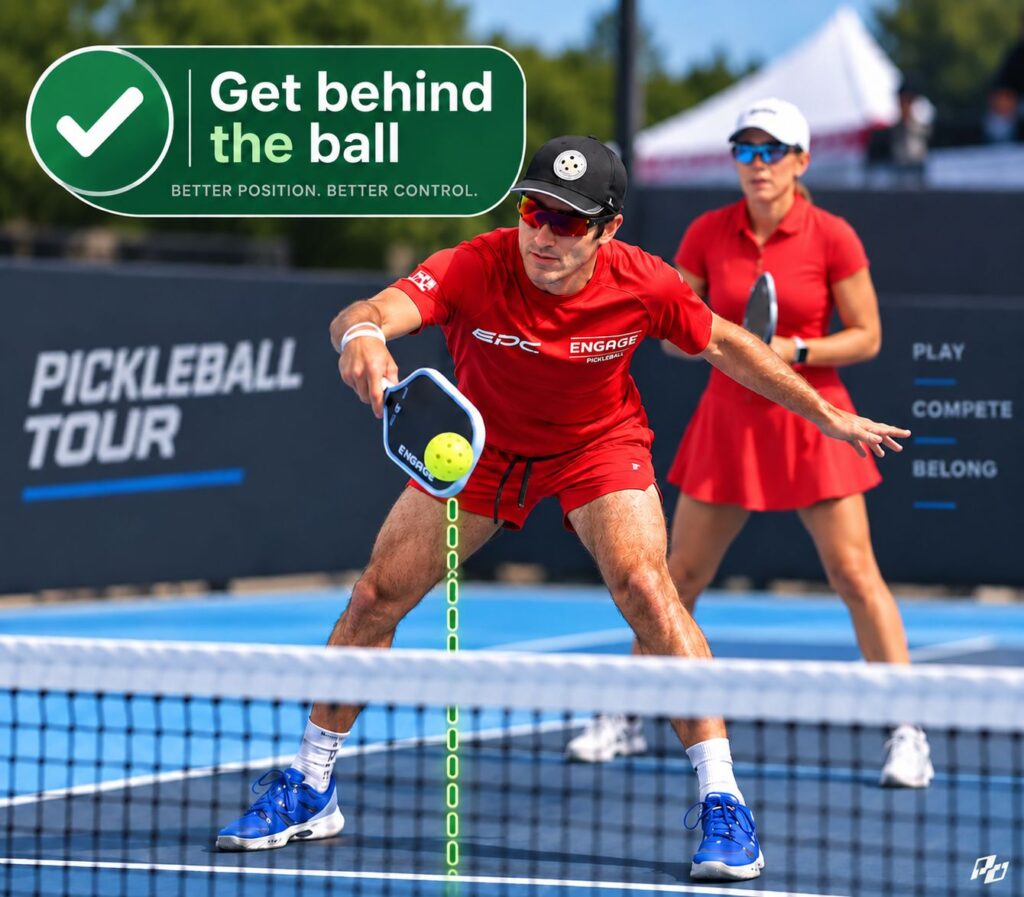
Pickleball coaches use a smart test for the forehand speed-up. Before worrying about paddle speed, get behind the ball.
Ideally, the ball should arrive inside your stance rather than outside the line of your foot. That sounds like a tiny detail. It isn’t. If the ball is outside your body, you reach.
Once you reach:
- your shoulder gets involved
- your paddle path becomes longer
- your target options shrink
- and your recovery gets slower
But move laterally first and put the ball more inside your frame? Now you can disguise several shots from the same position.
You might:
- roll middle
- pull cross-body
- go line
- attack the hip
- or simply dink again
That is one of the hidden differences between having an attack and having options. And options are what make aggression difficult to defend.
The cue
Don’t ask: “Is this ball high?”
Ask: “Can I get my body behind it without reaching?”
If not, the dink may be better than the attack.
A Higher Ball Can Still Be a Bad Attack
Here’s another one that catches intermediate players.
Suppose a dink sits slightly high.
Great.
But you’re leaning backward.
Attack?
Probably not.
Pro player Connor Garnett specifically looks at whether his weight is moving into the ball. If he’s fading backward, the shot loses quality—and, just as importantly, he’s poorly positioned for the counter.
That second part matters more than the first.
Rec players judge an attack by whether they can hit it. Better attackers judge it by whether they can hit the next ball too.
So here’s a better attack test: could I play this speed-up and still be balanced if it comes straight back?
If the answer is no, the apparent opportunity may not actually be yours.
That is why an ugly little dink from balance can be more offensive than an impressive speed-up hit while falling away.
Stop Reading Your Contact Height. Read Theirs.
This is where attacking gets much more interesting.
Most players think:
“I’m contacting above the net, so I can attack.”
But the real question is: where will the ball be when it reaches the opponent?
You want an attack that arrives around the opponent’s midsection or lower rather than feeding a comfortable counter high in their strike zone.
That means your own contact height is only half the geometry.
Imagine two attacks from the same ball. One goes hard but rises into the opponent’s chest. The other has slightly less pace but dips toward the hip or lower.
Which is more aggressive?
Often the second.
Because now the defender has to hit up or awkwardly through the body, and that changes your next ball.
This is why the best speed-up isn’t necessarily the hardest one. It’s the one that gives the opponent the worst contact.
The Hold Isn’t Just Deception. It’s a Lie Detector.
You’ve probably seen good players get behind a dead dink and seem to pause for a fraction of a second. The obvious explanation is deception. That’s true.
But there is something even more useful happening: they’re watching what the defender does during the hold.
Coaches teach holding underneath a dead dink because opponents often reveal what they’re expecting. They may shade toward the backhand, preload a counter, or start protecting one lane before the attacker has committed.
Now the hold becomes information.
You show: “I might attack.” Then watch.
Does the opponent cheat backhand?
Shoulder may open.
Do they lean middle?
Line may become interesting.
Do they freeze perfectly neutral?
Maybe you haven’t earned anything yet.
And here’s the beautiful part:
You don’t have to attack.
Same hold.
Same preparation.
Dink.
Now you’ve made the opponent commit to a speed-up that never came.
Try this
Next time you receive a slow dead dink, don’t immediately decide where you’re going.
- Get there early.
- Set the paddle.
- Hold briefly.
- Watch the defender’s paddle.
- Then choose.
That is far more sophisticated than deciding your target before the ball even crosses the net.
Paddle Tip Down Is More Than a Style Choice
You’ve probably noticed high-level players attack forehands with the paddle tip dropped. There’s a reason.
When you’re properly behind the ball, the paddle tip naturally gets into a lower position. From there, the paddle can travel through several different paths without advertising the target too early.
That’s important for two reasons.
First, it helps produce lift when the contact isn’t well above the net.
Second, the setup resembles several different shots.
A tip-down position might become:
- a roll dink
- a middle speed-up
- a cross-body attack
- or another soft ball
Contrast that with a rec player who suddenly lifts the paddle, rotates the shoulders, and takes a big backswing.
They’re aggressive too. They’ve just told everybody about it.
Low Attacks Aren’t Wrong. They’re Expensive.
This is where pickleball instruction can sound contradictory.
One coach tells you: “Don’t attack below the net.”
Another shows you how to attack six inches below it.
Both can be reasonable.
Coach Jordan Briones explicitly teaches advanced players to attack some balls at net level and even several inches below, adjusting the paddle path and target. Higher balls allow a more linear path; lower balls require more lift and tighter target discipline.
But this does not mean every 3.5 should start flicking ankle-high dinks. Think of low attacks as expensive shots. They require more:
- spin
- trajectory control
- target accuracy
- and preparation for the counter
So the question isn’t: “Can this ball physically be attacked?” Almost anything can.
The better question is: “Is the advantage I can create worth the margin I’m giving up?”
That is a much better intermediate-player rule.
Your Target Should Depend on the Ball Height
Here’s something most rec players never consider. You shouldn’t necessarily use the same target from every contact height.
A lower speed-up may naturally favor the body or cross-body target because you’re already using a more upward and across swing path. A higher ball gives you more freedom to attack linearly and use the line.
Instead of memorizing “Attack the right hip,” let the contact decide the target.
Lower contact: favor safer targets — body, dominant hip, cross-body.
Higher contact: more lanes open — line, shoulder, seam, deeper angle.
Your target should come from the geometry of the ball, not your favorite Instagram speed-up.
Sometimes the Best First Speed-Up Is a Probe
Connor Garnett does something I think recreational players should steal immediately. Early in a match, he may attack middle partly to see what happens. Not necessarily to win. To collect information.
✔ Who takes it?
✔ Do they slide?
✔ Forehand or backhand?
✔ Does one player overprotect?
✔ Does their paddle finish low?
✔ Where does the counter come back?
Suddenly the first attack has given you a scouting report.
Maybe they slide well to middle but expose line.
Maybe their backhand counter is excellent but their body defense is awkward.
Maybe one player doesn’t move at all.
Your next attack should now be different. That’s the part most rec players skip.
They judge a speed-up as: winner or failure.
Better players judge it as: what did that attack teach me?
Don’t Attack the Opening. Attack the Counter You Want.
This is probably the most advanced idea in the article.
You’re looking at an open lane. Tempting. But before hitting there, ask: what is that target likely to send back?
A hard attack at someone’s forehand may look offensive—but if their forehand counter is their best shot, you’ve just started the firefight on their terms.
A slightly slower body attack may produce a blocked ball into your preferred forehand.
That’s better.
A useful principle during hands exchanges: get the ball down toward your opponent’s feet so their next shot has to travel upward.
So your goal doesn’t have to be: hit through them.
It can be: make them give me this next ball.
That’s a massive upgrade in how you think about aggression.
Out of the Air: Don’t Confuse Early Contact With Attack Permission
Taking a dink out of the air is aggressive. But it doesn’t mean the volley itself needs to be fast. This distinction is underrated.
By taking the ball early, you’ve already:
- stolen time
- held your kitchen position
- and prevented the dink from pushing you backward
That alone can be pressure. So if the volley is low around your knees, don’t force a speed-up simply because you touched it before the bounce.
Play an aggressive volley dink.
Move them.
Keep them uncomfortable.
Wait for the next ball.
Out-of-the-air attacks become much more attractive when the ball rises closer to hip level because you can send it more linearly instead of having to lift sharply into a prepared counter.
That is a useful threshold.
Not: volley = attack.
But: volley + height + balance + target = attack.
Watch coach Tony Roig break down a pro pickleball exchange and show exactly how volley dinks create pressure, control space, and set up the next ball:
Watch for the “Dead” Ball—But Understand What Dead Means
A dead dink isn’t simply a slow ball. It’s a ball that gives you time. That time lets you:
- move your feet
- get behind the ball
- hold
- read the defender
- and choose late
That’s why a slightly lower dead dink can sometimes be more useful than a higher ball arriving quickly into your body.
Height attracts your attention. Time creates the attack.
That’s a subtle but important difference.
Your Aggressive Dink Should Have a Second-Shot Plan
“Dink aggressively” is too vague. Try this instead: pick the reply you’re trying to create. For example:
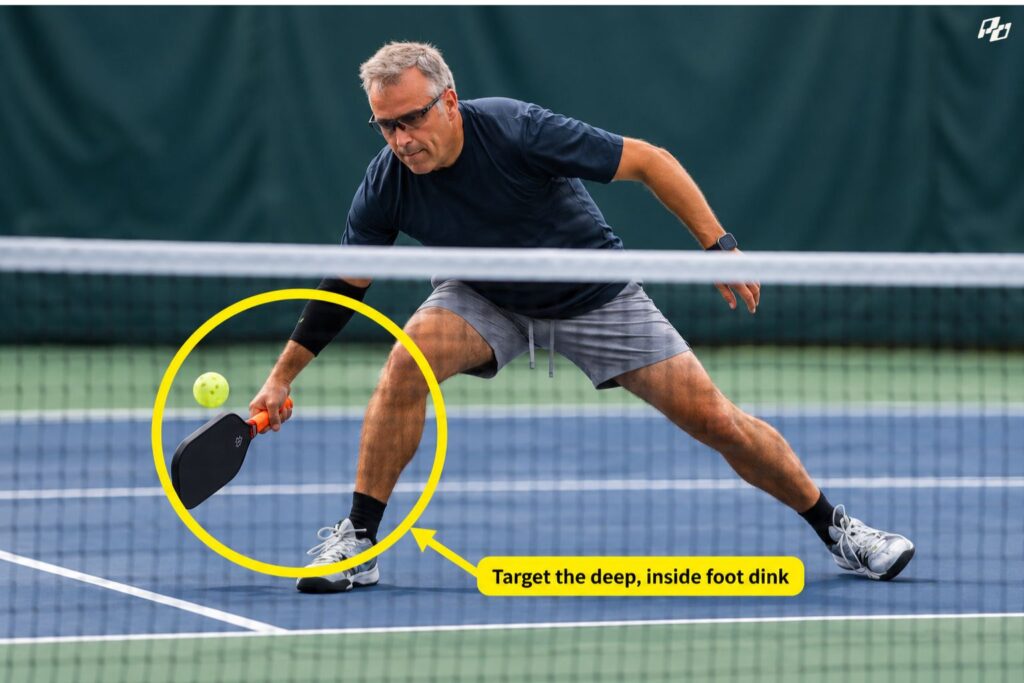
Deep inside-foot dink
Desired reply: a shortened, lifted dink.
Your plan: lean in and attack the next ball.
Wide angle dink
Desired reply: opponent reaches and pulls the ball back toward middle.
Your plan: close space and look for the volley.
Middle dink
Desired reply: reduced attacking angle and possible hesitation between opponents.
Your plan: look for the next ball that sits.
The aggressive-dinking idea is simple: use the first dink to create pressure, then attack the weaker reply that follows.
That is much better than randomly “dinking harder.” Every aggressive dink should answer: what am I trying to get next?
From the Baseline, Here’s the Clue Rec Players Miss
Whether you should drive isn’t only about where the return lands. Look at how it arrives.
Distinguish between:
- a short, high return that invites pressure
- a deep aggressive return that may justify a controlled drive to produce an easier fifth
- and softer balls where a drop may give you the cleaner path forward
That’s an important nuance.
A drive isn’t always an attempt to win or even advance immediately. Sometimes you’re driving because the next ball becomes easier to drop. That’s aggressive pickleball too.
You’re using pace to change the quality of the next contact.
The Most Aggressive Player May Be the One Who Waits
Here’s the paradox. The strongest attacker on the court may dink longer than you. Why? Because they know what they’re waiting for.
They’re not uncomfortable because the rally hasn’t sped up yet. They’re reading:✔ Is the ball finally dead?
✔ Did the opponent lean?
✔ Did the paddle cheat?
✔ Did I get behind the ball?
✔ Is my weight forward?
✔ Can I attack into a target that produces a predictable counter?
Now compare that with the impatient player.
Five dinks go by.
Nothing happens.
They think: “I need to do something.”
And that’s usually when they attack the worst ball of the rally. Aggression and impatience can look identical for one shot.
Over an entire game, they’re opposites.
The Five-Second Attack Audit
You don’t need to think through 12 concepts during play. Reduce it to five clues:
- SPACE — Is the ball inside my stance, or am I reaching?
- WEIGHT — Am I balanced and able to move through the shot?
- TIME — Is the ball sitting, or rushing me?
- TARGET — Can I make the opponent contact this ball uncomfortably?
- NEXT — Am I ready for the counter I’m likely to get?
If those line up, be aggressive. If they don’t, don’t become passive. Use the next dink to change one of them.
Create more space.
Move the defender.
Take time away.
Force a weaker contact.
Then look again.
That’s the part of aggressive pickleball people often don’t see.
The speed-up is just the visible moment.
The real attack started two shots earlier.