
A good pickleball return doesn’t need to paint the baseline. Aim about 2–3 feet inside it—deep enough to keep the server back, but safe enough to stay consistent. The real test: does the return make their third shot harder while giving you time to reach the kitchen?
Everybody tells you to return serve deep. Almost nobody tells you what deep actually means.
Does it need to touch the baseline?
Land within a foot?
Back third of the court?
And if your return lands three feet shorter but gives you enough time to reach the kitchen comfortably, did you really hit a worse return?
That is where the usual advice falls apart. A good return is not measured only by where the ball lands. It is measured by what the server has to do next.
If your return keeps them deep, prevents them from comfortably stepping forward into the third shot, and gives you time to establish the kitchen, it has done its job.
So instead of trying to paint the baseline, use a better test: did my return make their third shot harder while making my fourth shot easier?
That is “deep enough.”
First, Put an Actual Target on the Court
A regulation pickleball court is 44 feet long, with 22 feet from the net to each baseline.
The kitchen takes up the first 7 feet, leaving 15 feet between the kitchen line and baseline.
A useful return target is about 2–3 feet inside the baseline — deep enough to push the serving team back without flirting with the line.
Imagine a strip running across the court roughly three feet in front of the baseline.
That is your working deep zone.
Not the line itself.
Not the final six inches.
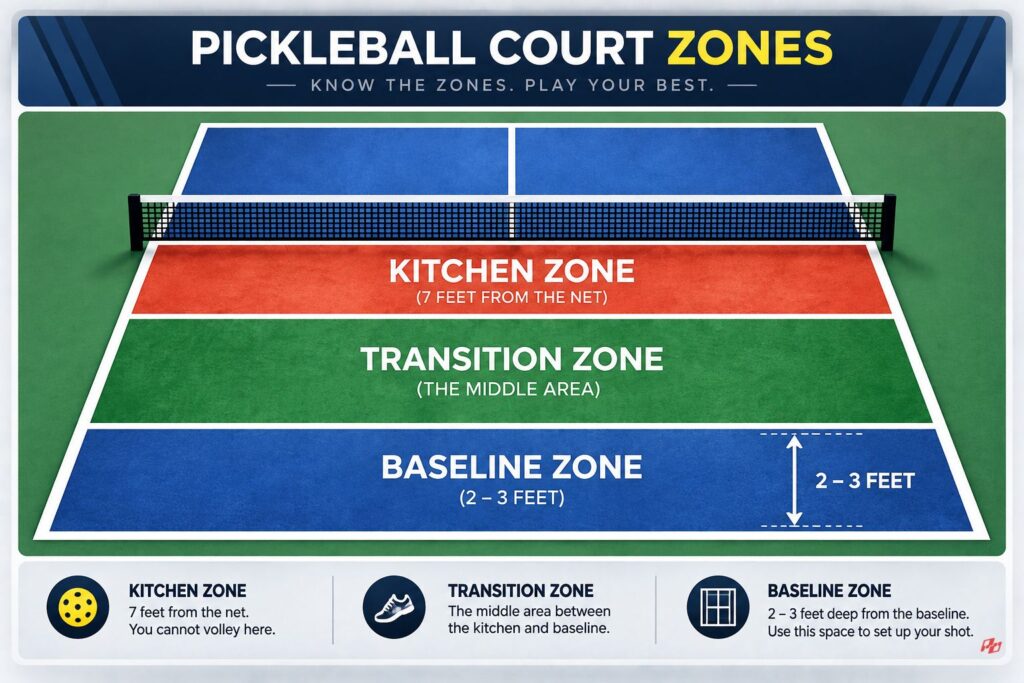
A ball landing two feet inside the baseline and staying in 95% of the time is far more valuable than one landing six inches from the line while you donate several returns long.
The intermediate-player mistake is confusing maximum depth with effective depth. They are not the same thing.
The Best Depth Test Happens After the Bounce
Here is the cue I would watch instead: where is the server when they contact the third ball?
If your return lands deep but bounces forward into their strike zone and they comfortably step inside the baseline to attack it, the return may not have been as effective as it looked.
If your return lands a little shorter but pushes through the court and forces them to stay behind the baseline, that may actually be the better ball.
Coach Jordan Briones teaches players to read return depth when deciding what third shot to hit. When a return comes deep, the server often has to create space and may be forced backward before making the third. Shorter returns allow them to close that space and attack earlier.
That gives us a better definition:
A deep return is one that keeps the server from comfortably moving forward before the third shot.
That is much more useful than measuring inches.
Why Two Identically Deep Returns Can Play Completely Differently
Say two returns both land three feet inside the baseline.
Return A is a flat bullet.
Return B has slightly more height and arrives slower.
Same depth.
Very different rally.
The fast return may jam the server, rush their preparation, or force contact while their weight is moving backward. But it also gets there faster.
That means you have less time to reach the kitchen.
The higher, slower return gives the server more preparation time—but gives you more time too.
Adding a little loft can buy you more time to move forward. The return isn’t just a shot at the server. It’s also a transport shot that helps you get to the kitchen.
You’re trying to send the ball deep while transporting your body from the baseline to the kitchen.
That changes how you should think about pace.
Stop Trying to Win the Return
This is where many 3.5–4.0 players make the return harder than it needs to be. They see a soft serve and think: attack.
Big topspin.
Sharp angle.
Hard drive toward the corner.
Sometimes it works.
But the receiving team already has a structural advantage because the serving team must let the return bounce before playing the third shot.
You don’t need to manufacture another advantage by hitting a low-percentage winner.
Pickleball Union’s coach Marko Grgic recommends using the deep middle as your bread-and butter return target. It gives you more margin, reduces your opponent’s attacking angles, and keeps you from flirting unnecessarily with the sidelines. For most rec players, deep and central beats flashy and risky.
Think of your return as: depth first → time second → placement third → pace fourth.
Not because pace is bad. Because pace should serve those first three jobs.
The Deep Return Should Feel Almost Boring
Watch what happens mechanically when players try to “really hit a deep return.”
Their backswing gets bigger.
Their wrist becomes active.
Their shoulders open early.
Their finish gets long.
Then they either launch the ball long or become afraid of launching it long and suddenly dump the next return short. A dependable deep return generally comes from something simpler:
- Give yourself room behind the baseline.
- Turn early.
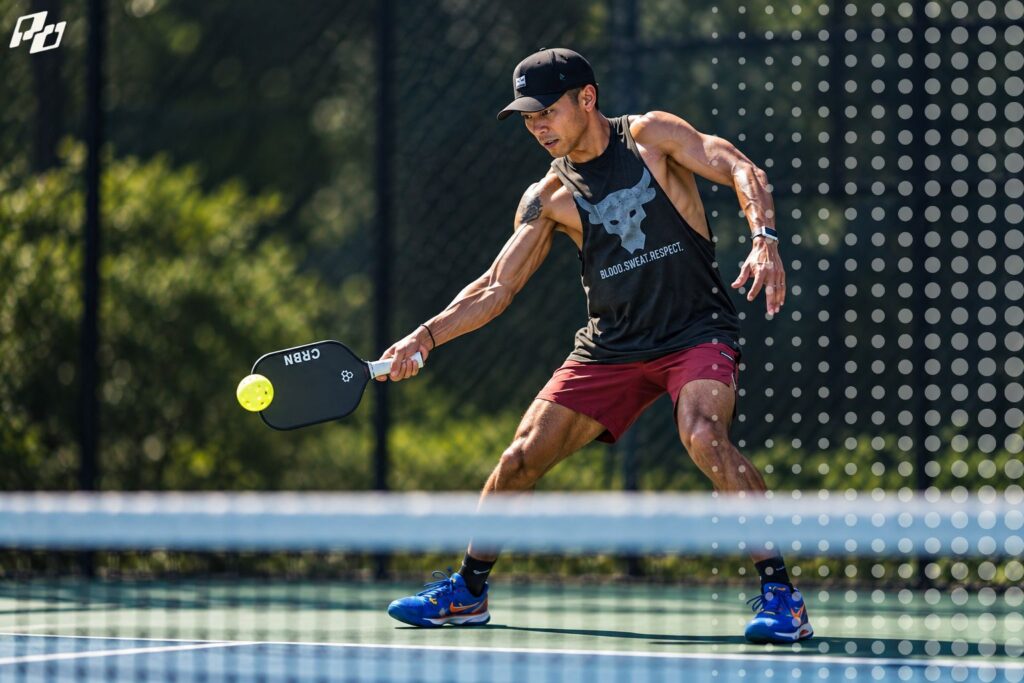
- Contact the ball comfortably in front.
- Move your weight through the shot.
- Let the paddle travel toward the target.
- Then continue forward.
Watch this quick one-minute tip from Pickleball Union coach Marko Grgic on the 3 keys to hitting a great, deep return and moving forward with control:
Standing too close to the baseline can make a deep serve much harder to handle.
If the serve pushes you backward at contact, controlling a deep return becomes more difficult. And once your momentum is moving backward, getting forward to the kitchen immediately after the return becomes much tougher.
That is one of the most overlooked causes of short returns. The problem is not always your swing. Sometimes you simply started too close.
Try This: Judge Your Return by Your Feet
Here’s a much better feedback system than staring at where the ball landed. After hitting your return, ask: was I moving forward naturally after contact?
If yes, your mechanics probably supported the tactical goal.
If you had to stop, lean backward, fall sideways, or admire the shot before moving, the return may have been deep—but it did not necessarily help you.
The return and your movement to the kitchen should feel like one continuous action.
Hit.
Go.
Not:
Hit.
Watch.
Go.
A Higher Return Is Not Automatically a Weak Return
Some intermediate players hate giving the return height because “high balls are attackable.” That logic makes sense at the kitchen. It is less useful here.
The serving team cannot volley the return. It has to bounce. That changes everything. A controlled return with a little extra arc can:
- stay in the air longer
- give you another step toward the kitchen
- produce safer net clearance
- and still land deep
A low, screaming return may look more aggressive but can actually rush you more than the server.
That does not mean moonball every return. Think comfortable arc, not lob.
Enough trajectory that you’re not trying to thread the ball six inches over the net from the baseline.
Deep and Fast vs. Deep and Slow
This is where Tanner Tomassi’s third-shot advice becomes especially useful.
Tomassi distinguishes between a deep, aggressive return that pushes the server onto the back foot and a deep but softer return that gives the server more time to set up. He teaches different third-shot responses depending on those conditions.
For the returner, that means you can intentionally create different problems.
Deep + Faster
Best when:
- the serve is attackable
- you are balanced
- you can still move forward immediately
- and the server struggles when rushed
- You are trying to take away setup time
Deep + More Loft
Best when:
- you need more time to reach the kitchen
- the serve pulled you wide
- you’re returning while slightly stretched
- or mobility makes getting forward more difficult
Now you’re buying yourself time. Both can be excellent returns.
Depth does not require one speed.
Deep Middle Is Better Than “Deep Anywhere”
Once your depth becomes consistent, placement starts to matter. For most rec players, I would build the default around: deep middle, with a slight bias toward the weaker backhand.
It also gives you something valuable that corner-hunting doesn’t: margin.
If you’re aiming three feet inside the baseline and several feet inside the sideline, your paddle can be slightly wrong in two directions and the return still lands in.
Aim at the intersection of the baseline and sideline and suddenly two tiny errors become faults.
Intermediate pickleball is often less about hitting a better ball and more about choosing a target that tolerates a slightly imperfect swing.
The Depth Test I’d Use in Practice
Forget trying to hit ten perfect returns. Put down a marker—or simply visualize a line—about three feet inside the baseline.
Hit 20 returns.
Score them differently:
2 points: lands in the deep zone and lets you arrive at the kitchen under control.
1 point: slightly shorter, but still keeps the server behind or near the baseline.
0 points: short enough that the server comfortably steps into the court.
Minus 1: long or missed.
That last category matters. Because if chasing extra depth creates faults, your “aggressive” return is actually losing value.
Once you can repeatedly reach the deep zone, start varying:
- deep middle
- deep backhand
- deep with more loft
- deep with more pace
Same landing goal. Different problem for the server.