
An ATP in pickleball works best when you move early, let the ball travel wide and low, then hit late through a deep target. Don’t force a sharp angle. Get your body outside the ball, stay balanced, and aim deep around the post instead of trying to manufacture a highlight shot.
You finally get one.
The opponent pulls you way off the sideline.
The ball keeps drifting outside the court.
The post is no longer blocking you.
ATP.
So you rush over, try to carve some ridiculous angle into the kitchen… …and miss it three feet wide. Or, into the net.
That is how a lot of ATPs get wasted.
The funny thing is that the around-the-post shot usually gets easier when you stop trying to make the angle sharper.
Let the ball travel farther.
Let it drop lower.
Get your body farther outside the court.
Then hit toward a big, deep target.
The ATP already has the angle. Your job is mostly not to ruin it.
The ATP Is a Patience Shot Disguised as a Highlight Shot
The obvious instinct is: “I have to get to this ball quickly.” You do. But getting there quickly and hitting it quickly are two different things.
Move early, but wait as long as you can before contact. Let the ball travel low and outside the sideline before you hit.
A simple cue: if both feet are carrying you outside the sideline, you probably have a real ATP. If you’re just reaching across the line, you probably don’t.
That distinction is huge.
The goal is: move early → hit late.
Most missed ATPs reverse it: move late → hit early.
Stop Trying to Bend the Ball Around the Post
Here’s the non-obvious part. You don’t need to manufacture some crazy sideways angle. The incoming ball has already done most of that work for you.
A sharp crosscourt dink is traveling: forward + sideways + away from the court.
If you wait, it continues moving outside the post.
Now the post disappears from the shot line.
Your target becomes much larger.
That’s why it helps to let the ball drop lower and aim toward a deep baseline corner instead of forcing a sharp, short angle.
Aiming deeper provides more margin than trying to thread the sharpest possible angle back into the kitchen.
Think: Don’t create the ATP angle. Let the ball reveal it.
Our friend and pickleball coach Will East makes the same point in this super-short video. Watch how he stays patient on the ATP and targets the deep baseline corner instead of forcing a sharp angle:
Lower Is Better—For a Strange Reason
On almost every normal pickleball shot, a very low contact makes your life harder. The ATP is different. The ball does not have to travel over the net.
There is no minimum height requirement for an around-the-post shot as long as the ball legally lands in the opponent’s court.
So letting the ball drop creates a flatter lane.
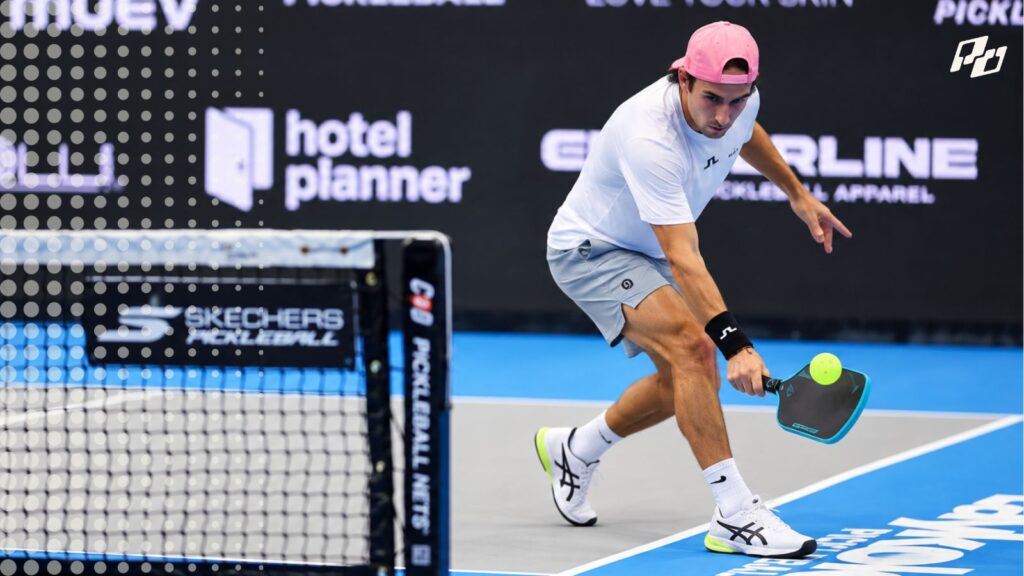
Instead of lifting over 34 inches of net, you can send the ball almost horizontally around the post.
That is why coaches repeatedly teach: stay low and let the ball fall. Let it get as close to the ground as you can comfortably handle.
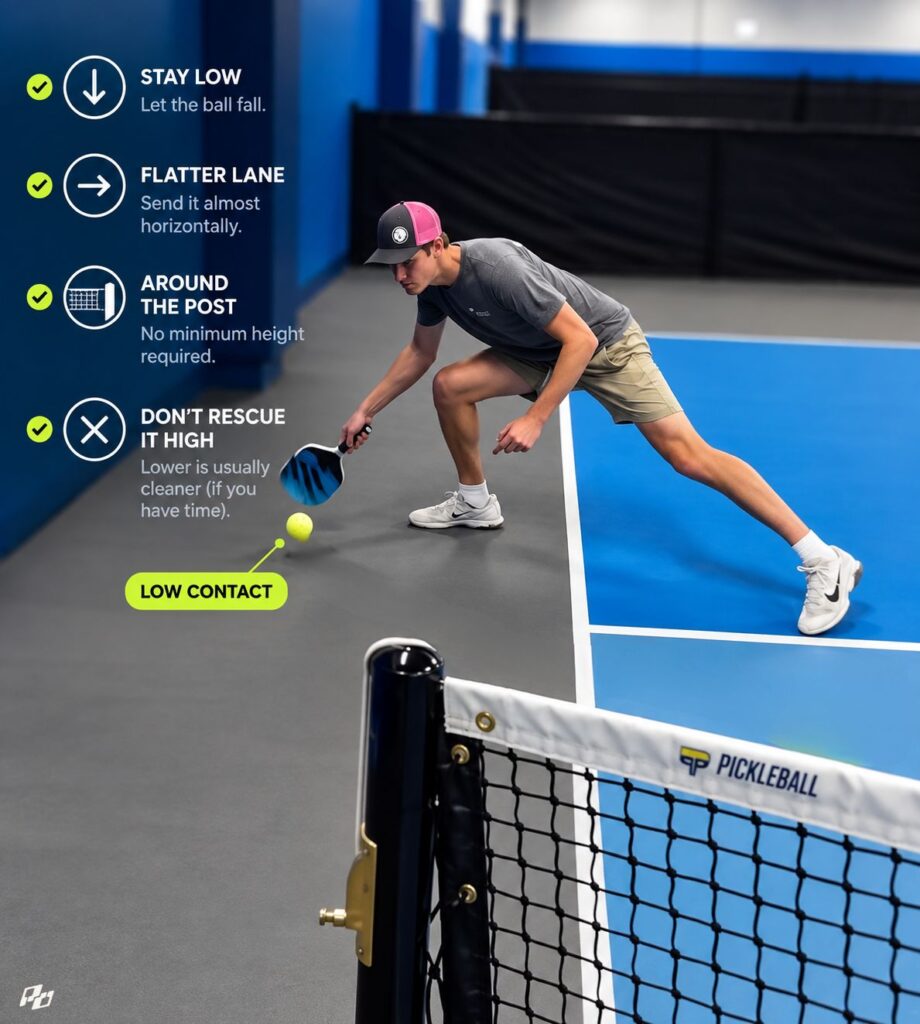
Don’t take that literally and wait until the ball is bouncing twice. The point is simply that you don’t need to rescue the ball high.
If you’re balanced and still have time, lower usually creates a cleaner ATP lane.
The Paddle Doesn’t Need to Scoop It
Another useful cue is to keep the paddle more sideways through contact, rather than dropping the paddle head too much and trying to scoop the ball upward.
That makes sense geometrically. You’re no longer trying to clear the net. So you don’t need the same low-to-high lift you might use on a defensive dink.
The cleaner ATP often feels closer to: through the ball than under the ball.
That’s why the best ones look so flat. You can add a little topspin for control, but this isn’t the place for excessive wrist action.
Get Your Body Around the Ball
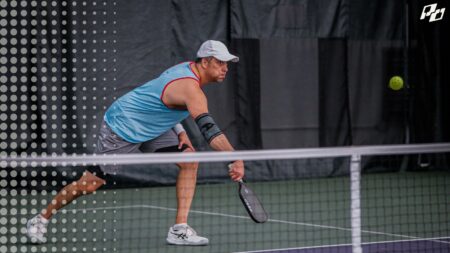
A common ATP miss happens when you reach the ball with your paddle—but your body is still too far inside the court.
Now you’re stretching sideways, the ball is beside you instead of in front of you, and the wrist has to manufacture the angle. Instead, keep moving until you can get outside and slightly behind the ball.
A useful cue is: Lead with your front shoulder and get your chest around the outside of the ball.
You don’t need to literally run past it. You just want enough body position that your arm can swing naturally through the ball instead of reaching sideways for it.
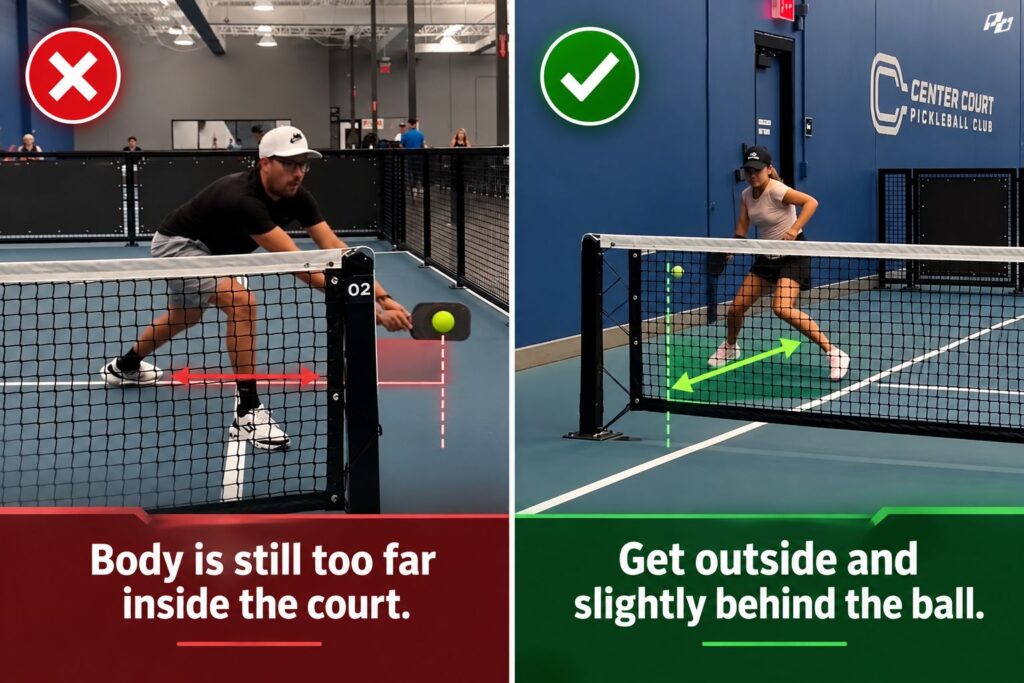
Think of the difference this way:
- Bad ATP: body inside → arm reaches → wrist flicks.
- Better ATP: body gets outside → ball stays in front → paddle swings through.
Forehand ATP: Shuffle. Backhand ATP: Cross Over.
The footwork changes depending on which side you’re hitting from.
Forehand ATP
Use lateral shuffle steps to move outside the court, then plant your outside foot so you can stay balanced and hit through the ball.
The shuffle keeps your chest more open to the court and makes it easier to control the shot without getting tangled up.
Think: shuffle out → plant → stay low → hit through.
Backhand ATP
A cross-step or crossover is often more natural because you need to cover more space and get your body around the outside of the ball.
That crossover helps you travel farther without taking a series of tiny shuffle steps.
Think: cross over → get outside the ball → set your balance → swing through.
The important part on both sides is the same: Don’t arrive reaching.
Get your feet far enough outside the court that the ball stays in front of you and you can hit through it comfortably.
The ATP Has a “Too Early” Warning Sign
Here’s an easy diagnostic.
At contact, look at the net post. If the post still seems directly between your paddle and the target, you’re probably forcing the ATP too soon.
If you’ve allowed the ball to travel far enough that you can clearly see the opponent’s court around the outside of the post, the shot becomes much simpler.
A useful cue is to move with the ball until it travels far enough outside the post that you can clearly see the open court.
Don’t ask: “Is the ball wide?”
Ask: “Can I see my target around the post yet?”
If not, be patient.
Don’t Overhit It
This may be the most wasted advantage on the shot. You’ve got:
- no net to clear
- a weird incoming angle
- a defender scrambling
- and a huge deep target
Then you swing at 100%.
Good ATP instruction generally agrees: placement and clean contact matter more than maximum power.
A hard ATP feels great. A controlled ATP two feet inside the baseline counts exactly the same.
And because the ball can travel extremely low, even moderate pace can be very difficult to defend.
The Opponent May Get It Back
This matters more now than it used to.
Pro Callie Smith has noted that ATPs have become increasingly common as players generate more spin and improve their ability to execute them. Defenders are also getting much better at anticipating ATPs.
So don’t hit your ATP and pose for the highlight reel. You’ve probably run several feet outside the sideline.
If the opponent somehow gets the ball back, your court is exposed. So:
- Hit.
- Watch briefly.
- Then get back.
Practice the Miss You Keep Making
Don’t practice ATPs by standing outside the sideline and feeding yourself perfect balls. That teaches the finish but not the hard part: recognition.
Instead, dink crosscourt with a partner. Have them occasionally hit a sharper angle. Your first job is not even to hit the ATP.
Call: “ATP.”
Or: “No ATP.”
Then play the ball. Once you start recognizing the opportunity, add the shot.
Watch this ATP go wrong because the player targets the kitchen instead of the open court and deep corner:
The One Cue I’d Keep
If you’re tired of wasting ATPs, don’t tell yourself: “Hit a better angle.”
Tell yourself: “Move early. Hit late.”
Get outside.
Stay low.
Let the ball keep traveling.
Wait until the post disappears from your line.
Then send it deep through the opening that the ball already created.
Because the ATP isn’t difficult because you need an incredible shot. Most of the time, it’s difficult because you’re trying to hit it before it becomes easy.