
For pickleball backhand counters, use one hand on body or middle balls where speed and quick reaction matter most. Add the second hand when the ball moves outside your backhand shoulder and you need more stability and leverage. If it gets too wide for two hands, go back to one for reach.
A lot of rec players treat the backhand counter like they have to pick a camp. One hand or two?
But that’s usually the wrong question. At the kitchen, better players often use both—because the right choice changes with the ball.
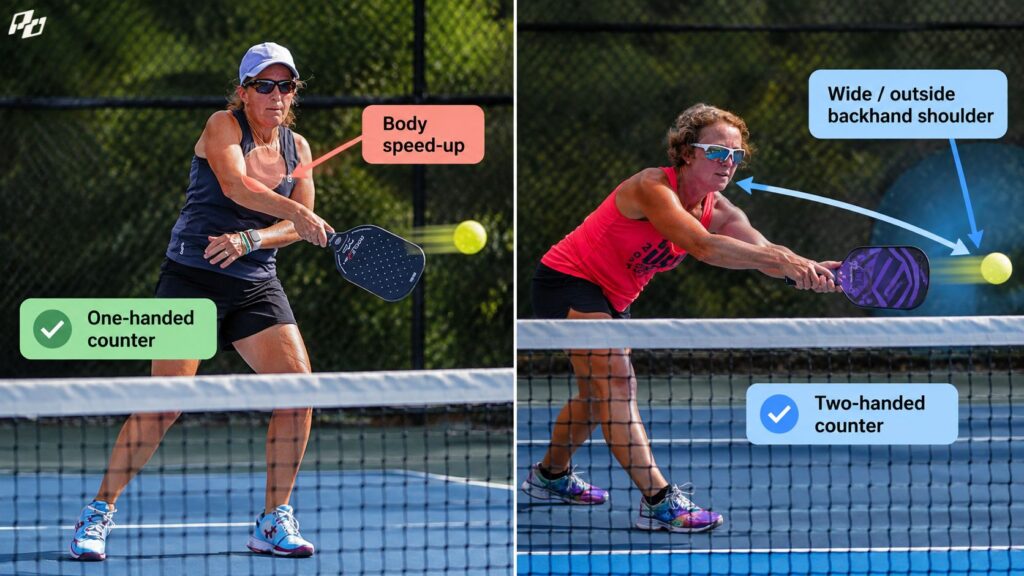
If the ball comes into your body or between your shoulders, a one-handed backhand counter is often faster and simpler.
If the ball sits in your backhand-side hitting slot—not jammed in front of you and not stretched too wide—the second hand can add stability, leverage, and control.
That gives intermediate players a much more useful rule: jammed/in front: one hand. In the backhand slot: two hands. Stretched wide: back to one.
And once you start using the two shots for different jobs, counters get a lot less confusing.
Why This Starts Mattering Around 3.5
At 3.0, most players are still trying to block hard balls back.
By 3.5–4.0, opponents start speeding up more intelligently, firefights last longer, and simply getting a paddle on the ball is no longer enough.
Now you want to counter with quality.
That exposes a weakness in many one-handed counters: when the ball moves into the backhand-side hitting slot, the paddle can become harder to stabilize while still creating useful pace.
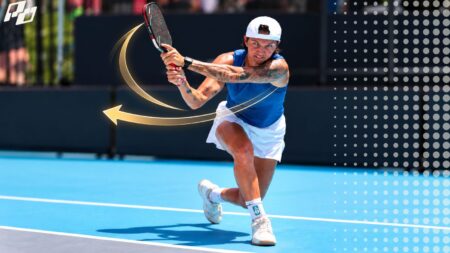
The second hand helps because it adds another point of control. World No. 21 PPA pro Mari Humberg describes the two-handed counter as a shoulder-driven shot and warns against letting the non-dominant elbow collapse into the body, because that can reduce both reach and power.
So the advantage isn’t just “two hands = more power.”
It’s really: more structure when the ball is farther away.
Start With the One-Handed Counter
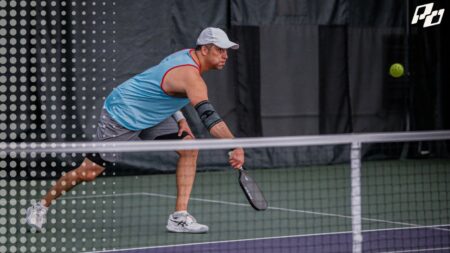
The one-handed counter should still be your default for a lot of balls. Especially when the ball comes:
- at the chestdirectly in front of the body
- between the shouldersj
- ammed and arriving too fast to organize two hands
- stretched wide where you need maximum reach
Why?
Because one hand is quick. There is less movement required to organize the paddle, and you can keep the stroke very compact.
For a body-speed-up, you usually don’t need to manufacture much power anyway. The opponent has already supplied it. You’re redirecting.
A good one-handed counter looks almost boring: paddle in front → meet ball early → short extension → recover.
No big backswing.
No dramatic wrist snap.
No long follow-through.
The more violent the incoming ball, the less you often need to add.
The Backhand-Side Ball Is Where Two Hands Help
This is the ball that gets rec players.
You reach with one hand.
The arm gets farther from the torso.
The paddle starts to feel heavy.
The face wobbles.
And suddenly what should have been a counter becomes a weak block—or a ball flying six feet long.
That is where two hands become useful. The second hand can give you:
✔️ more paddle stability
✔️ better leverage
✔️ better directional control
✔️ a stronger swing through contact
That doesn’t mean two hands somehow give you more reach.
In fact, two-handed backhands generally reduce your maximum reach because both arms are connected to the paddle. That’s why the real sweet spot is a ball that is wide enough to need support but not so wide that two hands physically can’t get there.
That distinction is important.
Here’s the Actual Decision Map
For a right-handed player:
| Incoming ball | Better starting choice |
|---|---|
| At chest / body | One-handed counter |
| Between shoulders | One-handed counter |
| Slightly outside left shoulder | Two-handed counter |
| Far enough outside that two hands restrict reach | One-handed reach/block |
| Higher floating ball outside backhand shoulder | Two-handed attack/counter |
| Ball already jammed and on you fast | One hand |
That last row matters.
Even if you love your two-hander, sometimes there simply isn’t enough time to get the second hand organized.
So the rule isn’t: wide = always two.
It’s: wide enough to need support, but still close enough to set two hands.
Don’t Make the Two-Hander Too Big
This is where rec players usually overdo it. They learn the two-handed backhand and suddenly every counter becomes a miniature groundstroke.
Huge turn.
Big backswing.
Long follow-through.
Too slow.
The counter is still a kitchen shot.
You’re close to the opponent.
The ball is arriving quickly.
So even with two hands, the stroke should stay compact.
Keep the stance open rather than turning fully sideways. A closed stance can slow your recovery if the opponent sends the next ball back quickly.
That’s one of the most useful technical details here.
You’re not hitting a baseline two-hander. You’re countering from a firefight position. So keep the chest relatively available to the court:
@thepickleballchir MASTER your two-handed backhand counter with this 3-step progression! 1️⃣ Catch + swing — no paddle. Learn the movement pattern first. 2️⃣ Slow motion — grab the paddle and hit controlled counters while focusing on clean, repeatable mechanics. 3️⃣ Full speed — increase the pace while maintaining the same basic movement pattern. 🔥 CATCH ➡️ SLOW ➡️ FULL SPEED Try this progression during your next pickleball practice! #pickleball #pickleballtiktok #pickleballplayers #pickleballtips #pickleballislife ♬ Crate Diggin Sax – Sol Price
The One-Handed Counter Has a Different Strength
This is the other half of the article. Two hands add stability. One hand adds speed and freedom.
If the ball comes directly into your body, trying to force two hands onto it can actually make you slower.
That is why Zane Navratil and other high-level players teach using both options rather than treating the choice as ideological.
One hand is especially useful when:
✔️ you are jammed
✔️ the ball is very fast
✔️ you need instant paddle access
✔️ you need extra reach
That’s why the two shots complement each other so well.
The one-hander solves time and reach.
The two-hander solves stability and leverage.
Stop Switching Based on Preference. Switch Based on Spacing.
This is probably the biggest upgrade for intermediate players.
A lot of rec players decide before the rally: “I’m a two-handed backhand player.” or “I only use one hand.”
Better players decide from the ball. That’s a much more useful habit.
Instead of asking: “Which backhand do I like?” ask: “How far is this ball from my body?”
That single question often tells you what to do.
The Best Drill Is Not 50 Two-Handed Counters in a Row
If you only feed the same wide ball over and over, you’ll learn the stroke. You won’t learn the decision. And the decision is the harder part.
Try this instead.
Stand at the kitchen with a partner directly across from you. Have them randomly speed up balls:
- at your chest
- between your shoulders
- slightly outside your backhand shoulder
- farther wide
Your job is to choose: one hand or two hands before contact.
Do not worry about winning the exchange at first. You’re training recognition. After 20–30 feeds, patterns start to become automatic. Then make it live.
That’s when the real benefit appears.
What Changes When You Get This Right?
The first improvement usually isn’t more winners. It’s fewer awkward counters.
✔️ Balls that used to twist your paddle no longer do.
✔️ Wide speed-ups stop feeling like survival shots.
✔️ Body attacks get cleaner because you aren’t trying to squeeze two hands into a tiny window.
And most importantly, you stop being late because you’re no longer forcing one backhand solution onto every ball.
That’s the real gain. You become more adaptable without adding more complexity.