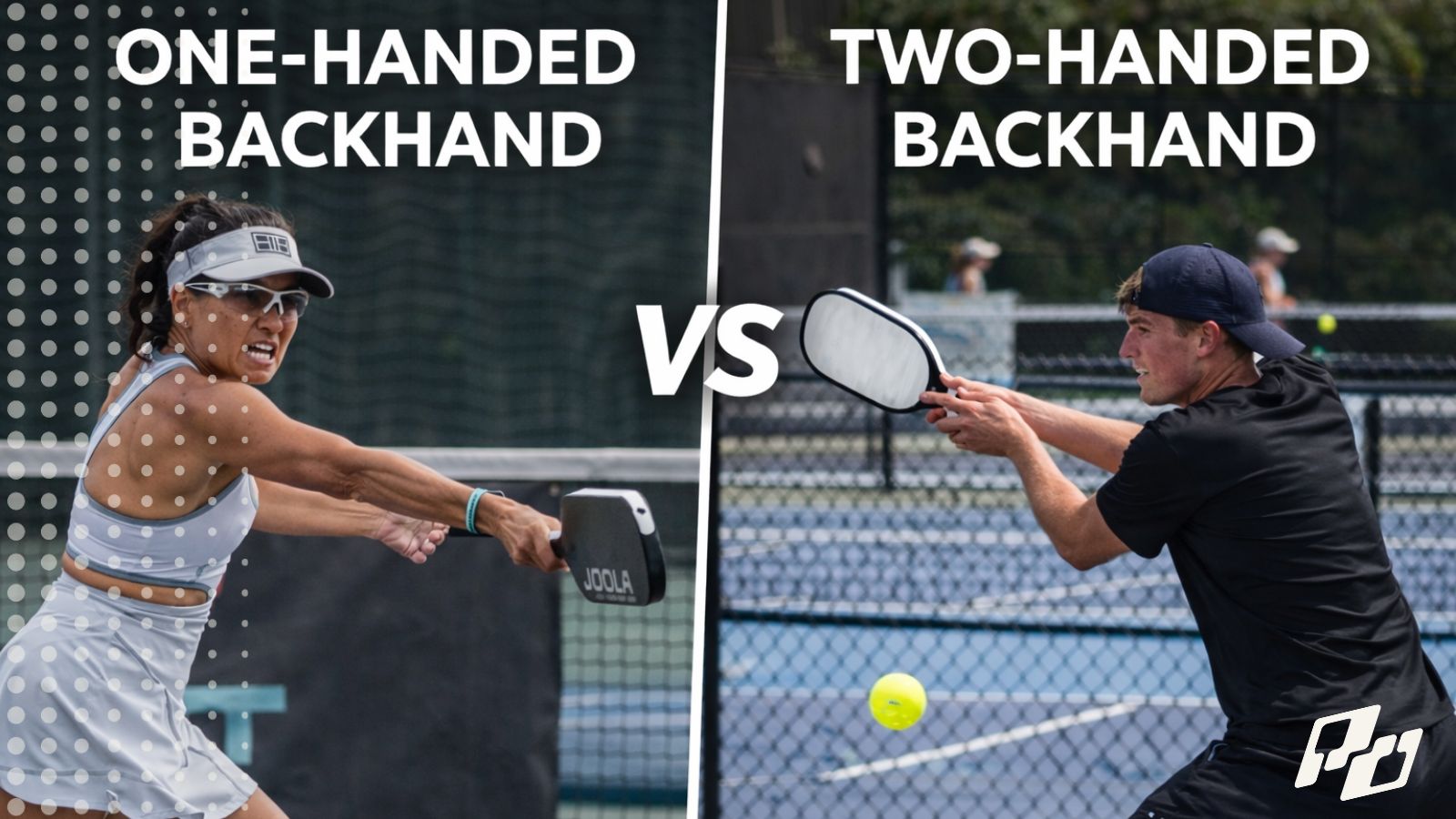
If you’ve been playing pickleball long enough to feel mostly comfortable, you’ve probably noticed a pattern.
Your forehand feels reliable.
Your one-handed backhand works… until the game speeds up.
➡️ Then come the jammed speed-ups.
➡️ The body shots.
➡️ The fast kitchen exchanges where your paddle feels late, unstable, or overpowered.
That’s usually when players start asking about the two-handed backhand—not because the one-hander is “bad,” but because it starts getting exposed under pressure.
Here’s the key mindset shift right up front:
You don’t replace your one-handed backhand with a two-handed backhand.
You add the two-hander as a second gear.
Advanced players don’t pick sides. They switch based on time, spacing, and ball location—sometimes within the same rally. This guide breaks down exactly how to do that.
The Real Reason Players Add a Two-Handed Backhand (It’s Not Power)
Most rec players assume the two-handed backhand exists to hit harder. In reality, power is the least important upgrade it provides.
What the second hand really gives you is:
- more leverage against pace
- better paddle-face stability
- tighter control on counters
- increased margin when redirecting the ball
Adding the second hand helps the paddle face stay closed and the swing path stay more forward than upward. That’s why pro players often use a two-hander on backhand counters and speed-ups that would be risky one-handed—especially down the line.
This is about controlling chaos, not creating it.
The Core Decision Rule (This Comes Before Technique)
Before grip details, mechanics, or drills, you need a decision framework. Without one, players misuse the two-hander and often get worse before they get better.
Here’s the rule high-level players actually use:
If you have time to move your body into position → two hands.
If the ball is already on you → one hand.
That’s it.
Everything else in this article flows from that principle. Here’s pro player Mary Humberg breaking this principle down:
What Each Backhand Is Actually Good For
Rec players often expect one backhand to solve every situation. That’s the mistake. Each version solves a different constraint, usually related to time and space.
One-Handed Backhand: The Emergency Tool
The one-handed backhand is best thought of as a reaction tool, not a shot you’re trying to shape or finesse. It shows up when things happen fast and you’re just trying to survive the exchange.
It works best when:
- the ball gets jammed into your body, so there’s no time or space to add a second hand
- you’re reacting instead of setting up, because your feet didn’t get you there in time
- the ball forces contact outside your ideal strike zone, and you’re reaching with your arm rather than moving your whole body
- you’re blocking or punching back pace just to keep the point neutral
When we say “reach” here, we don’t mean stretching wide like a groundstroke. We mean having a usable option when your feet can’t move. With one hand, you can get the paddle out in front of or across your body quickly, without needing rotation, setup, or leverage.
Think of it like an airbag. It pops out instantly, absorbs the hit, and keeps you in the point—but it’s not the tool you use to steer or control the rally.
Two-Handed Backhand: The Leverage Tool
The two-handed backhand shows up when you’re no longer in emergency mode and can actually do something intentional with the ball.
It’s the option you use when you have just enough time to get organized—even if that’s only a small adjustment step.
It works best when:
- you have time to shift or sidestep, even half a step, so your body—not just your arm—gets involved
- the ball is slightly away from your body, giving you room to extend both hands comfortably
- you’re countering pace, not just sticking the paddle out to survive
- you want to pull the ball back into the court with shape instead of pushing it straight and hoping it stays in:
Adding the second hand gives you leverage and a more stable paddle face. That extra stability is what keeps backhand counters from flying long and lets you attack down the line with confidence when the ball is there.
If the one-hander is about staying alive, the two-hander is about taking control without rushing it.
Common Scenarios Where the Switch Matters
These situations show up constantly in rec play, but most players default instead of deciding.
1️⃣ Speed-Ups at the Body
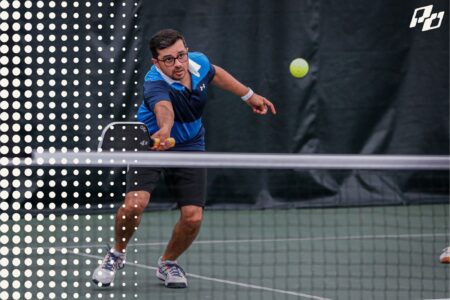
When the ball comes directly at your chest or face, you’re usually out of time. Forcing a two-hander here often leads to jammed elbows or late contact.
The one-handed punch keeps things compact and fast.
2️⃣ Wide Backhand in Doubles (Especially When Stacking)
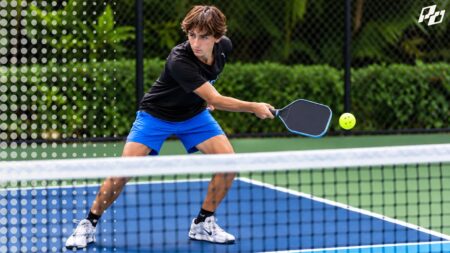
When you’re pulled wide and need to bring the ball back into the court, the two-hander becomes critical.
Pros almost always add the second hand here to help close the face and pull the ball inward instead of pushing it out.
3️⃣ Kitchen Hands Battles
In fast exchanges, advanced players switch constantly:
- two hands when they can square up
- one hand when jammed or late
The mistake rec players make is committing to one option before they read the ball.
Why the Two-Handed Backhand Elevates the Soft Game
One of the most underrated benefits of the two-hander is what it does for dinks and resets.
With the non-dominant hand guiding the paddle, it becomes easier to:
- brush for topspin on backhand dinks
- keep the paddle face stable under pressure
- disguise speed-ups from the same setup
- control depth without over-swinging
That’s why many players successfully adopt the two-hander first in the soft game, even before using it aggressively.
What Actually Changes Mechanically (And What Shouldn’t)
What changes with two hands ✅
- more leverage from the non-dominant arm
- a naturally more closed paddle face
- a shorter, more compact swing
- better stability on off-center contact
What should not change 🚫
- big backswings
- exaggerated shoulder rotation
- trying to muscle the ball
If your two-hander feels slow or clumsy, it’s almost always because you’re swinging too big.
The Most Common Mistakes When Adding a Two-Handed Backhand
These mistakes don’t just slow improvement—they actively undermine confidence.
❌ Forcing two hands when jammed
If the ball is already on you, it’s too late. Two hands require space.
❌ Adding the second hand too late
The off-hand should come on during your move—not at contact.
❌ Over-rotating the shoulders
The two-hander is compact by design. Too much rotation costs time and opens angles.
❌ Abandoning the one-hander entirely
You still need reach and emergency defense when rallies speed up.
A Practice Progression That Actually Transfers to Games
Instead of isolating strokes, train decision-making.
Have a partner:
- Feed a slightly wider ball → you move and hit two-handed
- Immediately fire a faster body ball → you punch one-handed
You’re teaching your brain to choose, not memorize swings.
One-Handed vs Two-Handed Backhand: When Each Actually Wins
One handed vs two-handed backhand isn’t about preference. It’s about time, spacing, and what the ball is forcing you to do.
| Situation / Constraint | One-Handed Backhand | Two-Handed Backhand |
|---|---|---|
| Time available | Best when reaction time is short and decisions are forced | Best when you have even a half-step to get organized |
| Ball location | Ball is jammed at chest, hip, or shoulder | Ball is slightly away from the body with space to extend |
| Primary goal | Survival / neutralization | Control / redirection |
| Paddle path | Compact, short punch | Forward, more controlled path |
| Face stability | Lower — relies on timing | Higher — second hand stabilizes face |
| Best use case | Emergency blocks, body speed-ups, late reactions | Counters, down-the-line attacks, controlled speed-ups |
| Soft game role | Rarely ideal; limited shaping | Excellent for dinks, resets, and disguise |
| Common mistake | Overusing it when there is time | Forcing it when the ball is already on you |
| What it rewards | Quick hands, reach, reflex | Footwork, spacing, leverage |
| What it punishes | Poor timing under pace | Late setup and over-rotation |
The Big Picture: How to Actually Integrate This
The biggest mistake players make with the two-handed backhand isn’t technical—it’s philosophical. They treat it like a new shot they need to “use more,” instead of a tool that quietly changes how they see incoming balls.
At first, the two-hander shouldn’t feel dominant. It should feel selective. You’re not trying to hit it often—you’re trying to recognize when the court gives you permission to use it. That permission comes from space, balance, and time, not confidence or intent.
This is why players who force the two-hander early get frustrated. They’re trying to impose it on situations that still demand a one-handed response. The breakthrough happens when the choice becomes automatic: your feet organize, the off-hand joins early, and the decision is already made before you consciously think about it.
Here’s the quiet upgrade most players miss: once your brain knows you can add the second hand when time allows, it stops rushing everything else. You swing later, not faster. You read better. You stop defaulting.
That’s when the two-handed backhand stops being something you “practice” and starts being something your game simply has access to.
And that’s the real upgrade.