
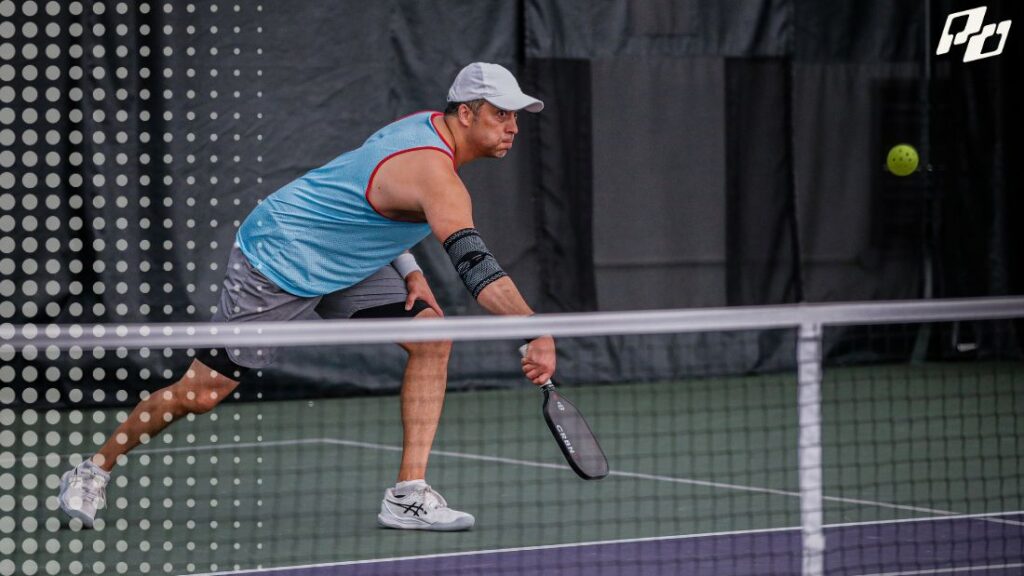
To get the ball down in pickleball, aim to make your opponent contact it below net height, ideally near the feet. Use hard rolls or drives when you’re balanced and above the net, and soft resets or dinks when you’re under pressure. The goal is simple: make them hit up, then attack the next ball.
You hear this phrase everywhere in pickleball: “Get the ball down.” Coaches say it. Better players say it. Partners yell it after a rally.
And popular coach Kyle Koszuta’s version we recently heard gets to the heart of why it matters: a soft ball at someone’s feet can be more useful than a hard ball at their chest, because down often creates up. Once your opponent has to contact below net height, they are much more likely to lift the next ball — and that is the ball you can attack.
That sounds simple.
Actually doing it is not.
Because “get it down” does not mean hit everything harder, aim at the shoes every time, or force a steep downward ball from below the net.
It means learning to create a ball your opponent has to hit up from an uncomfortable contact point.
That is the real skill.
And around 3.0–3.5, this is one of the biggest strategic jumps players can make: stop asking, “Can I hit this hard?” and start asking, “Can I make them hit the next ball up?”
First, “Down” Is About Their Contact Point
This is the part that clears up almost everything. A ball does not have to be smashed downward to count as “getting it down.”
A soft dink can do it.
A roll can do it.
A reset can do it.
A compact counter can do it.
Even a block can do it.
The common result is that the opponent ends up contacting the ball low — ideally around the feet, ankles, or below net height — instead of comfortably attacking from waist or chest height.
That is why Koszuta’s idea of soft and hard working together is so useful.
The soft ball may not win the point.
It creates the ball that does.
So think of the rally as a height battle:
You make them hit up.
They give you something higher.
Now you get to hit down.
That is the cycle you’re trying to create.
The Most Important Rule: You Can Only Hit Down From the Right Ball
Here is where rec players get the idea backward. They hear: “Get it at their feet.” Then they try to attack a ball that is already at their feet.
That usually means lifting hard from below the net, which is exactly how pop-ups and out balls happen.
When the ball is below your control window, particularly around the feet or knees, the smarter play is usually to neutralize first rather than force offense.
So use this simple filter:
If your contact is high:
You may be able to drive or roll the ball down toward their feet.
If your contact is low:
Send it softly into the kitchen and make them lift the next ball.
Same objective.
Different shot.
That is why “get it down” should never be confused with: “hit down on every ball.”
There Are Really Three Ways to Get the Ball Down
This makes the idea much easier to practice.
1. Hard Down
This is the obvious one.
You get a ball at or above net height, you are balanced, and you can attack through it. Now the feet become a very good target.
The ball arrives low and fast, which limits the opponent’s ability to counter aggressively. This is especially useful against a player who is:
- moving forward
- slightly late getting established
- standing upright
- recovering from a wide ball
- trying to transition through midcourt
A hard ball at the feet of a player who is still moving is much nastier than the same ball directly into a set paddle.
2. Soft Down
This is the part rec players underuse.
Suppose the opponent attacks you hard. You are not in a position to counter cleanly. Your instinct may be to hit hard back. But sometimes the better answer is to take all that pace away and drop the ball softly into the kitchen at their feet.
Now they have to lift.
Loose grip, compact paddle, minimal swing, and enough loft to make the ball land low where the opponent cannot continue comfortably hitting down.
Pro player Tyson McGuffin teaches a similar defensive idea when players are jammed or under pressure: simplify the stroke, remove unnecessary wrist action, and accept the reset instead of trying to manufacture offense.
This is what Koszuta means when he says the soft ball can create the hard ball you actually want.
A good soft ball is not passive. It is offense one shot early.
Now watch this short video where coach Kyle Koszuta explains how to target the feet with both hard attacks and softer shots:
3. Down by Location, Not Speed
This is the sneakiest version.
Many times I have highlighted the inside foot as an especially difficult target during dink exchanges because it restricts the opponent’s paddle space and leverage.
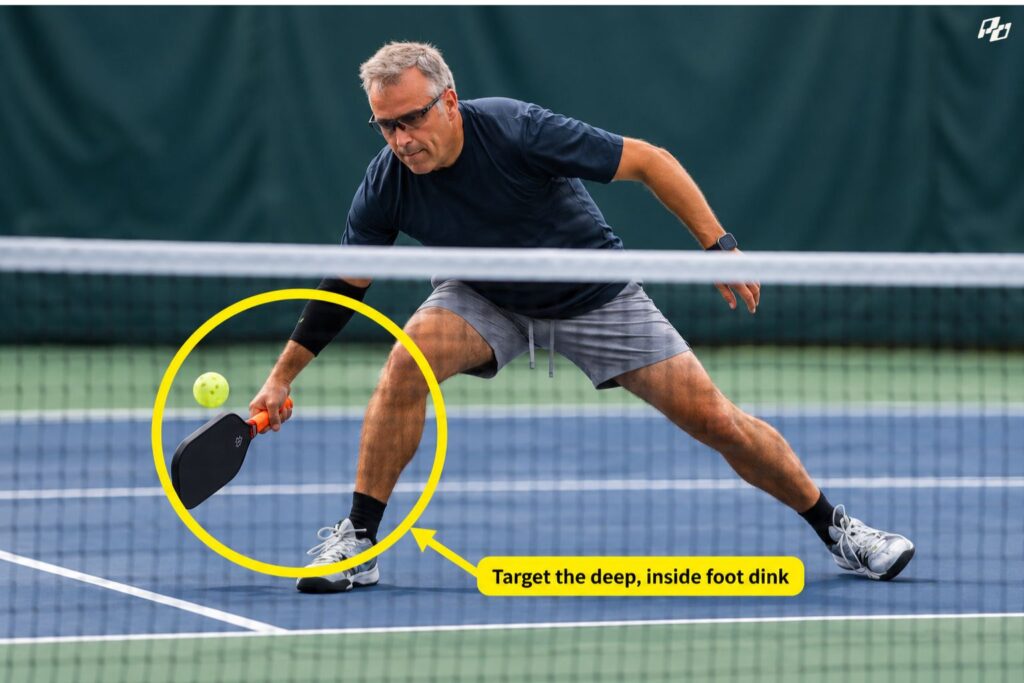
That is useful because it gives you a more precise version of “hit the feet.” You do not always have to aim at the exact toes.
Often the nastier target is the inside foot or inside ankle, where the player has less room to extend the paddle cleanly and may have to move before they can organize the shot.
So if two right-handed players are at the kitchen and you are dinking crosscourt, try thinking: inside foot, not sideline.
That target can create a more awkward upward reply without requiring you to hit a riskier angle.
Which Opponent Should You Target?
This is where the strategy becomes more interesting.
“Feet” is not automatically the best target against both players. Look for the player who is currently least prepared to deal with a low ball.
That is often:
✔ the player still moving through transition
✔ the player recovering from a wide reach
✔ the player standing taller
✔ the player with weaker low volleys or resets
✔ the player whose paddle is late getting down
This is why targeting the feet of the transitioning player is so effective.
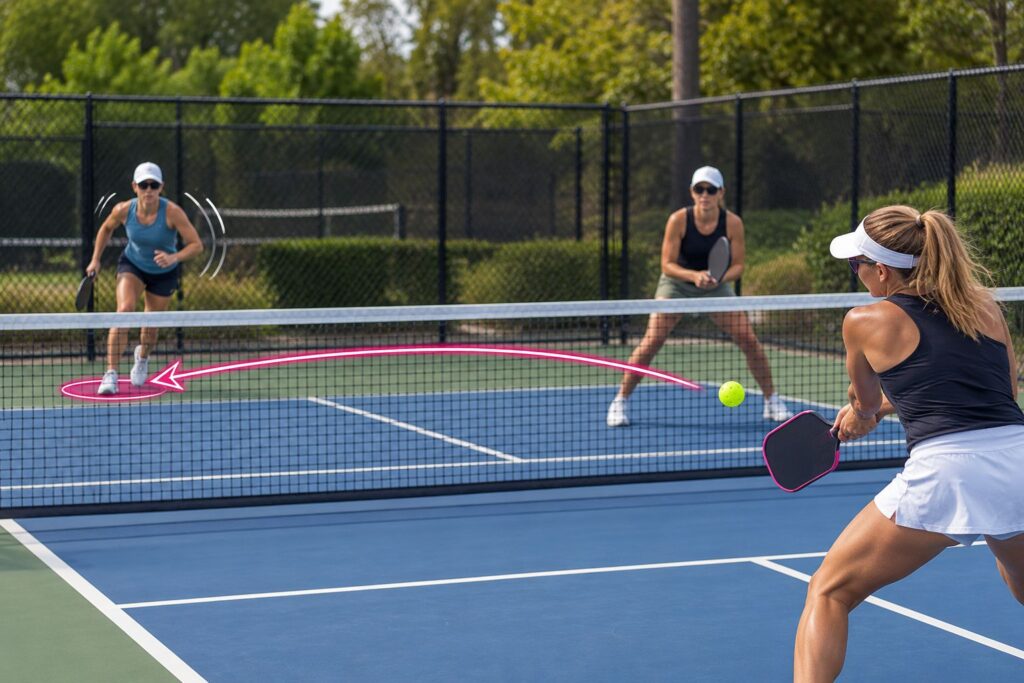
Someone established at the kitchen has better balance and can often take the ball early. Someone moving from baseline to kitchen has to manage the ball while their body is still changing position.
That is much harder.
So if one opponent is at the kitchen and the other is three feet behind it? The deeper player’s feet are often the more valuable target.
How Do You Actually Make the Ball Stay Down?
Here is the mechanical part. There are different techniques depending on whether you are attacking or softening.
On a hard ball
If you are above net height:
- contact in front
- keep the paddle path compact
- use controlled topspin when appropriate
- aim through a large target around the feet or lower body
- expect the ball back
Do not try to hit the feet by violently chopping downward. That usually shrinks your margin.
A roll or controlled drive can create a ball that dips through the opponent’s lower contact zone without needing a dramatic downward swing.
On a soft ball
If you are defending:
- establish your feet as much as possible
- loosen the grip
- keep the paddle in front
- shorten the backswing
- use a slightly open face
- absorb incoming pace
- land the ball low in the kitchen
The goal is not to “win” the reset. The goal is to make the opponent contact the next ball low. That is success.
When NOT to Aim at the Feet
This matters just as much.
If you are stretched, late, off balance, or contacting well below the net, trying to laser the opponent’s feet may be too ambitious.
That is where the phrase gets players into trouble. Sometimes the correct “down” ball is simply: middle kitchen with margin.
Reset guidance repeatedly emphasizes that the best reset is not necessarily the shortest or most precise ball. It is the one that removes the opponent’s comfortable downward attack.
So if you can put it exactly at the shoes safely, great. If you cannot, put it somewhere that forces the opponent to wait, reach, bend, or hit up.
That accomplishes the same strategic job.
The Biggest Mistake: Thinking the First Down Ball Should Win
This is probably the most useful part of Koszuta’s idea. Rec players often hit a good low ball and then immediately become impatient.
They expect: low ball = winner.
But low balls usually create weaker balls.
Those are not the same thing.
You hit a soft dink at the feet.
Opponent lifts it slightly.
That may give you a firmer roll.
They block that.
Now you get the real putaway.
That might be a three-shot sequence: down → up → harder down instead of a single heroic shot.
This is why better pickleball often looks less explosive than rec pickleball right up until the point suddenly ends. The pressure accumulates.
How to Practice This Without Just Saying “Aim at Their Feet”
Drill 1: The Down-Up Game
Goal: Learn to create the attack instead of forcing it.
One player starts at the kitchen line. The other player feeds.
The hitter’s first shot must stay low and go toward the opponent’s feet. They are not allowed to attack hard right away.
If that low ball creates a pop-up, now they can finish the point aggressively.
Think: Low ball → high reply → attack
Not: See ball → hit hard
Start with dinks, then progress to volleys, and finally try it from the transition zone.
Drill 2: Hard Feed, Soft Feet
Goal: Get comfortable resetting hard balls from transition.
Put one player at the kitchen line and the other in the transition zone.
- Kitchen player attacks firmly.
- Transition player resets the ball softly toward the kitchen player’s feet.
- Kitchen player plays the next ball out.
- Repeat for 10 feeds.
Then change the defender’s position: closer to the kitchen → middle transition → farther back.
Pay attention to how your reset changes at each distance.
As you change distance, notice how your paddle angle, grip pressure, and amount of lift need to adjust to the incoming ball.
Drill 3: Inside-Foot Dinking
Play crosscourt dinks.
For five minutes, forget winners. Your only goal is to land the ball near the opponent’s inside foot.
Then switch sides.
This teaches something far more useful than generic “deep dinking”: how to move the opponent’s contact point downward and inward.
The inside-foot concept is especially useful here because it gives the drill a precise target rather than “somewhere low.”
Try This in a Real Game
For one game, stop counting winners. Count up-balls you created.
Any time your shot forces an opponent to contact low and send the next ball upward, mentally give yourself a point.
You may start noticing that your best shot of the rally was not the final smash. It was the boring little ball immediately before it.
That is the mindset shift.