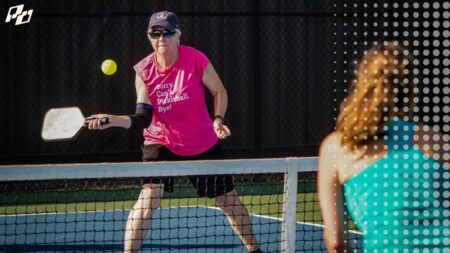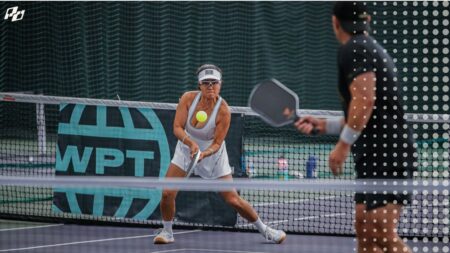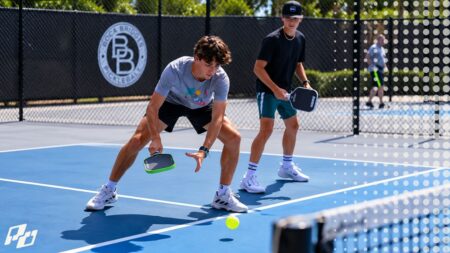

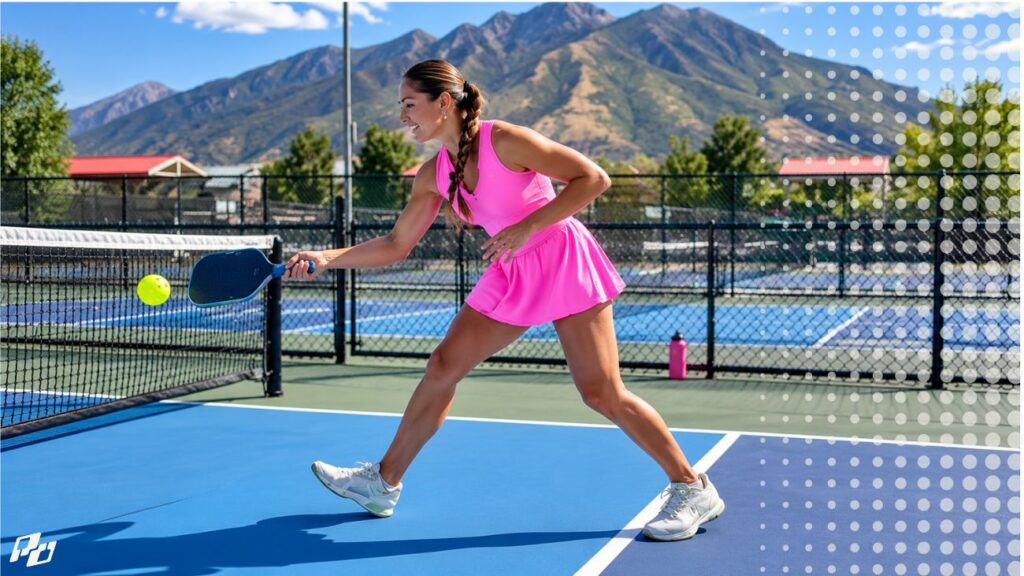
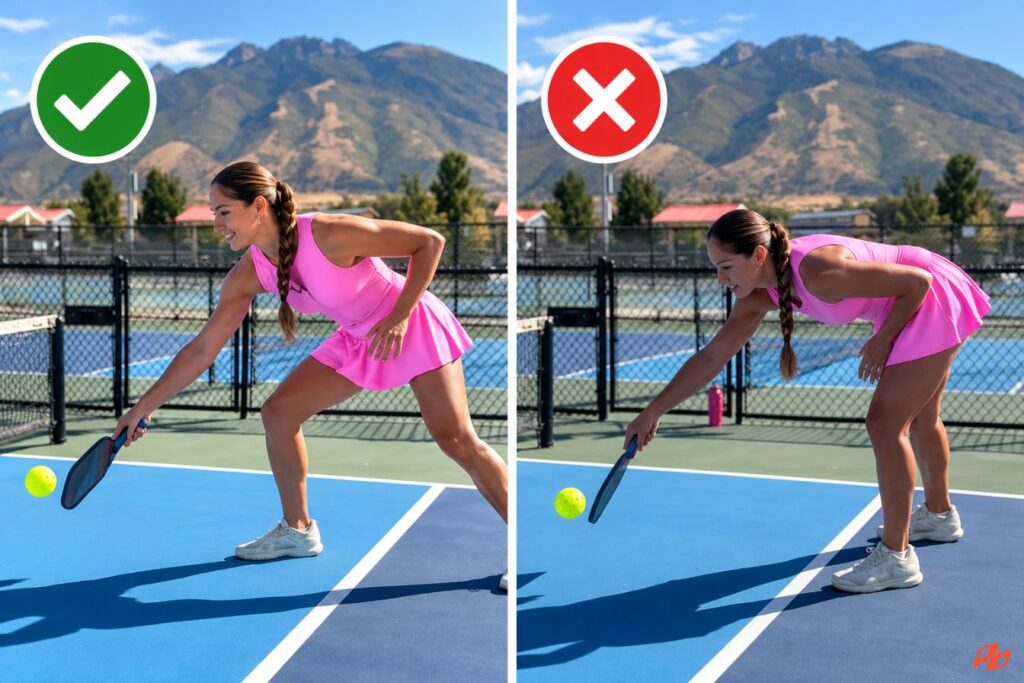
For short dinks, don’t reach from behind the kitchen line. Step into the non-volley zone early, ideally before the bounce, and hit from a balanced position. Then recover back out. Moving your feet improves control, contact quality, and readiness for the next shot.
There’s a strange thing you’ll see constantly in pickleball.
A dink lands two or three feet inside the kitchen. The player is standing safely behind the NVZ line.
And instead of moving toward the ball, they stay planted and perform what can only be described as the world’s longest reach—arm stretched forward, chest falling toward the net, back foot barely hanging on.
All because somewhere in their pickleball education they absorbed one message: don’t go in the kitchen.
I have a much better message: go in.
The non-volley zone isn’t a forbidden zone. It’s exactly what its proper name says: a non-volley zone. You can enter it, stand in it and hit a ball from it after the ball bounces.
And once you stop being afraid of those seven feet of court, something interesting happens: short dinks stop pulling you off balance and start giving you opportunities.
Think of the kitchen as borrowed real estate
Here’s the idea I wish more rec players learned: when a ball bounces short, borrow the kitchen for one shot.
Step in.
Get your body to the ball.
Make a balanced contact.
Then give the kitchen back.
After you’ve touched the NVZ, you cannot volley again until both feet have made contact with the playing surface completely outside it. USA Pickleball’s referee guidance is explicit about that re-establishment requirement.
So the sequence becomes: IN → HIT → OUT → READY.
That’s very different from: REACH → HIT → STUMBLE → PANIC.
And that difference is much bigger than it looks.
The real problem with reaching isn’t the dink you just hit
You might reach into the kitchen and successfully make the dink. So you think: worked fine.
But the cost often appears one shot later.
When you stretch your arm and upper body forward while your feet stay behind, your center of mass moves beyond your base. You are now hitting while your body is trying not to fall forward.
That gives you less precise paddle control.
More importantly, after contact you have to recover your balance before you can react to the opponent.
Good movement gets your weight underneath you, creates cleaner contact in front of the body and makes recovery for the following shot easier.
So here’s a useful way to think about it: every unnecessary reach creates “recovery debt.”
You save yourself one step now. Then pay for it when the ball comes back. And at the kitchen, where the next ball might arrive in a fraction of a second, that’s a terrible loan.
@rionpickleball Wait…you CAN step in the kitchen?😳 The kitchen rules confuses so many new pickleball players. #pickleball #PickleballRules #PickleballTok #kitchenrules #beginnerpickleball ♬ hate that i made you love me – Ariana Grande
Here’s the part many players don’t know: you can step in BEFORE the bounce
This is the genuinely useful rules wrinkle. You do not have to stand outside the kitchen, wait for the dink to bounce and then step in.
If you can clearly read that the incoming ball is going to bounce, you can enter the kitchen before it lands, establish your balance and wait for the bounce.
Then hit.
That’s legal because the restriction is on volleying, not entering the zone. Experienced players discussing this exact situation often point out how much easier it is to prepare when you move early rather than treating the bounce as a starting gun.
This changes the movement completely.
Intermediate version: bounce → realize it’s short → lunge → reach → dink
Better version: recognize short ball → step in → balance → bounce → dink
That half-second of preparation is enormous. You aren’t rushing toward the ball anymore. You’re waiting for it.
Don’t step closer just to get closer—step in to fix your contact point
This is the important distinction. The goal isn’t:
“Ball landed in kitchen, therefore I must step in.”
The goal is:
“Can I contact this ball comfortably without sacrificing balance?”
If yes, stay where you are.
If reaching would drag your shoulders past your knees, force your paddle away from your body or leave you falling forward, move.
So instead of judging the ball by where it lands, judge it by what it does to your body.
That’s a much better intermediate-level cue.
There’s also a hidden offensive benefit
Stepping in isn’t only defensive housekeeping. It can change what you can do with the ball.
If you reach from behind the line, you’re often contacting the ball at maximum extension. From there, your options shrink.
You mostly have one task: get the ball back over.
Move your body closer and suddenly you may be able to:
- take the ball from a more comfortable height
- redirect it sharply
- dink behind the opponent
- push it deeper toward a foot
- disguise your direction
- or accelerate a ball that sits high enough
Coaching on aggressive dinking emphasizes that earlier, higher contact can increase the available angles.
So that short dink isn’t always your opponent pushing you around. Sometimes they’ve actually invited you closer to the net with time to establish yourself.
That can be useful.
But don’t move into the kitchen and admire your work
This is where the technique fails for a lot of players.
They step in beautifully.
Hit the dink.
And stay there.
Now the opponent catches their dink early and punches the ball back through the air.
You instinctively volley it.
Fault.
Remember: once you’ve entered the NVZ, you need to re-establish outside before volleying again. That means your dink isn’t finished at contact.
Your real movement is: step in → hit → push back out.
Think boomerang, not camping trip. Your recovery should begin almost as the paddle finishes.
And sometimes you should NOT step in
This tip can easily get overused.
If the ball is comfortably reachable while you’re balanced at the NVZ line, staying outside preserves your ability to volley the next ball immediately.
That’s valuable.
You’re trading something whenever you enter: better access to this bounced ball for temporary loss of your volley position.
Strong players make that trade only when it improves the contact enough to justify it.
So I’d use this simple threshold: if your paddle can reach but your body can’t stay balanced, move your feet.
That’s the ball you step into.
Try the “borrow and return” drill
Instead of standing at the kitchen line and hitting 100 cooperative dinks, have your partner randomly alternate between: a normal dink you can handle from the line, and a shorter dink that forces you forward.
Your job isn’t merely to return the ball. Score yourself like this:
+1: You recognize the short ball early and move in before reaching.
+1: You’re balanced when you make contact.
+1: Both feet re-establish behind the NVZ line before your partner’s next attackable ball.
–1: You stretch your upper body instead of moving.
–1: You remain trapped inside the kitchen after the shot.
Twenty balls. Add up your points across all 20 (penalties subtract). A perfect run is 60.
Score guide:
- 40+: The habit is forming.
- 20-39: Good start. Keep drilling.
- Below 20: Slow down and focus on moving your feet before you swing.
The kitchen rule may be teaching you the wrong behavior
Beginners understandably hear: stay out of the kitchen. It’s an easy shortcut for learning the rule. But eventually you have to delete it. Because the actual rule is: don’t volley while connected to the kitchen.
Those are completely different instructions.
One makes players afraid of seven feet of perfectly usable court. The other gives them freedom to move.
So next time an opponent drops a dink painfully short, don’t lean farther and farther over the line trying to prove you can reach it.
Go get it.
Borrow the kitchen. Make the shot. Give it back.
That might be one of the simplest ways to make your dinking look—and feel—far less intermediate.