
Most pickleball paddles are a sandwich: two face sheets, usually carbon fiber or fiberglass, bonded to a honeycomb or foam core, plus an edge and a handle. They are built one of two ways. A cold-pressed paddle is bonded as a flat panel without heat, cut to shape, then capped with an edge guard. A thermoformed paddle is heat-cured in a two-piece mold, so the faces, core and foam edge come out as one shell.
That one difference explains most of what you hear at the courts: why some paddles have a plastic rim and some look seamless, and why everyone at open play suddenly has an opinion about foam.
Below, you can watch animations for both builds side by side, then see how paddles got here, from a plywood paddle in 1965 to the foam-filled shells on the shelf now.
What is a pickleball paddle made of?
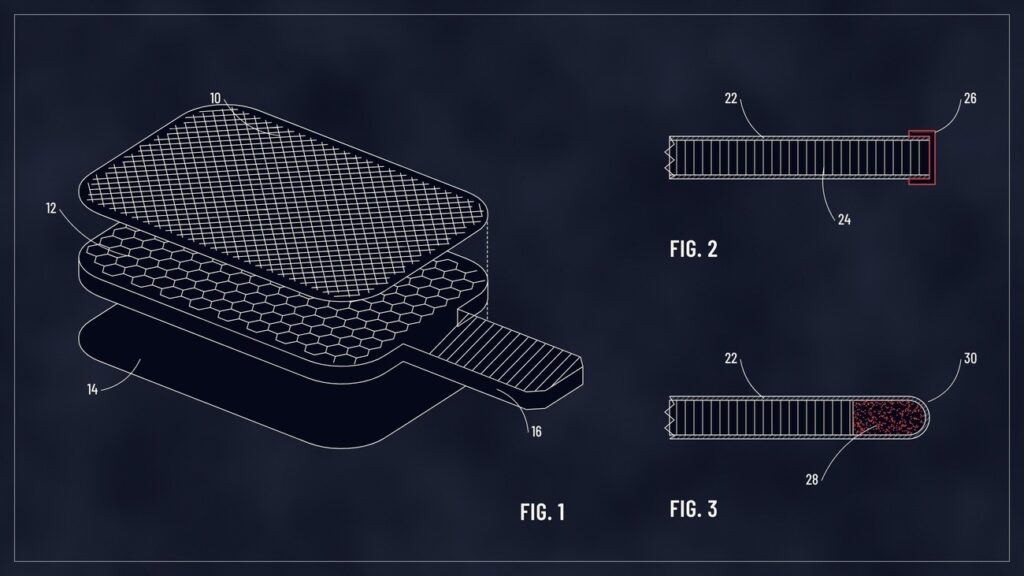
Four parts: a face on each side, a core in the middle, an edge around the outside and a handle. The face is what you hit with. The core decides most of how the paddle feels. The edge and the handle are where the two building methods differ most.
The face
The face sheets are the skin on each side of the core. Early composite paddles used fiberglass, then graphite. Most performance paddles now use carbon fiber, often “raw” carbon left unpainted.
The core
The core is the thick middle layer, and it has changed more than any other part:
- Nomex or aluminum honeycomb. The first composite paddles in the mid-1980s used these. Light and stiff.
- Polypropylene honeycomb. A plastic honeycomb that became the standard core. Still common today.
- Honeycomb plus a foam ring. “Hybrid” paddles, from 2024, keep a honeycomb center and add a ring of EVA foam around the perimeter.
- Full foam. From 2025, some paddles replace the honeycomb entirely with foam. The newest designs mix foams of different densities, most commonly EPP and EVA.
You will also hear about “core crush”, where a honeycomb core breaks down with use. Players notice it. In our 2026 Paddle Consumer Report, durability, not performance, was the top theme when owners told us what they’d change about their paddle. One Selkirk owner put core crush better than any spec sheet: “That the combs inside last longer. I have dead spots.”
When we asked 1,068 players in the August 2026 wave of our 2026 Paddle Consumer Report what paddle they play, 37% didn’t name a model: they left it blank, wrote “unknown” or gave only the brand. Plenty of players don’t know what they’re playing, let alone what’s inside it. That’s exactly why it’s worth knowing.
The edge
How the edge is finished tells you how the paddle was built. A cold-pressed paddle is cut out of a flat panel, which leaves the honeycomb cells open around the outside, so it gets a plastic edge guard.
A thermoformed paddle comes out of the mold with a foam-sealed edge, so many have a thin guard or none at all.
The handle
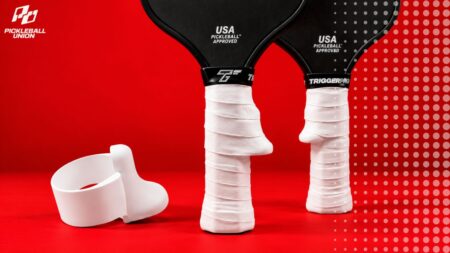
The handle is built onto the paddle body and wrapped in a grip. Handle length and grip size are about fit, not construction, so we cover them in our paddle quiz instead.
How is a paddle built? Cold press vs thermoformed
Same materials, two very different builds. A cold press makes a flat panel and cuts a paddle out of it. A thermoforming mold makes the paddle itself, in its final shape. Step through both presses side by side:
One press makes a sheet; the other makes a paddle.
Read the steps
- Lay up. Cold press: a flat sheet of carbon, a slab of polypropylene honeycomb and a second carbon sheet, glued together, with no paddle shape yet. Thermoformed: the face sheets and core are cut to paddle shape first, and the core already has a foam strip around its edge.
- Press. Cold press: the press squeezes the panel while the glue sets, with the platens at room temperature. Thermoformed: a heated mold closes on the stack at around 130 to 150°C, and the epoxy flows between the layers.
- Open. Cold press: out comes a flat rectangle of carbon and honeycomb. Thermoformed: after cooling, the stack comes out bonded as one piece.
- Shape. Cold press: a CNC router cuts the paddle out of the panel, leaving the honeycomb cells open around the edge. Thermoformed: nothing to cut; the paddle left the mold in its final shape, with foam already sealing the edge.
- Edge. Cold press: a plastic edge guard goes over the cut to close the cells and protect the edge. Thermoformed: the sealed, foam-filled edge does that job, so many thermoformed paddles have a thin guard or none.
How a cold-pressed paddle is made
Think plywood shop, not oven. The faces and core are glued into a big flat panel and held in a press until the glue sets, without added heat. A CNC router then cuts the paddle shape out of that panel. Cutting exposes the honeycomb around the outside, so an edge guard goes on to close it up and take the knocks.
This is how most paddles were built for years, and it is still how plenty of good ones are built. Paddletek, for one, argues it is the better method because it keeps heat away from the core.
How a thermoformed paddle is made
Thermoforming builds the paddle in its final shape from the start. The faces and a pre-shaped core, already ringed with foam, go into a two-piece mold. The mold heats to roughly 130 to 150°C (patent US12263387), the epoxy flows and cures, and the whole stack bonds into one shell.
That single shell is what brands mean by “unibody”. There is no cut edge to cover, which is why so many thermoformed paddles look seamless.
Which one should you buy?
Neither method is automatically better. Construction changes how a paddle feels and holds up, but your swing, your level and your budget matter more.
Our 2026 Paddle Consumer Report backs that up: the most common reason players gave for their final choice was play-testing the paddle (27%), and players who researched before buying (reviews, demos, a coach) scored their paddle +56 on Net Promoter Score, 33 points higher than players who bought on price or by default.
If you are choosing between two paddles, take the paddle quiz, which matches you from lab data in about 3 minutes, or start with our picks for beginners.
How paddles changed, by construction
Paddles have gone through seven builds in about 60 years, and each one is easiest to understand by what is inside it. Here they are in order, named by construction rather than by marketing labels.
Wood (1965 to the mid-1980s)
The first paddles were cut from plywood, later from Baltic birch. They were solid, cheap to make and heavy, at about 13 ounces. If you have ever played with a wooden paddle at a park, you know why players wanted something lighter.
Splitting the slab into a light core between two thin faces halved the weight.
Composite honeycomb (from 1984)
On December 21, 1984, Arlen Paranto, a Boeing industrial engineer, finished what pickleball.com’s paddle history calls the world’s first composite paddle. He built it with his son Steve in the family garage in Eatonville, Washington, out of Boeing floor paneling: a honeycomb core with fiberglass faces (Steve Paranto’s interview with Pickleball Central).
Arlen sold his paddles as Pro-Lite, a name meant to say “lightest paddle available”. The composites that followed used Nomex or aluminum honeycomb cores and moved from fiberglass to graphite faces, at roughly half the weight of wood. Two faces around a light core is still the basic recipe today.
Polypropylene honeycomb, cold-pressed (late 1990s to about 2010)
Nobody agrees on exactly when, but polypropylene honeycomb took over as the standard core somewhere between the late 1990s and about 2010.
These paddles were cold-pressed: glued into a flat panel, cut to shape and finished with a separate edge guard. Their known weak spot was delamination, where a face starts to separate from the core.
Thermoformed unibody (went mainstream around 2022)
Thermoforming moved the build into a heated mold. Raw carbon faces and a foam-ringed core bond into one sealed shell, with no cut edge. JOOLA’s CFS line and CRBN’s Power Series (January 2023) were among the paddles that made it mainstream.
One-piece paddles existed before this, but around 2022 is when thermoforming took over the conversation.
Hybrid: honeycomb plus foam (2024)
Hybrids kept a honeycomb center and added a ring of EVA foam around the perimeter. JOOLA’s line, sold as Gen 3, was the landmark. In May 2024, USA Pickleball removed 17 JOOLA models, including several from that line, from its approved list after JOOLA said it had submitted the wrong paddles for certification (USA Pickleball’s statement).
Each step trades a little more honeycomb for foam.
Full foam (2025)
Full-foam paddles drop the honeycomb completely. CRBN launched its TruFoam Genesis on January 30, 2025, and calls it the first; Selkirk followed with Project 008 PureFoam in February 2025. For what foam changes on the court, see why foam paddles are taking over, or read our reviews of the CRBN Genesis and CPX Hyper+.
Tuned and multi-foam (2025 to now)
The newest paddles go one step further and mix foams of different densities in one core, so one foam adds structure, another rebound and another damping. Manufacturers most often combine EPP and EVA foam.
CPX’s Hyper+ and Honolulu’s J2NF family are examples on shelves now (our explainer).
A note on “Gen” numbers
You will see paddles sold as Gen 1 through Gen 5. Those are marketing labels: no governing body defines them, and USA Pickleball does not classify paddles that way.
Brands use them loosely, but roughly, Gen 1 is cold-pressed, Gen 2 thermoformed, Gen 3 foam-added honeycomb and Gen 4 full foam, with “Gen 5” now used for multi-foam cores. Here is what “Gen 5” actually means, and why the label can mislead you.
Pickleball paddle construction FAQ
What are pickleball paddles made of?
A face, a core, an edge and a handle. Faces are usually fiberglass or carbon fiber. Cores are polypropylene honeycomb, foam, or a mix of both. Older paddles used Nomex or aluminum honeycomb, and the first ones were plywood.
What is the difference between cold-pressed and thermoformed paddles?
How the shell is built. A cold-pressed paddle bonds its faces to the core without heat, gets cut to shape from a flat panel, then gets an edge guard over the exposed core. A thermoformed paddle is heat-cured in a two-piece mold at roughly 130 to 150°C, so it comes out already shaped, with a foam-sealed edge.
What does hot pressed mean on a pickleball paddle?
It depends who is selling it, because there is no standard definition. Some factories use “hot pressed” for a paddle bonded under heat and pressure but finished like a cold-pressed one, with a separate edge guard rather than a molded shell (NEX Pickleball). The useful question is simpler: does the paddle have a separate edge guard over a cut edge, or a sealed, molded edge?
What does unibody mean on a pickleball paddle?
The faces, core and edge are bonded into one shell instead of being separate parts. That is what thermoforming produces: no separate edge guard covering a cut edge.
What is a hybrid pickleball paddle?
A paddle with a honeycomb center and a ring of EVA foam around the perimeter. Hybrids arrived in 2024, led by JOOLA’s line.
How are foam pickleball paddles made?
The honeycomb core is replaced with foam, and the paddle is built around it. Full-foam paddles arrived in 2025 with CRBN’s TruFoam Genesis (January 30), which CRBN calls the first, and Selkirk’s Project 008 PureFoam (February).
What were the first pickleball paddles made of?
Wood. The first paddles in 1965 were plywood, later Baltic birch, and weighed about 13 ounces. Composite paddles with honeycomb cores replaced them from 1984 at roughly half the weight.
Which construction should I buy?
The one that fits how you play, not the newest one. Construction changes feel and durability, but your swing, budget and level matter more. The paddle quiz matches you in about 3 minutes.
Sources
- Pickleball.com: The history of pickleball paddles
- Pickleball Central: The history of composite paddles, with Steve Paranto
- Pickleball Science: Paddle materials
- Pickleball Studio: Core crushing explained
- Pickleball Studio: Thermoforming is here to stay
- 11SIX24: What is a thermoformed paddle?
- Paddletek: Why cold-pressed is better
- US patent 12,263,387 B1: Pickleball paddle and methods of manufacturing
- RPM: Paddle generations
- Pickleheads: JOOLA Perseus
- The Dink: CRBN TruFoam and the race to Gen 4
- USA Pickleball: Statement on decertified JOOLA paddles
- NEX Pickleball: Thermoformed vs hot-pressed