
Pickleball paddles can change during their first few hours of use, especially some foam and thicker-core designs. At the same time, your timing is adapting too. Track blocks, resets, drops, and drives over the first 5–10 hours. Gradual settling can be normal; sudden extra pop, dead spots, rattling, or inconsistent response may signal a problem.
A strange thing is happening with modern pickleball paddles. For years, the standard advice was simple: paddles don’t break in—you just get used to them.
Then paddle companies started putting language like this directly on product pages: “Break in the paddle through play for optimal performance.”
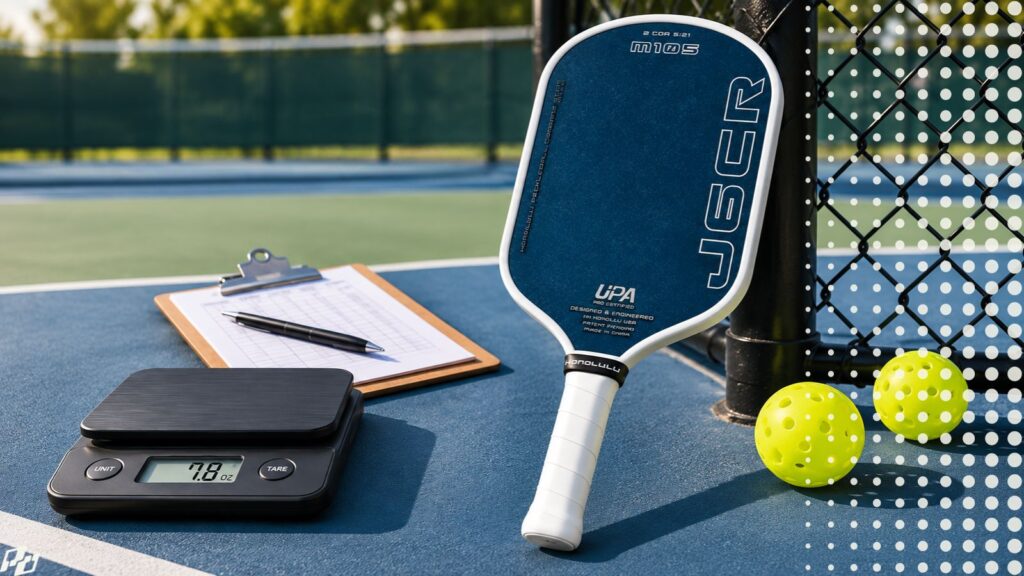
That exact notice now appears on Honolulu’s new M105, a multi-density foam paddle that the company says develops its intended performance through use.
So that old answer is getting harder to use.
Sometimes you’re simply adjusting. Sometimes the paddle is changing with use. And sometimes a sudden change is a warning sign.
So the better question is: what changed—and is it normal?
The First Clue: Paddle Labs Now Break Paddles In on Purpose
This isn’t just internet paddle mythology anymore.
UPA-A, the certification body used for professional PPA and MLP competition, now deliberately runs paddles through an accelerated break-in process before testing them again.
For 2027 certification, it even introduced an automated break-in machine designed to repeatedly load and flex paddles under standardized conditions. The reason is straightforward: some paddles change enough with use that testing only the brand-new version doesn’t tell the full story.
Pickle Pro Labs says its testing has shown that construction matters enormously.
Some paddles remain quite stable. Others gain measurable rebound performance as the structure loosens or settles.
Its broader testing found that thicker traditional cores, hybrid constructions and some rigid-foam cores can show more significant break-in than thinner traditional paddles or resilient foam designs.
So the blanket statement that “paddles never break in” has become difficult to defend. The equally broad statement that every paddle needs 10 hours to wake up isn’t very useful either.
There is no universal clock.
Think Like a Paddle Detective
When a paddle feels different on day five than it did on day one, there are four likely explanations.
Suspect #1: You
This one is still responsible for a lot of cases.
Ben Johns, one of the most accomplished professional pickleball players in the sport, was asked how amateur players should adapt to new paddles, and his answer centered on repetitions.
Your body learns the new balance point, swing weight, launch angle, sweet spot and rebound response surprisingly quickly. Johns also recommends identifying the specific shot that feels wrong rather than deciding vaguely that the paddle “feels weird.”
That’s a great diagnostic habit.
Say your third-shot drops were sailing for two sessions but now they’re landing. Meanwhile your blocks, serves and drives feel basically unchanged.
There’s a good chance you calibrated. Your hands figured out how much energy the face needs.
Suspect #2: The Core
This is the actual break-in players are talking about.
Repeated impact can alter how a paddle structure flexes and returns energy. The amount varies by construction.
One experienced player reported that paddles can feel less stiff and more controllable after roughly 2–4 hours of play. That’s anecdotal rather than a universal benchmark, but it lines up with the broader observation that some modern constructions settle noticeably during their first few sessions.
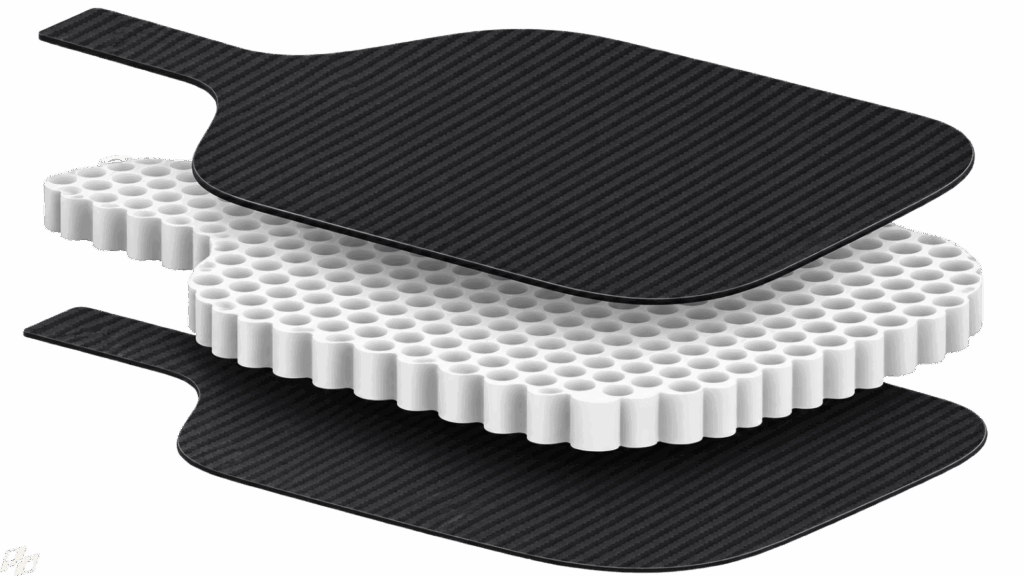
Owners of newer foam paddles report similarly mixed experiences.
One Vatic V-Sol owner described about 4–5 hours of break-in followed by little further change over roughly 190 hours. Another player said a different foam paddle continued getting more powerful much later.
That variation is the important part. Construction matters more than somebody else’s hour count.
The Best Way to Detect Real Break-In: Watch Your Short Swings
Full drives are actually a poor diagnostic tool. You create so much of the pace yourself that small changes in the paddle can disappear inside differences in swing speed.
A better place to watch is the kitchen. Pay attention to:
Blocks.
Counters.
Punch volleys.
Resets.
Those shots use compact swings, so changes in rebound are easier to notice.
Suppose your block volley used to land around the transition zone. Three sessions later, the same compact block starts reaching the baseline. That deserves attention.
Or perhaps your reset suddenly requires less push from the hand. That could be the paddle settling.
Independent paddle tester John Kew recently tracked a foam paddle over 100 games and found its measured power metric moved from 0.416 to 0.427. His conclusion was that the change was real but small enough that many players probably wouldn’t perceive it. That’s useful context.
Measured break-in doesn’t automatically mean dramatic break-in.
Suspect #3: The Face
Here’s an easy one to overlook.
Your paddle can feel different even if the core hasn’t meaningfully changed. Surface texture changes with use too.
Grit can wear, become contaminated or—on some newer surfaces—change slightly as the face wears in. That affects spin and ball interaction without necessarily changing rebound.
So if your topspin drive suddenly stops diving the way it did during week one, check the face before deciding the paddle “lost power.”
Clean it according to the manufacturer’s instructions and repeat the same shots.
Experienced paddle testers explicitly separate surface wear, structural break-in and player adaptation because all three can create a similar feeling on court.
Suspect #4: Something Broke
This is where the word “break-in” can become dangerous. A paddle getting slightly softer or more responsive over its first several sessions may be normal.
A paddle suddenly becoming wildly springy, developing dead areas, making strange noises or producing inconsistent rebounds is different.
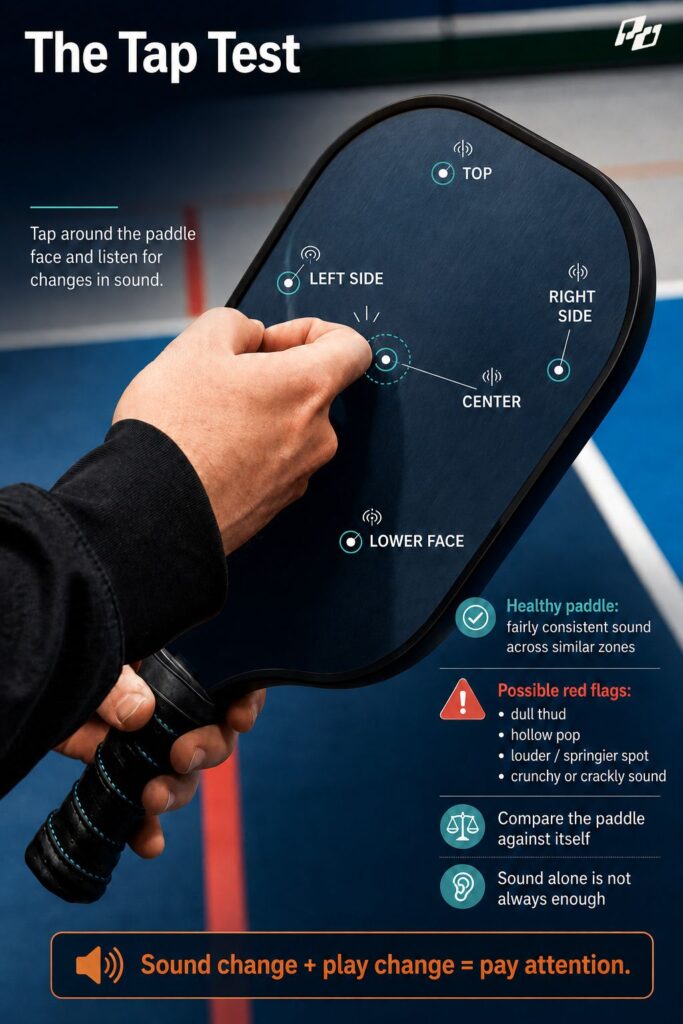
UPA-A specifically advises retiring paddles that develop visible cracking, rattling or a crunching sensation when the face is squeezed.
That distinction matters because structural damage can sometimes feel good at first.
More trampoline.
More pop.
More speed.
And then much less predictability.
If your paddle suddenly feels way hotter rather than gradually settling, don’t congratulate yourself on finishing the break-in period.
Inspect it.
A Better First-10-Hours Routine
I wouldn’t artificially “break in” a paddle.
No massage gun. No bending it over your knee. No beating the face against something because somebody on Reddit said it wakes the foam up.
Labs use aggressive mechanical break-in because they are stress testing paddles, not teaching consumers how to prepare them. Pickle Pro Labs explicitly says its accelerated method is more aggressive than ordinary play. For a rec player, normal ball impact gives you everything you need.
I’d use the first ten hours like this.
Hour 0: Create a Fingerprint
Hit:
10 drives
10 third-shot drops
10 resets
10 punch volleys
Don’t judge whether they’re “good.” Notice what normal contact produces.
Where does the block land?
How much hand does the reset need?
How high does the drop launch?
How deep does your normal drive travel?
That becomes your baseline.
Around Hour 3: Repeat the Same Four Shots
This is where some players begin noticing a softer feel or a little more pocketing. Don’t change your mechanics just to manufacture a difference. Use the same swing.
If the paddle changed, the ball should tell you.
Around Hour 8–10: Check Again
By now two useful things have happened:
- You’ve accumulated enough reps to adapt.
- And any obvious early structural settling has had time to show itself.
Your goal is predictability.
If you know what your ordinary swing will produce, the paddle has probably reached a useful working relationship with your game.
Should You Use a Ball Machine to Speed It Up?
Sure—but mainly because it gives you lots of repeatable contacts. Players in current paddle discussions often use ball machines when they want to get comfortable with a new paddle quickly before competition.
The important part is the type of reps. Don’t stand there smashing 300 forehands. Feed:
20 blocks.
20 resets.
20 drops.
20 drives.
That gives both you and the paddle a meaningful range of impacts while showing you which part of the response is changing.
When Should You Actually Judge a New Paddle?
Our previous guide on adapting to a paddle focused mostly on the player-learning side, and that advice still holds.
Several sessions are usually more informative than one. But with newer paddle constructions, I’d add one extra rule:
Don’t evaluate only whether you’ve gotten better with the paddle. Evaluate whether the paddle itself stayed predictable.
For an intermediate player, I’d use this rough timeline:
| Time | What You’re Learning |
|---|---|
| First hour | Weight, balance, launch, basic feel |
| 2–4 hours | Early adaptation; possible initial structural settling |
| 5–10 hours | Paddle’s more stable playing personality becomes clearer |
| After that | Sudden changes deserve investigation |
Those aren’t universal material limits. They’re a practical observation schedule.
One Last Test
There’s an easy question I’d ask after every new-paddle session: “Did I miss because I misjudged the ball—or because the paddle surprised me?”
If the answer keeps being the first one, keep playing. You’re learning. If the answer repeatedly becomes the second one, start paying attention to the equipment.
That’s the part of paddle break-in most rec players miss.
The goal isn’t to wait until your paddle becomes “better.” The goal is to learn when it becomes predictable.
Once you know that, you’ve found the version of the paddle you can actually trust in a match.