
Pickleball Union earns a commission on purchases made through links in this article, at no extra cost to you. Our reviews are editorially independent – brands do not see or approve content before publication.
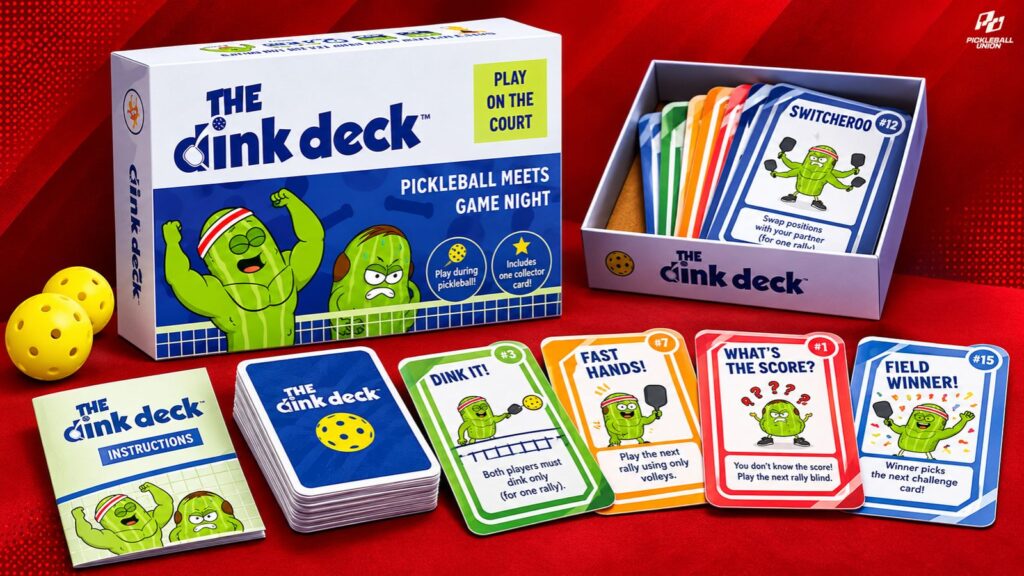
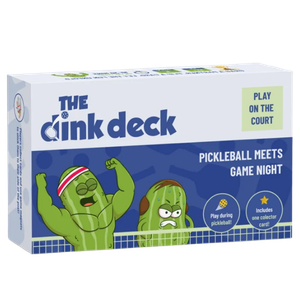
The Dink Deck is a 60-card pickleball challenge game that adds skill shots, funny moments, and optional scoring to regular play. It works best for social groups, families, clubs, and players who enjoy house rules and friendly competition.
Pickleball is already the most social sport I know. Four people can be absolutely certain it’s their serve, all cite a different score, and then laugh about it for the rest of the match.
So what happens when you throw a deck of cards into the mix?
You get The Dink Deck, a courtside pickleball challenge game that gives your group something else to chase besides 11 points—with a good dose of humor thrown in.
I tested it with several rec players over three weeks. My takeaway is pretty simple: with the right group, it’s fun. With the wrong group, everyone will probably just want to play pickleball.
After testing it, I’m giving The Dink Deck 3.75 balls out of 5.
- 60 pickleball challenge cards
- Built for social rec play
- Easy to customize with house rules
- Mix of skill shots + funny moments
- Best for groups, families & club socials
Code UNION26: 15% off a single deck through Dec 31
The Dink Deck at a Glance
| Category | My Take |
|---|---|
| Overall | 3.75/5 |
| Type | Courtside pickleball card/challenge game |
| Best for | Social rec groups, clubs, families, kids and casual events |
| Players | Singles or doubles; I think doubles fits best |
| Cards | 60 gameplay cards + 1 collectible card |
| Included | 3 magnets, instructions, challenge cards |
| Price | $34.99 for one game; $59.99 for two |
| Best trait | Easy to customize with your own house rules |
| Main tradeoff | Some challenges can take too long or be unrealistic for average rec players |
| Bottom line | A fun social add-on, not something I’d use for every rec session |
Pros
✅ Adds fun without changing the game
✅ Great for social play
✅ Easy to customize
✅ Mixes skill with some fun challenges
✅ Fun for kids and families
✅ Reasonable $35 gift
✅ Bragging rights may be better than extra scoring
Cons
❌ Instructions could be clearer
❌ Some card actions are two hard to accomplish
❌ You may only use a few cards per game
❌ Magnets feel weak
❌ Extra scoring can be distracting
❌ Competitive groups may prefer normal play
Who It’s For | Who Should Skip It
| Who It’s For | Who Should Skip It |
|---|---|
| ✔ Social rec groups | ✖ Players who want serious, competitive games |
| ✔ Clubs and pickleball socials | ✖ Groups that already struggle to remember the score |
| ✔ Families and younger players | ✖ Players who don’t enjoy side challenges |
| ✔ Groups that like house rules and friendly trash talk | ✖ Players who want every rally focused on winning |
| ✔ Gift shoppers looking for something different | ✖ Anyone expecting a completely new pickleball game |
| ✔ Players who enjoy ATPs, Ernes, tweeners and trick-shot challenges | ✖ Lower-level groups unwilling to swap out difficult cards |
For the right foursome, I think it works. For my everyday rec group? I wouldn’t automatically bring it every Saturday morning.
What Is The Dink Deck?
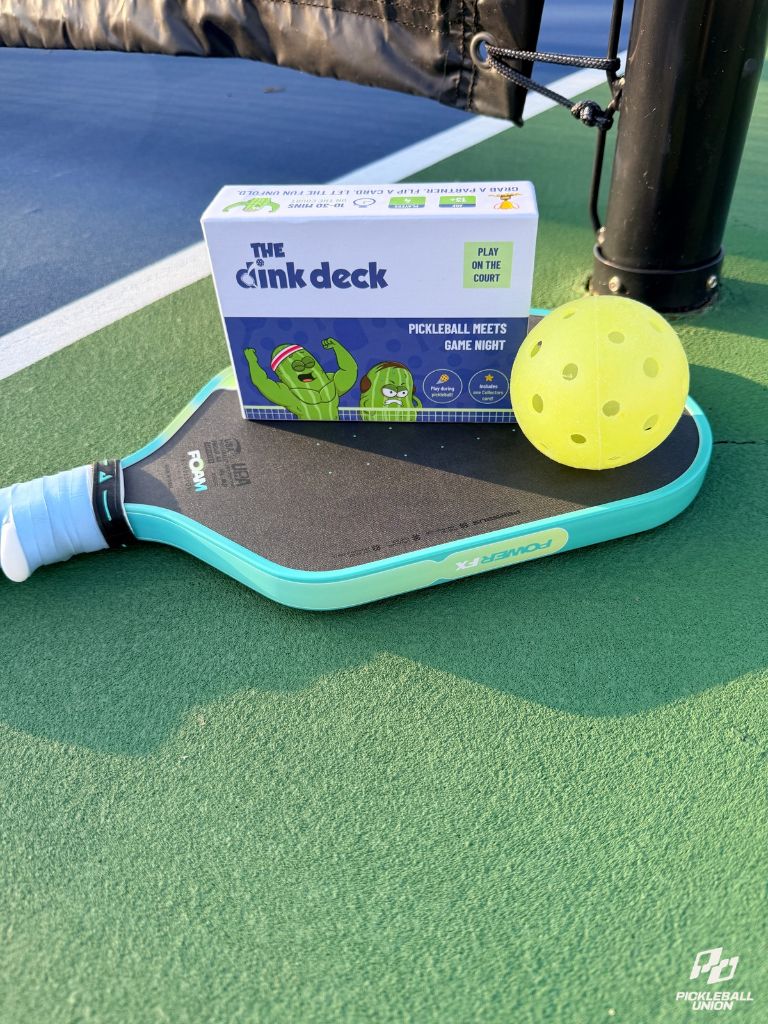
The Dink Deck is a 60-card challenge game played during a normal pickleball match.
You still play pickleball.
You still keep the normal score, but you are drawing a random card and completing or avoiding that action listed before drawing another.
The cards give both teams another shot, mistake or courtside moment to watch for.
Score two points for a net crawler that dribbles over. Lose two for a “Phantom Ball”—otherwise known as swinging and completely missing the ball.
You might draw an ATP, an Erne, an overhead winner or a challenge involving your non-dominant hand.
Or somebody might simply swear after dumping an easy ball into the net. That counts too.
The cards you collect can add or subtract points from a separate Dink Deck score at the end of the game.
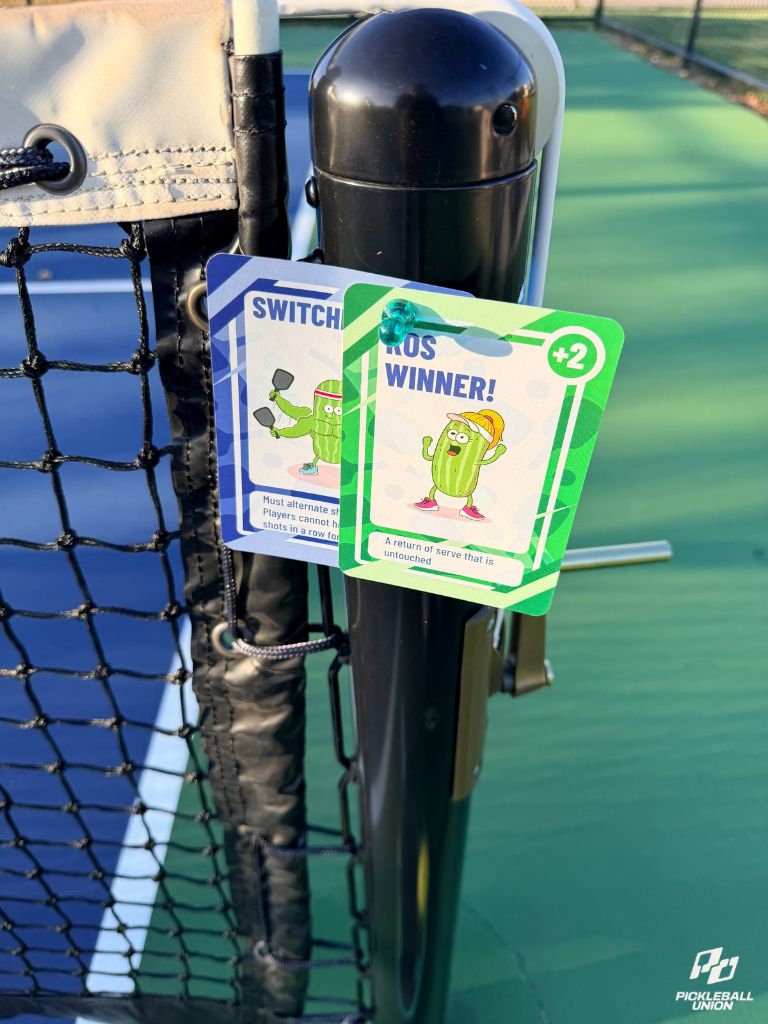
The game comes with small magnets designed to hold completed cards on the metal net post. While the magnets work to some degree, they are weak and can barely hold two cards at once.
What The Dink Deck Team Told Me
I spoke with one of the game’s developers, and their goal was simple: add more challenge, teamwork, and humor without changing pickleball itself.
The deck was also designed to be flexible. You can draw multiple cards, swap them out, skip the extra scoring, or create your own rules.
That flexibility is a big plus—it works best when you adapt it to your group.
What’s in the Deck?
There are several types of cards.
Positive “Hero” Cards
These reward you for accomplishing something.
A few examples:
- ROS Winner: Hit a return of serve your opponent can’t touch.
- Spike Winner: Hit an unreturnable overhead smash.
- Non-Dominable Snowman: Successfully return a ball with your non-dominant hand.
You’ll also find challenges involving shots like ATPs, Ernes and tweeners.
Say an ATP card is active and somebody suddenly pulls you wide with a sharp crosscourt dink. Normally, I’m just trying to survive that ball.
Now I’m thinking: Wait a minute…I might actually get a card out of this.
Of course, you might spend the entire game waiting for that opportunity and never see it. That was our experience.
Negative “DinkleDoc” Cards
These add restrictions or penalize mistakes.
A couple examples:
- “No Smashes” takes overhead bangers away for the next rally.
- “Body Shot” comes into play if the ball hits you.
And then there are cards built around the little disasters that make recreational pickleball fun. The swearing challenge is a perfect example.
Someone gets an easy overhead. They put it directly into the net. They then give the entire court a loud review of their own performance. That is exactly the kind of card I think most groups will enjoy.
Honestly, those moments may get more action than waiting for your 3.5 friend to hit their first Erne.
Spotlight and Tie Breaker Cards
Spotlight cards give everyone a shared challenge.
- “Rally Masters” rewards the longest rally.
- “Fastest Hand Battle” rewards the longest volley exchange.
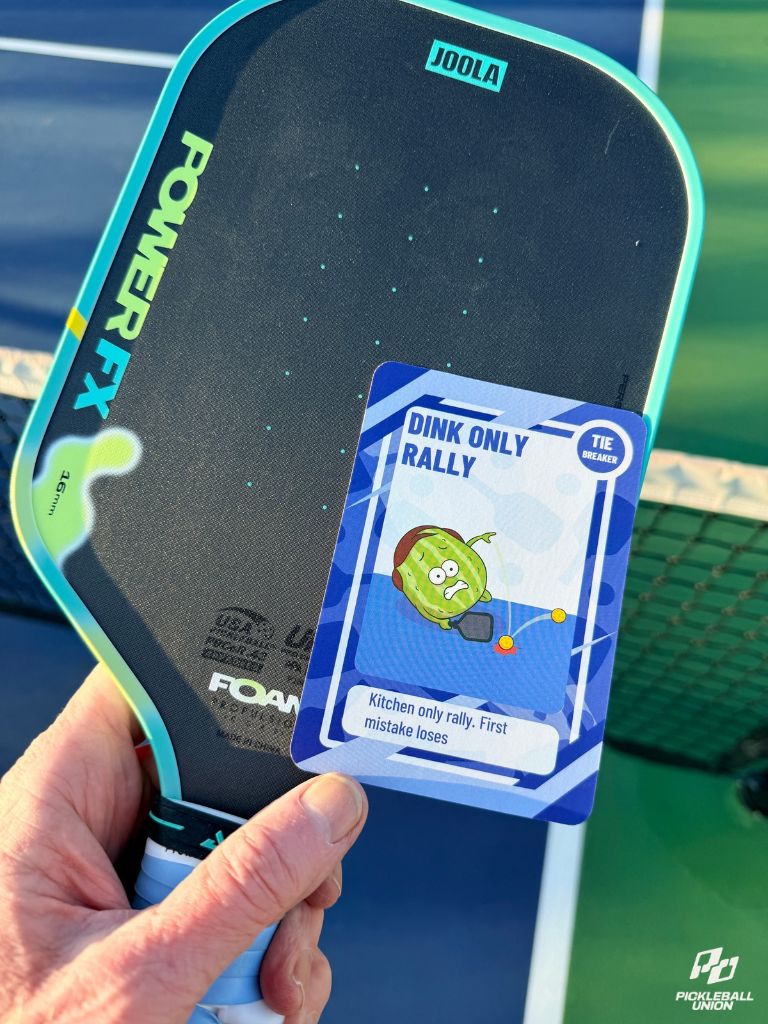
- Tie Breaker cards settle the Dink Deck score if things finish even, including a one-rally showdown.
How to Play
The basic format is easy once you understand it.
- Set up your normal pickleball game.
- Flip a card and read it aloud.
- Play normally while both teams watch for the challenge.
- When someone achieves—or fails—the challenge, that side claims the card.
- Flip the next card.
- At the end, use the positive and negative card values to create your Dink Deck score.
One important detail: winning the card and winning the rally are not necessarily the same thing.
That took me a minute to wrap my head around initially. And that leads to one of my main criticisms.
Game On: Rec Testing
This is where the review got more interesting. My first outing required a little convincing. My regular rec group immediately had the same questions I did:
- Is this going to slow down the game?
- Will the scoring get confusing?
- Do we really need another thing to remember when we’re already trying to remember the score and who’s serving?
Fair enough.
Fortunately, it was a group I knew well, so we went for it.
In the first match, we only completed two cards. Each challenge took almost the entire game. Then we drew a tweener card. Nobody in our group had ever hit a tweener.
So that one wasn’t exactly flying off the net post.
The second match went better—we completed four cards. The third game, three. And that’s when the group understood something: you are not going to fly through this deck. Some cards may stay active for a long time.
That’s not necessarily bad. But I think it’s important to know going in.
The Best Part: Make Your Own Rules
This is probably my favorite thing about The Dink Deck.
You don’t have to follow everything exactly. In fact, after testing it, I’m not sure I would. I’d start with one shared card that either team can claim.
If everyone is enjoying it, put two cards in play—maybe one skill challenge and one funny courtside challenge.
You could also change cards after every side out. Or give each team its own card. Or forget the extra score completely and just play for bragging rights.
Two weeks later, I brought the game back out with the original group plus two additional teams. The reaction was pretty telling.
Two players really liked the challenge and saw the appeal for casual rec play. The other six weren’t convinced they needed the full scoring system unless we modified it.
Nobody was immediately planning to buy a deck themselves. But several were happy to keep playing the challenges.
That tells me something. The challenges may actually be more valuable than the scoring system.
Hit the ATP?
Take the card.
Miss the ball completely?
Everybody laughs.
Maybe you don’t need to add and subtract everything afterward.
Where It Gets Tricky
Some cards simply ask too much of an average rec group. An advanced foursome might enjoy hunting ATPs and Ernes.
Your normal Saturday morning group may stare at that card for nine points wondering whether anyone is ever going to do it.
I’d swap it out.
The point is to add something fun to the game, not hold everyone hostage until somebody accidentally becomes Ben Johns.
And the second issue is mental bandwidth. Some of us are already standing there asking: “Wait…6-4-1 or 4-6-2?”
Now add:
“Who had the red card?”
“Did that count?”
“Was that worth two or three?”
You can see where this is going. That’s why I think simpler is better.
Value
At $34.99, I think the price is reasonable. I wouldn’t call it something every pickleball player needs.
But it makes sense as:
- A stocking stuffer
- Birthday gift
- White elephant gift for a pickleball group
- Club prize
- Tournament raffle prize
- Gift for somebody who already owns six paddles and doesn’t need another one
There’s enough content in the deck and enough flexibility in the rules that the price doesn’t bother me.
The bigger question is simply whether your group is the type that will actually use it.
Where I’d Bring It
The Dink Deck makes the most sense to me at:
- Club socials
- Family games
- Weekend pickleball with friends
- Holiday gatherings
- Casual mixers
- Games with teens or pre-teens
- That last round when somebody says, “One more?”
- Tournament side events or prizes
Two players in my group specifically mentioned that their kids who play would probably enjoy the extra challenges.
I can see that.
Pickleball already gives me plenty to think about and laugh about, so most days I’m perfectly happy playing it straight. But if everyone is in the mood for something different? Deal me in.
And if somebody in my group actually hits that tweener, I’m happy to stop the game, hand them the card, give them a high five and deliver a loud hell yeah!
The Final Score
| Category | Rating |
|---|---|
| Concept / originality | 🎾🎾🎾🎾½ |
| Fun factor | 🎾🎾🎾🎾 |
| Ease of play | 🎾🎾🎾¾ |
| Instructions | 🎾🎾🎾½ |
| Replayability | 🎾🎾🎾¾ |
| Social / group appeal | 🎾🎾🎾🎾¼ |
| Price / value | 🎾🎾🎾🎾 |
| Overall | 🎾🎾🎾¾ |
Pickleball already gives us plenty of ups, downs, ridiculous shots, and arguments about the score. Most of us are perfectly happy playing to 11. The Dink Deck is not trying to replace that.
What it does is give the right group another reason to laugh, compete, try weird shots, and give each other a little grief.
For serious everyday rec play, I probably would not use it often. But for social games, families, younger players, club events, or groups that love challenges, I can absolutely see it working.
My 3.75/5 rating is less about the quality or the $35 price and more about how often I think people will actually use it.
Some groups will play it once and go straight back to regular pickleball. Others will start inventing house rules before the first game is over. Those are probably the people The Dink Deck was made for.
- 60 pickleball challenge cards
- Built for social rec play
- Easy to customize with house rules
- Mix of skill shots + funny moments
- Best for groups, families & club socials
Code UNION26: 15% off a single deck through Dec 31
Pickle on, my friends… pickle on.
The Dink Deck FAQ
What is The Dink Deck?
The Dink Deck is a 60-card pickleball challenge game played alongside a regular match. Cards reward or penalize certain shots, mistakes, and funny court moments.
How much does The Dink Deck cost?
It costs $34.99 for one game or $59.99 for two.
Who is The Dink Deck best for?
It works best for social rec groups, clubs, families, kids, and players who enjoy extra challenges and house rules.
Does it replace normal pickleball scoring?
No. You still keep the normal pickleball score, while the cards can create a separate bonus score or simply be used for bragging rights.
Is The Dink Deck worth it?
For social groups that like challenges and humor, yes. More competitive players may prefer to stick with regular pickleball.