


Merged pickleball tournament brackets can put 3.5 players against much stronger opponents. USA Pickleball allows some bracket combining, while DUPR recommends keeping skill divisions within 0.5. Check how brackets may be merged, whether matches affect DUPR, and refund rules before registering.
Imagine paying for a 3.0–3.5 tournament. You pick your partner. Block off the weekend. Pay the entry fee. Maybe drive an hour or two.
Then you arrive and hear: “We didn’t have enough teams, so we combined your bracket with the 4.0–4.5s.”
Wait… what?
That exact complaint sparked a big pickleball discussion this week.
One player said his 3.0–3.5 men’s doubles bracket was combined with the 4.0–4.5 division because there weren’t enough higher-level teams.
His team got crushed.
His DUPR dropped.
And in another event, he said his 65+ division was combined so broadly that he ended up facing much younger players, including a 16-year-old and a 20-year-old.
His frustration was pretty simple: he signed up for one tournament experience and got another.
And judging by the responses, he’s definitely not the only player who’s run into this.
First: this is not necessarily sandbagging
This part matters.
The stronger players usually aren’t secretly sneaking into a lower bracket. In many cases, nobody “played down” at all. The tournament director simply combined two underfilled divisions.
That’s very different.
USA Pickleball allows tournament directors to combine skill or age divisions when there aren’t enough registrations to run them separately.
So merged brackets are not automatically shady. Sometimes they’re the only way to give everyone enough matches.
The issue is how wide that merge gets—and whether players know about it before they show up.
DUPR itself says brackets shouldn’t get too wide
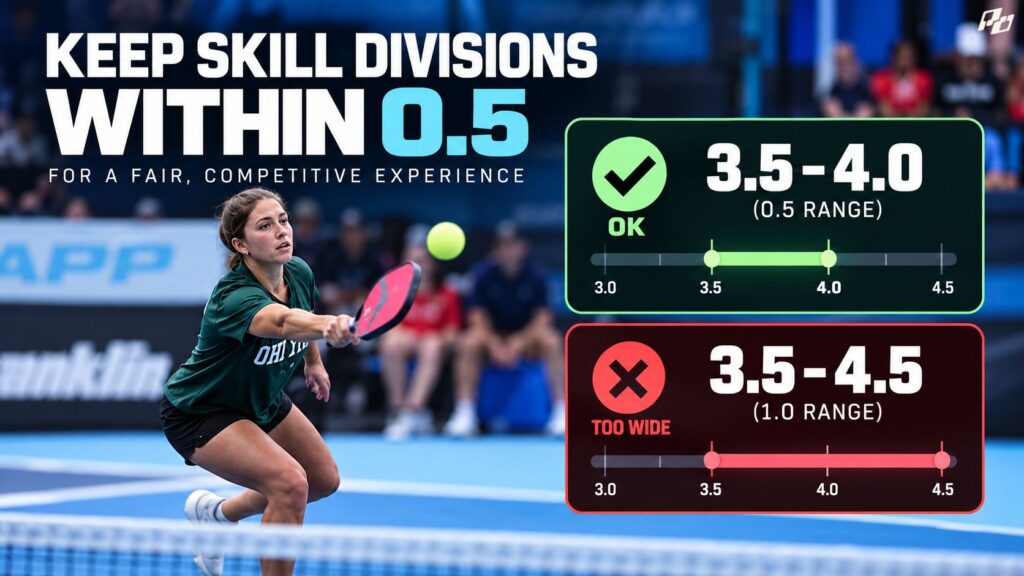
Here’s where things get interesting. DUPR’s tournament guidance recommends keeping skill divisions within a 0.5 rating range.
Their example:
✅ 3.5–4.0
❌ 3.5–4.5
That makes sense.
A 3.5 playing a 4.0 may still get a useful, competitive match. A 3.5 repeatedly facing 4.5s is a very different experience.
So yes, USA Pickleball allows brackets to be combined when necessary. But DUPR also recognizes that overly wide divisions create mismatches, frustration, and less useful competition.
That distinction is important.
But will losing to a 4.5 tank your DUPR?
Not automatically.
This is probably the biggest misconception in the whole discussion. DUPR doesn’t work like this:
Win = rating up
Loss = rating down
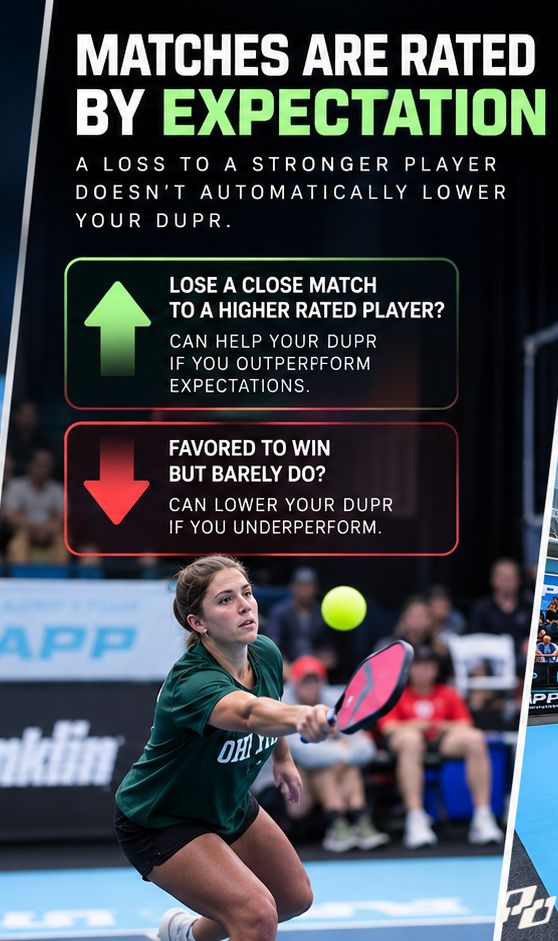
Instead, it looks at how you performed compared with what it expected based on the players on the court.
So if you’re a 3.5 playing a stronger opponent and DUPR expects you to lose badly, a competitive loss can actually be a decent result.
For example: if you’re expected to lose 11–4 and instead lose 11–9, you performed better than expected.
That can help your rating.
The opposite can happen too.
If you’re heavily favored and barely win, your rating can actually move the wrong way because you underperformed expectation.
So the real risk is not simply: “I played a 4.5.”
It’s: “I got beaten much worse than the system expected.”
And tournament matches can matter more
This is why players care.
DUPR gives more weight to verified tournament and club results than ordinary self-reported recreational matches. So when you enter a rated tournament, the bracket you’re placed in matters.
You’re not just getting extra games. You’re potentially feeding meaningful results into your rating history.
That makes good bracket management more important.
The real problem isn’t merging
It’s surprise merging. That’s the part I’d be annoyed about too.
If the registration page clearly says:
“Brackets may be combined with adjacent skill or age divisions if entries are low.”
Fine.
You know the deal.
But if you pay for a 3.0–3.5 event, arrive Saturday morning, and suddenly learn you’re facing multiple 4.3s and 4.5s?
That feels very different.
You didn’t just pay for court time.
You paid for a certain kind of competitive experience.
And that’s where communication matters.
One important distinction: skill vs. age
This is another place players get confused. In official tournament structures, “playing down” in age can happen differently than playing down in skill.
A player may be allowed to enter a younger age division in some formats. That does not mean a 4.0 player can simply choose to enter a 3.5 skill bracket whenever they want.
Skill and age rules are separate.
So if you suddenly see stronger players in your bracket, don’t automatically assume they sandbagged.
They may have been moved there by the tournament director.
Before you pay, ask these 6 questions
This is probably the most useful thing you can take from all of this.
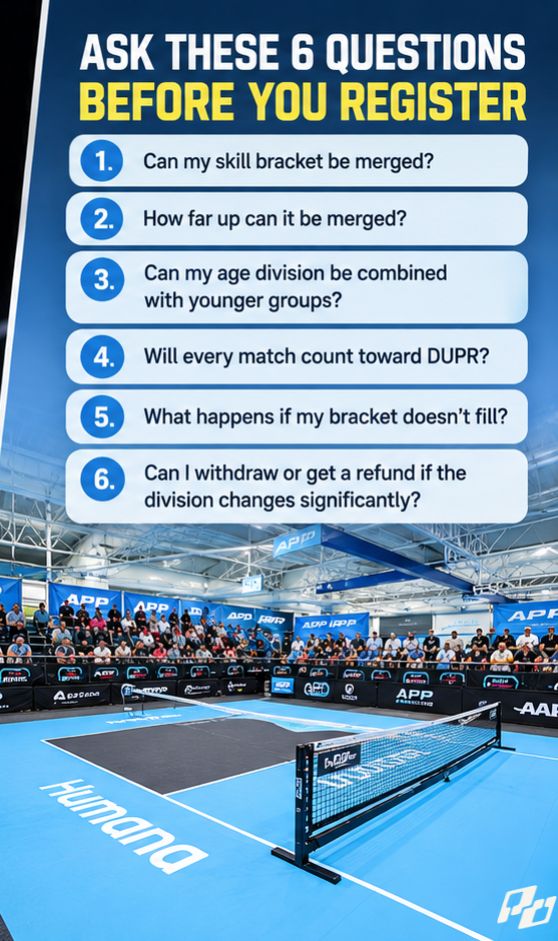
Before clicking “Register,” find out:
✅ Can my skill bracket be merged?
✅ How far up can it be merged?
✅ Can my age division be combined with younger groups?
✅ Will every match count toward DUPR?
✅ What happens if my bracket doesn’t fill?
✅ Can I withdraw or get a refund if the division changes significantly?
If the event page doesn’t say, email the tournament director. It takes two minutes. It may save you a very frustrating Saturday.
And check the final bracket before you leave home
Once brackets are posted, actually look at them. Don’t just check your start time.
Look at the teams.
Look at their ratings.
If you signed up for 3.5 and suddenly see half the bracket sitting around 4.2–4.5, ask what changed.
Maybe there’s a perfectly reasonable explanation.
Maybe divisions were consolidated.
Maybe players moved.
But you’re much better off having that conversation before you’re standing next to Court 7 wondering why your first opponent looks like they belong in an APP qualifier.
Our take
Merged brackets are not automatically bad tournament management. Sometimes they’re necessary.
But there’s a big difference between combining 3.5 and 4.0 with clear notice—and letting someone register for 3.0–3.5, then surprising them with 4.5 opponents on tournament morning.
And no, playing stronger players does not automatically wreck your DUPR.
The system accounts for opponent strength and expected performance. But that doesn’t excuse sloppy communication.
The real problem isn’t merged brackets. It’s surprise merged brackets.
So before your next tournament, ask one very simple question: “What happens to my bracket if it doesn’t fill?”
That might be the most valuable tournament question you ask all year.