Most intermediates think they can hit a topspin drop — until they try to use it in a real match. Suddenly, that buttery drop turns into a flat floater that sits up like a gift-wrapped volley, or a laser that never makes it over the net.
Hitting a clean topspin drop isn’t just about brushing the ball — it’s about controlling the shape of the spin, the shape of your body, and the shape of the rally.
Here are three advanced tips to finally make your topspin drop consistent, heavy, and match-ready.
1. Master Spin Shape, Not Just Spin
At this level, you already know how to create topspin. But the shape of your spin — how steep or shallow your swing path is — determines whether your drop dives softly or sails long.
The biggest mistake intermediates make?
They swing too steeply from low to high, producing a loopy, defensive arc that gives opponents time to step in and counter.
The pros do the opposite: they hit a flatter, forward-shaped spin — more like a compact windshield-wiper than a fishing rod cast:
Try this:
- Start your paddle at knee height, not your ankles.
- Swing forward through the ball before finishing upward — about a 60/40 split of forward vs. vertical motion.
- Keep the face slightly closed, but not buried. You’re creating forward roll, not spin for spin’s sake.
Why it works: A forward-shaped spin adds penetrating trajectory and faster dip, forcing your opponent to hit up on their next shot. It’s the difference between a “safe” drop and a forcing one.
2. Build From the Ground Up — Literally
Most players think their topspin drop issues come from the paddle face — but it usually starts in the hips.
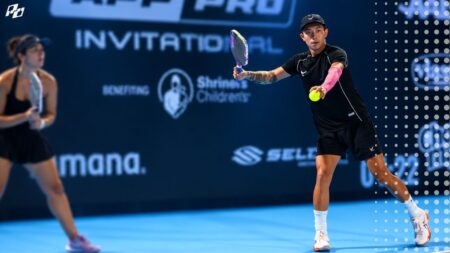
If your drops float high or come off flat, your lower body and torso aren’t syncing with your swing. The best players, like Ben Johns, load through their hips, unwind their core through contact, and shift weight forward smoothly — no lunging, no reaching.
Here’s the big difference: Ben’s topspin drop looks effortless because it’s compact. Most intermediates over-swing, taking a big backswing to “create spin.” But that only adds momentum and lifts the ball too high:
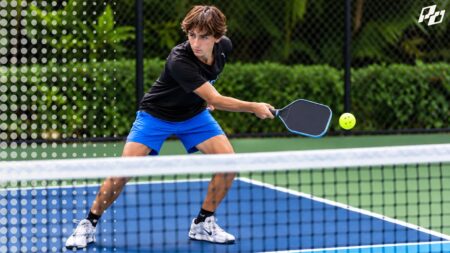
Even though it’s a topspin shot, it’s still a drop — it has to land in the kitchen. Keep the paddle in front of your body, use a short swing, and brush low to high with your body connected.
Try this: From midcourt, hit a few drops using only your hips and torso — no arms. Then add your arm motion while keeping that compact rhythm. You’ll feel the ball “sit” longer on the paddle, giving you the heavy, controlled dip you’re after.
Compact swing, connected body — that’s the Ben Johns difference.
3. Shape the Rally, Not Just the Shot
Once you’ve got the feel for a controlled topspin drop, the next level is knowing when to use it — and when not to.
The topspin drop isn’t a “default” third shot; it’s a tactical disruptor.
Here’s the framework pros and high-level coaches use:
- Use it when:
- Your opponents are stacked at the baseline — topspin pulls them forward into awkward timing.
- You’re transitioning and want to move in behind a dipping ball that can’t be attacked.
- You’re crosscourt and have space to let the spin arc and dive naturally.
- Avoid it when:
- The ball sits too low — you’ll brush up too steeply and lose control.
- Your opponents are already at the kitchen — you’re better off driving or slicing.
- You’re off balance — spin without structure equals chaos.
Pro application: Try mixing it as a fifth-shot tool instead of just a third-shot one. Hitting a compact topspin drop after an initial drive often catches opponents mid-transition, forcing an awkward half-volley.
Why it works: A heavy topspin drop neutralizes the counter-attack window. Even if your opponent blocks it, the ball comes back higher — perfect for your next attack or kitchen move-in.
Bonus Section: Advanced Fixes & Drills
🧩 Fix #1: The “Brush-Late” Error
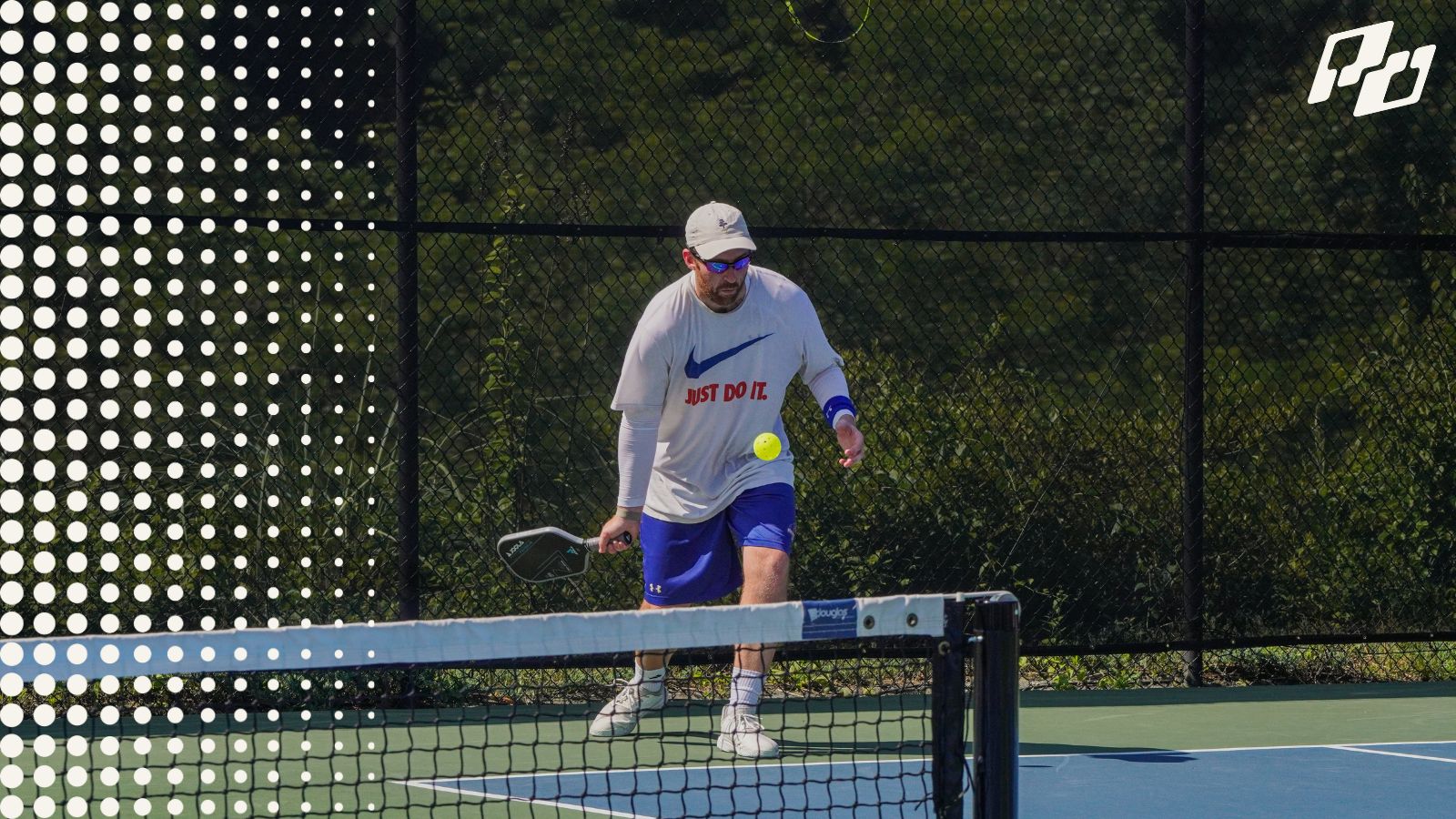
If your topspin drop is dying into the net, you’re contacting too far behind your body. Step in and contact slightly in front of your lead knee.
This keeps your swing path through the ball, not under it.
🧩 Fix #2: The “Wrist-Flick Trap”
Too many intermediates try to “flick” spin with their wrist. That kills control. Instead, think of your paddle and forearm as a single lever — the wrist stays loose, but stable. The spin comes from brushing motion, not flexing.
🧩 Fix #3: Spin + Placement Drill
Set up a bucket target just inside the kitchen crosscourt. Hit ten topspin drops focusing on landing the ball past the net but before the centerline.
This helps you control not just how you spin the ball, but where your topspin lands — a crucial difference at 3.5+.
Control Spin, Don’t Worship It
At intermediate level, it’s easy to overvalue spin — to chase more RPMs instead of more control. But here’s the truth:
The best topspin drops aren’t the ones that look cool — they’re the ones that land heavy, early, and neutralize pace.
Topspin isn’t the goal; it’s the vehicle to better ball shape, depth, and control under pressure.
Once you start shaping spin with purpose, not habit, your drops stop being “good enough” and start being downright uncomfortable to return.