
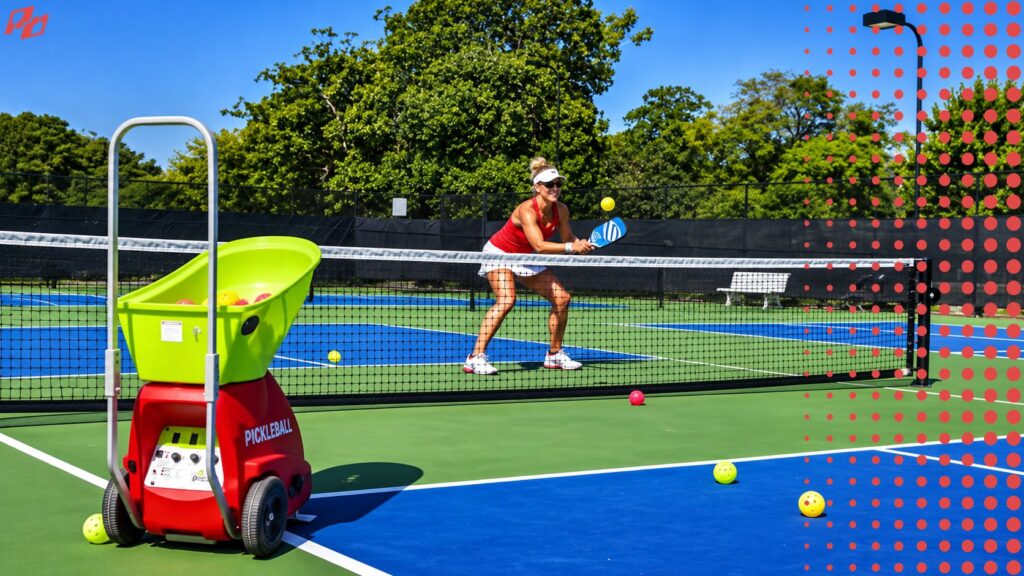
Pickleball machines can be worth it for rec players who need lots of repeatable reps on specific shots. They’re best for drops, resets, returns, drives, and counters—but they can’t replace live play for decision-making, positioning, or reading opponents.
A pickleball machine can cost about $100 or nearly $4,000. That is a ridiculous range for products that all promise roughly the same thing: More practice.
At the cheap end, you’re getting something closer to an automatic ball feeder. At the expensive end, you’re buying a programmable practice partner that can change speed, spin, direction, height, and shot sequence.
So the real question isn’t:
“Are pickleball machines worth it?”
It’s:
“What problem am I paying this machine to solve?”
If you already play four times a week but your backhand reset appears twice per session and breaks down every time, a machine can be incredibly useful.
If what you really need is better decision-making, partner movement, shot selection, or reading opponents?
A $2,000 machine cannot give you that.
The Price Range Is Bigger Than Most Players Realize
Current machines span several very different categories.
| Type | Rough Price | What You’re Really Getting |
|---|---|---|
| Basic feeder | $100–$300 | Repeatable balls, limited capacity and variation |
| Entry/mid-level machine | $800–$1,400 | Better speed, capacity, oscillation and spin |
| Advanced machine | $1,700–$2,300 | Programmable drills, more locations, app/remote control |
| Club/pro-level machine | $2,500–$4,000+ | Maximum capacity, variation and sophisticated patterns |
For perspective, Furlihong currently lists its basic 3802PBH at $99.99. It feeds roughly every four seconds, holds about 19 balls before extensions, and offers basic angle and oscillation adjustments.
If you want a closer look at what you actually get at that price, read our full Furlihong review here.
At the other extreme, Spinshot’s Player Pickleball Machine starts around $2,079, while Lobster’s high-end Pickle Phenom reaches roughly $3,899.
That’s why comparing all “pickleball machines” as if they are the same product doesn’t make much sense.
They aren’t.
The $1,000 Question: What Does a Machine Actually Make You Better At?
A ball machine is exceptionally good at one thing: giving you the same problem repeatedly. That sounds boring. It is also incredibly useful.
Suppose your backhand third-shot drop is unreliable. In normal open play, you might get five legitimate chances to hit it in an hour. With a machine, you can hit 50 or 100 from essentially the same position.
Then you can change the depth.
Then the height.
Then add movement.
Top pros repeatedly emphasize this volume of purposeful repetition. PPA player Chris Haworth has described hitting 100 repetitions in roughly five minutes on specific groundstroke patterns, while Riley Newman and other pros regularly recommend repetitive drilling to automate basic mechanics.
That’s where a machine earns its money.
Not because it “plays pickleball” with you. Because it lets you isolate a weakness long enough to actually change it.
The Best Reason to Buy One: You Have a Rep Bottleneck
Here’s my favorite test. Before buying a machine, finish this sentence:
“I need hundreds more repetitions of ______.”
If you immediately have an answer, the purchase starts making sense.
Maybe it’s:
- your backhand return
- your transition reset
- your forehand roll
- your two-handed backhand dink
- your third-shot drop from the left side
- your counter against a ball aimed at your paddle hip
Those are machine-friendly problems.
Experienced 4.0+ players discussing ball machines make exactly this distinction: specific shots that might appear only a handful of times during games can be repeated dozens or hundreds of times during focused machine work.
If you cannot finish that sentence? I probably wouldn’t spend $1,000 yet.
What a Machine Cannot Teach You
This is where people overestimate them.
A ball machine knows where the next ball is going. Eventually, you do too. Real opponents don’t cooperate like that.
They disguise attacks.
They change direction.
They speed up unexpectedly.
They move after contact.
They react to your shot.
They make you choose.
That is why even elite players combine drilling with live games.
Anna Leigh Waters has explained that although much of her training involves drilling, she still deliberately keeps game play in the mix because practice does not perfectly reproduce what happens during competition. Her coach makes the same point: you eventually have to practice using what you learned inside an actual game.
That is the limitation every machine owner needs to understand.
Machines teach execution. Humans teach recognition and decisions.
You need both.
The Biggest Machine-Training Mistake
Set the machine at the baseline.
Turn it on.
Hit 200 forehands.
Feel fantastic.
Go home.
That can absolutely improve contact. It can also make you very good at hitting one predictable ball you almost never receive exactly that way in a match.
Motor-learning research has repeatedly examined this difference between predictable “blocked” practice and more variable practice. Blocked repetition often makes you look better during the practice itself; greater variability can help retention and transfer because your brain has to continually reconstruct the movement solution.
A 2026 study, for example, found better 24-hour retention following random rather than blocked practice on a motor task, although sports-specific research remains more complicated and context-dependent.
So use the machine in stages.
⮕ Start predictable.
⮕ Then make it messy.
How I’d Structure a 30-Minute Machine Session
You do not need two hours.
In fact, I’d rather see an intermediate player do 25–35 focused minutes two or three times a week than hit balls mindlessly for 90 minutes once every two weeks.
Christian Alshon has recommended spending roughly 10–15 minutes at a time on core skills rather than trying to practice everything simultaneously.
A machine session could look like this:
| Time | What You’re Doing |
|---|---|
| 5 minutes | Groove the movement at comfortable speed |
| 10 minutes | Repeat one specific shot and target |
| 10 minutes | Add location, spin, depth or movement variation |
| 5 minutes | Alternate two shots or simulate a simple pattern |
For example:
- First, hit comfortable third-shot drops.
- Then demand that they land in a specific section of the kitchen.
- Then alternate deeper and shorter feeds.
- Finally, play a pattern: drive one ball, reset the next.
Now the machine is helping you solve something closer to a pickleball problem rather than simply feeding balls.
How Many Balls Should You Hit?
There isn’t a magic number. Quality matters more than bragging that you hit 600 balls. But volume is one of the machine’s biggest advantages.
For learning a specific stroke, 50–100 purposeful repetitions is a useful training block. That doesn’t mean 100 identical swings.
✔ Hit 20.
✔ Check what the ball is doing.
✔ Change something.
✔ Hit another 20.
✔ Film five or ten reps if possible.
✔ Then change the feed slightly.
One experienced machine user made a particularly good point: filming short blocks can stop you from spending 30 minutes unknowingly rehearsing a bad mechanic.
A machine gives you repetition. It does not tell you whether what you are repeating is correct.
Which Shots Give You the Best Return?
Machines are especially useful for shots where volume and contact quality matter more than deception.
✔ Returns are excellent.
✔ Drives are excellent.
✔ Third-shot drops are excellent.
Transition resets can be excellent if the machine can vary depth and height.
Overheads are surprisingly useful because nobody wants to stand there feeding you 80 overheads.
Counters and blocks can also be productive if the machine can deliver enough speed and height variation.
Where machines become less convincing is in highly interactive kitchen work. A good human can dink, read your ball, unexpectedly speed up, defend your attack and change patterns.
Most machines still cannot reproduce that interaction convincingly.
Players who use machines regularly often make the same distinction: machines excel for groundstrokes, drops and repetitive counters, while a good drilling partner remains superior for reactive kitchen play.
Cheap Machine or Real Training Machine?
This might be the most important buying decision.
A $100–$300 machine can absolutely be useful. But think of it as a feeder, not a robotic opponent.
The Furlihong model in our own Pickleball Union machine guide is a good example. It can provide affordable repetition for basic shots, but its capacity, variation and training ceiling are nowhere near a premium machine.
That can still be worth $100. Especially if you want to discover whether you even enjoy solo drilling.
Where I’d hesitate is spending $400–$700 on something that still behaves like a $100 feeder.
That middle zone can become awkward. Once your spending approaches $1,000, I want meaningful features: good ball capacity, reliable speed control, useful spin, oscillation, decent portability, replacement parts, and a company likely to support the machine in five years.
- Auto-feed every 4 seconds
- 3 angles + 4 speeds
- Auto-swing for forehand/backhand
- Holds up to 19 balls
- AC, battery, or power-bank powered

The Feature I’d Pay For Before Maximum Speed
Oscillation. And, ideally, controlled two-line oscillation.
A machine firing 65 mph sounds impressive. Most intermediate rec players don’t need 65 mph very often. What they do need is to move.
One ball forehand.
Next ball backhand.
Recover.
Split.
Adjust.
Hit.
A machine that makes you reposition is much more valuable than one that simply launches harder.
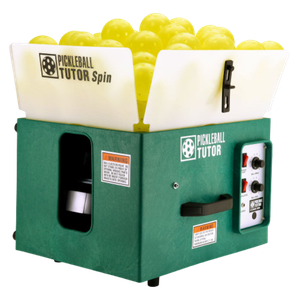
The Pickleball Tutor Spin, for example, holds around 125 balls, reaches 60 mph and offers oscillation, with an optional two-line setup. The Tutor Plus adds topspin/backspin and reaches 65 mph.
That kind of functionality gives you room to progress.
What Else Is Worth Paying For?
Portability sounds boring until you own a 45-pound machine. Then it becomes everything.
If you have to load it into an SUV, wheel it 200 yards, unload 100 balls, set it up, reverse the process and carry it upstairs afterward, your beautiful $2,000 robot may start spending a lot of time in the garage.
Owners repeatedly mention this real-world friction: court access, storage, setup time and simply finding the motivation to transport the machine can determine whether it gets used enough to justify the cost.
I’d prioritize ease of transport, hopper capacity and simple controls before paying for twenty fancy drills you may never use.
So Which Machines Would We Actually Look At?
Pickleball Union already has a full comparison of machines, so I wouldn’t duplicate the buying guide here.
Our current guide names the Pickleball Tutor Spin the best overall choice for most rec players because it combines portability, capacity, spin capability and useful training features without becoming excessively complicated.
- Right and left spin settings
- Holds up to 125 balls
- Speeds up to 60 MPH
- Compact and easy to transport
For players who want more game-style movement and a higher training ceiling, the guide favors the Lobster Pickle Two, which adds two-line oscillation, spin variation and longer battery life.
- 2-line oscillation with remote
- Holds up to 135 balls
- Topspin and backspin options
- 4–6 hours per charge

Those are the kinds of machines I’d investigate if you already know you like drilling.
If you’ve never spent 30 minutes alone intentionally practicing one shot? Try borrowing or renting one first.
The ROI Test
Here’s a simple way to decide.
Imagine you spend $1,200 on a machine. Use it twice a week for a year and that’s roughly 100 sessions.
Your cost is around $12 per practice session before balls, battery replacement or accessories.
Use it 12 times before it disappears into the garage? You paid $100 per session.
That’s the whole decision.
The value of a ball machine has surprisingly little to do with the machine. It has everything to do with whether you’ll actually build practice around it.
My Verdict for Intermediate Rec Players
If you’re a 3.5 or 4.0 player who already knows exactly which shots are holding you back, a good ball machine can be one of the fastest ways to accumulate the repetitions needed to change them.
I would seriously consider one if you can train two or three short sessions a week, have easy court access, enjoy drilling alone and can name two or three specific shots you want to develop.
I would hold off if your biggest problems are positioning, shot selection, communication, reading opponents or knowing when to attack.
Those problems need humans.
And I wouldn’t automatically buy the most advanced machine you can afford. Buy the simplest machine that can create the variation you’ll eventually need.
Because the best pickleball machine isn’t the one that can fire a 65-mph topspin ball into three different corners. It’s the one you’ll still wheel onto the court six months from now.
And if all you need is 100 clean backhand drops without begging a friend to feed them? That machine may be worth every dollar.