
Toxic pickleball habits can ruin rec games fast. Learn how to spot poor sportsmanship, handle difficult partners, control frustration, and avoid becoming the player everyone quietly avoids.
Most unpleasant pickleball players don’t walk onto the court thinking: Today I’m going to ruin this foursome.
Usually it starts much smaller.
A partner misses three returns.
You sigh.
Someone makes a close line call.
You start watching every call suspiciously.
Your partner pops up another dink.
You explain what they’re doing wrong.
Then they tighten up, miss more balls, and suddenly everybody is playing worse and having less fun.
That progression matters because sports psychologists have found something rec players feel all the time: emotion spreads through teams.
Research in professional sports has found links between teammates’ moods and individual mood and perceived performance. Other work on team collapse has identified blaming teammates, individualizing responsibility, frustration, and negative emotional contagion as factors that can keep a team spiraling once things start going badly.
Pickleball may only have two people on a team, but that arguably makes the effect easier to feel.
There is nowhere for bad energy to hide.
So instead of another list of “annoying pickleball personalities,” it’s more useful to learn what these behaviors look like early—and what to do before four strangers turn a 15-minute rec game into group therapy.
The first warning sign is often your partner’s body language
Some difficult partners say almost nothing. That doesn’t make them subtle.
You miss a third-shot drop.
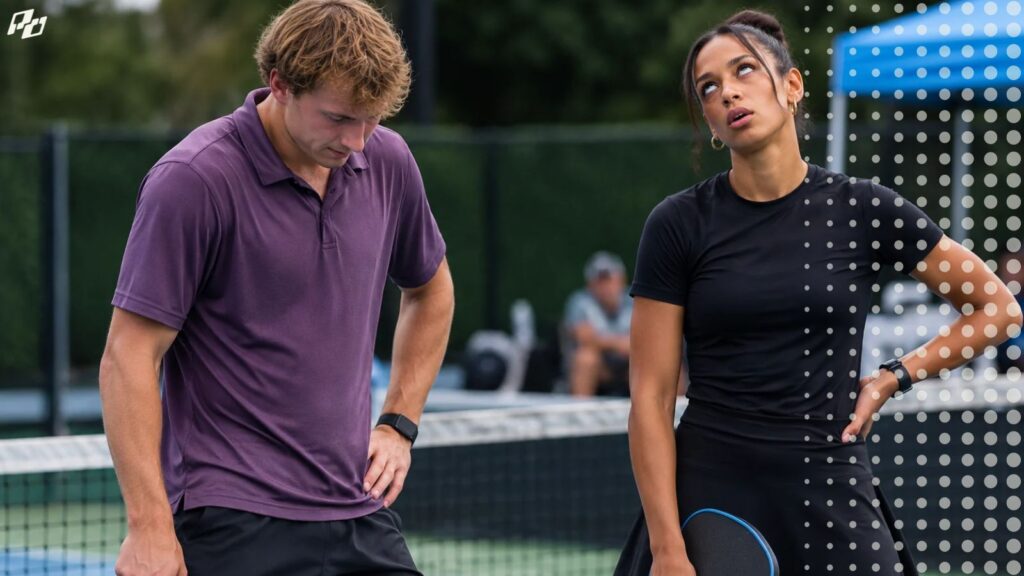
They stare at the ceiling.
Another miss.
Big exhale.
Then comes the head shake.
Sports psychologists take this kind of teammate interaction seriously because emotional responses can transfer between people. Research has even found that how one teammate regulates stress can influence another teammate’s response to the same stressful situation.
And pickleball gives partners dozens of tiny interactions every game. That means your face after your partner misses may matter more than you think.
USA Pickleball’s own sportsmanship guidance specifically tells players to avoid criticism and negative non-verbal communication toward partners.
If you recognize this behavior in your partner, don’t start managing their emotions point by point. Keep communication boring and useful.
“Good idea.”
“We’re fine.”
“Same ball.”
“Let’s go.”
Then move on.
Trying to cheerlead somebody aggressively when they’re irritated can become another form of pressure.
If you recognize the eye-roll person in yourself, pay attention to what happens immediately after an error.
Many players believe they’re only frustrated with themselves. Your partner cannot read that distinction.
All they see is the reaction.
The unsolicited coach usually thinks they’re helping
This one is fascinating because intent and effect can be completely different.
Your partner misses two dinks.
You know why.
Their paddle face is opening.
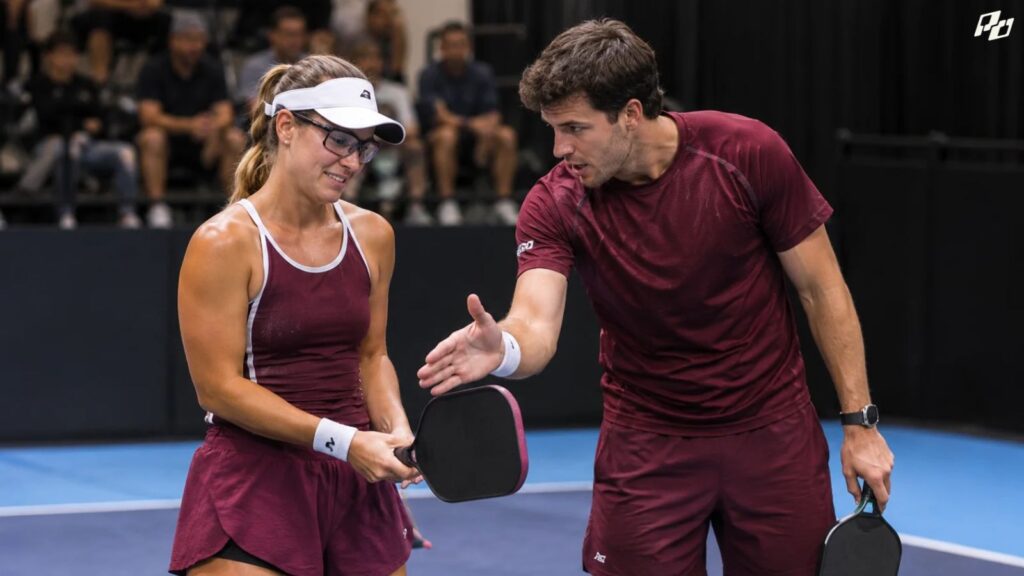
So you say: “You’re dropping your wrist. Keep it out front.”
Perfectly reasonable technical advice. Except now the player has gone from seeing a ball to thinking about their wrist, contact point, paddle face—and whether you’re judging the next miss.
Research on choking under pressure has long examined how attention can become disrupted when athletes become overly conscious of movement mechanics that normally run more automatically. Sport psychologist Christopher Mesagno and colleagues have extensively studied these pressure mechanisms and the interventions used to manage them.
That doesn’t mean one comment causes choking. It means mid-game technical instruction can create more cognitive traffic at exactly the wrong moment.
USA Pickleball is unusually clear about the etiquette here: provide coaching only when it’s requested.
So if somebody is coaching you through every mistake, a friendly: “I appreciate it—I’m trying not to think about mechanics during games.” usually solves the problem.
And if you’re the coachy one? Ask first.
“Want something I noticed?”
If the answer is no, congratulations. You just saved both of you five awkward minutes.
The blamer is often protecting something
Listen carefully after certain players lose.
The ball was bad.
The wind was awful.
Their partner couldn’t make a return.
The opponents were targeting.
The paddle felt weird.
The court surface was slow.
Maybe all of those things were true. The interesting part is when their own contribution disappears completely.
Research on collective team collapse has found that coaches and sport psychologists view blaming others and reduced individual accountability as behaviors that can help sustain a collapse after it begins.
That makes intuitive sense.
If every failure belongs to somebody else, there’s nothing for you to adjust. You’ll also see a quieter version of ego protection: the tanker.
A player gets down 8-2 and suddenly stops moving, tries ridiculous winners, or acts as though the game never mattered anyway.
Now losing has an explanation: I wasn’t really trying.
That protects the ego beautifully. It also makes you miserable to play with.
If you notice yourself mentally checking out when losing, shrink the game. Forget 8-2. Play the next three rallies as if they’re their own mini-game.
You don’t need a miracle comeback. You need to start competing again.
Watch what happens when somebody’s status feels threatened
Pickleball has an unusually visible hierarchy.
Ratings.
DUPR.
Open-play groups.
Beginner, intermediate, advanced.
3.5, 4.0, 4.5.
Who gets invited where.
Who people rack paddles with.
Who people quietly avoid.
That creates status pressure.
You can sometimes spot it in players who only want to “play up,” immediately abandon a partner after one loss, avoid games that might hurt their rating, or seek out weaker games they can dominate. Those exact frustrations come up repeatedly among rec players.
There’s nothing wrong with wanting strong competition. The trouble begins when every recreational game becomes evidence about who you are as a player.
Then losing to somebody lower-rated feels humiliating.
A weaker partner feels like a threat. A bad game becomes something that requires an explanation.
Sport-performance research consistently links factors including confidence, motivation, self-efficacy, attention and stress management with performance. A 2025 meta-analysis covering 127 studies and more than 24,000 participants found a meaningful overall relationship between psychological factors and athletic performance.
In practical terms, protecting your pickleball identity can eventually interfere with playing pickleball.
One useful test: would I still want this game if nobody recorded the score or knew the result?
If the answer changes dramatically, your rating may be taking up too much space in your head.
Then there’s the player who wants the rec win a little too badly
You know the situation.
Three players are reasonably matched.
One clearly isn’t.
And every third ball goes to that player.
Perfect tournament strategy.
Pretty miserable open play.
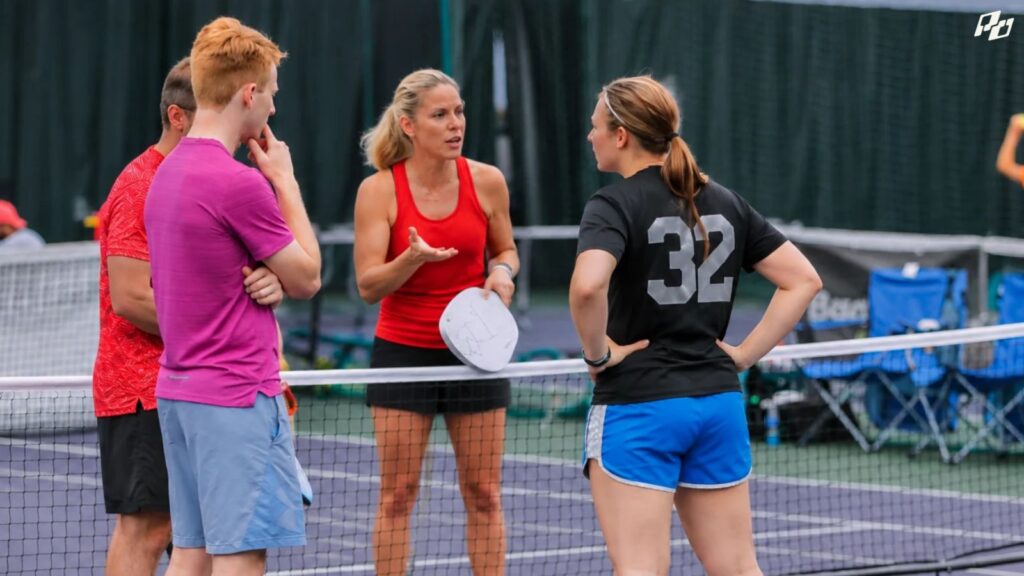
This is one of the few etiquette questions where USA Pickleball gives remarkably direct guidance: stronger players in social play should avoid excessively targeting weaker players and should not slam balls directly at players. Its recreational-program guidance similarly advises players not to play “keep away” from the best opponent just to win and not to exploit physical limitations in rec play.
Context matters.
If four competitive players agreed they’re playing hard, target whoever you want. If one person is clearly outmatched and everybody showed up for social open play, winning 11-3 by feeding them 90% of the balls proves very little.
Experienced rec players often understand something newer competitive players don’t: the quality of the game is part of the objective.
Sometimes the best shot strategically is not the best choice socially. That doesn’t require patronizing weaker players or feeding them cupcakes.
✔ Spread the ball around.
✔ Challenge the better player.
✔ Keep rallies interesting.
You might even improve more.
Line calls reveal people very quickly
Close line calls are almost perfect little psychology experiments.
The ball lands near the line.
Nobody has replay.
Nobody has Hawkeye.
You have perhaps half a second to decide whether uncertainty benefits you or your opponent.
USA Pickleball’s rule is beautifully simple: you should only call a ball out when you can clearly see space between the ball and the line. Doubt favors the opponent.
Its sportsmanship guidance goes further: don’t argue opponents’ calls, promptly correct your partner if they make a wrong one, and resolve uncertainty in the opponent’s favor.
For rec players, there’s also a practical reason not to litigate every questionable call.
The point is already gone. The next four points can disappear while you’re still replaying it in your head.
If somebody makes one questionable call, keep playing. If it becomes a pattern, you can calmly address the pattern:
“We’ve had a few really close ones called out. Can we give the line the benefit of the doubt?”
That is far more productive than beginning a cross-examination after every bounce.
And if the calls keep coming?
You are allowed to finish the game and choose different opponents next time. Rec play does not require you to reform everybody you meet.
Constant apologizing is more complicated than it looks
Miss a serve.
“Sorry.”
Pop one up.
“Sorry.”
Miss an ATP.
“Sorry.”
Players often do this because they’re conscientious and don’t want to disappoint their partner.
But repeated apologies can quietly make the game feel heavier. Now every miss has social consequences.
Your partner may even start comforting you rather than preparing for the next rally.
Self-talk researchers have found that structured self-talk can improve sports performance, with one meta-analysis finding a moderate beneficial effect across studies. The important part is that useful self-talk tends to direct attention toward the task rather than simply judging the outcome.
So instead of apologizing after an ordinary miss, give yourself something playable:
“Next one.”
“Higher.”
“Move my feet.”
Or say nothing at all.
Save “sorry” for the situations where apologies belong—hitting someone, creating confusion, making an obviously unfair call.
Missing a third-shot drop is not a moral failure.
When somebody really is difficult, stop trying to win the personality contest
This may be the most useful open-play skill of all. Somebody will eventually annoy you.
Maybe they celebrate your misses.
Maybe they coach you.
Maybe they cheat.
Maybe they yell.
Maybe they repeatedly target someone who clearly cannot defend themselves.
Your first instinct may be to show them how ridiculous they’re being. That usually produces two difficult players instead of one.
A better approach is proportional.
- For something minor, ignore it.
- For something distracting, make one simple request.
- For something affecting fairness, state the issue without diagnosing the person.
- For genuinely unsafe, abusive or repeated behavior, stop playing with them or involve the facility organizer.
Notice what’s missing:
“You’re toxic.”
“You always do this.”
“Everyone hates playing with you.”
Those statements attack identity, which almost guarantees defensiveness. Behavior is easier to discuss.
“Could you hold the coaching until after the game?”
“Let’s give close calls to the other team.”
“Can we spread the ball around a little? This is social play.”
Clear. Specific. Done.
The uncomfortable part: occasionally, you’re the problem
Probably all of us are.
The encouraging part is that a lot of these habits are recognizable once you know what to look for—the chronic apologizer, the tanker, the ball hog, the unsolicited referee, the constant narrator, the overcompetitive partner.
That matters because self-awareness is usually where better court behavior starts. That’s healthier than identifying twelve irritating people at your club while somehow appearing nowhere on the list yourself.
A good self-check happens after a rough game.
Not: Did I play well?
Try: What was it like to partner with me when I wasn’t playing well?
That is a much harder question.
Were you still communicating?
Did your partner start playing safer because they feared your reaction?
Did you coach?
Did you visibly check out?
Did you explain every error?
Did you stop giving your partner balls because you no longer trusted them?
That’s where sportsmanship and performance start overlapping.
Because the player everyone wants beside them usually isn’t relentlessly cheerful. They’re emotionally predictable.
They can miss.
They can lose.
They can disagree with a call.
They can get frustrated.
And the other three people still know the game isn’t about to become weird.
Respect people, make fair calls, rotate fairly, avoid unnecessary criticism, support your partner, and adjust appropriately in social play.
That may be the real advanced skill in rec pickleball.
Your third-shot drop matters.
Your hands matter.
Your footwork matters.
But if people see your paddle in the rack and quietly move theirs somewhere else, you’ve found a part of your game worth working on too.