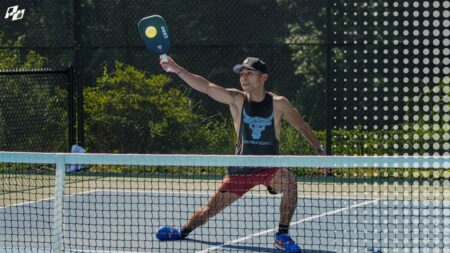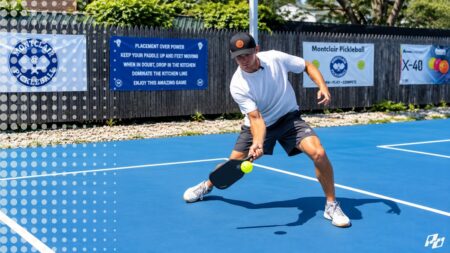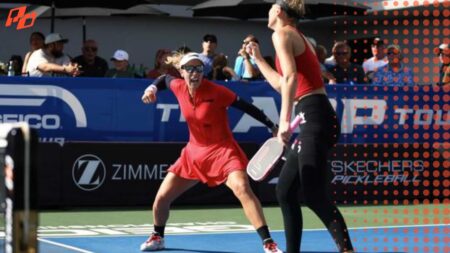

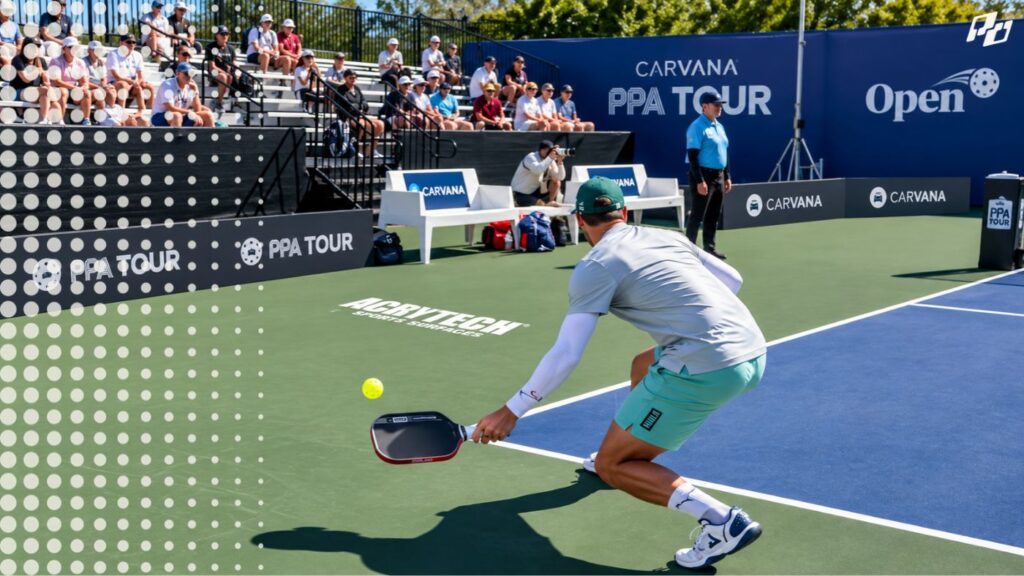
Ben Johns has started using left-handed forehands in singles, giving him extra reach and another attacking option. For rec players, switching hands can help on wide balls or in singles—but only if the transfer is automatic. Build a solid backhand first, then treat the second forehand as a specialty weapon.
Ben Johns did something at the 2026 Opendoor Pickleball World Championships that looked almost disrespectfully casual.
The right-hander started switching the paddle into his left hand and ripping forehand drives.
Not once.
Repeatedly.
Johns, currently No. 1 in the PPA world rankings and owner of 189 career PPA titles, used the shot throughout his opening singles match against Brandon French. He won in three games, 11-7, 1-11, 11-5.
And this was not invented on the spot.
Johns has previously explained that he played tennis with two forehands, copied the idea from his brother Collin, and even used two forehands in pickleball singles early in his career.
So the interesting question is not whether Ben can hit left-handed. Clearly he can. The question for the rest of us is: should an intermediate player actually train this?
Surprisingly, maybe. Just probably not for the reason you think.
Why a second forehand suddenly makes more sense in singles
Look at what modern singles has become.
More driving.
More passing.
More baseline exchanges.
More players arriving from tennis with legitimate groundstrokes.
Johns himself reportedly explained after the match that when he first moved into pickleball, he did not need his left-handed forehand as much because singles involved more dropping, coming forward, and cat-and-mouse play. As singles became faster and more drive-oriented, the shot became interesting again.
That makes sense mechanically.
Imagine a right-hander pulled hard toward the left sideline. Normally the options are:
- run around the ball
- hit a one-handed backhand
- or set up a two-handed backhand
Switching hands gives you another possibility: a full-extension left-handed forehand.
You gain reach because the hitting arm is now on the outside of the body instead of crossing your torso.
Experienced players who switch hands repeatedly mention exactly that benefit: balls that feel barely outside backhand range can become reachable with the opposite arm fully extended.
For singles, where one extra step of coverage can decide the rally, that matters.
There is another reason Ben can do it that most players overlook
The left-handed forehand is not completely foreign to someone with a strong two-handed backhand.
For a right-handed player, the left hand often supplies much of the acceleration and topspin on the two-hander.
Pickleball coaching manuals explicitly teach the non-dominant hand as an active driver of the two-handed backhand, while the dominant hand provides stability and guidance. We have written about this before at Pickleball Union.
In our guide to the modern two-handed backhand dink, we noted that the off hand is doing much of the work, particularly when generating topspin.
That gives you an interesting progression:
Two-handed backhand.
Left hand learns to drive the paddle.
Dominant hand begins doing less.
Eventually?
Take the dominant hand away. Suddenly the left-handed forehand does not feel quite as absurd.
But this should not become your escape from learning a backhand
This is the biggest trap. A lot of newer players discover hand switching because they cannot hit a backhand.
Ball goes left.
Paddle goes into left hand.
Problem solved.
For a while.
Experienced players are generally skeptical of that approach because better opponents eventually expose the transition itself. Players discussing hand switching repeatedly describe it as useful for extreme reach or unusual situations—but warn that relying on it can stop development of a proper backhand.
That distinction is important.
Ben Johns did not switch hands because he never learned a backhand. He has one of the most complete skill sets the sport has seen.
He is adding another option on top of it.
For an intermediate player, I would use the same hierarchy. Build your backhand first. Then experiment.
Where the shot actually makes sense
There are three situations where I think an intermediate player could reasonably explore it.
1. Singles baseline coverage
This is the most obvious one.
You have time.
You are farther from the opponent.
And the extra reach can matter.
If you are pulled very wide to your backhand side and can switch early enough, a non-dominant forehand may let you drive through the ball instead of stretching for a weak backhand.
2. Emergency reach
This is probably the most useful version for rec doubles.
A ball gets outside your normal backhand reach.
Switch hands.
Extend.
Get it back.
Senior pro Rick Witsken has used hand switching for exactly this reason, describing how the extra extension helped him retrieve balls that would otherwise pass him. He has also taught the technique selectively to players with mobility limitations or natural ambidextrous ability.
3. Players with an unusually capable off hand
Some people simply have better bilateral coordination.
Maybe you played hockey, baseball, table tennis, lacrosse, or another sport that developed both sides.
Maybe you already hit a strong two-handed backhand.
Maybe your left-handed forehand feels surprisingly natural after ten minutes.
Then the experiment costs less.
If your first five lefty balls look like you’re holding a frying pan during an earthquake, there are probably better uses of your drilling time.
Where I would absolutely avoid it
Kitchen firefights. You do not have the time.
At seven feet from the net, switching hands introduces another movement between recognition and contact.
That delay is tiny.
So is the reaction window.
Even experienced hand-switchers generally acknowledge that fast kitchen exchanges are the worst environment for the technique.
And in doubles, there is another complication: your partner.
If you are normally right-handed, your partner has learned which middle balls belong to your forehand and which belong to your backhand.
Now suddenly you become left-handed halfway through the point. That can create two forehands where there used to be one—or no obvious owner at all.
Good hand switching therefore needs communication, especially in competitive doubles.
The hidden cost is not the left-handed swing
It is the transfer.
This is what people who experiment with the technique notice quickly. You can learn to hit a decent non-dominant forehand. The hard part is getting the paddle into that hand:
Early.
Cleanly.
With the correct grip.
Without watching it.
And without losing court awareness.
One experienced player described the switching itself as requiring mental energy even after both forehands had become reasonably functional.
That is the real test.
If the ball gives you enough time to think: “Okay, switch hands… find the grip…” you may already have had time for a normal backhand.
The transfer needs to become boring.
Here is how I would train it
Do not start in a game. Start at the baseline.
Hit ten ordinary forehands with your dominant hand.
Transfer the paddle.
Hit ten easy forehands with the other hand.
No power.
Just clean contact.
Then alternate:
- right forehand
- transfer
- left forehand
- transfer back
The paddle should travel directly from one hand into the other rather than being tossed, flipped, or rotated unnecessarily.
Once you can alternate without looking at your hand, add movement.
Feed one ball toward the right sideline.
Next ball toward the left.
Use a forehand on both sides.
Now you are training what Johns is actually doing: recognize → transfer → move → strike.
A Reddit player who deliberately trained ambidextrous play described using a similar wall drill—alternating forehands with each hand until the switch became automatic.
Five minutes is plenty. This should not consume half your practice session.
The best shortcut may already be in your two-handed backhand
Here is the experiment I would give a 3.5–4.0 player.
Hit twenty two-handed backhand drives. Now hit another ten, but gradually reduce how much the dominant hand contributes.
Then remove it after the preparation and let the non-dominant hand finish the swing.
Finally, try a few balls completely one-handed with the off hand.
You may discover that the movement already exists. That is because the modern two-handed backhand has quietly been teaching your non-dominant arm how to hit a forehand.
We have previously argued that the non-dominant hand should stay active throughout the game because it helps with rotation, balance, paddle recovery, and backhand control.
Ben is taking that idea to its logical extreme. His support hand occasionally becomes the hitting hand.
Could this actually become more common?
Possibly in singles. I am much less convinced about doubles.
Modern pickleball has already normalized something that once looked unusual: the two-handed backhand.
By the end of 2024, it had become so common that even longtime one-handers—including Johns—were incorporating it.
So techniques do change. The argument for two forehands is legitimate:
✔ More reach
✔ Natural open-side acceleration
✔ Potentially more topspin
✔ No need to wrap the arm across the body
The argument against it is just as strong:
✖ Another decision
✖ Another grip transition
✖ Less reaction time
✖ More partner confusion
✖ Twice as many strokes to maintain
That is why I do not expect every 3.5 player to start carrying two forehands. But I can absolutely imagine more singles players experimenting with it.
Try the Ben test
If you are curious, give yourself twenty minutes.
Not twenty matches.
Twenty minutes.
Stand at the baseline and hit fifty easy non-dominant forehands. Then alternate sides. Do not judge power.
Judge three things:
Can you find the grip without looking?
Can you make clean contact while moving?
Does the extra reach actually solve a problem your backhand does not?
If all three answers start becoming yes, keep experimenting.
If the transfer feels awkward and your backhand already handles the same ball comfortably, spend the time improving the backhand instead.
Ben Johns can make two forehands look like the next evolution of pickleball.
For most intermediate players, it is probably closer to a specialty tool. But specialty tools can still be useful.
Especially when one of the greatest players ever suddenly pulls an old one out of the bag—and starts using it with actual points on the line.