

DUPR has confirmed that intruders got into its platform. A week after it told users, players opened the app and found matches they didn’t recognize.
DUPR’s CEO, Tito Machado, told me on Nov 27 that those matches were “tied to a few director accounts” and that DUPR has removed them. He didn’t say whether they’re connected to the intrusion.
DUPR says the information accessed may include your full name, email address, cell phone number, date of birth, city and state or mailing address, and match results.
DUPR emailed users on Nov 19, from a dupr.com address. The subject line: “Important Security Update & Account Notice for Your DUPR Account.”
The email calls it “an unauthorized data intrusion affecting certain user profile details,” and it asks every user to change their DUPR password now. Below: what players found, DUPR’s answer, what was accessed, the three things DUPR asks you to do, and what the notice leaves out.
What players found
DUPR’s notice told users they might see “inaccurate or altered match results” on their profiles. On Thanksgiving, a week after it went out, coaches started posting their match histories.
Dino Dinopoulos, a professional coach now based in New York City, posted a video of his DUPR profile on Nov 26. It shows his doubles rating at 5.368, marked as a career high.
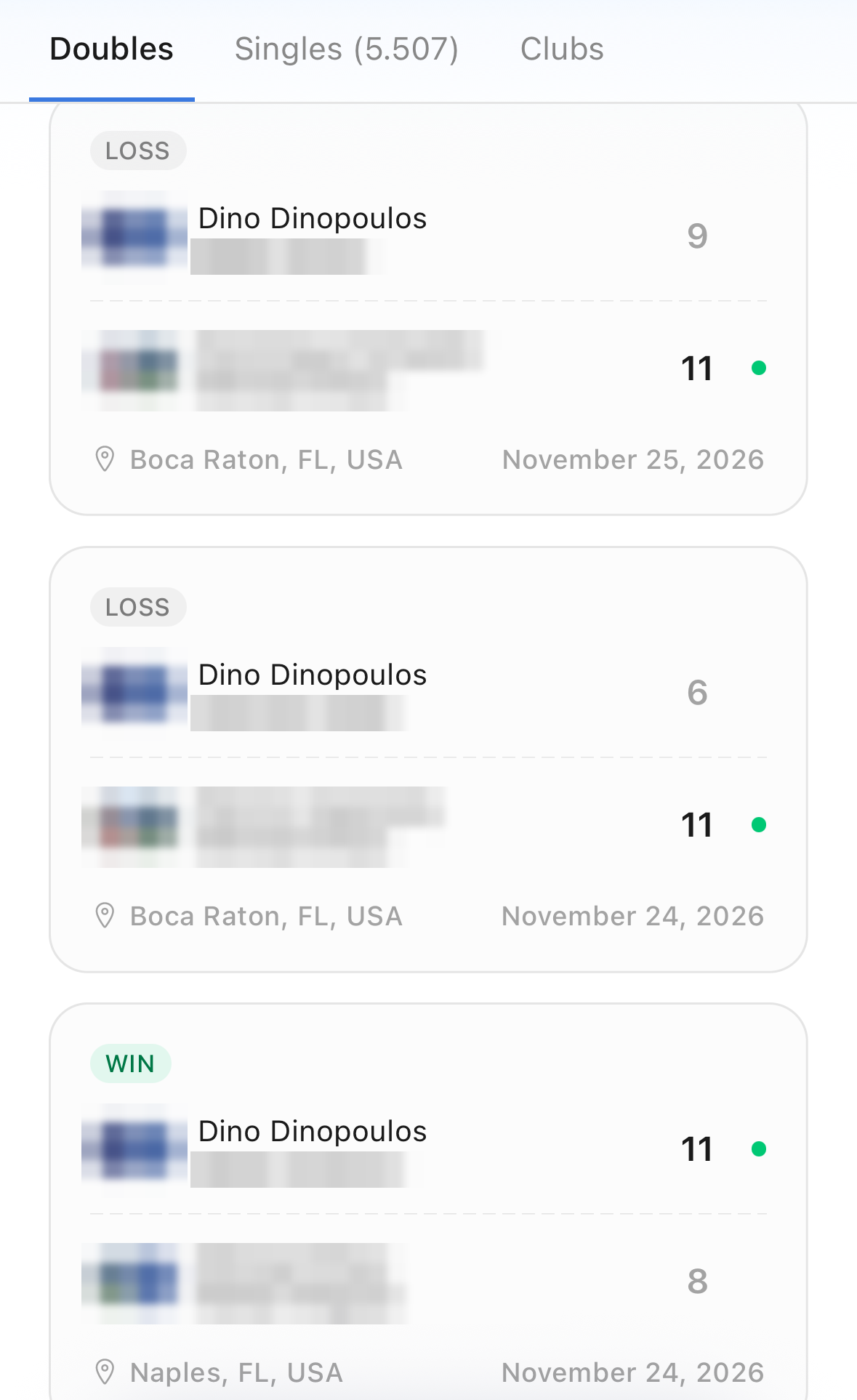
“I was a five two something in doubles and then now it’s got me at this,” he says. His recent matches, dated Nov 24 and 25, list partners and opponents he says he doesn’t know.
The video then turns to his father’s match history. It lists a loss in an event labeled “pro_singles_womens,” with four players on the court, dated Nov 21.
Dino answered my questions on the morning of Nov 27 and sent me screenshots of his match history.
He didn’t see DUPR’s Nov 19 email. He noticed on Thanksgiving, after seeing someone else’s story about being hacked, and checking his DUPR turned into the topic at dinner with his dad.
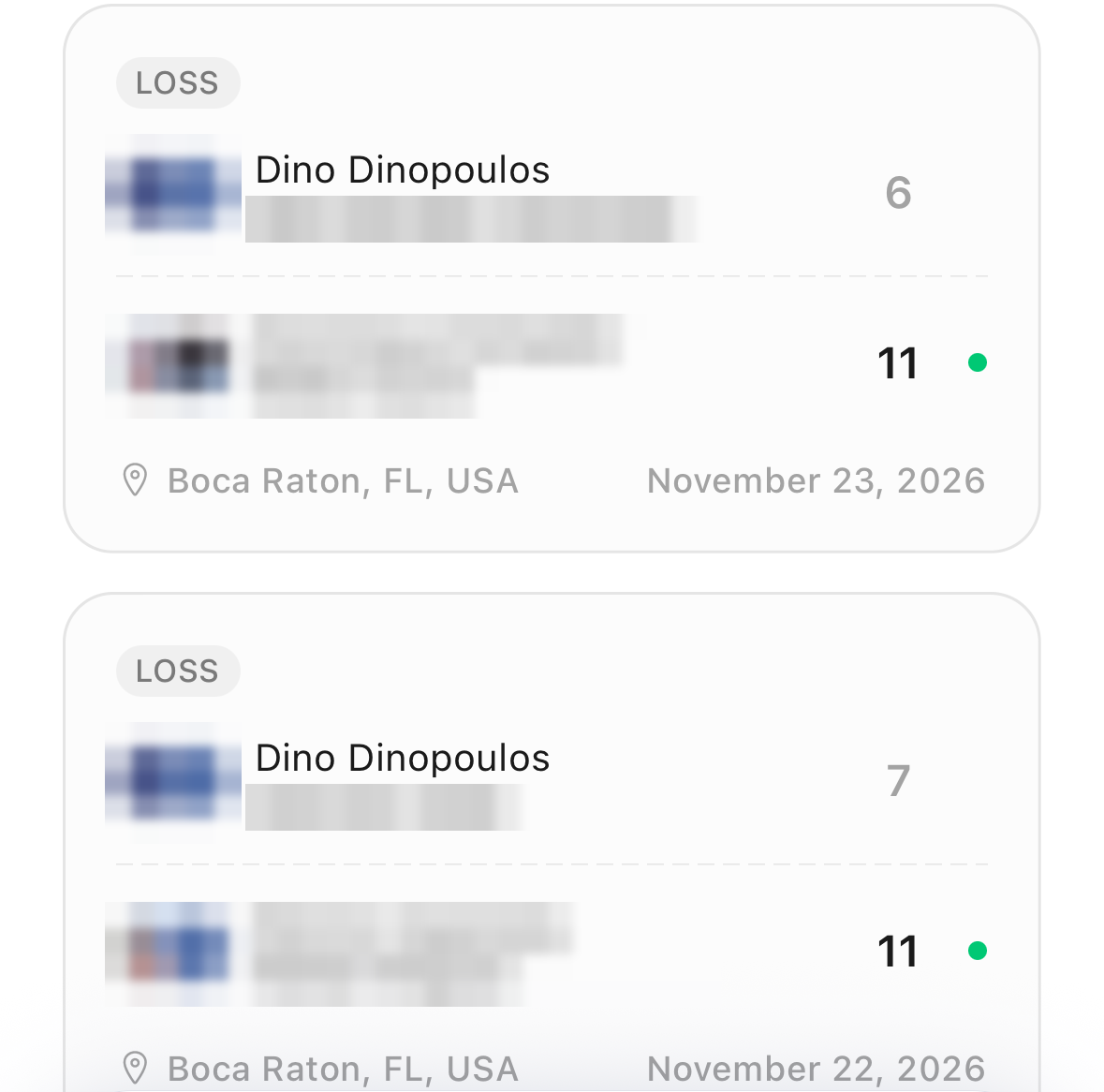
His doubles history showed about six matches he says he never played. The five in his screenshots are dated Nov 22 to Nov 25, in Boca Raton and Naples, Florida. Four of those five are losses, and his rating still went up. He told me it was 5.26 before these matches showed up.
“I’d imagine if your score went down you’re eager to report it,” he said. When I asked whether he had reported the matches to DUPR, he said no. He posted about them on Instagram instead, to see whether other players had the same thing.
Albert Fitch, a coach in Maryland, posted his own screenshots on Thanksgiving: doubles results dated Nov 24 and 25, against players he said he didn’t know.
Like Dino, he checked after seeing someone else’s post. “Saw a handful of matches that I had never played with people I’ve never even met before,” he told me.
The match history he sent me shows those results in Dunkirk and Olney, Maryland. DUPR’s page for one of them labels it a pro mixed doubles semifinal at the “Barcelona Open 2026,” lists the location as Dunkirk, and shows both players on his side as men. He joked that he wished he’d known he played a pro match in Barcelona.
On that page, his doubles rating drops from 5.044 to 5.042. He told me neither his rating nor his reliability score was really affected.
All of those dates fall after DUPR’s Nov 19 notice. We don’t know who entered those matches or how, and neither coach claims to. Dino asks in his video: “Is it real? Is it fake? Who knows?”
DUPR’s answer on those matches
DUPR’s CEO, Tito Machado, answered my question about these matches by text on Nov 27. “The fake matches were tied to a few director accounts,” he told me. “We’ve resolved that issue and removed the matches.”
He didn’t say what kind of director accounts those were, whose they were, how many matches were involved, or whether this is connected to the intrusion. He said he would answer the rest of my questions by email on Monday, Nov 30.
Albert said DUPR reached out to him quickly after his story went up. Someone on DUPR’s team wrote to him from DUPR’s Instagram account: “Please disregard any unfamiliar matches and associated email notifications. These matches will be removed, and no action is needed on your end at this time.”
DUPR’s Nov 19 notice says that if you see inaccurate or altered results on your profile, it is reviewing all records and incorrect ones “will be corrected in the near future.” In its warning about messages from the intruders, the same notice says not to click links, “even if they claim to be a password reset or match notification link.”
Neither DUPR answer says whether ratings that moved with those matches, like Dino’s, have been put back.
I checked my own DUPR history, and every match in it is one I played. So this doesn’t look like it affects every player. It’s still worth checking yours, even if your number went up.
DUPR’s help center says that if a club match you didn’t play shows up on your profile, you should contact DUPR. It adds: “The rating is adjusted right after the changes are made.”
What DUPR says was accessed
The list, in DUPR’s order:
- Full name
- Email address
- Cell phone number
- Date of birth
- City and state, or your mailing address if you gave DUPR one
- Match results
DUPR’s wording is that the information accessed “may include” those items. It doesn’t say which apply to your account.
DUPR says Social Security numbers, driver’s license numbers, credit card numbers and banking details were not involved, because it doesn’t collect or store them.
On passwords, the email says: “We do not store any passwords, and we run them through a one-way scrambler.”
It adds that the intruders got into “a limited number of individual accounts” from the outside, two ways: by testing passwords that had leaked from unrelated websites where people reused them, and through phishing emails that got users to click a link and type in their login.
The three things DUPR asks you to do
DUPR asks every user to take three precautions “right away.” Its words are in quotes.
- Change your DUPR password now, “by going directly to www.dupr.com in your browser.” Type the address in yourself. DUPR’s rule: “never use links inside unexpected emails or text messages.”
- “Never reuse passwords across websites.” Give DUPR a password you use nowhere else, and change it on any other account where you used the same login.
- “Always verify the sender before clicking links or entering your password.” DUPR says it will never ask you to confirm your password through an unsolicited email or text link.
If someone contacts you about your DUPR data
The email carries a second warning. DUPR says the party behind the intrusion “has threatened to contact our users directly” by email or text, in an attempt to cause alarm, damage DUPR’s reputation or trick users into clicking malicious links.
If you get an unexpected email, text or call from someone claiming to have your DUPR data, DUPR’s instructions are:
- Don’t reply or engage.
- Don’t click any link or download any attachment, even if it looks like a password reset or a match notification.
- Be cautious of messages that use your name, birth date, address or match history to look legitimate, or that ask you to send money or share a one-time verification code.
DUPR says it will never ask for your Social Security number, driver’s license, banking or credit card details by email, text or phone. Its line: “Any request like this is not from us.”
What the notice doesn’t say
DUPR says it is working with outside cybersecurity experts, its legal advisors and “federal law enforcement,” and that it has “refused to give in to extortion demands.”
Six things the notice leaves out:
- How many accounts were accessed. The email says “certain user profile details” and gives no number. DUPR’s home page counts 2 million rated players.
- Whether any belong to players under 18. DUPR’s privacy policy, last modified Aug 27, 2025, says the service is available to players 13 to 17 with a parent’s or guardian’s consent, and to players under 13 with a parent’s verified consent.
- When it started, and whether the intruders are out. DUPR says it first detected “suspicious activity” in September and alerted users then. Since then, it says, it has seen “continued, intermittent activity from the intruders,” and it is working to block “ongoing unauthorized activity.” It doesn’t say when the intrusion began or that it has ended.
- Whether any of the information has been published or offered for sale.
- How many match results were altered, how you would know if yours were, and whether any rating that moved has been put back.
- Why the details took until Nov 19, and which state regulators it has told. DUPR says it was “advised to wait until the forensic investigation was completed” before sharing what it found, and that the investigation “has just been completed.” The notice mentions no state regulator.
I sent DUPR those questions on the morning of Nov 27 and will add its answers here when they come.
When we checked on Nov 27, DUPR’s blog, home page and help center carried no notice about any of this.
What the FTC says to do after a notice like this
DUPR’s three steps cover passwords and links. For anything past that, I’m quoting the Federal Trade Commission and nobody else.
Its alert on data breach notices says to “act quickly to protect yourself.” After changing passwords, its next step is: “Turn on multi-factor authentication.”
That’s the passcode from an app, or the security key, that some accounts ask for on top of a password. The FTC: “This helps secure your account even if your password is exposed.”
You can change a password. You can’t change your date of birth or your address.
The FTC’s checklist for information caught in a data breach starts with your credit: “Freeze your credit to make it harder for someone to use your information.”
It says a freeze is free to place and to lift, and “While a freeze is in place, nobody can open a new credit account.”
It also tells you to keep checking your credit reports at AnnualCreditReport.com: “You can check your reports online every week for free.”
If a child in your family has a DUPR account, the same checklist has a line for the parents: “Request a free credit freeze for your child.”
For how the rating itself works, start with our DUPR explainer. For the rule DUPR changed on Nov 4, see what changes at open play.