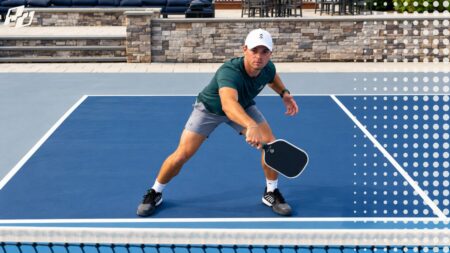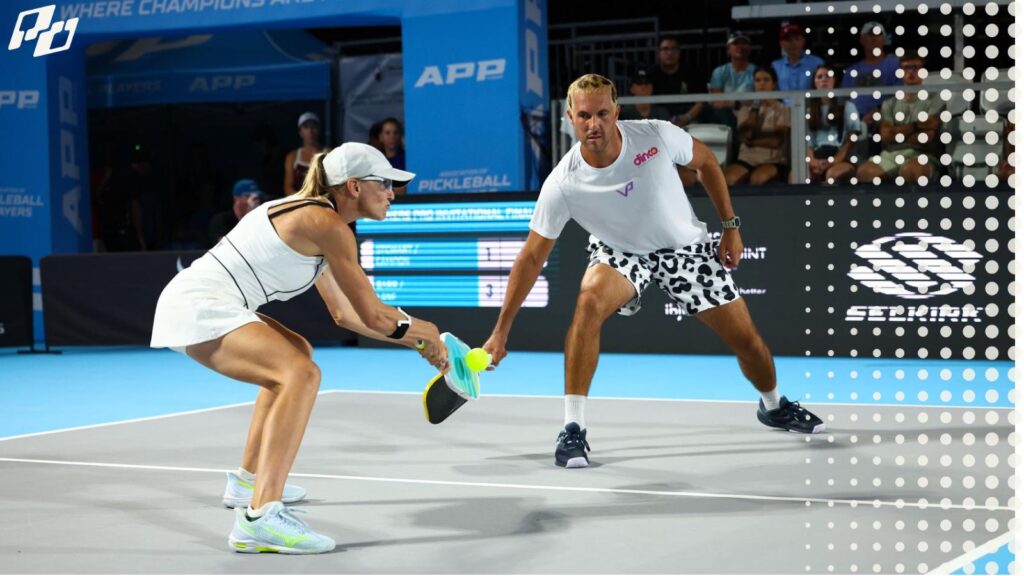
A flat dink is best when you need control, margin, or recovery, while a topspin dink is more useful when you’re balanced and want extra pace, depth, and dip. Advanced players use both—the better choice depends on contact height, spacing, and whether you’re neutralizing or applying pressure.
Watch high-level pickleball today and you’ll see a lot more topspin at the kitchen than you did a few years ago.
Forehand topspin dinks are everywhere. Two-handed backhand topspin dinks are increasingly common. Pros use spin to push opponents off the line, attack their feet, and create balls that dip aggressively after crossing the net. One analysis of the modern pro game even called increased topspin usage one of the biggest changes in how elite pickleball has evolved.
That creates an understandable question for recreational players:
If topspin is better, should I stop hitting flat dinks altogether?
No.
A good flat—or more accurately, neutral push/lift dink—is not a beginner shot that you graduate from. It does a different job.
The best kitchen players do not choose between “basic” and “advanced.” They choose between neutralizing the rally and applying pressure.
That is the distinction worth learning.
First, What Do We Mean by a Flat Dink?
A truly spinless ball is relatively rare.
When coaches talk about a “flat dink,” they usually mean a ball hit with very little intentional spin, using a simple forward swing and a relatively stable paddle face.
Spin comes from the relationship between paddle path and paddle-face angle: when the face is essentially square to the swing path, the resulting ball has relatively little spin.
The common flat versions are:
Lift dink: softer, slightly higher trajectory, typically used to neutralize pressure.
Push dink: flatter and more forward, often deeper toward the opponent’s feet.
Neither requires trying to brush heavily up the back of the ball. That simplicity is exactly why they remain useful.
What Topspin Actually Gives You
Topspin changes the flight of the ball.
The paddle travels forward and upward through contact, creating forward rotation. That rotation helps the ball curve downward sooner.
That means you can often hit:
- slightly harder
- slightly higher over the net
- deeper toward the opponent’s feet
without sending the ball as far.
Topspin dink is an aggressive dink option precisely because the spin helps maintain a low trajectory while allowing more pressure.
So yes: Topspin gives you offensive margin.
But only when your contact allows you to create it cleanly.
The Mistake: Assuming Topspin Is Always More Advanced
This is where beginner and intermediate players get themselves into trouble. They learn a topspin dink and suddenly try to roll every ball.
Now a simple neutral ball becomes:
- paddle tip down
- brush upward
- create spin
- control depth
- recover
That adds variables.
James Ignatowich specifically warns against generating dink topspin through excessive wrist action. His recommendation is a smooth, repeatable paddle path with the face controlled rather than trying to manufacture spin with a last-second flip.
If your spacing is bad or the ball is too low, forcing topspin often produces exactly what you were trying to avoid: net balls and pop-ups.
Cue
Spin when the ball gives you spin. Don’t manufacture it from a bad position.
When the Flat Dink Is Actually the Better Shot
1. You’re stretched or recovering
This is probably the clearest situation.
If an opponent pulls you wide and you are reaching or moving through contact, your priority should be getting back into the point.
A simple lift or neutral dink gives you more margin and recovery time.
Trying to generate heavy topspin while off balance requires extra paddle movement at exactly the moment you need fewer variables.
Recent coaching on dink styles makes the same distinction: offensive topspin is most effective when you are balanced behind the ball; simpler neutral/cup/lift variations become more useful when you are stretched or compromised.
2. The ball is very low
Topspin requires room for the paddle to get below the contact and travel upward.
If the ball is around your shoelaces and you are barely getting underneath it, there may not be enough space to create a clean brushing path.
A soft neutral lift is usually safer.
This is not “playing scared.” It is respecting the geometry of the contact.
3. You need maximum consistency
Sometimes the correct strategic choice is simply:
Make them hit another dink.
Maybe you are defending game point.
Maybe your opponent is impatient.
Maybe they have already missed three speed-ups.
There is no requirement to make every kitchen ball difficult.
4. You want a simple directional change
A flatter dink can be easier when redirecting:
- crosscourt to middle
- middle to line
- forehand to backhand
If placement is the priority, you may not need additional spin.
A ball that reaches the correct foot is often more valuable than a heavier topspin dink that misses its target by two feet.
When Topspin Is Worth Using
Topspin becomes especially useful when you have three things: space, balance, and useful contact height.
1. The ball sits up slightly
Not high enough to speed up. But high enough that you can comfortably get the paddle below it.
This is probably the ideal topspin-dink ball.
You can brush forward and upward, add pace, and send the ball aggressively toward the opponent’s feet.
2. You’re balanced behind the ball
This is critical. Topspin works best when:
- your feet are set
- contact is in front
- the paddle has room to travel
- you are not reaching
Current topspin-dink coaching repeatedly identifies those conditions as the green light for adding spin.
3. You want depth without giving away height
This is where topspin shines. A flat push dink hit hard and deep can become attackable if it carries too high.
Topspin lets you produce more forward pace while still bringing the ball down. That is why it is such a useful shoelace dink.
The objective is not simply “more spin.”
It is:
More pressure without giving the opponent a comfortable volley.
4. You want to push someone off the kitchen
A deeper topspin dink can force an opponent to:
- back up
- short-hop
- contact near their feet
- move while hitting
That creates the next opportunity.
Flat vs. Topspin: The Practical Decision
| Situation | Better Starting Choice | Why |
|---|---|---|
| Stretched wide | Flat/lift | Simpler, more margin |
| Very low contact | Flat/lift | Easier to get underneath safely |
| Recovering balance | Flat | Buys time |
| Opponent already uncomfortable | Flat may be enough | Don’t add unnecessary risk |
| Balanced + ball sitting up | Topspin | Apply pressure |
| Want deep shoelace target | Topspin | More pace with dip |
| Opponent standing tight to kitchen | Topspin | Can pressure feet and push them back |
| Changing direction precisely | Often flat | Fewer variables |
| Trying to create an attackable next ball | Topspin | More offensive trajectory |
The point is not memorizing the table. It is understanding the difference between: survival / neutralization and pressure / offense.
Do Pros Still Hit Flat Dinks?
Yes. What has changed is that they have more options.
Modern pros use topspin much more frequently than earlier generations, particularly on aggressive forehand and two-handed backhand dinks.
But pro training still includes reset dinks, push dinks, short-hop dinks, slice dinks, and other neutral variations. Many experienced pickleball coaches recommend to specifically rotate through different dink types rather than treating topspin as the only correct soft shot.
That tells you something important.
Higher-level pickleball is not: flat → graduate to topspin.
It is: flat + topspin + slice + volley dink + reset = choose the right tool.
The Push Dink Is the Important Middle Ground
There is another reason the “flat vs. topspin” debate can be misleading. A flat dink does not have to be passive.
Tyson McGuffin has taught the push dink as a safe but aggressive option: compact mechanics, more forward intent, and depth toward the back of the opponent’s kitchen. That means you can create pressure without producing heavy spin.
This is extremely useful for 3.5 players.
Instead of thinking:
“I need more topspin to make my dinks aggressive.”
Try:
“Can I make my current dink deeper, lower, and better targeted first?”
Often, the answer is yes.
Here’s Tyson breaking down when to use the push dink and how to execute it effectively:
Don’t Confuse Spin With Dink Quality
This is probably the most important point. A beautifully spinning ball that lands waist-high is a bad dink. A nearly flat ball that jams the opponent’s inside foot is a good one.
Judge the shot by:
- contact height you give the opponent
- depth
- placement
- whether they are balanced
- whether they can attack
Not by how impressive the ball looks in flight.
Cue
Outcome first. Spin second.
How I’d Build Topspin Into a 3.5 Player’s Game
1. Own the neutral dink
Crosscourt.
Middle.
Straight ahead.
No spin required.
2. Add topspin from an easy forehand position
Get balanced.
Contact in front.
Brush forward and up.
Keep the wrist quiet.
3. Alternate flat and topspin
Flat → topspin → flat → topspin
Same target.
Same preparation.
4. Make the choice live
Low or stretched ball → neutralize.
Comfortable ball with space → topspin.
That is what transfers into games.
The Rule I’d Give Intermediate Players
If you are a 3.0 or early 3.5 player and your flat dink is still unreliable, do not feel pressured to add topspin because the pros use it.
Build the stable shot first.
If you are a solid 3.5–4.0 player, topspin should absolutely become part of your kitchen game—but as an offensive option, not your default answer to every ball.
Use a flatter dink when you need: margin, recovery, simplicity, or precision.
Use topspin when you have: balance, space, and a reason to apply pressure.
That is the real difference.
Flat dinking is not what you do before you become advanced. It is what advanced players still use when the situation does not justify anything more complicated.
And topspin is not “better.” It is simply more useful when the ball—and your position—allow you to take advantage of it.