
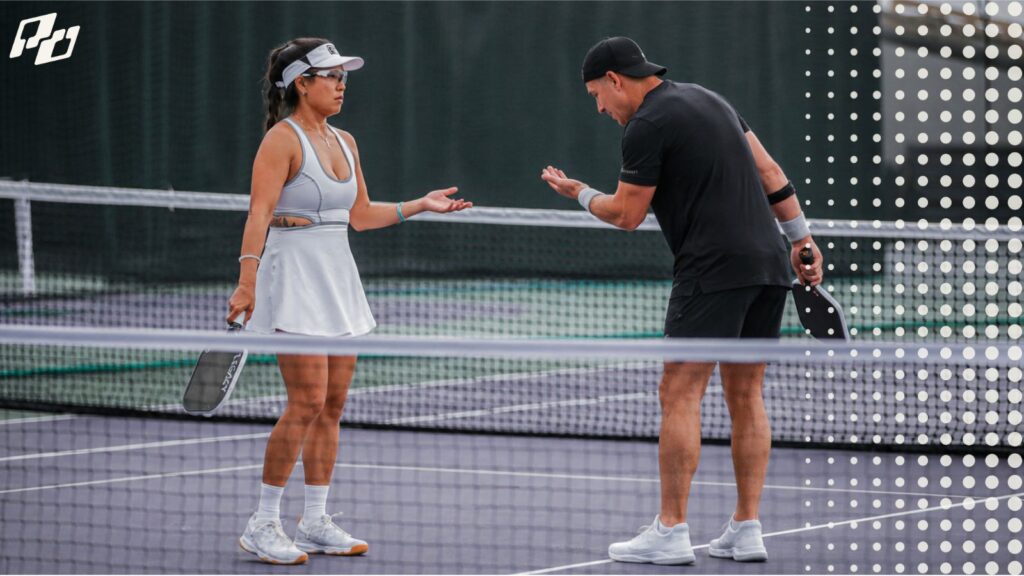
Apologize in pickleball when your actions affect safety, fairness, communication, or another player—not for every missed shot. Use a quick “my bad” for small partner mistakes, and a direct apology when you make a bad call, create a safety issue, overcoach, lose your temper, or genuinely hurt someone.
We’ve already made the case for not apologizing after every missed third-shot drop, dink into the net, or return that sails long. You’re playing a sport. Missing is part of it. But there’s another side to this.
Sometimes you really should say sorry.
The useful distinction is not whether you lost the point. It is what you did to the other people on the court.
Miss a routine dink?
Probably no apology necessary.
Call your partner off a ball and then completely abandon it?
Different story.
Question an opponent’s line call, realize they were right, and spend the next minute arguing anyway?
Apologize.
Accidentally drill someone in the face?
Definitely apologize.
The rule I’d use is:
Don’t apologize for competing imperfectly. Apologize when your action creates a problem for someone else.
That makes “sorry” mean something again.
Your Miss Usually Does Not Require an Apology
Start here because recreational players dramatically overuse this one.
You miss a third.
“Sorry.”
Miss a return.
“Sorry.”
Attack the correct ball but put it six inches long.
“Sorry.”
Your partner does not need an apology for every execution error. Coaches and experienced players repeatedly warn that this can pull attention backward, lower confidence, and eventually make your partner feel responsible for reassuring you.
Instead, distinguish between a bad result and a bad decision that affected your partner. You attack a legitimate high ball and miss it?
“Right ball. Next one.”
You poach a ball your partner had comfortably lined up, then dump it into the net?
“That was yours. My bad.”
Now the acknowledgment has a purpose.
Apologize When You Create Confusion for Your Partner
This is one of the situations intermediate players often overlook. Imagine a high middle ball. Your partner is preparing to hit it. At the last second you yell:
“Mine!”
They pull off. Then you hesitate and don’t hit it either.
That deserves acknowledgment—not because you missed, but because your communication caused your partner to stop playing the ball.
Same thing if you:
- call “out” early and the ball lands in
- yell “yours” too late
- change your stacking position without telling your partner
- unexpectedly switch sides and create confusion
- make a late poach call that causes a collision or hesitation
Keep the apology specific:
“Late call. That was mine.”
That is much better than:
“Sorry, sorry, sorry. I don’t know what I was doing.”
Good doubles communication should make the next rally easier. Researching experienced-player and coaching advice produces the same recurring theme: specific ownership is more useful than an apology spiral.
Apologize When You Take a Ball That Was Clearly Your Partner’s
Poaching itself does not require an apology. Good doubles players poach. But there is a difference between a smart poach and simply stealing your partner’s ball.
Suppose your partner has a comfortable forehand, is balanced and preparing to attack. You reach across, take it awkwardly, and put it into the net.
Don’t say:
“Well, I thought I had it.”
Try:
“I crowded you there. That was yours.”
This matters because you’re not merely acknowledging the miss. You’re reassuring your partner that you understand the court responsibility and aren’t planning to keep invading their space.
Then fix it.
An apology followed by three identical poaches is not particularly convincing.
If You Hit Someone, Read the Situation
Body shots are part of pickleball. You do not need to apologize every time a legal speed-up catches an opponent on the thigh.
But there are degrees.
⮕ Routine body shot
You attack the body intentionally, the opponent misses the block, ball catches their hip.
A quick:
“You good?”
is plenty.
⮕ Uncomfortable hit
The ball catches someone in the chest, throat, or another sensitive area.
Stop and check:
“Sorry—are you okay?”
⮕ Face or eye
Don’t immediately turn around and celebrate the point. Check on them.
USA Pickleball’s Sportsmanship Guide explicitly prioritizes safety and also tells stronger players in social play to avoid slamming balls directly at other players.
And context matters.
Driving aggressively at another competitive 4.5 player is different from repeatedly drilling a much less mobile beginner during casual open play.
Legal does not automatically mean socially appropriate.
The Net-Cord Apology Is Mostly a Courtesy
You hit the tape.
The ball trickles over.
Your opponent had no chance.
Many players instinctively raise a hand. That is fine. But don’t confuse it with admitting wrongdoing.
You haven’t violated a rule or done anything strategically inappropriate. You’re simply acknowledging:
“I know I got fortunate there.”
A paddle raise, hand gesture, or quick “sorry” is enough. And if you’re playing your best friend and both of you laugh instead, civilization will probably survive.
This is etiquette, not penance.
Apologize When You Make a Bad Call
This one matters much more.
Players should respect opponents’ calls, correct a partner’s incorrect call promptly, resolve uncertainty in favor of opponents, and call faults on themselves or their partner even when opponents don’t notice them.
So imagine you confidently call:
“OUT!”
Then realize you actually saw the ball clip the line.
Correct it immediately.
“That caught the line. My mistake.”
Don’t spend 30 seconds explaining your viewing angle. And if you argued aggressively before realizing you were wrong?
That deserves a real apology:
“You were right. I shouldn’t have argued that. Sorry.”
Notice the difference.
The first fixes a call.
The second repairs your behavior.
That is exactly where an apology belongs.
Apologize When Your Temper Spills Onto Everyone Else
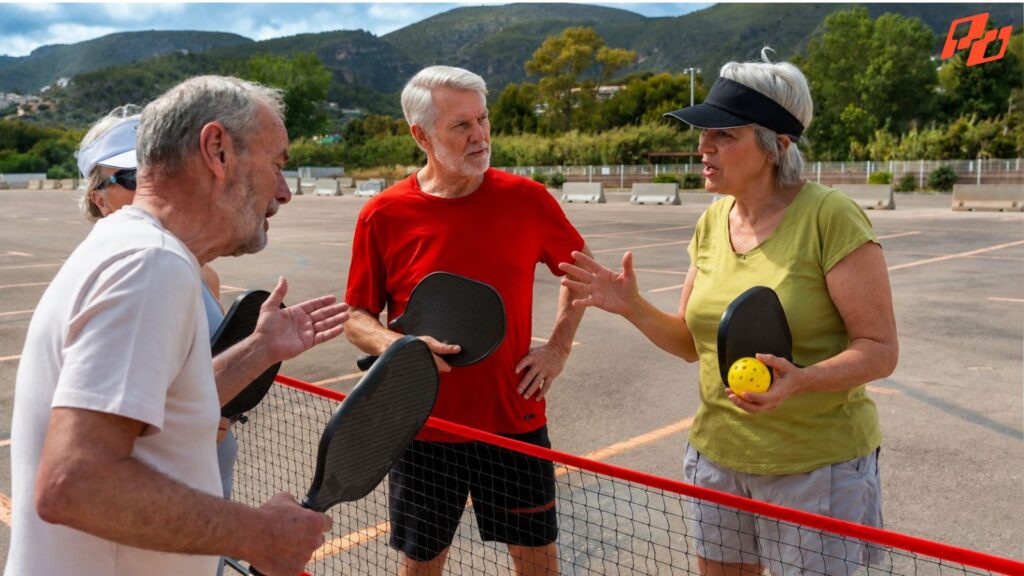
You don’t have to apologize for being frustrated. You probably should apologize if you make everyone else experience it.
That includes:
- yelling at your partner
- swearing at someone
- throwing or slamming your paddle
- aggressively firing a dead ball
- making a sarcastic comment about a line call
- repeatedly displaying hostile body language toward your partner
If you cross that line, don’t disguise the apology:
“Sorry, but that call was terrible.”
That’s not an apology.
Try:
“Sorry. I got frustrated and took it out on you. That wasn’t fair.”
Then move on.
Apologize When You Give Unwanted Coaching
This is a subtle one. Your partner misses two dinks and suddenly you’ve become their instructor.
“You’re opening the paddle.”
Next point:
“Stay lower.”
Next point:
“You’re taking that too late.”
Then your partner finally says:
“Can we just play?”
This is a good moment for:
“Yep. Sorry—I was overcoaching.”
And stop. Give your partner coaching or advice only when they ask for it. Don’t follow your apology with:
“I was only trying to help.”
That turns the apology into a defense of the behavior you supposedly just apologized for.
Apologize When You Accidentally Create a Safety Problem
Some apologies have nothing to do with points.
Your ball rolls onto the neighboring court and you fail to warn anyone.
You walk behind an active court while players are chasing a lob.
You swing your paddle carelessly and nearly hit your partner.
You leave a loose ball near someone’s feet.
Those deserve immediate attention because the consequence can be an injury. Players should always prioritize safety, warn others when a stray ball creates danger, and wait for play to stop before crossing an active court.
The correct sequence is: Warn first. Fix the hazard. Apologize second.
Not:
“Sorry!”
while the ball continues rolling underneath someone’s feet.
There Are Also Times to Apologize After the Match
Not everything needs to be handled between rallies. Suppose you realize halfway through a competitive match that you’ve been visibly frustrated with your partner. Stopping after every point to discuss your emotional state probably isn’t helpful. Finish the match.
Then say:
“I was getting frustrated and my body language toward you wasn’t good. Sorry about that.”
That’s useful because you’re addressing something that actually affected the partnership. The same applies if you:
- became overly controlling tactically
- blamed your partner
- ignored an agreed strategy
- became argumentative
- made the game unpleasant
Experienced doubles advice consistently emphasizes that partners notice negative body language—sighs, turning away, paddle slaps and visible disappointment—even when nothing critical is said aloud.
Sometimes the apology you owe isn’t for what you said. It’s for what you communicated without saying anything.
“My Bad” and “I’m Sorry” Aren’t Quite the Same
I would use them differently.
| Situation | Better Response |
|---|---|
| Took partner’s ball | “My bad—that was yours.” |
| Made a late communication call | “Late call. My fault.” |
| Routine execution miss | No apology needed |
| Lucky net cord | Quick hand raise / “sorry” |
| Hit opponent painfully | “Sorry—are you okay?” |
| Incorrect line call | “That was in. My mistake.” |
| Argued disrespectfully | “You were right. Sorry I argued it.” |
| Snapped at partner | Real apology |
| Created a safety hazard | Warn, fix it, then apologize |
| Gave unwanted coaching | “Sorry—I was overcoaching.” |
“My bad” works beautifully for a small piece of court accountability.
“I’m sorry” should carry a little more weight.
If you use the same apology for a missed dink and for snapping at your partner, you’re treating two very different things as equivalent.
A Good Pickleball Apology Has Three Parts
You don’t need a speech. The best ones usually do three things:
1. Name what happened.
“I called that late.”
2. Own your part.
“That was on me.”
3. Fix the next action.
“I’ll call it earlier next time.”
That’s enough.
“I crowded you. My fault. I’ll give you that ball next time.”
Compare that with:
“Oh my God, I’m so sorry. I’m playing terribly. I don’t know what’s wrong with me.”
The second version forces your partner to reassure you.
That is exactly the problem coaches identify with chronic apologizing: instead of clearing the mistake, you make your partner carry your emotional response to it.
The Easiest Rule to Remember
Before saying sorry, ask yourself:
Did I simply miss—or did I negatively affect someone else?
If you missed a normal shot, reset and play.
If you confused your partner, crossed a boundary, made an unfair call, created danger, behaved poorly, or genuinely hurt someone, acknowledge it.
Then make the apology short, specific and finished. You don’t need to apologize for being an imperfect pickleball player.
But when your actions affect the fairness, safety, trust, or enjoyment of the people sharing the court with you?
That’s exactly when “sorry” still matters.