


If your friend keeps cheating at pickleball, it is usually worth saying something — but calmly and privately, not like a courtroom drama. Focus on the behavior, not the person. In rec play, the goal is not to win the argument. It is to protect fairness, trust, and the overall vibe.
If you play enough rec pickleball, this situation eventually shows up.
A friend keeps making sketchy line calls. They “miss” kitchen faults that somehow only happen on their side. They get weirdly certain on balls they clearly did not see well. Maybe it is not full villain behavior. Maybe it is selective eyesight. Maybe it is “competitive enthusiasm.” But whatever you call it, the same question starts creeping in:
Do I say something, or do I just let it go?
Here is the honest answer: yes, you usually should address it — but not like a prosecutor, and not in the middle of a public meltdown. In rec pickleball, the goal is not to “win the case.” The goal is to protect trust, keep the game playable, and stop a bad pattern before it turns the whole court against somebody. USA Pickleball’s sportsmanship guidance puts a lot of emphasis on fair line calls, respecting opponents’ calls on their side, and questioning calls respectfully rather than arguing.
That is the frame that helps most here.
This is not really just about rules. It is about friendship, atmosphere, and whether people still want to share a court with you next week.
First: are they actually cheating, or just bad at making calls?
This matters more than people think.
A lot of rec conflicts get worse because players jump straight from “bad call” to “cheater.” Sometimes that is deserved. Sometimes it is not. Self-officiated sports are messy because people are biased, emotional, late to react, blocked by a partner, or simply worse at seeing the ball than they think they are.
Sports psychology research on cheating and gamesmanship shows that moral behavior in sport is often shaped by pressure, self-justification, and situational bias, not just cartoon-level dishonesty.
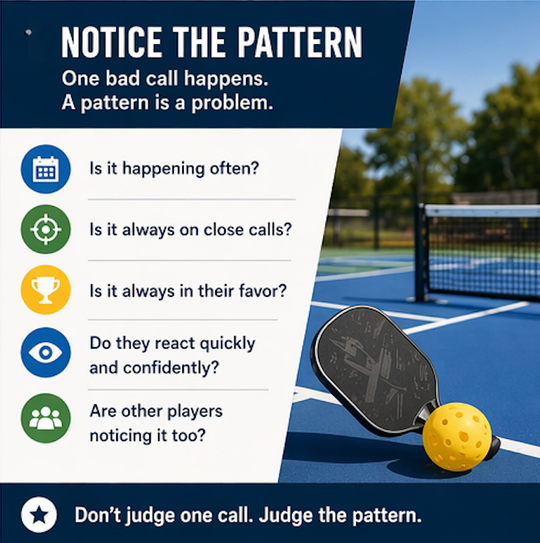
So before you go nuclear, ask yourself:
- Is this happening occasionally or constantly?
- Is it always on close balls?
- Is it always in their favor?
- Do they react instantly and confidently, or hesitantly and defensively?
- Are other players noticing it too?
One bad call is pickleball.
A pattern is something else.
That is why the most useful mental shift is this: Do not judge the person from one call. Judge the pattern.
What the rules and etiquette actually say
The official and etiquette side is pretty clear on the basics.
In pickleball, players are responsible for making line calls on their end of the court, and sportsmanship matters a lot because the game is usually self-officiated. USA Pickleball says players should make calls fairly, call their own ball out if they see it out, and question opponents respectfully rather than argue. General line-calling etiquette guidance boils the rec version down even more simply: make fair, immediate calls, and when in doubt, play it out.
That last line is huge.
A lot of rec cheating lives in the gap between:
- “I’m not totally sure,” and
- “but I’m calling it out anyway.”
That is not sharp officiating.
That is how trust dies.
So if your friend is routinely making uncertain calls in their own favor, that is not just annoying. It is bad pickleball etiquette.
Why this feels worse when it’s a friend
Because now it is not only a rules problem. It is a relationship problem.
If a random stranger at open play makes bad calls, you can shrug, avoid them next round, and move on with your life. But if it is a friend, the emotional math changes. You are suddenly balancing:
- fairness
- awkwardness
- loyalty
- social chemistry
- and your own desire not to look dramatic
That is why so many players do nothing for too long.
They tell themselves:
- “It’s only rec play.”
- “Maybe I’m overreacting.”
- “I don’t want to embarrass them.”
- “It’s not worth making it weird.”
And then the problem gets worse.
Because what usually happens is not peace.
What usually happens is resentment.
You stop trusting their calls.
Other players notice.
The vibe gets tense.
And now everyone is performing fake politeness around a problem nobody addressed.
So should you call them out?
Yes — but quietly, specifically, and with the goal of fixing the behavior, not shaming the person.
That is the sweet spot.
In rec pickleball, the best move is usually not:
“Are you serious? That was in.”
or
“You always do this.”
That kind of language might feel satisfying for three seconds, but it almost always makes people defensive. And once someone feels accused in public, they stop listening and start protecting their ego.
Sports-psych guidance on confronting cheating in competition consistently recommends staying calm, focusing on the specific behavior, and using appropriate channels rather than escalating emotionally.
So yes, say something. But say it like someone who wants the game to get better, not like someone auditioning for courtroom TV.
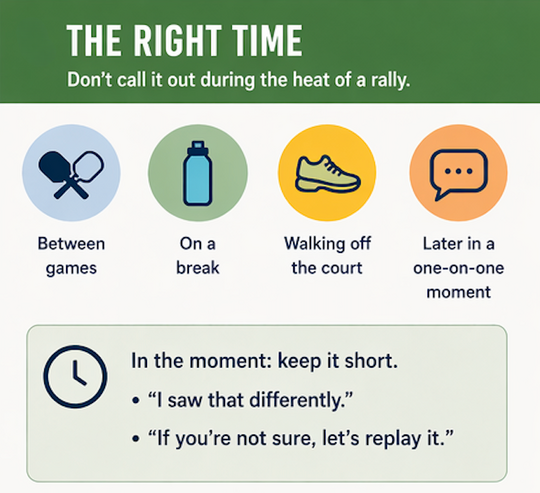
The best time to say something
Usually not in the middle of a heated rally dispute. That is one of the biggest rec-player mistakes.
In the moment, people are keyed up, certain they are right, protective of their image, and much less able to hear nuance.
If the call is really bad and you need to address it right then, keep it short:
- “I saw that differently.”
- “Are you sure you saw space?”
- “If you’re not sure, let’s replay it.”
- “On close ones, let’s give the benefit if we didn’t see it clearly.”
Then move on. But if there is a pattern, the better conversation usually happens:
- between games
- on a water break
- walking off the court
- or later in a casual one-on-one moment
That gives you a much better chance of getting honesty instead of denial.
What should you actually say?
Keep it simple, calm, and behavior-focused. Good versions sound like this:
- “Hey, I’ve noticed a few line calls lately that felt pretty quick on really close balls.”
- “I know rec calls are tough sometimes, but on the close ones, can we be a little more careful?”
- “A couple of those looked in from my angle. If you’re not sure, let’s play them.”
- “I’d rather keep this clean than win points on fuzzy calls.”
- “I’m not trying to make it a thing — I just want the game to feel fair.”
That kind of language works because it does three things: it stays specific, protects dignity, and gives them a path to correct it without feeling publicly humiliated.
What usually does not help:
- “You cheat.”
- “No one likes playing with you.”
- “You’re always calling balls out.”
- “You only do this when you’re losing.”
Even if you believe some of that is true, it is not the best first move if your actual goal is improvement.
What if they deny it?
They probably will, at least at first.
That does not automatically mean they are malicious. People are very good at defending their self-image, especially in sports where they think of themselves as fair. Self-justification is common; people often do not experience their own behavior as “cheating” even when it clearly advantages them.
So if they say:
- “I’m just calling what I see,”
- “I’m not cheating,”
- “You’re taking this too seriously,”
do not immediately escalate. Try:
- “I get that. I’m just saying it’s starting to feel noticeable.”
- “Totally — I’m not saying it’s intentional. I just think on the close ones we need to be more careful.”
- “That’s fair, but if we’re not sure, I’d rather replay it than guess.”
This is where tone matters a lot.
Your job is to make honesty easier than defensiveness.
What if they really are cheating on purpose?
Then your job changes.
If someone is clearly and repeatedly gaming the calls, ignoring fair-play norms, and showing no interest in correction, you do not need to become their full-time ethics coach.
At that point, the practical rec-play options are usually:
- stop partnering with them,
- stop playing meaningful games with them,
- keep matches light and low-stakes,
- or, if it is affecting a group, let the organizer know.
This is especially true in recurring open play groups, leagues, or club environments where etiquette matters to everyone.
Unwritten-ethics guides for rec pickleball all make the same broader point: court culture depends on players handling disputes calmly and protecting the social fabric, not just the score.
That means you do not owe endless patience to someone who keeps poisoning the trust.
The sports psychology piece: why people do this
This part helps, because it keeps you from seeing every bad call as proof your friend is secretly a villain.
People cheat or shade reality in sports for a bunch of familiar reasons:
- ego
- insecurity
- fear of losing
- identity
- pressure
- and the need to feel competent
In rec pickleball, there is often another factor too: social self-protection.
A player may hate the feeling of losing in front of friends, looking foolish, or feeling outclassed. So they start bending calls just enough to protect themselves. Not because they sat down and decided to become a petty tyrant — but because their competitiveness got ahead of their integrity. That does not excuse it. It just helps explain why shame-based confrontation often fails.
This is why the most effective call-out is often not “You’re cheating.”
It is: “You don’t need to do this. Let’s keep it clean.”
That gives them a chance to return to the version of themselves they probably prefer.
What about the “it’s just rec play” argument?
This is one of the most common excuses, and it sounds reasonable until you think about it for more than six seconds.
If it is “just rec play,” then why are we cheating in it?
That is the problem.
Rec pickleball is supposed to be lower stakes, more social, more forgiving. That is exactly why bad line calls and sketchy honesty feel so irritating there. They do not belong. They turn the easiest version of the sport into something tense and weird.
And the etiquette side is clear here too: unwritten rules of rec play are built around fairness, pace, sportsmanship, and being someone people want on their court.
So yes, it is “just rec play.”
That is why you should keep it fair.
A good rule for rec players
Here is the cleanest rule I can give you:
Address the behavior once, calmly and directly.
Then let their response tell you who they are.
If they respond with:
- “You know what, fair point,”
- “Yeah, I may have rushed that,”
- “Let’s replay close ones,”
great. That is a player worth keeping around.
If they respond with:
- denial
- sarcasm
- more sketchy calls
- or turning you into the problem
then the issue is not eyesight anymore.
It is character and court behavior.
That tells you plenty.
How to protect the vibe while still protecting fairness
This is the real rec-player challenge.
You do not want to be passive. You also do not want to become the guy who turns every Tuesday open play into a Senate hearing.
So use this progression:
If it is isolated:
Let it go or gently question it.
If it becomes a pattern:
Address it one-on-one, calmly.
If it keeps going:
Set boundaries with how and when you play with them.
If it affects the group:
Bring in an organizer or group norm.
That is how grown-up rec players handle messy stuff without setting the whole court on fire.
What should you do in the moment, point by point?
A few practical cues help a lot:
✅ Stay calm first.
✅ Question the call, not the person.
✅ If no one is sure, replay it.
✅ Do not pile up old grievances mid-rally.
✅ Save the bigger conversation for later.
✅ Protect the game, not your ego.
Those cues sound simple, but they stop a lot of bad scenes.