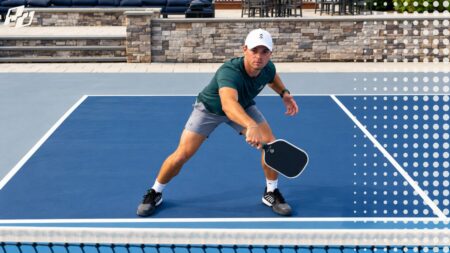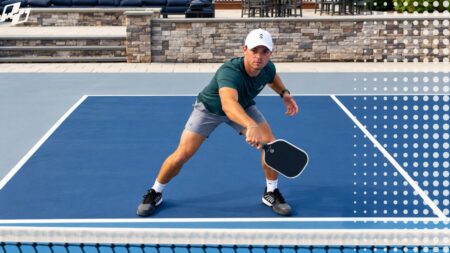


A baseline reset in pickleball is a soft defensive shot used when you are deep, under pressure, and not in a good position to attack. Instead of forcing a risky drive, it helps you slow the rally down, neutralize the attack, and stay in the point.
A lot of rec players think of the reset as a transition-zone shot.
That makes sense. Most of the time, when coaches talk about resets, they are talking about that awkward middle-court area where you are trying not to get blasted before you reach the kitchen.
But you can absolutely reset from the baseline too.
Not all the time. Not on every ball. And not in the exact same way you would reset from the transition zone. But yes — when you are stuck back, off balance, or getting pressured by a team that keeps you pinned deep, a baseline reset can be the smartest way to slow the point down and give yourself a chance to work back in.
That is also why the baseline reset works best when you stay wide and low, contact the ball out in front, and keep a slightly open paddle face.
That is an important distinction, because a lot of rec players from the baseline think they only have two choices:
- rip a drive
- or try a normal third-shot-style drop
Sometimes those are the wrong answers. Sometimes the better answer is: soften the ball, neutralize the attack, and stay in the point.
That is what the baseline reset is for.
What is a baseline reset, exactly?
A baseline reset is a defensive soft shot hit from deep in the court when you are under pressure and need to take pace off the ball, buy time, and make the next shot less attackable.
That is the simplest definition.
USA Pickleball defines the reset more broadly as a soft, controlled shot used when you are under pressure to slow the pace and recover from a tough defensive position.
So a baseline reset is not some weird specialty trick. It is just the reset concept used from farther back.
That is why the mental picture matters:
⮕ This is not a normal attacking drop.
⮕ This is not a baseline dink.
⮕ And this is definitely not a bailout moonball.
It is a controlled, defensive neutralizer.
When should you reset from the baseline?
This is the first question that matters, because a lot of rec players hear “baseline reset” and start trying it on balls they should just drive or drop normally.
The best time to reset from the baseline is when you are deep, under pressure, and not in a good position to attack.
That usually means one or more of these things is true:
- you are late
- you are stretched
- the incoming ball is hard and low
- your feet are not set
- your opponents are already up and hunting the next ball
- or your previous shot left you stuck deeper than you wanted
So the real rule is not: “Baseline = drive or drop.”
It is: “Baseline + pressure + bad position = reset can be the right answer.”
That is a much smarter framework.
When is a baseline reset better than a drive?
Usually when the drive is more hopeful than realistic.
A lot of rec players get trapped here. They are deep, leaning, maybe a little jammed, and they still try to hit an aggressive drive because it feels more assertive. But if the incoming ball has you defending, a rushed drive often just creates the exact thing you do not want:
a ball your opponents can hammer again.
That is why resets matter. A reset is not about looking aggressive. It is about making the rally less dangerous.
So if you are stuck back and the drive feels rushed, off balance, or likely to sit up anyway, the baseline reset may be the better shot.
When is a baseline reset different from a transition-zone reset?
This is the most important technical part of the whole article.
The goal is similar in both cases: soften the ball, neutralize the rally, and make the next shot less attackable.
But the situation is different.
From the transition zone
You are closer to the kitchen.
The incoming ball gets on you faster.
Your reset usually has to be softer and more precise because you have less court in front of you to work with.
You are also more likely to be taking the ball off the short hop or out of the air while still moving forward.
That means transition-zone resets are usually more about absorbing pace, staying low, and neutralizing under pressure than creating shape from distance.
The margin is smaller, the timing is tighter, and the footwork matters more because you are trying to calm the point down while still working your way in.
From the baseline
You are deeper.
You usually have a little more court to work with.
You often have a little more time, but also more distance to cover before you can really improve your position.
The reset may need a touch more shape or lift to travel farther and still land safely.
That means the baseline reset is usually:
- a little more lifted
- a little less “dead-hands tiny”
- and more about neutralizing from distance than absorbing fire in close quarters
That is why players get confused when they try to hit the exact same reset from both places. The intent is the same, but the flight and feel are not identical.
What should a good baseline reset look like?
A good baseline reset should look boring in the best possible way. It should:
- clear the net safely
- land low enough and short enough that the opponents cannot attack comfortably
- take pace off the ball
- and buy you time to stay in the rally or move forward under better conditions
For most rec players, the best baseline reset comes from a few simple habits: get wide and low, keep your weight forward, make contact out in front instead of down by your feet, and use a slightly open paddle face so the ball lifts over the net with control.
That is a strong baseline-reset model because it fixes three of the most common rec-player mistakes:
- standing too upright
- contacting the ball too low and too late
- and keeping the paddle face too closed
All three make the reset much harder than it needs to be.
How do you actually hit a baseline reset?
Let’s make this practical.
1. Get wide and low first
A lot of baseline resets go wrong before contact even happens. If your base is too narrow or your chest is too high, the shot gets pokey and unstable.
Think: wide base, quiet body, athletic posture
2. Reach out in front, not down at your feet
If you let the ball get too close to your body or too low by your feet, the reset turns into a rescue shot instead of a controlled one.
That is one of the biggest differences between players who can actually reset and players who just bunt panic balls back.
3. Use a slightly open face
If the paddle face is too closed, the ball dies into the net. If it is too open, the shot floats too much.
Think: open enough to lift, not so open that it floats
4. Soften the hands
This is not a hit-through-it shot. It is a controlled absorb-and-guide shot.
If you swing too hard, you are usually just giving the other team another ball to attack.
5. Aim for neutral, not magic
A lot of rec players try to hit the perfect baseline reset. That is usually the wrong goal.
The real job is simple: make the next ball less dangerous
Sometimes good enough and in is exactly the right shot.
What are the best cues for rec players?
A few short cues help more than one long mechanical speech. For the baseline reset, I’d use:
- Wide and low
- Out in front
- Open and soft
- Lift, don’t pop
- Neutralize first
- Buy time
Those cues line up well with current reset teaching.
What does the baseline reset help with?
It helps with more than people think.
1. It keeps you in points you would otherwise lose
This is the most obvious benefit. Instead of trying to outgun a good attacking ball from a bad position, you soften it and give yourself another touch.
2. It makes your court advancement more realistic
A lot of rec players try to force their way forward with low-percentage drives. A baseline reset can give you a calmer path into the next ball.
3. It gives you a better answer when your normal drop is not there
This is a big one. Sometimes the baseline ball is too hard, too low, or too rushed for a “normal” pretty third-shot drop. A reset gives you another defensive option.
What are the most common mistakes?
These are the big ones:
- Standing too upright: When you are too tall through the shot, the reset gets stiff and loses control.
- Catching the ball too low: If the ball gets trapped down by your feet, the reset usually turns into a desperate flick.
- Swinging too big: A reset is not a drive in disguise. Big swings usually add too much pace.
- Popping it up: Too much wrist, too open a face, or too much upward panic can leave the ball sitting up.
- Resetting balls you should attack: Not every baseline ball needs a reset. If you are balanced and the ball is attackable, a drive or controlled drop may be the better choice.
That is why shot selection matters just as much as technique.
When should you not reset from the baseline?
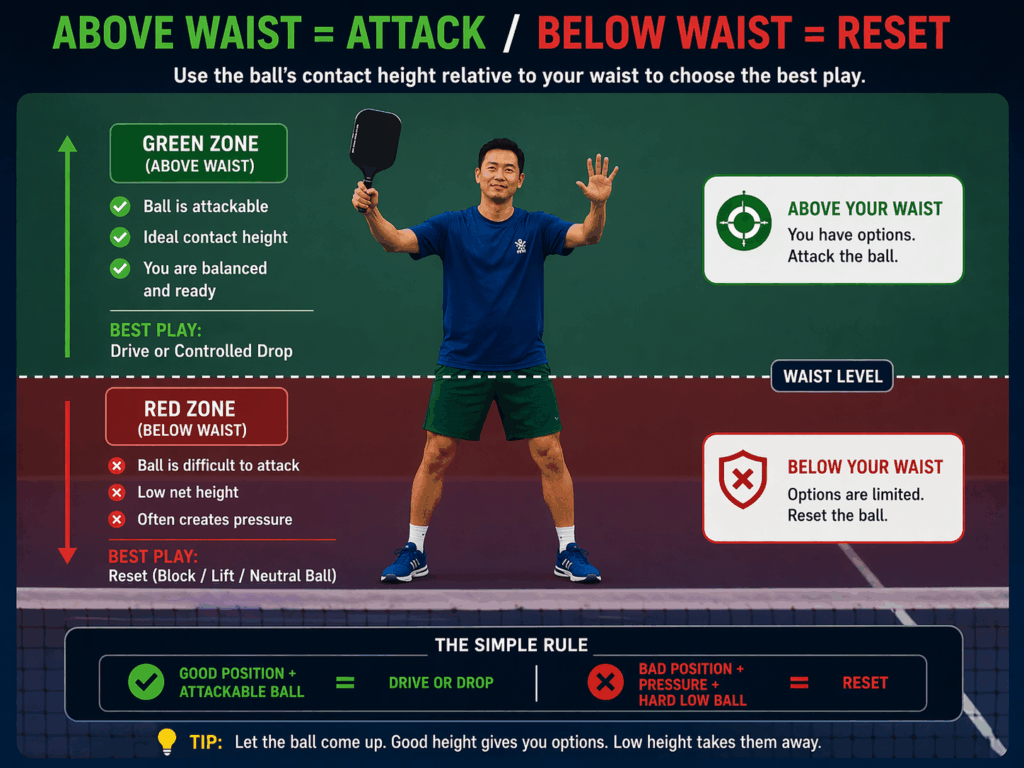
You should not treat the baseline reset as your default answer to everything.
If the ball is:
- attackable
- above a comfortable strike zone
- and you are balanced and ready
then a drive or controlled drop may be the better play.
So the real framework is:
- good position + attackable ball = drive or drop
- bad position + pressure + hard low ball = reset
That is the clearer way to think about it.
What drill helps most?
One of the best drills for this is a work-up drill from the baseline to the kitchen.
Here’s how it works: one player starts at the baseline and the other starts up at the kitchen. The baseline player begins by hitting two controlled balls from deep in the court, then steps forward into the next zone and hits two more, this time focusing on resets. Then they move up again, hit two more, and keep repeating that pattern until they reach the kitchen and finish with dinks.
Why this drill works so well:
- it connects baseline control, transition resets, and kitchen play instead of treating them like separate skills
- it teaches you to work forward in stages
- and it helps you feel how the shot changes as you move through different parts of the court
That makes it a great rec-player drill, because real pickleball usually is not about hitting one perfect reset and magically arriving at the kitchen. It is about progressing through zones under pressure.
What is the mental shift rec players need?
Do not think of the baseline reset as a weak shot.
Think of it as a smart survival shot.
A lot of rec players resist soft defensive choices because they feel passive. But the point is not to look aggressive. The point is to make your opponent hit one more shot from a less comfortable position.
That is the entire logic of the reset: take chaos and make it smaller.
And that is why it is such a valuable shot.