
Fix your high backhand volley by stopping the downward chop. Turn the paddle more sideways, use a small shoulder load, extend your arm through the ball, and aim to the feet or middle. The goal is controlled power — not a wrist snap that sends the ball long or into the net.
The high backhand volley should be one of the easiest balls to punish.
It is above the net.
It is in your strike zone.
Your opponent probably gave you height.
And yet a lot of rec players turn it into one of the messiest shots in their game.
They chop down.
They snap the wrist.
They swing with the paddle tip straight up.
They either dump it into the net or launch it long.
Higher-level shots are not about more wrist and more drama; they are about cleaner mechanics, better paddle-face control, and using the body in the right sequence.
For intermediate rec players, the high backhand volley is not just a “get it back” shot.
It is a chance to take control.
But only if you stop treating it like a chop.
The Big Mistake: Chopping Down With the Paddle Tip Up
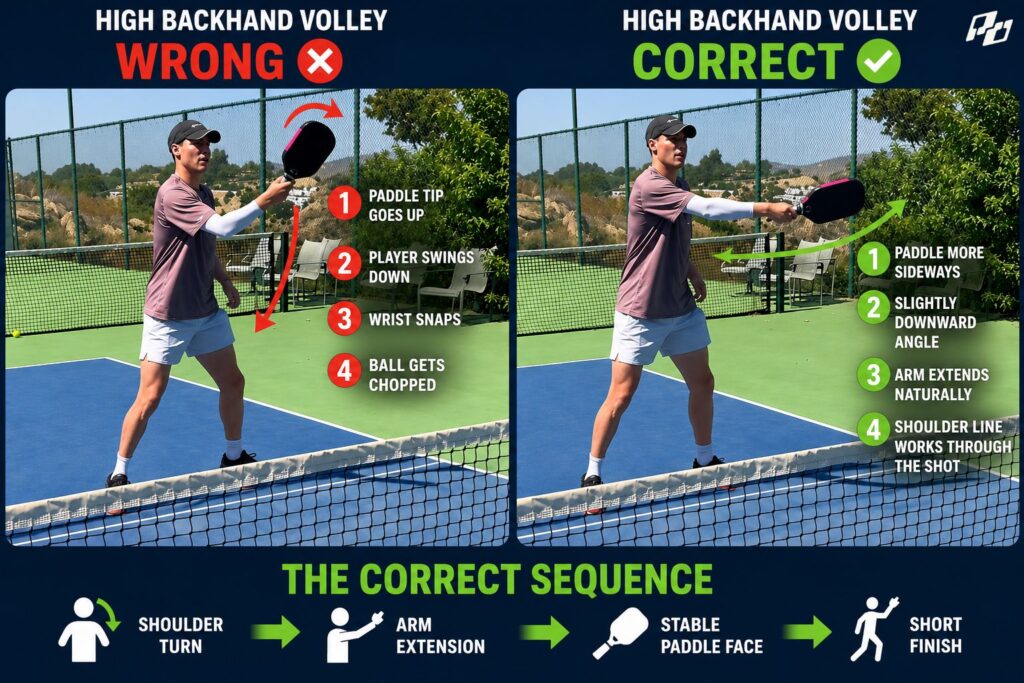
The common rec-player version looks powerful. It is not. The paddle tip goes up. The player swings down. The wrist snaps. The ball gets chopped.
That feels aggressive, but it creates two problems:
| What Happens | Why It Hurts You |
|---|---|
| The paddle face changes too much | Small wrist changes send the ball long, wide, or into the net |
| You lose body power | The shot depends on a quick wrist snap instead of the arm, shoulder, and torso |
| The ball often floats or dives | You get either a sitter or an error, not controlled pressure |
| You recover late | Big chop finishes make the next ball harder |
The high backhand volley should feel more like a sideways drive through the ball than a downward axe swing.
A useful way to think about it:
You are not cutting the ball down.
You are sending the ball through the target with a slightly downward path.
That difference is huge.
Why the Sideways Paddle Works Better
Instead of holding the paddle tip straight up, turn the paddle more sideways with a slightly downward angle.
That gives your arm room to extend and lets your shoulder line work through the shot.
Coaches who teach backhand volleys often emphasize compact contact out in front, a stable paddle face, and controlled forward pressure rather than a big wristy swing.
The goal is to create power from a bigger structure:
shoulder turn → arm extension → stable paddle face → short finish
Not: wrist snap → paddle flip → hope
When the paddle is sideways and slightly angled down, you can drive the ball with more control because the face stays predictable longer.
Cue: “Sideways face, forward force.”
The Contact Window: High, In Front, and Not Too Close
This shot breaks down when the ball gets too close to your body.
If the ball is jammed near your chest or shoulder, you will probably chop or slap because your arm has no space.
For a dangerous high backhand volley, the contact should be:
- in front of your body
- slightly away from your hitting shoulder
- high enough to attack without lifting
- far enough forward that your arm can extend
Extension is where the shot gets both power and precision. Without space, you are stuck using wrist.
Cue: “Give the arm room to unload.”
If you feel cramped, do not force the putaway. Block, reset, or punch to a safer target.
Use the Shoulder, Not Just the Hand
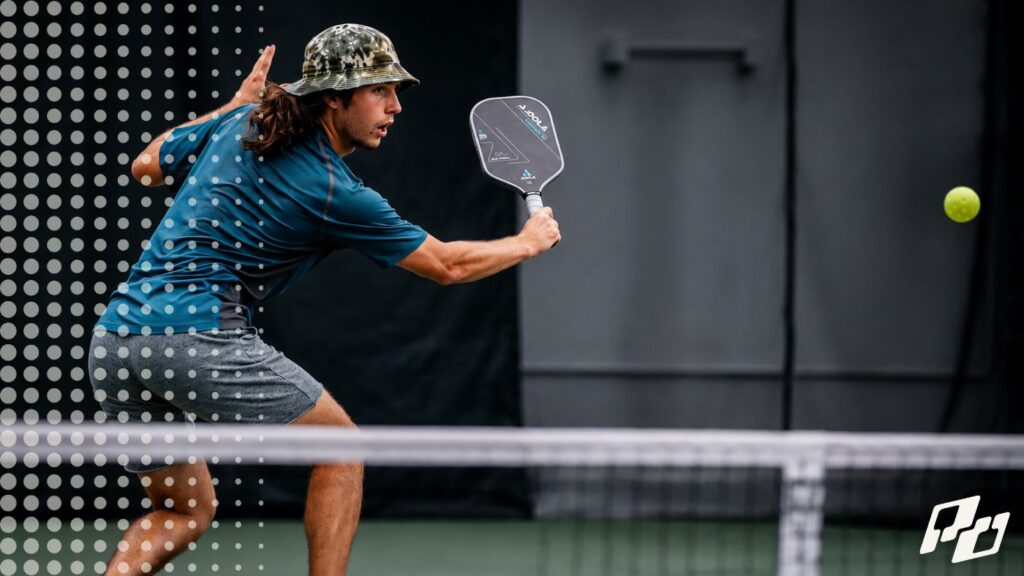
The high backhand volley gets powerful when your upper body helps.
You do not need a giant backswing. But you do need a small shoulder turn so the shot has stored energy.
Think of loading the upper body just enough that you can release the arm forward through the ball.
Your chest and shoulders turn slightly, then your arm extends outward toward the target. That gives you power without needing to flick the wrist.
Ben Johns breaks down the mechanics behind a powerful high backhand volley.
Bad feel: wrist slaps down.
Good feel: shoulder and arm drive through.
Cue: “Shoulder loads it. Arm sends it.”
Where to Aim the High Backhand Volley
Do not aim for a highlight. Aim for the ball your opponent hates.
From a high backhand volley, your best targets are usually:
| Target | Why It Works |
|---|---|
| Opponent’s feet | Forces a low block or pop-up |
| Middle seam | Creates hesitation between partners |
| Paddle-side hip | Jams the counter |
| Behind the player leaning in | Punishes forward momentum |
| Open court | Use only when you are balanced and contact is clean |
For most rec players, the safest aggressive target is: down through the middle or at the feet. That keeps the ball low and reduces your chance of overhitting.
That sounds strange, but it works. You can swing with intent without aiming for a tiny sideline.
When Not to Go Big
A high backhand volley is attackable, but not every high backhand volley is a green light. Do not try to crush it when:
❌ you are jammed
❌ the ball is already behind you
❌ you are falling sideways
❌ your paddle face is late
❌ you would need a big wrist save
❌ your opponent is already waiting to counter
In those moments, use a compact punch or controlled block instead.
Advanced players do not attack because the ball is technically high. They attack because the ball is high and their body is organized.
Height alone is not enough.
The High Backhand Volley Decision Table
| Ball You Get | Best Choice | Why |
|---|---|---|
| High, in front, and away from body | Drive/punish | You have room to extend |
| High but jammed | Short punch/block | Wristy power will be inconsistent |
| High but behind you | Reset or controlled redirect | You are late |
| High and opponent is moving forward | Attack feet or hip | They are vulnerable |
| High but you are off balance | Control first | Body position does not support power |
| High and you have clear middle target | Attack middle | High percentage pressure |
A high backhand volley is only attackable if your paddle face is already organized before you accelerate. If you have to “find” the face during the swing, you are not attacking — you are gambling.
A Better Practice Drill
Do not just have someone feed easy high balls and smash them. That teaches the wrong thing.
Try this instead:
Start at the kitchen. Have a partner feed high backhand volleys in three zones:
Zone 1: comfortable in front
Attack through the feet or middle.
Zone 2: slightly jammed
Use a compact punch, not a big swing.
Zone 3: slightly late or off balance
Control the ball and recover.
The goal is to train the decision, not just the stroke.
After each shot, ask:
Did I have room to extend?
Did the paddle face stay stable?
Did I recover for the next ball?
If the answer is no, you probably tried to do too much.
Common Mistakes and Fixes
| Mistake | What It Usually Means | Better Fix |
|---|---|---|
| Chopping down | You are relying on wrist | Turn paddle sideways and drive forward |
| Ball goes long | Face opened or swing was too big | Shorten finish and aim feet/middle |
| Ball goes into net | Too much downward chop | Think forward with slight downward angle |
| Shot feels weak | No shoulder load or arm extension | Add compact coil and extend through |
| You feel jammed | Contact too close | Move contact farther in front or punch instead |
| You cannot recover | Swing is too dramatic | Finish shorter and reload |
The Cues That Actually Help
“Sideways face, forward force.”
Turn the paddle so you can drive through, not chop down.
“Give the arm room to unload.”
Contact must be in front and away from the body.
“Shoulder loads it. Arm sends it.”
Use upper-body structure instead of wrist snap.
“Power to a boring target.”
Feet and middle beat tiny sidelines.
“High ball, stable body, then attack.”
Do not confuse height with permission.
Make This Shot Less Dramatic
The high backhand volley does not need to look violent to be dangerous. In fact, the more dramatic it looks, the more likely you are chopping, snapping, or over-swinging.
The better version is cleaner.
- Sideways paddle.
- Small shoulder turn.
- Arm extension.
- Stable face.
- Simple target.
That is how you get power that actually stays in the court.
A chopped high backhand volley might win one point.
A controlled high backhand volley makes opponents nervous every time they float a ball to that side.
That is the real upgrade.
Not a bigger swing.
A better transfer of force.