
Improve your pickleball forehand drive by using a compact backswing, body-led rotation, natural paddle lag, and an opposite-shoulder finish. Swing at about 70–85% effort, keep grip pressure moderate, and practice the same motion under live-ball conditions so the drive stays powerful, controlled, and repeatable in games.
Most recreational players think their forehand needs more power. It usually doesn’t. What it needs is better mechanics that create power consistently.
That’s exactly how the best players make their drives look effortless. They’re not muscling the ball. They’re repeating the same efficient movement over and over until pace, topspin, and depth become automatic.
The three adjustments below are simple, but they’re the same concepts many high-level coaches use to build a forehand that holds up under pressure.
Master them, and you’ll notice something surprising: your drive won’t just get faster.
It will get heavier, more accurate, and far more reliable—the kind of forehand opponents stop attacking because they know what’s coming.
1. Shrink Your Backswing Before You Add Power
One of the biggest myths in pickleball is that bigger swings create bigger drives. Actually, the opposite is usually true.
The longer your backswing gets, the harder it becomes to time, especially against faster opponents.
A simple wall drill fixes this surprisingly quickly.
Stand close enough to a wall that you can’t take the paddle far behind your body. As you load, trace a small “C” shape with your paddle while keeping your non-hitting hand against the wall for as long as possible.
That second part is the secret.
Your left hand (for right-handed players) isn’t there for balance.
It’s there to stop your shoulders from flying open too early.
Many intermediate players rotate their chest almost immediately. Once that happens, the arm has to take over, the swing gets longer, and consistency disappears.
Keeping the shoulders closed just a fraction longer allows your hips and torso to deliver the paddle through the ball instead of your arm trying to manufacture all the power.
Why it works
A compact backswing gives you three major advantages:
- The paddle reaches contact sooner.
- The paddle face stays more stable.
- Your body—not just your arm—creates the speed.
Ironically, shortening the swing usually makes the ball come off the paddle heavier.
Cue
“Small C. Big finish.”
Think compact on the way back.
Explosive through the ball.
How to transfer it to games
Don’t stop with the wall drill.
Immediately hit live forehands while trying to make your backswing look exactly the same.
If your swing suddenly doubles in size once the ball starts moving, you’re chasing power instead of repeating mechanics.
Your practice swing and match swing should look almost identical.
2. Stop Pulling the Paddle. Learn to Create Lag.
Lag means the paddle briefly trails behind your hand as your body starts the forward swing. That small delay stores energy and releases it into the ball.
The key: you don’t force lag with your wrist. It happens naturally when your body rotates first and the paddle follows.
A simple net drill helps you feel this.
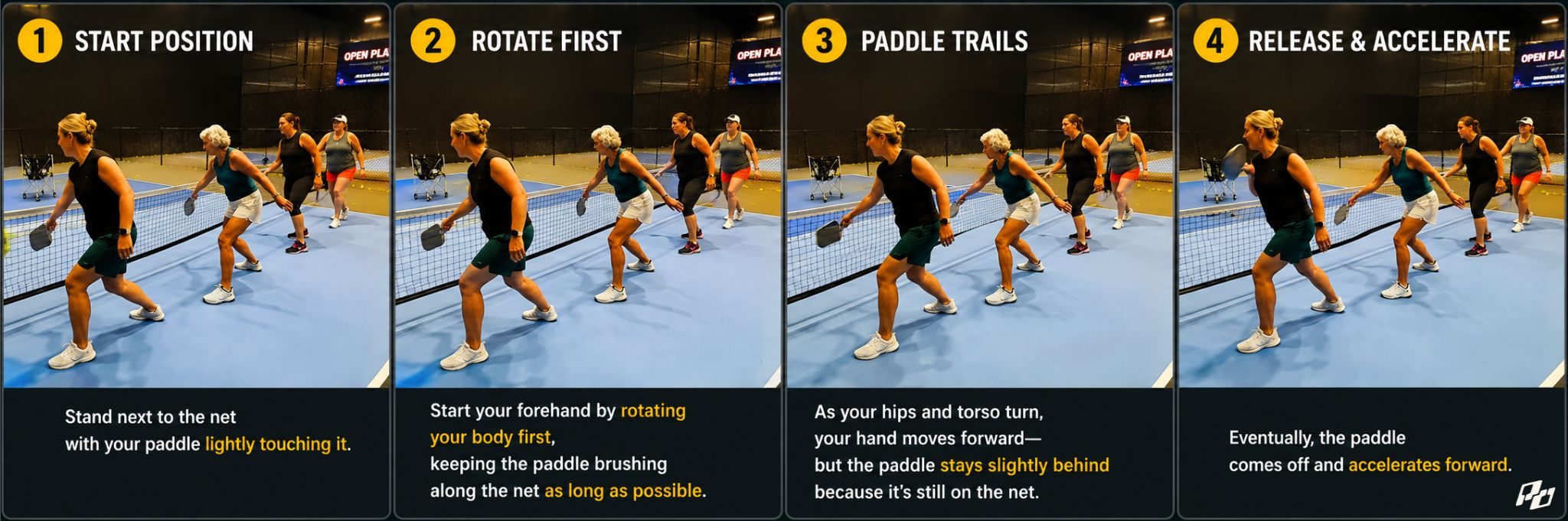
Stand next to the net with your paddle lightly touching it. Start your forehand by rotating your body first, keeping the paddle brushing along the net as long as possible.
As your hips and torso turn, your hand moves forward—but the paddle stays slightly behind because it’s still on the net.
Eventually, the paddle comes off and accelerates forward.
That’s lag. You’re not pulling the paddle—you’re letting your body lead and the paddle catch up.
Start slow and focus on the feeling, not speed. Once it feels natural, step away and hit gentle forehands while recreating the same sequence.
Why it works
Most players never experience true lag because they’re trying to hit the ball too hard.
Removing the ball removes the pressure. Now your brain can actually learn the movement pattern before speed gets involved.
When you add the ball back, the paddle starts feeling lighter, the swing feels smoother, and the power shows up almost effortlessly.
And the same lag principle that adds power to your drive also shows up on your serve:
Cue
“Body first. Paddle follows.”
Don’t pull the paddle.
Let your body deliver it.
How to transfer it to games
Before every practice session:
- Rehearse three slow-motion forehands.
- Hit three live drives.
- Repeat.
Alternating between rehearsal and live shots teaches your body to recognize the same movement under different conditions instead of learning two separate swings.
3. Finish to Your Opposite Shoulder
A lot of players blame inconsistent contact. Often the real problem is an inconsistent finish.
Watch most recreational players hit ten forehands and you’ll probably see ten different follow-throughs.
- Some stop at waist height.
- Some finish above their head.
- Some wrap around the body immediately.
Every different finish usually means a different swing path.
One of the easiest fixes is aiming your follow-through toward your opposite shoulder. For right-handed players, that means finishing toward the left shoulder:
This naturally encourages extension through the ball before the paddle finishes across the body.
Why it works
The follow-through tells the story of the swing. A consistent finish usually means:
- Similar paddle path.
- Similar extension.
- Similar contact.
- Similar paddle face.
Players who stop too low often drive the ball straight into the net.
Players who lift too high usually launch the ball long.
The opposite-shoulder finish naturally creates a balanced path between those two extremes.
Cue
“Finish to the opposite shoulder.”
Or even better: “Throw the ball forward—not upward.”
That image encourages extension instead of lifting.
How to transfer it to games
Don’t judge your drive only by whether it landed in. After every forehand, quickly ask yourself: “Where did my paddle finish?”
If the finish changes every swing, the mechanics probably changed too.
Consistency starts by repeating the movement—not hoping for the same result.
How Hard Should You Actually Swing?
This surprises a lot of players. The best forehand drive is rarely hit at 100%.
Most top coaches recommend something closer to 70–85% effort on routine drives.
Why?
Because paddle speed isn’t the same as body tension. The moment players try to hit every drive as hard as possible, they usually:
- lose their spacing
- rush their rotation
- tighten their grip
- flatten the ball
- recover slower for the next shot
Ironically, an 80% swing with clean mechanics often produces a heavier, more difficult ball than a wild 100% swing.
Save maximum effort for obvious putaways.
Your normal drive should feel fast…
…not desperate.
Cue
“Fast swing. Calm body.”
The Grip Pressure Mistake Almost Nobody Talks About
Players spend a lot of time worrying about grips. Much fewer think about grip pressure.
If you’re squeezing the paddle at a 9 or 10 out of 10, your forehand usually becomes stiff.
❌ The wrist stops moving naturally.
❌ The forearm tightens.
❌ The arm takes over.
Instead, think of grip pressure changing during the swing.
Start around 3–4 out of 10 during preparation.
Increase naturally to around 5–6 through contact.
Then relax again.
You’re not trying to keep the paddle loose. You’re trying to keep your arm relaxed enough that the paddle can accelerate naturally.
Cue
“Hold the paddle firmly—not tightly.”
Three Hidden Mistakes That Quietly Kill Your Forehand
Most players know a giant backswing is a problem. These mistakes are harder to spot.
| If your drive… | The hidden reason may be… | Better fix |
|---|---|---|
| Feels rushed even when you had time | You moved to the ball instead of creating your contact window | Move your feet earlier and create space before swinging |
| Has good pace but sits up for easy volleys | You’re driving forward but not giving the ball enough topspin shape | Finish through the opposite shoulder and let the ball dip |
| Looks great in drills but disappears in games | You’ve never practiced the forehand while making decisions | Mix drives, drops, and resets instead of repeating identical feeds |
These are the kinds of problems that frustrate intermediate players because they don’t look technical.
But they usually are.
Why These Adjustments Work Together
These aren’t three random forehand tips. They’re one connected movement.
| Stage | Focus | Result |
|---|---|---|
| Compact backswing | Stay connected and keep the shoulders closed | Better timing and consistency |
| Create lag | Let the body power the paddle | Effortless pace and heavier drives |
| Consistent finish | Extend through the ball | Better control, depth, and topspin |
Most rec players try to fix the forehand at contact. The real improvements happen before and after contact.
The backswing creates the position.
The body creates the speed.
The finish reveals whether everything happened correctly.
A Simple 15-Minute Forehand Session
If you want these changes to show up in games, don’t just hit forehands for 15 minutes. Build the movement progressively.
5 minutes: Wall drill. Focus on the compact “C” backswing and keeping the shoulders closed.
5 minutes: Alternate three shadow swings with three live forehand drives, concentrating on creating lag naturally.
5 minutes: Play live points where your only goal is repeating the same compact swing and opposite-shoulder finish—not hitting winners.
That final step is what most players skip.
You don’t improve because you understand a tip. You improve because your body learns to repeat it when the ball becomes unpredictable.
The Real Goal: Build a Forehand That Holds Up Under Pressure
Here’s the mistake most rec players make. They judge their forehand by its best shot.
The better question is: Can you hit the same drive on your first ball… and your fifteenth?
That’s what wins games.
Here’s one final piece of advice that almost nobody practices: Pay attention to your misses.
They tell you exactly which part of the swing broke down.
- Ball into the net? You probably lost extension or contacted the ball too late.
- Ball sailing long? Your body likely opened early or your swing became all arm.
- Ball with pace but no pressure? You created speed, but not enough topspin shape to make it dip.
If the same miss keeps showing up, don’t swing harder. Fix the movement that created it.
One final challenge: The next time you hit ten forehand drives, ignore whether they landed in.
Instead, ask yourself four questions:
- Did my backswing stay compact?
- Did my body lead the swing?
- Did I stay relaxed instead of forcing power?
- Did I finish on my opposite shoulder?
If you can answer yes four times in a row, you’re building something far more valuable than a highlight-reel forehand.
You’re building a forehand that survives pressure, bad bounces, deep returns, and close games.