
Pickleball is generally less intense than tennis, but it may be easier to play consistently, especially for older adults. Tennis usually delivers a stronger cardiovascular and muscular workout, while pickleball offers accessibility, social connection, and moderate exercise. The healthier choice is the sport you can play regularly, safely, and enjoyably.
The pickleball-versus-tennis argument usually starts with court space, noise, or which sport requires more skill.
But there is a better question: which one is actually better for your health?
At first glance, tennis appears to win. The court is larger, the rallies often demand more running, and heart rates tend to climb higher.
Pickleball, however, has a powerful advantage that is harder to measure: more people can play it, play it often, and keep playing it as they age.
That may matter more than which sport produces the toughest 60-minute workout.
The fairest conclusion is not that one sport is universally healthier. Tennis generally provides the greater physical stimulus. Pickleball may be the more sustainable health habit for players who want meaningful exercise without the same running demands, serving stress, or court coverage.
Here is what the research—and the realities of recreational play—suggest.
Tennis Usually Wins the Intensity Battle
If you compare a typical tennis session with a typical doubles pickleball session, tennis usually demands more.
Players cover a larger court, accelerate over longer distances, hit overhead serves, and recover between wider positions. That generally means more running and a higher cardiovascular workload.
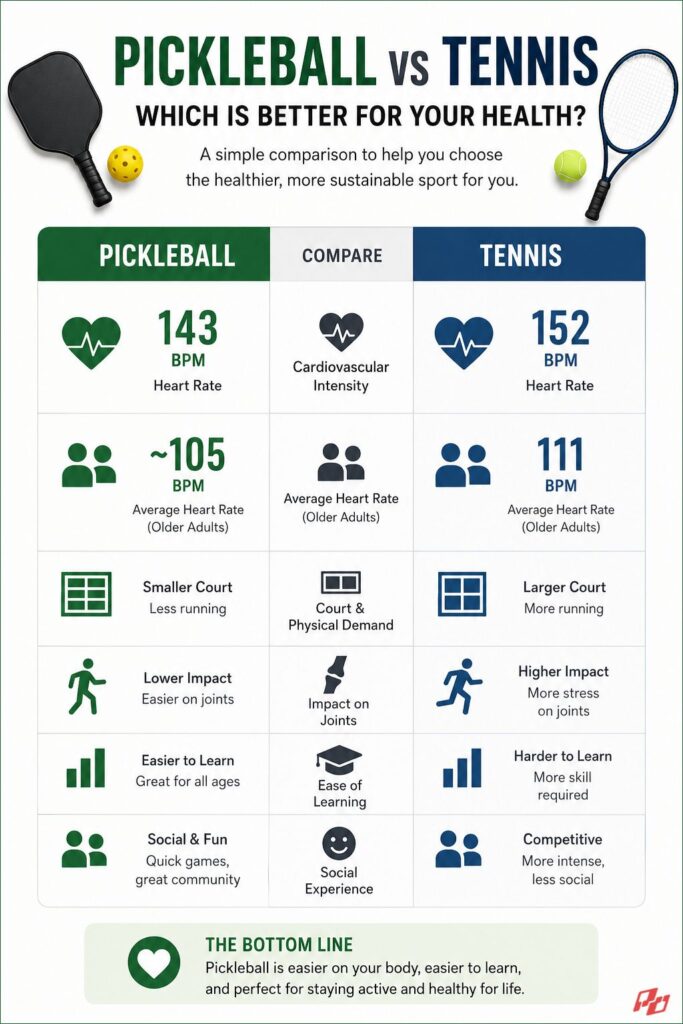
Research based on Apple Watch workout data found that recorded peak heart rates were higher during tennis than pickleball, although both sports produced substantial activity. The average peak was reported at approximately 152 beats per minute for tennis and 143 for pickleball.
That does not make pickleball ineffective.
A study of older adults playing singles and doubles pickleball found average heart rates around 111 beats per minute, with singles players recording more steps than doubles players. Those figures suggest that pickleball can provide legitimate moderate-intensity activity, especially during longer sessions or competitive games.
The format matters enormously.
A fast singles pickleball game can be far more demanding than relaxed doubles tennis. Conversely, social doubles pickleball filled with short rallies and long conversations may not challenge the cardiovascular system very much.
So the better comparison is not simply tennis versus pickleball.
It is:
- singles versus doubles
- competitive play versus casual play
- continuous rallies versus frequent breaks
- sixty minutes of movement versus sixty minutes of court time
The practical takeaway
⮕ Tennis usually provides the harder cardiovascular workout.
Pickleball still counts as meaningful activity, but players who spend most of their time in low-movement doubles may need to add brisk walking, cycling, intervals, or strength training away from the court.
Pickleball’s Biggest Health Advantage Is Accessibility
A demanding workout only helps if you can perform it safely and consistently. This is where pickleball becomes extremely compelling.
The smaller court reduces the amount of ground players must cover. The underhand serve is generally less demanding on the shoulder than tennis’s overhead service motion. The ball is slower, the paddle is lighter than a tennis racquet, and doubles play allows partners to share the court.
For players with reduced mobility—or former tennis players who no longer want to cover a full tennis court—those differences can be the reason they remain active.
That does not mean pickleball is effortless. Competitive rallies still involve rapid reactions, lateral movement, lunging, bending, rotation, and repeated acceleration.
But the entry point is lower.
A player can begin with short sessions, limited court coverage, and cooperative doubles. As confidence and conditioning improve, the same sport can become surprisingly intense.
This scalability may be pickleball’s most underrated health benefit.
It works for the beginner learning to keep score, the 70-year-old former tennis player, and the athletic 4.5 player exchanging hands battles at the kitchen.
Which Sport Is Easier on the Body?
Pickleball is often described as low-impact. That is true only in a relative sense.
Compared with tennis, pickleball generally requires less long-distance sprinting and fewer high-force overhead serves. The smaller court can reduce overall running volume, particularly in doubles.
But pickleball still includes abrupt stops, lateral pushes, backpedaling, reaching, twisting, and lunging for low balls.
Those movements can be demanding, especially for players who begin the sport after years of limited activity.
Injury surveillance has found that many pickleball-related injuries involve older adults, with strains, sprains, fractures, falls, and lower-leg problems appearing frequently. One analysis of emergency-department data found that a large majority of recorded pickleball injuries occurred in adults over 60.
That does not prove pickleball is unusually dangerous.
Older adults make up a large portion of the player base, and emergency-department databases capture injuries severe enough to require care—not the total number of hours played.
⮕ Still, the finding reinforces an important point: pickleball is easier to start than tennis, but it should not be treated like a nonsport.
The game feels approachable, which may tempt new players to play three hours before their calves, Achilles tendons, hips, and balance systems are ready for it.
The sport is accessible.
Your body may not be—not yet.
Tennis May Do More for Muscle and Bone
Tennis’s greater court coverage and explosiveness can provide a stronger stimulus for the legs, trunk, and cardiovascular system.
The wider movements demand more force from the hips and legs. The overhead serve recruits the shoulder and trunk through a larger range. Longer sprints and harder changes of direction may challenge muscle and bone more than typical recreational doubles pickleball.
Weight-bearing sports with multidirectional movement can support bone health, although the benefit depends on intensity, frequency, age, nutrition, and previous training.
Tennis has a longer and deeper research history in this area. Pickleball research is much newer, so we do not yet have the same volume of long-term evidence.
That does not mean pickleball fails to strengthen the body.
Repeated squatting, lunging, shuffling, reaching, and changing direction create a meaningful musculoskeletal load—particularly for previously sedentary players.
But recreational pickleball should not replace strength training.
Court play alone may not adequately challenge:
- the posterior chain
- upper-body pulling strength
- calf capacity
- single-leg stability
- progressive bone-loading capacity
⮕ For long-term health, pickleball works best as part of a broader routine that includes resistance exercise and balance training.
The Brain Benefits May Be Closer Than the Physical Ones
Tennis and pickleball both require far more than simply hitting a ball. Players continually process:
- ball speed;
- spin;
- trajectory;
- opponent positioning;
- partner movement;
- score;
- shot selection;
- risk.
Those demands combine movement with rapid decision-making.
That is valuable because physical activity and cognitively challenging tasks both support healthy brain function. In pickleball, the player must track the ball, coordinate the hands and feet, adjust to unpredictable shots, and make tactical decisions within fractions of a second.
Intermediate pickleball adds another layer.
You are no longer merely reacting. You are deciding whether to drive or drop, recognizing attackable balls, disguising speed-ups, protecting the middle, and anticipating the next two shots.
That mental workload is one reason pickleball can remain engaging long after the novelty disappears.
⮕ It is exercise disguised as a tactical puzzle.
Pickleball May Have the Social Edge
This is where pickleball makes its strongest case.
Tennis can be highly social, especially in doubles, leagues, and clubs. But tennis often requires arranging a partner, reserving a court, and matching players by level.
Pickleball open play lowers those barriers.
Players frequently arrive alone, rotate into games, and meet several partners and opponents during one session. A morning at the courts can function as exercise, competition, and social gathering at the same time.
That matters because social connection is not a minor wellness bonus. Isolation and loneliness are associated with poorer mental and physical health, while regular social engagement can support emotional well-being.
Research examining racket sports has found associations with lower mortality, although those studies cannot prove that the sport itself caused the difference. People who play racket sports may also have greater income, better access to facilities, healthier habits, and stronger social networks.
One widely cited analysis of more than 80,000 adults found that participation in racket sports was associated with a substantially lower risk of all-cause and cardiovascular mortality than inactivity. The study grouped racket sports together and predated pickleball’s current boom, so its findings should not be presented as pickleball-specific proof.
Still, pickleball combines several factors associated with healthy aging:
- regular movement;
- skill learning;
- competition;
- social interaction;
- a strong reason to leave the house.
That combination may be more important than any isolated calorie number.
Does Tennis Really Add Nearly 10 Years to Your Life?
You may have seen the headline that tennis players live almost 10 years longer.
It came from an observational analysis of the Copenhagen City Heart Study. Researchers reported that tennis participation was associated with approximately 9.7 additional years of life expectancy compared with a sedentary lifestyle. Badminton, soccer, cycling, swimming, jogging, and gym exercise were also associated with longer life, but tennis produced the largest estimate.
That result is fascinating.
It is not proof that picking up a racquet adds exactly 9.7 years to your life.
Observational studies can identify associations, but they cannot fully separate the sport from the type of people who choose it. Tennis players may differ from inactive adults in income, medical care, diet, education, social connection, and many other ways.
Pickleball also was not included as a meaningful category in that research.
The honest answer is that we do not yet have decades of pickleball-specific longevity data.
The sport’s modern participation boom is too recent. Any claim that pickleball extends life by a specific number of years would be premature.
So, Is Pickleball Healthier Than Tennis?
It depends on the player.
Tennis may be healthier for you when:
- you can tolerate the larger court and higher intensity;
- you want a more vigorous cardiovascular workout;
- you enjoy running and explosive movement;
- you can recover well between sessions;
- the physical challenge keeps you motivated.
Pickleball may be healthier for you when:
- tennis’s court coverage limits how often you can play;
- shoulder or mobility restrictions make tennis difficult;
- you are returning to exercise;
- social connection is a major reason you stay active;
- you can play pickleball consistently without excessive soreness or injury;
- the enjoyment of the game keeps you moving several times per week.
The sport that produces the greatest laboratory workload is not always the sport that creates the best real-life health outcome.
A vigorous tennis match played twice a month may deliver less total benefit than pickleball played three times per week—especially if the pickleball player also strength-trains and walks regularly.
⮕ Consistency usually beats theoretical superiority.
How to Make Doubles Pickleball More Athletic
You do not need to play singles to turn pickleball into a better workout. The key is to increase movement density—more purposeful movement, less standing and watching.
Start with these four changes:
1. Recover Before You Watch
After every shot, move back into position immediately. Do not admire a good dink, drive, or lob. Hit, recover, then track the next ball.
This adds dozens of extra acceleration and balance movements during a game while improving court coverage.
2. Earn the Kitchen Line
During practice, start one team at the baseline and require both players to reach the non-volley line under control before they can score.
This creates repeated drop, advance, split-step, reset, and recovery sequences—far more athletic than beginning every rally at the kitchen.
3. Use Crosscourt Skinny Singles Intervals
Play crosscourt skinny singles for 60 to 90 seconds at a time, with short rests.
Recover to a neutral position after every shot instead of remaining where the ball pulled you. The narrow court still creates plenty of lateral movement, lunging, stopping, and balance work without the demands of full singles.
4. Track Rally Density, Not Court Time
A two-hour open-play session can include a lot of waiting.
Instead, play focused 10- to 12-minute blocks with breaks between rallies kept under 20 seconds. Track long rallies, successful transition sequences, or how often you recover before your opponent makes contact.
⮕ For your next session, choose one rule: recover immediately after every shot and split-step before every opponent contact.
That simple constraint will make doubles feel faster, more physical, and more athletic—without changing the game itself.
My Take
Tennis is usually the better workout.
Pickleball may be the better habit.
That distinction matters.
Tennis asks more from the heart, legs, and shoulders. Pickleball asks less upfront, welcomes a wider range of players, and creates a social structure that makes people want to return.
For many recreational players—especially those over 50—the healthiest sport is not the one that burns the most calories in one match.
It is the one they can play consistently, recover from, enjoy, and combine with strength and mobility work.
Pickleball does not need to beat tennis in every category to be extraordinary for your health. It only needs to keep you moving, learning, competing, and coming back.