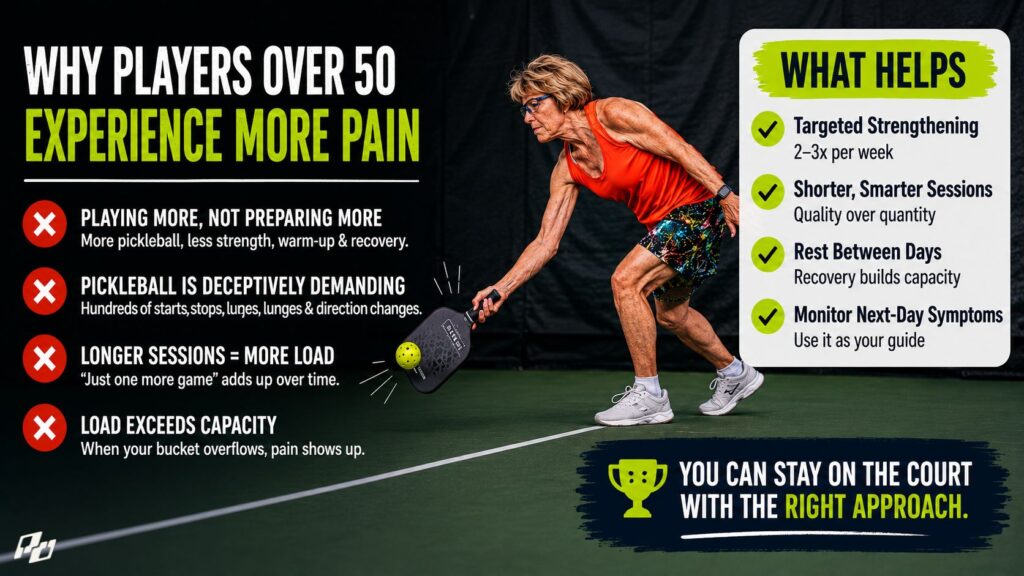
Pickleball pain after 50 is not always caused by aging. It often reflects excessive playing volume, reduced strength, limited recovery, or a sudden increase in activity. Shorter sessions, targeted strengthening, rest between playing days, and monitoring next-day symptoms can help reduce pain and keep you on the court.
“It’s just my age.”
If you’ve played pickleball for a few years, you’ve probably heard that phrase—or maybe you’ve said it yourself.
“My Achilles just isn’t what it used to be.”
“My knees hurt because I’m getting older.”
“My feet ache every morning now. That’s life after 60.”
Usually, the story is the same.
A nagging pain starts in the Achilles, heel, knee, or shoulder. You take a few days off, maybe ice it, maybe stretch a little, and it settles down.
Then you get back on the court…
…and after a few games, it’s right back where it started.
After enough repetitions of this cycle, many players stop thinking of it as a problem they can solve. Instead, they chalk it up to aging.
I recently came across a physical therapist who said something that stuck with me:
“Most pickleball players aren’t dealing with a body that’s wearing out. They’re dealing with a body that hasn’t prepared for the demands they’re placing on it.”
The more I looked into what sports medicine doctors, physical therapists, and professional pickleball players recommend, the more I realized there’s a lot of truth to that statement.
Not because age doesn’t matter—it absolutely does.
But because age is only part of the equation.
Many of the aches recreational pickleball players live with aren’t inevitable consequences of getting older. They’re often the result of asking the body to do more than it’s currently prepared to handle.
The encouraging part? That’s something you can actually change.
Age Is Real—But It’s Not the Whole Story
Let’s get one thing out of the way. This isn’t one of those articles claiming, “Age is just a number.” It isn’t.
Our bodies change as we get older.
After about age 30, we gradually lose muscle mass and strength unless we actively train to maintain them. Tendons become a little less forgiving when workloads suddenly increase. Recovery typically takes longer, and conditions like osteoarthritis become more common.
Those changes are real.
Research also shows that older pickleball players experience more lower-body injuries than younger players, particularly falls, fractures, Achilles injuries and knee problems. That’s one reason injury rates have risen as the sport has exploded among adults over 50.
So yes… your age matters. But here’s the important distinction.
Age changes your starting point. It doesn’t automatically explain every ache or pain you feel after pickleball.
Sports medicine physicians repeatedly make this distinction.
For example, doctors at Hospital for Special Surgery point out that many people with knee osteoarthritis can continue playing pickleball successfully. The goal isn’t necessarily to stop playing—it’s to manage the condition through appropriate exercise, strength training and smart workload management rather than simply accepting pain as unavoidable.
That’s a very different message from:
“You’re getting older. Learn to live with it.”
The Mistake Many Recreational Players Make
Here’s something I’ve noticed watching recreational pickleball.
Most players adjust their expectations as they get older. Very few adjust their preparation. Think about it.
At 45, maybe you played twice a week.
At 60, you’re retired, your local courts are five minutes away, and suddenly you’re playing five mornings a week.
That’s fantastic.
Except…
many players make one major change.
They play more pickleball.
At the same time, they do less of everything that helps them tolerate pickleball.
Strength training disappears.
Warm-ups become a few dinks.
Recovery becomes an afterthought.
Mobility work happens only when something starts hurting.
Then, when pain shows up, age gets all the blame. But imagine asking your car to drive twice as many miles while changing the oil half as often. Would you blame the car’s age? Or would you admit it wasn’t being maintained for the workload?
Your body works in a surprisingly similar way.
Why Pickleball Is Harder on Your Body Than It Looks
One reason this catches so many people off guard is that pickleball doesn’t feel like an intense sport.
You’re not sprinting the length of a tennis court.
You’re not running a marathon.
Your heart rate might not even feel that high.
But underneath the surface, your lower body is doing an enormous amount of work. Every point involves accelerating, stopping, lunging, shuffling sideways, pushing off one leg, recovering to the kitchen, then doing it all over again.
An average open-play session can include hundreds of small accelerations and decelerations.
Your lungs may not be exhausted. Your calves, knees and feet might be. That’s especially true because pickleball is unique in one important way. Most recreational players don’t stop when they’re physically tired.
They stop when everyone else leaves.
A “quick hour” turns into three.
One game becomes six.
Then someone says,
“One more?”
And suddenly your Achilles has absorbed another 30 minutes of repeated loading. Sports medicine physicians often talk about load versus capacity. It’s one of the simplest ways to understand recurring pain.
The Concept That Explains Most Recurring Pickleball Pain
Think of your body like a bucket. Every time you play pickleball, you pour water into it. Strength training makes the bucket bigger. Recovery empties some of the water. Sleep helps. Good nutrition helps.
Playing four hours of open play? That’s a lot of water.
If your bucket is big enough…
no problem.
If it isn’t…
eventually it overflows.
Pain is often the overflow warning. That doesn’t necessarily mean something is torn. It doesn’t even mean you’ve caused permanent damage. It often means your current workload is exceeding your current capacity.
That’s why taking a week off frequently “fixes” the problem… until you go right back to the exact same routine.
Why Rest Keeps Fooling You
This is probably the most common cycle in recreational pickleball.
- Play.
- Pain develops.
- Rest for a few days.
- Pain settles.
- Play again.
- Pain returns.
It feels logical to conclude,
“Well, I guess I’m just getting older.”
But another explanation is often more accurate. Nothing actually changed. You temporarily removed the stress. You didn’t improve your body’s ability to handle that stress.
This is especially true for many tendon problems.
Current clinical guidelines for Achilles tendinopathy don’t recommend endless cycles of rest. Instead, they emphasize gradually rebuilding the tendon’s ability to tolerate load through progressive strengthening.
The goal isn’t simply to reduce pain today. The goal is to make the tendon capable of handling tomorrow’s pickleball session.
The same principle applies to many recurring aches. Calming symptoms is not the same thing as increasing capacity.
That’s why some players spend months bouncing between the couch and the pickleball court without ever making real progress.
What Age Actually Changes—and What You Should Change With It
Let’s come back to the age question. Because age absolutely changes how you should approach pickleball. It just doesn’t mean you should expect to hurt all the time. As we get older, three things become especially important.
First, recovery matters more.
You may no longer bounce back from three consecutive days of open play the way you did ten years ago. That doesn’t mean you should stop playing—it means your schedule may need more recovery between harder sessions.
Second, strength becomes increasingly valuable.
After about age 50, maintaining muscle becomes something you actively train for rather than something your body does automatically.
That’s one reason strength training has such a profound effect on older pickleball players. Stronger calves reduce stress on the Achilles. Stronger hips help control the knee during lunges. Better leg strength improves balance and makes falls less likely.
Perhaps the biggest mistake many recreational players make is replacing strength training with more pickleball.
The two are not interchangeable. Pickleball uses strength. It doesn’t build all the strength required to protect your joints from pickleball.
Third, your body becomes less tolerant of sudden changes.
One of the highest-risk situations isn’t simply being 65. It’s being 65, taking three weeks off because of vacation, then jumping straight into a three-hour round robin.
Your tissues haven’t forgotten how to move.
They’ve simply lost some of their recent conditioning.
That’s why sports medicine physicians recommend increasing activity gradually after illness, injury or time away from the court.
The encouraging news is that older bodies are still remarkably adaptable.
Muscles still grow stronger.
Balance improves.
Tendons respond to progressive loading.
You may need a little more patience than you did at 35, but your body is still capable of building the qualities that keep you healthy on the court.
The goal isn’t to play like you’re 30 again. It’s to prepare like someone who wants to keep playing well into their 70s.
What Your Pain Is Trying to Tell You
One mistake I see over and over is players treating every ache exactly the same.
Achilles pain?
Stretch it.
Heel pain?
Buy new shoes.
Knee pain?
Wear a brace.
Shoulder pain?
Take a week off.
The problem is that pain is just a symptom. The real question is: what’s creating more stress than your body can currently handle?
Here’s how sports medicine doctors and physical therapists typically think about the most common pickleball pains.
Achilles Pain: Usually a Load Problem, Not an Age Problem
The Achilles tendon is probably the hardest-working tendon in pickleball.
- Every explosive first step.
- Every recovery to the kitchen.
- Every split step.
- Every lunge.
- Every push back after a dink exchange.
Your Achilles acts like a spring, storing energy and releasing it with every movement.
That’s fantastic…
until you ask it to do more than it’s ready for.
One thing many players notice is that the tendon doesn’t hurt much during the first game. Instead, it’s stiff getting out of bed the next morning.
That’s an important clue.
Physical therapists often pay close attention to morning stiffness, because it’s one of the classic signs that the tendon isn’t recovering well from yesterday’s workload.
⮕ What to change immediately
Don’t stop moving completely. Instead, reduce the activities that create the highest tendon loads.
For a couple of weeks, that usually means:
- shorten sessions from three hours to 90 minutes
- avoid consecutive playing days
- play doubles instead of singles
- drill resets and dinks instead of playing endless competitive games
- stop the session when your push-off starts feeling weaker
One of the biggest mistakes players make is continuing to play after they begin compensating.
If you notice yourself taking shorter steps…
avoiding pushing off one foot…
or reaching instead of moving…
you’re no longer just “playing through soreness.” You’re changing your mechanics. That’s when other injuries start appearing.
Build the tendon instead of protecting it forever
Research consistently shows that tendons need load.
Not random load.
Progressive load.
A simple starting point is slow calf raises. Perform them slowly enough that the tendon actually has to work.
- Two seconds up.
- Pause.
- Three seconds down.
Start with both legs if necessary. Eventually progress to single-leg raises. When bodyweight becomes easy add resistance. A backpack with books works perfectly.
The goal isn’t simply to eliminate pain. It’s to create an Achilles that can comfortably tolerate 200 split steps during open play.
That’s a very different objective.
Heel Pain: Sometimes Your Foot Isn’t the Problem
Many players assume heel pain means they need better shoes. Sometimes they do. But often that’s only part of the story.
One of the biggest contributors to plantar heel pain is simply asking the calf-foot system to absorb more repeated force than it’s ready for. Think about what happens during two hours of pickleball.
Hundreds of tiny pushes.
Hundreds of weight shifts.
Hundreds of decelerations.
Your plantar fascia helps transfer all of that force. When it becomes overloaded, the first steps in the morning often become the most painful.
Then, strangely…
it loosens up.
Many players interpret that as: “It’s getting better.” Not necessarily. It simply means the tissue warmed up.
⮕ What to change
Instead of asking,
“What shoe should I buy?”
ask,
“Why is my foot suddenly handling 40% more court time than last month?”
The answer is often workload. Reduce total standing time. Avoid marathon open play. Take sitting breaks between games instead of remaining on your feet.
If your shoes have several hundred miles on them, replacing them may help—but don’t expect a new pair of shoes to fix a tissue that simply isn’t strong enough for your current playing volume.
Build stronger feet
One thing many players never train is the foot itself. Yet your foot is the first structure that absorbs force every single point.
Simple barefoot balance drills.
- Single-leg standing while brushing your teeth.
- Calf raises.
- Toe strengthening.
Those tiny exercises gradually increase your foot’s ability to handle pickleball. Professional players rarely think about strengthening their feet. They simply do it as part of becoming stronger athletes.
Front-of-the-Knee Pain: It Isn’t Always Your Knee
If your pain sits around the kneecap, especially after repeated lunges, the knee may be taking the blame for a problem that starts somewhere else.
Watch many rec players reach for a dink:
Their knee shoots forward.
Their hips stay almost vertical.
Their weight dumps into the front of the leg.
The knee absorbs nearly everything. Now watch stronger movers.
Their hips move back.
Their trunk leans slightly forward.
Their glutes and hamstrings help share the load.
That’s why the movement looks smoother.
Not because their knees are magic.
Because the force is spread across the whole body.
And that’s something every player can learn.
A cue that changes everything
Instead of thinking:
Bend your knee.
Think:
Sit into your hip.
You’ll immediately notice the movement feels stronger and more balanced.
Build the muscles that actually protect the knee
Research consistently shows that both quadriceps and hip strengthening improve many common knee pain conditions.
That means:
- Split squats.
- Step-downs.
- Reverse lunges.
- Romanian deadlifts.
- Side-stepping with a resistance band.
You don’t need bodybuilding workouts. You need stronger brakes.
“My Knee Has Arthritis”
This is probably the statement I hear most often from players over 60.
Sometimes it’s true.
Sometimes the X-ray shows arthritis.
Sometimes it doesn’t.
Here’s what’s important. Many people have arthritis on imaging without much pain. Others have significant pain with relatively mild arthritis.
The image doesn’t always predict how you’ll feel.
The encouraging news is that movement is actually one of the best treatments for osteoarthritis.
Not endless impact.
Not ignoring severe pain.
But regular movement.
Strength training.
Weight management.
Maintaining mobility.
Hospital for Special Surgery physicians often encourage patients with mild-to-moderate arthritis to continue playing pickleball—with appropriate modifications—because staying active generally helps joint health more than becoming sedentary.
⮕ How to keep playing
If your knee flares after three hours…don’t immediately quit pickleball. Instead ask:
- Can I play for 90 minutes?
- Can I play every other day?
- Can I drill instead of competing?
- Can I improve my leg strength?
- Can I lose ten pounds?
Even a modest reduction in body weight significantly reduces the force your knees experience with every step.
For many players, that’s more impactful than buying another brace.
The Most Important Check Happens the Next Morning
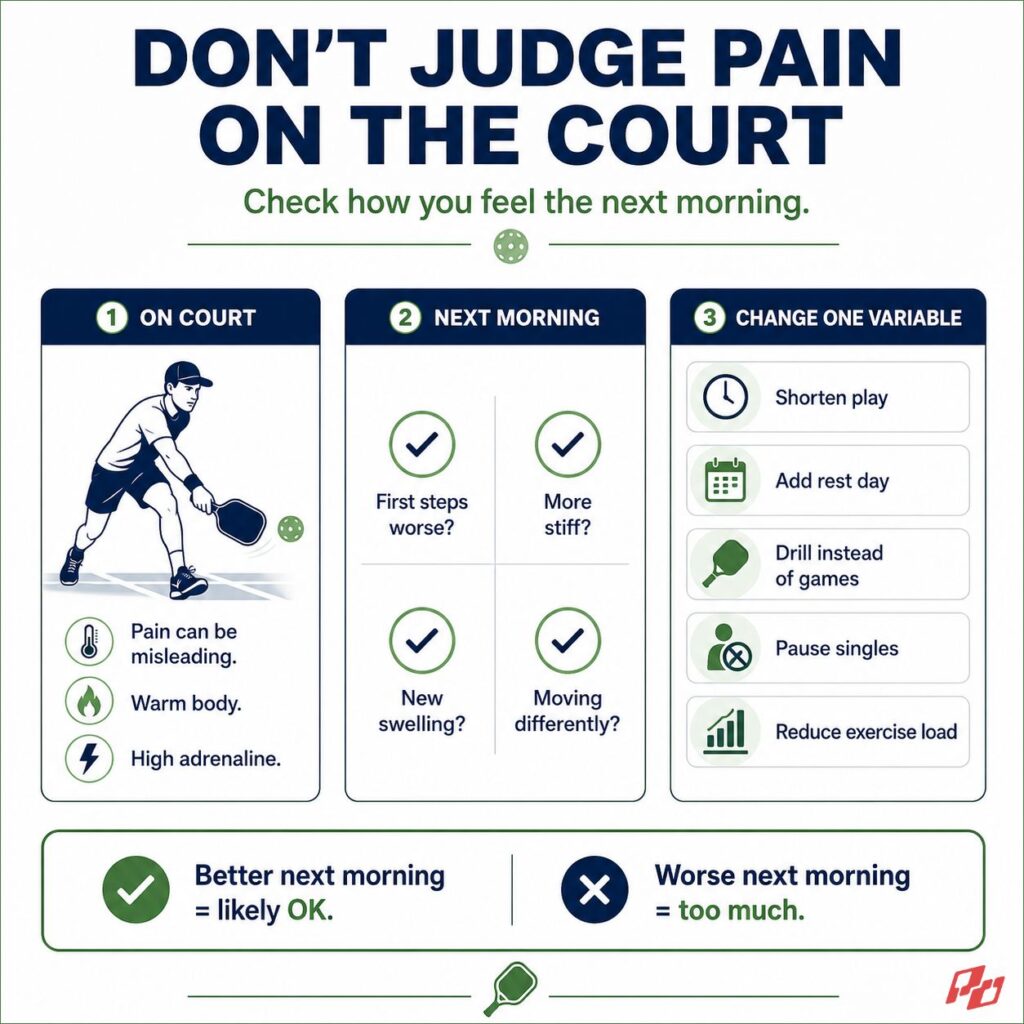
Most players judge pain while they’re still on the court. That’s not always reliable. Your body is warm, adrenaline is high, and irritated tissues may feel better once you start moving.
The better test is how you feel the next morning.
Ask yourself:
- Are the first few steps more painful than usual?
- Is the area noticeably stiffer?
- Is there new swelling?
- Am I limping or changing how I move?
Clinicians often look at this 24-hour response to judge whether a tendon, muscle, or joint tolerated the previous day’s workload.
If symptoms are close to normal by the next morning, the session may have been within your current capacity.
If your Achilles is much stiffer, your heel is more painful, or your knee is swollen, yesterday was probably too much.
That is not failure. It is useful feedback.
⮕ Change One Variable
Don’t respond by stopping everything or changing five things at once. Adjust one variable for the next few sessions:
✓ shorten three hours to 90 minutes;
✓ add a rest day between sessions;
✓ replace games with controlled drilling;
✓ pause singles temporarily;
✓ reduce the weight or repetitions in an aggravating exercise.
Then check your response the following morning.
A simple two-week log can make the pattern obvious. Record how long and hard you played, where you felt pain, and how you felt the next day.
You may discover that your Achilles flares only after two-hour sessions, your knee reacts to consecutive playing days, or your heel struggles after one particular type of workout.
When You Shouldn’t Try to Push Through It
One important disclaimer. Not every ache is a training problem. Sometimes pain is your body asking for a stronger calf. Sometimes it’s your body asking for a doctor.
Don’t keep experimenting with stretches and strength exercises if you have:
❌ a sudden pop in your Achilles or calf;
❌ rapid swelling or significant bruising;
❌ a knee that locks or repeatedly gives way;
❌ pain that gets progressively worse every time you play;
❌ persistent pain that doesn’t improve after reducing your workload for several weeks;
❌ numbness, weakness, or difficulty bearing weight.
Those symptoms deserve an evaluation by a physician or physical therapist.
The sooner you know exactly what’s going on, the sooner you can build the right recovery plan instead of guessing.
Stop Blaming the Calendar
At some point, almost every longtime player has the same thought.
Maybe it happens when your knee aches after a long session. Maybe it is when your Achilles feels stiff the next morning. Maybe you watch someone younger fly around the court and think, Well, that used to be me.
It is easy to blame age because age feels final. But pain is not always a verdict. Sometimes it is simply information.
It may be telling you that you played too long, returned too quickly after time off, or asked more from your body than you had prepared it to handle.
That is a much more useful message than, I am just getting older.
You do not need to move like you did at 30. You do not need to ignore every ache or prove anything by pushing through pain.
You just need to stay curious about what your body is telling you—and be willing to adjust.
Maybe that means ending a session one game earlier. Maybe it means adding a rest day. Maybe it means finally addressing the weakness or stiffness you have been working around for months.
Those small decisions may not feel dramatic, but they are often what keep people playing.