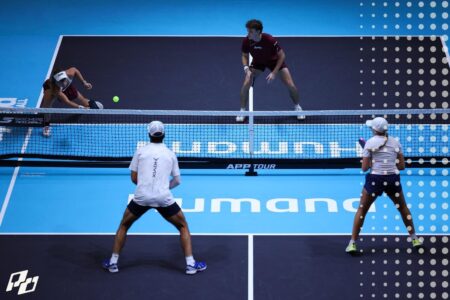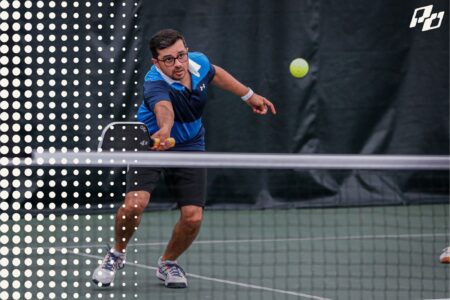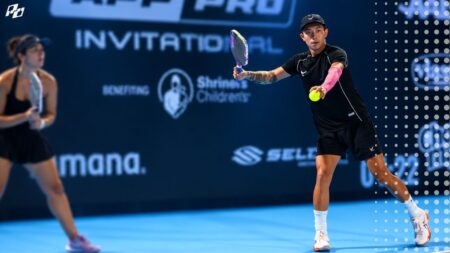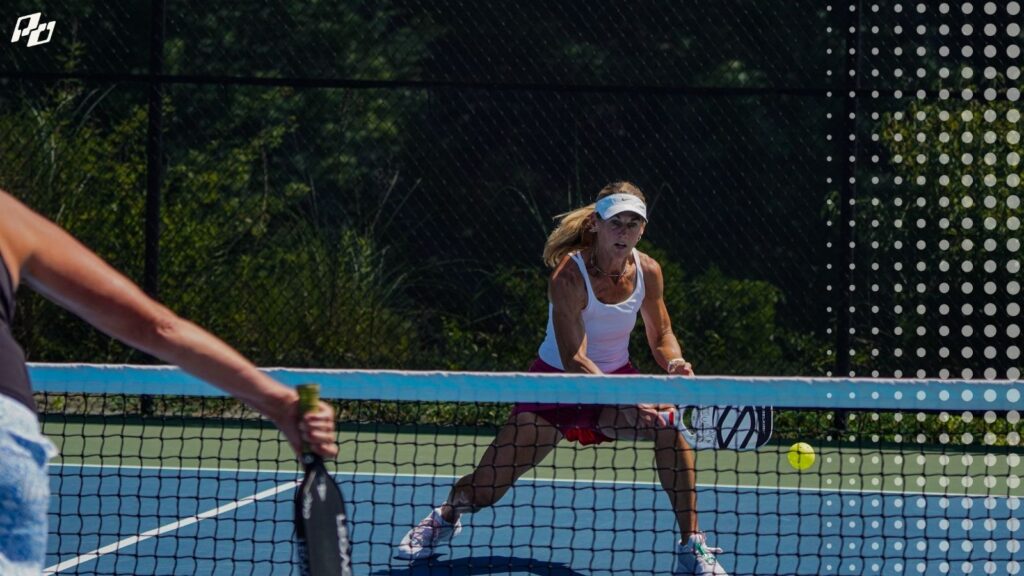
An inside-foot backhand speed-up works best when the ball sits high enough, you’re balanced, and your opponent is shading or protecting one side. Disguise it like a dink, accelerate compactly, and target the opening rather than forcing maximum pace.
We recently published a guide on defending inside-foot dinks—the awkward balls that crowd your base and force you to create space before contact.
Now let’s flip the problem around.
What if you are the player receiving that inside-foot ball?
At first glance, it looks like a terrible ball to attack. You’re on the right side, the dink lands near your inside left foot, and your backhand is cramped.
But advanced players have turned that awkward location into a legitimate offensive weapon.
James Ignatowich specifically teaches the two-handed backhand speed-up from the inside foot on the right side, and recent right-side coaching also treats this location as a useful deception opportunity when the opponent’s positioning gives you the right opening.
The key is understanding why the target opens—and when not to force it.
First: What Is the Inside-Foot Speed-Up?
For a right-handed player on the right side, the inside foot is typically the left foot, toward the middle of the court.
A dink landing there puts the ball into your backhand window.
That is normally an awkward attacking position. Ignatowich has pointed out that this location limits the right-side player’s offensive options, which is precisely why good opponents target it.
But if the ball sits up enough and you have time to organize your body, you can turn that backhand contact into a speed-up.
The basic idea is:
Same inside-foot setup. Different intention.
Instead of automatically dinking crosscourt again, you disguise an attack from the backhand. Take a look at how it’s done:
Why This Shot Works
The interesting part isn’t just the swing. It’s what the opponent tends to do before you hit.
Imagine you are on the right side and the left-side opponent across from you is right-handed. When they sense a speed-up coming, many players instinctively protect their forehand side.
They may shift slightly to their right, open space on the opposite side, or bias the paddle toward the forehand because they expect the harder ball there.
That creates the tactical opportunity described in the original coaching advice:
The more convincingly your preparation suggests a hard attack, the more the opponent may shade toward the side they trust most.
Recent speed-up coaching makes the same broader point: advanced attackers read where the opponent is sitting and target away from the paddle bias, rather than blindly choosing one body target every time.
So the shot works partly because you are attacking their anticipation, not simply their court position.
This Is Really a Disguise Shot
The inside-foot speed-up becomes much more effective when it starts like your dink.
If every inside-foot ball has looked like: backhand dink → backhand dink → backhand dink
and suddenly one leaves the paddle at speed, the opponent has less time to react. That is why the backswing needs to stay compact.
Big preparation gives the defender extra time to react before contact. A short, compact setup hides your intention longer and makes the speed-up harder to read.
Cue
Show dink. Deliver speed.
One Hand or Two?
Both are possible.
⮕ Two-handed backhand
This is the version Ignatowich specifically teaches from the right-side inside-foot position.
The second hand can provide:
- extra stability
- faster acceleration
- easier topspin
- better control from a cramped backhand position
Ignatowich’s coaching on right-side play treats the two-handed backhand as a particularly useful weapon from this location.
⮕ One-handed backhand
A one-handed version also works, especially for players who already own a strong one-handed backhand flick.
Ignatowich has also taught the one-handed backhand speed-up off the bounce, emphasizing getting low enough to work underneath the ball rather than trying to lift it with a desperate wrist flip.
For recreational players, I would not switch to two hands solely because this shot exists. Use whichever backhand you already control better.
The Ball Still Has to Be Attackable
This is where people get carried away.
The fact that pros can attack from the inside foot does not mean every inside-foot dink should become a speed-up.
Look for three things.
1. Enough contact height
The ball does not need to be a popup.
But you need enough space underneath and behind it to accelerate forward without dramatically lifting.
If the ball is ankle-high and dying, dink.
2. Balance
If you are reaching sideways, falling backward, or jammed against your own leg, you are not in a good attacking position.
Create space first.
3. An opponent worth attacking
If the opponent is already sitting perfectly balanced with the paddle centered, a mediocre speed-up may simply start a hands battle you are not favored to win.
If they are shifting, leaning, or protecting one side early? Now you have something to exploit.
Cue
Height + balance + opening = attack.
Where Should You Hit It?
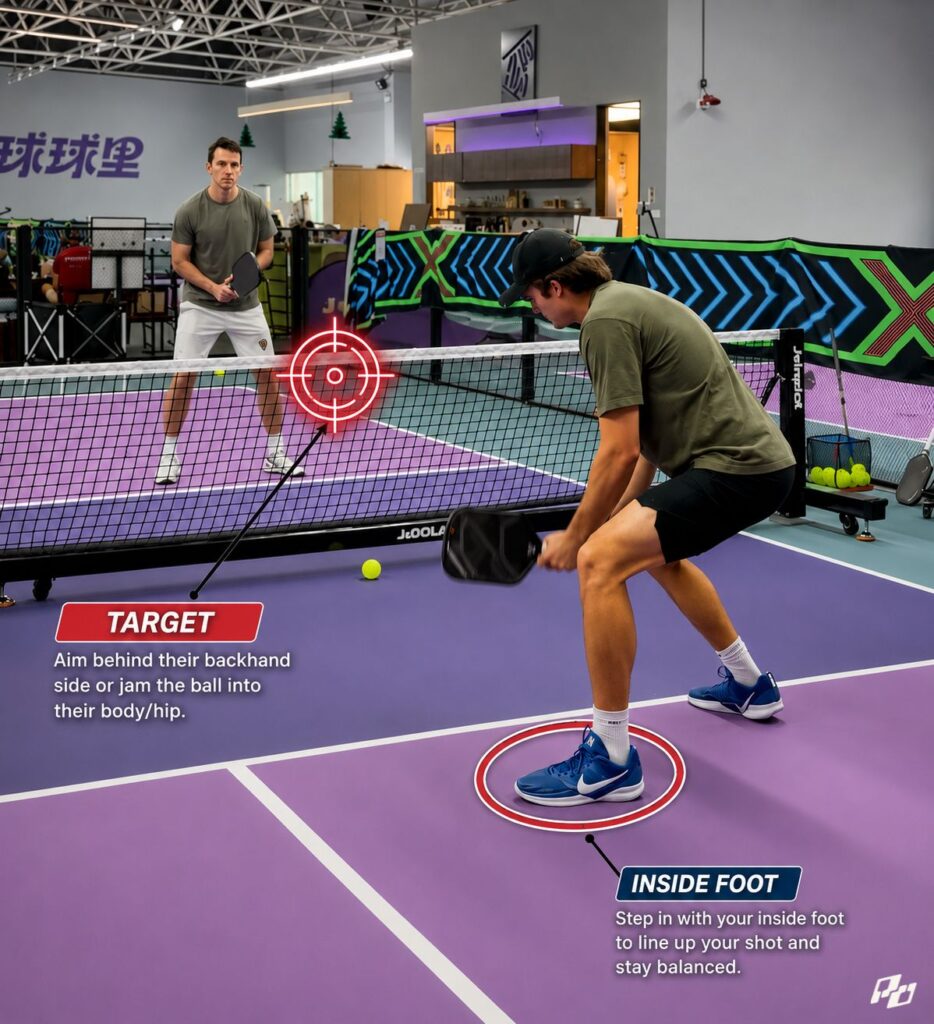
This is the most interesting tactical part. There is no universal “inside-foot speed-up target.”
Your target depends on what the opponent does.
⮕ They slide toward their forehand
Attack the newly exposed space.
This is the exact pattern behind the advice you started with: if a right-handed left-side player slides toward their dominant forehand side, the opposite lane can become surprisingly available.
⮕ Their paddle sits heavily backhand
Go toward the other hip.
Ignatowich’s broader speed-up framework recommends reading paddle position and targeting slightly away from where the defender is already loaded.
⮕ They stay neutral
Body and hip targets remain useful because they create indecision.
Speed-ups are often more effective when aimed at the body, hip, or shoulder because those targets create a reaction problem and can jam the defender, rather than relying on finding open court.
Be Careful Speeding Up Straight Into the Forehand
Here is an important limitation.
Ignatowich has specifically discussed why the right-side inside-foot ball can be difficult offensively: a speed-up straight through the middle may go directly into the opponent’s forehand, particularly against a strong left-side player.
That means “middle” is not automatically the safe attack.
Before accelerating, ask:
Whose paddle am I actually feeding?
If the answer is:
“Their best forehand counter,”
dink again.
The location of your contact does not excuse a bad target.
Don’t Hit It at 100%
A speed-up is usually better at controlled pace with accurate placement than maximum velocity with no follow-up plan. This is especially true off the bounce.
Hit too hard and:
- the ball may sail
- the opponent can dodge it
- your recovery takes longer
- your swing becomes easier to read
Too much pace can actually make the speed-up less effective. If the ball is clearly sailing long, a disciplined defender can simply let it go. The goal is controlled aggression—enough pace to rush the opponent while still keeping the ball inside the court.
For a 3.5–4.0 player, I would think: 70% pace, 100% intention.
Know Where the Counter Is Likely to Come Back
Advanced attackers think one shot ahead.
Ignatowich teaches a useful “triangle” concept: the direction of your speed-up influences the likely direction of the counter.
⮕ A straight attack tends to produce a straighter reply.
⮕ A diagonal attack tends to send the counter back along a diagonal path.
That matters because the speed-up itself may not win the rally. Often its job is to produce a predictable fifth ball.
So after you attack:
- recover the paddle immediately
- stay low
- know which side is likely to receive the counter
- be ready to finish or reset
Cue
Speed up, then expect it back.
The Pattern I’d Teach Intermediate Players
Don’t start by randomly trying inside-foot speed-ups in games. Build a pattern.
Ball 1: Dink from the inside-foot position.
Ball 2: Show the same preparation and dink again.
Ball 3: If they start leaning toward the expected dink—or the ball sits up—use the same setup and accelerate.
Same look. Different result.
Now the speed-up has context and is harder to read.
That is much more effective than deciding:
“I learned a new speed-up, so I’m trying it on the next ball.”
Who Should Actually Learn This?
3.0: Not yet. Build a reliable backhand dink and learn what attackable height looks like.
3.5: Yes, selectively. Add it when you can:
✅ dink reliably off the backhand
✅ create space around the inside-foot ball
✅ attack with compact preparation
4.0+: Absolutely. At this level, obvious attacks get read quickly. The real value comes from disguise, pattern recognition, and targeting.
The higher your level, the less this shot is about swinging harder—and the more it becomes about manipulating the defender.
The Biggest Mistake: Predetermining the Attack
You see the ball coming toward the inside foot and decide before the bounce:
“I’m speeding this one up.”
That is backwards.
First read: ball height
Then: your balance
Then: their positioning
Only then choose the attack.
- If the ball stays low, dink.
- If you are jammed, create space and dink.
- If the opponent never moves, reconsider the target.
But if the ball sits up, you are stable, and the opponent has started shading toward the side they expect?
Now the inside-foot speed-up becomes a very smart attack.
How I’d Think About the Inside-Foot Speed-Up
The inside-foot ball is awkward by design. Good players dink there because they know it restricts your options. That is exactly why turning it into an occasional attack is so useful.
You are taking a ball the opponent expects you to play defensively and showing them:
“You cannot automatically relax just because you found my inside foot.”
But the best version is not a desperate backhand rip. It is a disguised, controlled attack built on three reads:
Is the ball good enough?
Am I balanced enough?
Did my opponent give me an opening?
If yes, attack.
If not, dink again.
That is what makes the inside-foot speed-up dangerous—not that you can hit it hard, but that your opponent can no longer assume they know what is coming next.