A pickleball paddle may be holding you back if it consistently slows your hands, feels unstable on mishits, gives you too much or too little power, limits spin, or causes fatigue. The key is whether a different paddle repeatedly improves that specific problem without changing your technique.
Not sure where you land? Find your paddle first, then come back and read why it scored the way it did.
Pickleball players love blaming paddles.
Miss three resets?
“Too much pop.”
Lose a hands battle?
“Swing weight is too high.”
Serve lands short?
“Need more power.”
Sometimes they’re right.
But often, a new paddle simply gives you a different version of the same problem. The better question is:
Is my paddle consistently making an important part of my game harder even when my technique and timing are reasonably good?
That is when equipment becomes worth investigating.
A paddle does not need to be “bad” to hold you back. It can be an excellent paddle that is simply wrong for your strength, hand speed, contact quality, playing style, or current level.
Ten questions, three paddles matched to how you play, scored on lab data.
First: Rule Out the Player
Before spending $250, make sure the problem survives a technique check. If your dinks keep popping up, the paddle may be too lively.
But it could also be:
- grip pressure
- paddle-face angle
- late contact
- poor spacing
- hitting while moving
Recent coaching on control problems still puts grip and paddle angle ahead of equipment as common causes of misses.
So use this rule:
One bad shot is technique until proven otherwise. A repeatable pattern across weeks may be equipment.
The clearest evidence usually appears when you borrow another paddle. If the same technical mistake follows you immediately, your paddle probably wasn’t the main problem.
If a recurring limitation suddenly becomes noticeably easier without you changing your swing, now you have something worth investigating.
Sign #1: Your Hands Are Consistently Late
This is one of the clearest paddle mismatches.
At the kitchen, you see the counter early.
Your paddle is in front.
Your technique feels fine.
But you repeatedly arrive late during fast exchanges.
Look at swing weight, not just the ounces printed on the spec sheet.
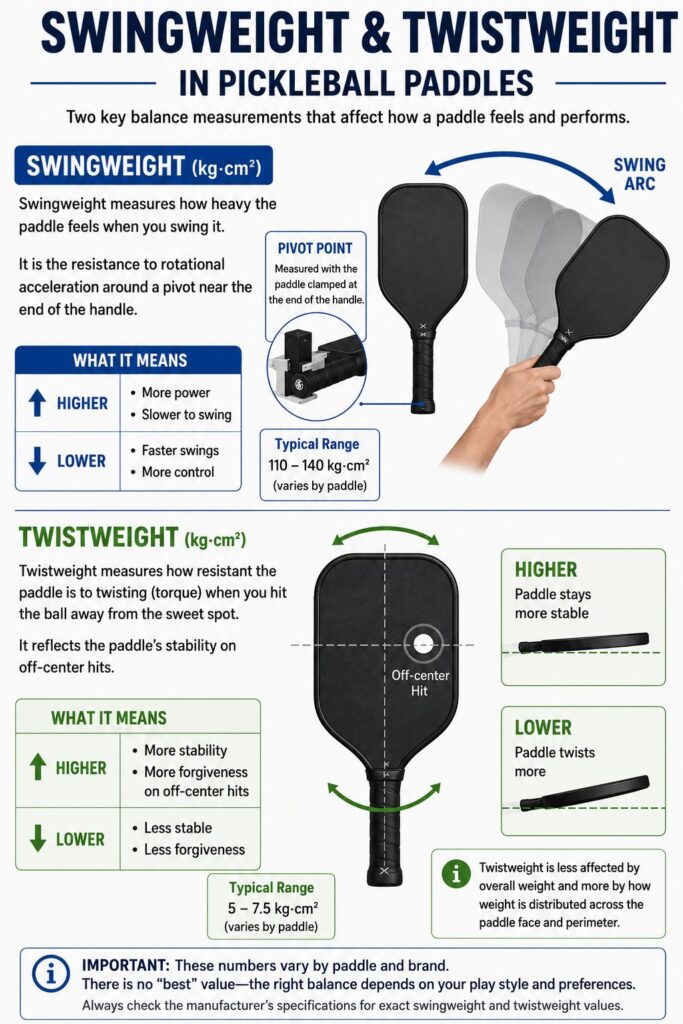
Swing weight measures rotational inertia—how heavy the paddle feels while moving. Two 8-ounce paddles can feel completely different because one carries more mass toward the tip. John Kew categorizes swing weight below 113 as low, 113–120 as medium, and 121+ as high.
JustPaddles similarly emphasizes that swing weight is often more informative than static weight when judging maneuverability.
Your paddle may be too demanding if:
- counters are consistently late
- forehand-to-backhand transitions feel slow
- the paddle feels great on drives but cumbersome at the kitchen
- your forearm tires during longer sessions
And this isn’t just theoretical. Some pros deliberately choke up on elongated handles specifically to reduce effective swing weight and improve hand speed.
If your paddle feels like a hammer during hands battles, more practice may help—but sometimes you simply bought too much paddle.
Sign #2: You Keep Missing the Sweet Spot
This one is especially relevant for 3.0–3.5 players.
Some elongated paddles trade width and torsional stability for reach and leverage. That may be fine for a player who contacts the center consistently. For a recreational player whose impact point moves around the face, it can create unnecessary punishment.
This is where twist weight matters.
Twist weight measures resistance to rotation on off-center contact. Higher twist weight generally means a more stable paddle and a wider effective sweet spot. John Kew currently classifies 6.6+ as high twist weight, while values below 6.0 are low.
Pickleball Central explains the same tradeoff: higher twist weight means less paddle rotation on mishits, while lower twist weight generally gives easier maneuverability but less stability.
Your paddle may be too unforgiving if:
- blocks die whenever you miss center
- slight mishits twist the handle noticeably
- resets vary wildly depending on contact location
- you constantly feel like the sweet spot is “tiny”.
At that point, a wider or more stable paddle may genuinely make your game easier.
That is not cheating. It is selecting equipment that matches your actual contact consistency.
Sign #3: You Generate Enough Power but Cannot Tame the Paddle
This is probably the most common upgrade mistake.
A player already generates decent pace. Then they buy one of the hottest paddles available because more power sounds better.
Suddenly:
- returns sail
- resets pop
- counters jump long
- dinks require constant hand-softening
- every defensive ball feels slightly dangerous
Modern power paddles can have significantly different rebound characteristics, and USA Pickleball introduced PBCoR specifically because increasingly reactive paddles created a larger trampoline effect.
If you are constantly taking power off every shot, your paddle may be working against your natural swing.
For a strong recreational player, an all-court or control-oriented paddle may actually produce better performance because it lets you swing freely rather than constantly applying the brakes.
Cue
If you spend the whole game taming the paddle, you may own too much power.
Sign #4: You Have to Overswing to Produce Normal Pace
The opposite happens too.
Maybe you have a very soft control paddle. Your dinks feel beautiful. But every deep serve requires a huge swing, counters sit up, and putaways keep coming back.
That can matter more as players get older or lose some natural racquet-head speed.
Independent testing now measures exit velocity precisely because “power” should not be reduced to marketing descriptions. JustPaddles’ Paddle Lab tests exit velocity alongside spin, swing weight, twist weight, balance, and consistency under standardized conditions.
A paddle may be holding you back if you repeatedly need a near-maximal swing to produce a ball that opponents handle comfortably.
You do not need the hottest paddle available.
You may simply need a little more rebound so your normal swing produces useful depth and pace.
Sign #5: Your Paddle Is Fighting the Shot You’re Trying to Develop
This becomes more important as players progress. A beginner can use almost any competent paddle. By 3.5–4.0, technique becomes more specialized.
Suppose you are developing:
- a two-handed backhand
- heavy topspin drives
- aggressive roll dinks
- fast counters
- strong serves
Now paddle shape and handle length matter.
- A very short handle may physically cramp a two-handed backhand.
- A very head-heavy elongated paddle may make kitchen counters slower.
- A low-spin surface may give you less margin when trying to shape topspin aggressively.
Intermediate and advanced players benefit from matching paddle characteristics to their style rather than simply buying a generic “best paddle.”
This is when an upgrade starts making sense:
Your technique has progressed beyond what the paddle was designed to support.
Sign #6: The Paddle Has Lost Something It Used to Have
Sometimes the paddle was perfect. It just isn’t anymore.
Surfaces wear.
Texture smooths.
Internal structures can change.
John Kew now specifically tracks spin and texture durability, not just initial RPM, because day-one performance does not always hold indefinitely.
Pay attention if:
- your spin suddenly drops despite the same stroke
- gritty texture has become polished
- a previously stable paddle develops dead areas
- the sound changes dramatically
- one area becomes unusually hot or soft
- the face feels inconsistent
Do not confuse normal surface smoothing with catastrophic failure.
But if the paddle plays noticeably differently than it did months ago, replacement may be justified.
Sign #7: You’re Customizing Around a Fundamental Mismatch
Adding weight can be extremely useful.
Advanced players use perimeter weighting to increase stability and sweet-spot performance, and many pros customize stock paddles.
But there is a point where customization becomes a warning sign. You bought a paddle that feels unstable. So you add weight.
Now it feels slow.
So you counterbalance the handle.
Now it weighs much more than you wanted.
At some point, you are no longer tuning the paddle. You are trying to turn it into a different paddle.
A useful rule
Customize a good fit. Don’t rebuild a bad fit.
A few grams can improve an already suitable paddle. They should not be required to make the paddle tolerable.
Sign #8: Your Arm or Shoulder Is Constantly Fighting It
This deserves more attention than performance.
A paddle does not have to cause an injury to be physically mismatched. A very high swing-weight or strongly head-heavy paddle can demand more effort to accelerate and decelerate repeatedly.
If you consistently notice:
- forearm fatigue
- shoulder fatigue
- difficulty getting the paddle around late in sessions
- a feeling of fighting the paddle rather than swinging it
the setup may simply be too demanding.
Swing weight and balance are especially relevant here because static weight alone does not tell you how the paddle will feel in motion.
Persistent pain deserves medical assessment, not just a paddle purchase.
But if another paddle with easier maneuverability immediately feels less exhausting, equipment may be part of the equation.
Sign #9: You’ve Outgrown a Very Basic Paddle
This does happen.
The opposite message—“equipment never matters”—is also wrong. A developing 3.0 player may be perfectly fine with a basic forgiving paddle.
At 4.0, they may begin wanting:
- stronger spin production
- more stability during counters
- more precise weighting
- better handle geometry
- greater power without overswinging
Intermediate players have moved beyond truly basic equipment but generally still benefit from forgiveness rather than hyper-specialized pro setups.
You do not need a $300 paddle because your DUPR rose.
But if your $40 starter paddle genuinely lacks the stability, spin, or response required by shots you can already execute, an upgrade can become meaningful.
The Test I’d Use Before Buying Anything
Do not buy based on frustration. Run a comparison.
Borrow or demo a paddle that is meaningfully different from yours. Not another nearly identical elongated 16mm paddle.
Change one characteristic.
Slow hands? Try lower swing weight.
Mishits hurt? Try higher twist weight or a wider shape.
Everything flies? Try a more controlled paddle.
Can’t generate depth? Try more rebound/power.
Spin fading? Try a fresher, higher-spin surface.
Then give the paddle time.
Don’t judge it in the first 10 minutes. New equipment often feels better simply because it feels different.
Play with it for several sessions before deciding.
A Simple Paddle-Holding-You-Back Checklist
| Problem | Possible Paddle Issue | Check First |
|---|---|---|
| Late in hands battles | Swing weight too high | Ready position and preparation |
| Constant mishits | Low twist weight / narrow sweet spot | Spacing and contact |
| Resets constantly fly | Too much rebound/pop | Grip pressure |
| Can’t create depth | Too little power | Swing mechanics |
| Weak spin despite good technique | Worn/low-spin surface | Contact and swing path |
| Two-handed backhand cramped | Handle too short | Grip setup |
| Paddle twists on blocks | Low stability | Contact location |
| Arm constantly fatigued | Swing weight/balance too demanding | Workload and technique |
Equipment diagnosis comes after basic technique diagnosis—not before it.
What Lab Data Can Actually Tell You
This is where paddle shopping has improved dramatically. Instead of relying entirely on:
“This paddle feels powerful.”
you can now compare:
- exit velocity
- spin rate
- swing weight
- twist weight
- balance point
- consistency
JustPaddles tests all six under standardized conditions, while John Kew’s database combines dynamic paddle measurements with spin, power, balance, and durability testing.
Those numbers are not a substitute for demoing. But they help explain why one paddle feels dramatically easier than another.
That matters because feeling is useful. Understanding the reason is better.
When You Definitely Don’t Need a New Paddle
Do not upgrade because:
- you lost three games
- your friend bought a new one
- your favorite pro changed sponsors
- a newer “generation” launched
- you missed a few drops
- your paddle is six months old
And definitely do not assume a new paddle is the answer every time your rating stalls. A good paddle can help development, but it cannot manufacture consistency for you.
If your current paddle:
✔️ feels comfortable
✔️ produces enough pace
✔️ gives you predictable touch
✔️ has a sweet spot you regularly find
✔️ moves quickly enough
✔️ remains structurally sound
you probably do not need to replace it. You may just need to practice.
When I’d Actually Change Paddles
I’d make the switch when I could finish this sentence clearly:
“My current paddle consistently makes ______ harder, and another type of paddle measurably improves that problem.”
For example:
“My elongated paddle consistently slows my counters, and a lower-swingweight hybrid makes me noticeably earlier.”
Good reason.
“My paddle feels old.”
Not enough.
Or:
“I’m constantly overswinging to create depth, and a slightly more powerful paddle gives me the same ball with a normal swing.”
Good reason.
The difference is specificity.
The Paddle Should Support Your Game, Not Define It
A paddle can absolutely hold you back. But the paddle becomes the likely culprit only when the limitation is repeatable, explainable, and improves when you change the relevant specification.
That is the test.
Before buying another paddle, ask:
What exactly is my current paddle preventing me from doing comfortably?
If you cannot answer that specifically, keep your money.
If you can—and a different setup repeatedly solves it—you may finally have a paddle problem rather than a pickleball problem.