Most players lump all spin together. But there are two different engines driving it:
- Macrospin = spin that comes from you: swing path, contact point on the ball, face angle, racket‑head speed, sequencing, and timing.
- Microspin = spin that comes from the paddle–ball interface: surface friction/texture, dwell time, and how clean/worn the face is.
If your contact point is off (too late, too close to the body, wrong height on the ball), no amount of grit can rescue the shot. Paddle choice fine‑tunes spin; technique multiplies it.
First, a quick definition (these terms are practical, not lab jargon)
To make the ideas sticky, I’ll use two labels throughout:
- Macrospin (stroke‑generated): What your mechanics deliver into contact — e.g., a low‑to‑high path for topspin, or a right‑to‑left path for sidespin, combined with where on the ball you make contact (above/below/inside/outside) and how fast the paddle is moving tangentially.
- Microspin (paddle‑generated): What the paddle can extract during contact — the frictional “grab,” dwell time, and surface micro‑texture that convert your tangential speed into actual rpm on the ball.
Think of macrospin as the horsepower, microspin as the tire grip. Slick tires (low friction) waste horsepower; but sticky tires can’t help if you’re pointing the car at the wrong turn.
Why this matters more than you think
- Equipment rules cap how “grippy” a legal paddle can be. Manufacturers live under the same ceiling, so most modern paddles are clustered within a fairly tight spin band.
- What separates consistent spinners from streaky ones isn’t a secret paddle — it’s where and how they touch the ball.
If you’ve ever bought a “higher‑RPM” paddle and still netted your roll volleys or floated your topspin dinks, this article is your fix.
The physics in plain English
When your paddle meets the ball, two things happen simultaneously:
- Normal force squashes the ball (that’s power/control).
- Frictional force at the face twists the ball (that’s spin).
Friction turns into spin only if there’s tangential motion at contact — either because your swing is brushing up/around the ball, or because the ball is moving across the face. The face can only “grab” what your swing is trying to do.
That’s macrospin → microspin.
A tiny, mighty window
Contact lasts a few milliseconds. In that blink, your paddle can only apply so much twisting impulse. That’s why the geometry of the hit — contact point and path — is everything.
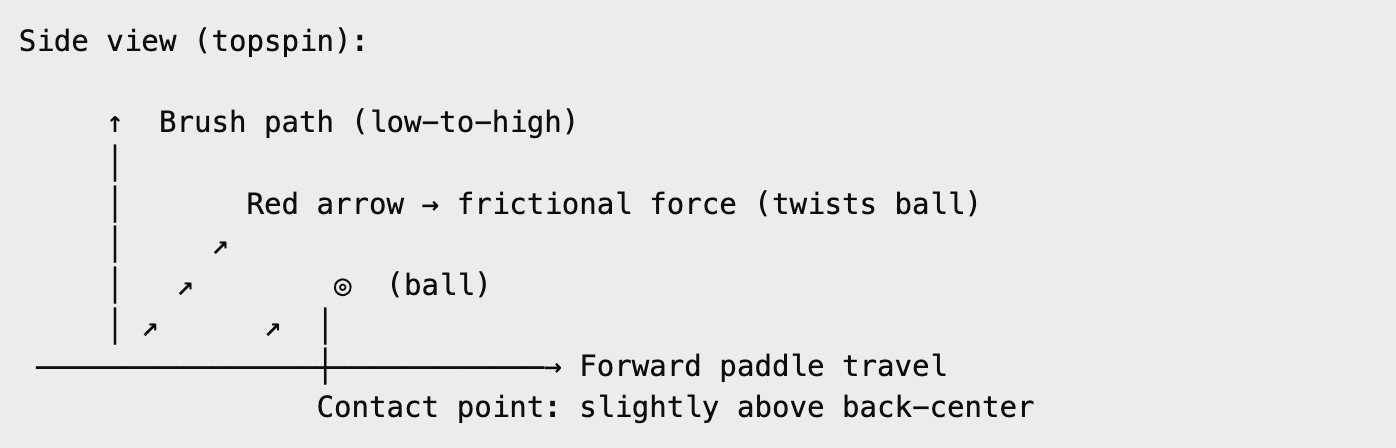
Key idea: If you strike the ball at its equator with a flat, straight path, friction has nothing “to bite.” But move contact slightly above back‑center with a low‑to‑high path and—boom—tangential speed creates topspin.
Macrospin (stroke‑generated): the big dial
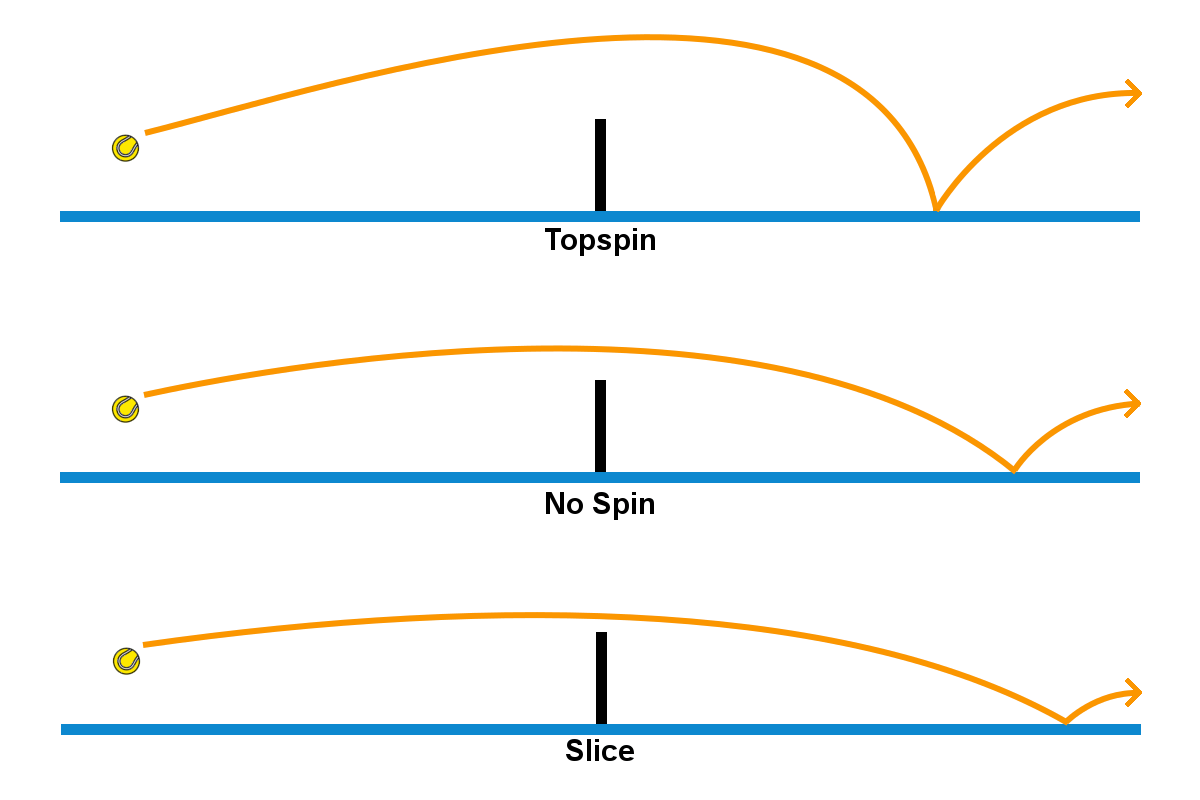
What it is: The rpm your mechanics make available before the ball even feels the paddle’s texture.
What controls it:
- Contact height on the ball. Above back‑center for topspin; below for backspin. “Outside” of the ball for sidespin. A few millimeters matter.
- Swing path & face angle. Low‑to‑high and slightly closed for topspin; high‑to‑low and slightly open for slice. For roll volleys, the path is compact but still up and across.
- Racket‑head speed at contact. Acceleration peaking right at impact — not before.
- Contact location relative to your body. Out front lets the wrist and forearm pronate/supinate; late contact kills brush.
- Sequencing. Legs → hips → torso → arm → wrist. If the kinetic chain stalls, the hand “pushes” instead of “brushing.”
Macrospin mistakes that grit can’t solve
- Meeting the ball too late (by your hip). You’ll push through the equator, producing float.
- Chopping down on an already low ball. You get underspin you don’t want and pop‑ups on the next shot.
- Locking the wrist. Brushing needs a small window of loose‑to‑firm: loose on approach, firm at collision.
- Setting the face too open/closed. Even a perfect brush path will bleed off into sidespin or float if the face is mis‑set by a couple of degrees.
Macrospin training cues
- “Find the seam”: imagine the equator seam; strike a hair above it for topspin.
- “Up the stairs”: feel the paddle travel up as it goes forward — not just forward.
- “Out front & away”: meet the ball a ball‑width further in front than you think and an inch farther from your torso.
- “Loose → snap”: soften on approach, then firm the last 3–5 cm into contact.
Microspin (paddle‑generated): the fine tuner
What it is: The rpm your paddle can extract from the tangential speed you bring to the party.
What controls it:
- Surface friction/texture (raw carbon vs. painted grit vs. fiberglass coatings).
- Dwell time (how long the ball “hugs” the face). Slightly longer dwell can help translate brush into spin, up to a point.
- Cleanliness & wear. A dusty or worn face gives the ball less to grab.
Reality check: Modern paddles live under the same legal ceiling for roughness and friction. Differences are real but incremental. Technique changes often dwarf them.
Microspin care checklist
- Wipe the face with a damp microfiber between games to remove dust and skin oils.
- Retire paddles whose top‑layer texture has visibly smoothed (especially painted grit). If your roll volleys suddenly float and your serve can’t dip, the face may be glazed.
- Avoid illegal “re‑gritting” hacks. Keep your spin gains legal and repeatable.
Data snapshot (for context, not dogma)
| What | Typical Range/Notes |
|---|---|
| Legal surface roughness | Industry testing commonly targets ~Rz ≤ 30 μm and Rt ≤ 40 μm; tournament paddle checks use Starrett SR series gauges. |
| Legal kinetic friction (paddle face) | Max μk ≈ 0.1875 (ASTM D1894 method). |
| Contact time (ball–paddle) | On the order of a few milliseconds; that tiny window limits how much frictional “twist” you can apply. |
| Spin categories (practical) | Reviewers often call ~1000–1199 rpm “low”, 1200–1499 “avg”, 1500+ “high”. Top modern paddles in some tests exceed ~1800–2000+ rpm. |
| Face wear effect | Painted grit can lose rpm quickly as it smooths; raw carbon tends to hold texture longer. |
Takeaway: Paddles differ, but the ceiling is policed. The fastest way to boost spin is still dialing in macrospin.
Contact point and spin outcome
Back view of a ball at contact (right‑handed player):
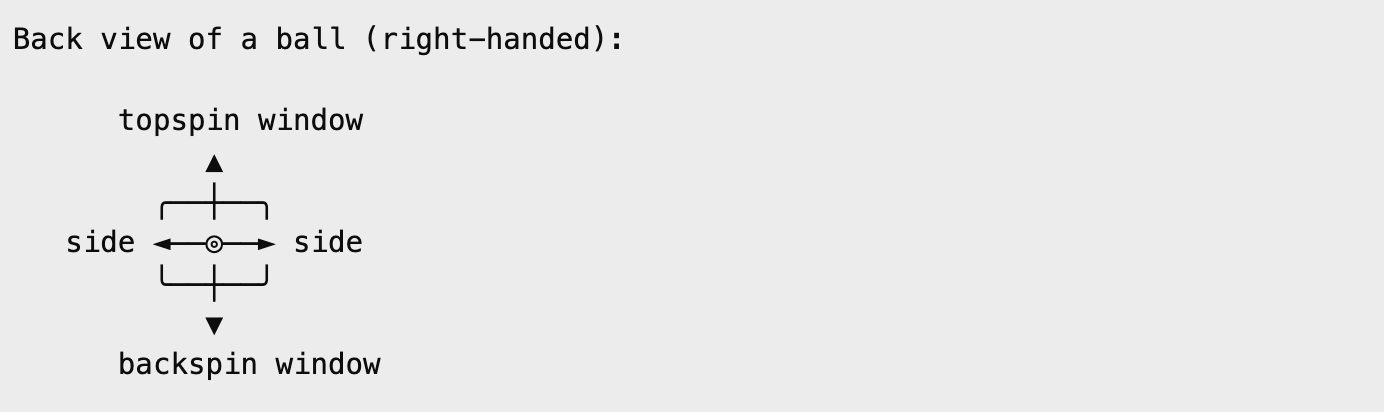
- Hit slightly ABOVE back‑center with a low‑to‑high path → topspin dip.
- Hit slightly BELOW back‑center with a high‑to‑low path → slice skid.
- Brush OUTSIDE the ball (right edge) with an across‑path → sidespin fade.
Here’s a quick way to picture it:
Why chasing “max grit” won’t save a bad contact point
Three reasons — all practical:
- Friction has a ceiling. Once you’re near the legal limit, adding “more grit” barely moves rpm unless you’re already bringing tangential speed to contact.
- Geometry beats texture. A paddle can only grab what your path and face angle present. If you contact at the equator with a flat path, friction mostly acts to stop sliding, not to spin up the ball.
- Millisecond math. With only a few ms of contact, better texture refines a good brush but can’t manufacture one out of a shove.
Litmus test: If a new “spin monster” paddle doesn’t fix your topspin dink within a session, the issue is almost always contact height or timing, not the face.
A simple 3‑part field test (10 minutes)
- Baseline brush: From NVZ, feed 20 slow balls and roll them cross‑court. Count true dips (balls that clear the net by < 18 inches and land past the kitchen).
- Contact‑height ladder: Repeat, purposely striking below/at/above the equator in sets of 10. Your highest dip% almost always comes from above‑equator contact.
- Clean‑vs‑dirty face: Wipe the face clean, repeat 10 rolls. If dip% rises a little, that’s microspin. If it jumps a lot, your macrospin (timing/path) got better during the drill.
Log the results; repeat next session. You’ll see quickly whether your limiting factor is macro or micro.
Technique blueprints to unlock macrospin
A) Roll‑volley (kitchen speed‑up you can land)
- Footwork: Split‑step in a low stance, knees bent, balanced.
- Prepare: Slightly eastern grip, paddle face open toward target, elbow relaxed off ribs.
- Path: Compact low‑to‑high, brushing the side of the ball with slight pronation.
- Contact: A ball‑width in front at yellow‑zone height, brushing outside edge crosscourt.
- Common miss: Over‑flat swing or late contact → ball sails long
Coach Briones breaks it down like this:
B) Topspin drop (from transition)
- Height bias: Let the ball fall into your strike zone; don’t reach.
- Path: Low‑to‑high with forearm pronation; aim over the middle strap height, let spin pull it down.
- Contact: In front, slightly outside the ball (for a tiny sidespin that helps the dip and angle).
C) Topspin dink (create dip, not pop‑ups)
- Stance: Tall chest, soft knees; keep head still.
- Path: Micro‑brush. Think “zip up a jacket.”
- Contact: Above back‑center. If you hear a thud, you pushed.
Optimizing microspin the right way (and staying legal)
- Choose durable texture. Raw carbon faces generally keep their friction longer than painted‑grit overlays.
- Mind thickness vs. feel. Thinner thermoformed cores often feel livelier and (for many testers) have measured higher rpm, but trade some dwell/control. Pick what fits your stroke.
- Cleanliness is free spin. Dust and skin oil are spin killers; wipe between games.
- Replace on wear, not on hype. If your face is glazed or your rpm fades after months, then upgrade.
Micro vs. Macro: when to adjust what
| Symptom | Likely Culprit | Fix First |
|---|---|---|
| Roll volleys sail long | Contact at equator; flat path | Move contact in front & higher on ball; close face 5–10° |
| Topspin dinks pop up | Wrist locked; late contact | Loose→firm wrist; meet earlier; micro‑brush |
| Drops sit up | No low‑to‑high; over‑open face | Add knee‑to‑shoulder path; neutral face |
| Slice is great, topspin weak | Habitual high‑to‑low path | Drill upward finish; target net‑strap |
| Spin improved after cleaning | Microspin ceiling | Keep the face clean; consider a more durable textured face |
FAQ — quick hitters
Q: If all paddles live under friction/roughness limits, why do some test at 1800–2000+ rpm?
A: Construction (raw carbon vs. paint), face layups, and core design change how efficiently the paddle converts your brush into rpm — but they’re still bounded. Technique takes you the rest of the way.
Q: Should I chase “max dwell” for more spin?
A: Up to a point. A bit more dwell helps if you already brush — but too much can feel mushy and cost timing. Always choose feel you can repeat under pressure.
Q: Can I re‑grit my paddle?
A: DIY grit can push you out of spec and into illegal territory. Clean first; replace when worn.
TL;DR — What Intermediate Players Should Take Away
- Technique > Texture: Don’t chase paddles for more spin. If your contact is off, grit can’t save you.
- Macrospin is king: Brush up on the ball, meet it slightly above back‑center, and make contact out front. That’s where real rpm comes from.
- Microspin is the helper: Keep your paddle face clean and textured, but know it only refines what your swing already creates.
- Field test it: Do the 20‑ball roll‑volley and topspin‑dink dip tests. Track if misses are timing/geometry (macro) or paddle face condition (micro).
- Mind the window: Contact lasts milliseconds — so geometry and timing are everything.
- Upgrade your habits before your gear: If your shots sail or float, fix contact point and swing path before blaming the paddle.
Bottom line: Master brushing technique and consistent contact first. Use paddle grit as seasoning, not the main ingredient.