
Three pickleball kitchen counters handle most speed-ups: use a soft backhand reset for balls outside your backhand, a compact backhand punch for body attacks, and a forehand punch for balls crossing toward your forehand. Match grip pressure to the shot, keep the paddle in front, and recover quickly.
You’re settled into a dink exchange when your opponent suddenly attacks.
The ball comes down the line, into your chest, or across your body. You react late, your paddle gets jammed, and the point is over before you can organize your feet.
Most recreational players blame slow hands.
But the bigger problem is often using the same response against every speed-up.
A ball moving away from your body should not be handled like one coming directly at your chest. And a speed-up crossing toward your forehand gives you a different opportunity than one attacking your backhand side.
The best kitchen defenders are not simply faster. They recognize the direction of the attack and choose the response that fits the ball.
Here are three counters that cover many of the speed-ups you’ll face at the kitchen line.
First, Win the Ready Position
Before choosing a reset or counter, your paddle needs to start in a position that gives you access to both sides of your body.
Many recreational players hold the paddle too low after dinking. Others allow it to drift toward the forehand because they are expecting another crosscourt ball.
Both habits add unnecessary movement when the opponent attacks.
Keep the paddle in front of your chest, with the tip around chest or shoulder height. Your elbows should remain relaxed and slightly separated from your body rather than pinned against your ribs.
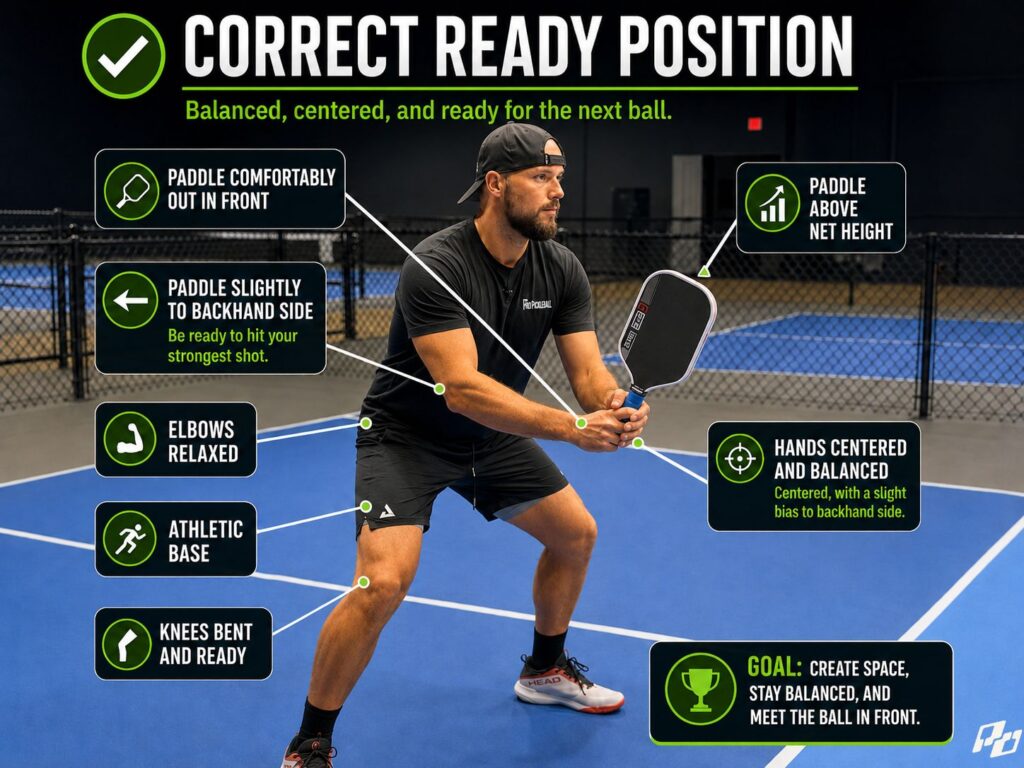
The goal is not to hold the paddle perfectly still. It is to begin from a neutral position that allows you to reach either side with a small, efficient movement.
Use this cue:
Paddle in front. Elbows free. Hands quiet.
A good ready position will not guarantee that you make every counter. But a poor one can make the correct shot almost impossible.
1. The Slice Backhand Reset
Use it when the speed-up travels down the line or outside your backhand side.
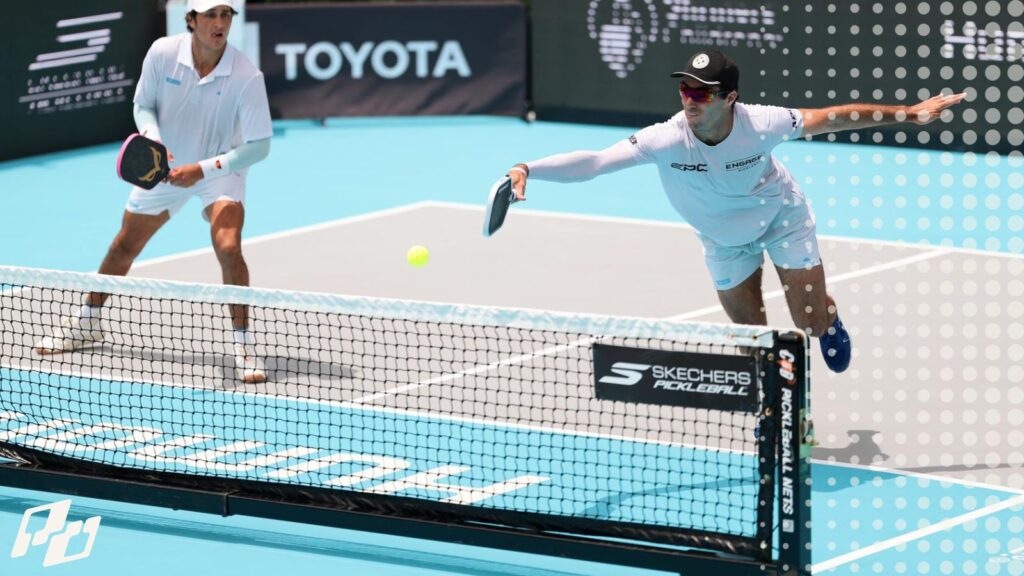
A down-the-line attack can be difficult because the ball is moving away from your body. You may be reaching laterally, contacting the ball outside your ideal strike zone, or trying to defend while slightly off balance.
That is usually a poor time to force an aggressive counter.
Instead, use a compact one-handed backhand reset. The open paddle face and soft slicing action help absorb the incoming pace and return the ball low into the kitchen.
You are not trying to win the point with this shot. You are trying to prevent your opponent from attacking the next ball.
⮕ How to hit it
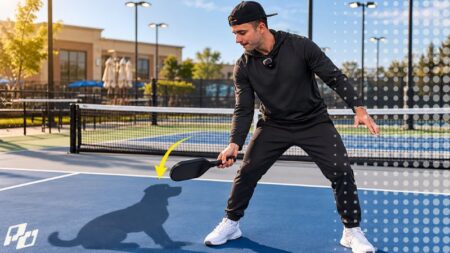
Reach with one hand to create space and range. Keep the paddle face slightly open and contact the ball in front of your body whenever possible.
Avoid taking a large backswing or chopping sharply underneath the ball. The motion should be short and controlled, with the paddle moving slightly forward and under the ball.
Let the opponent supply most of the pace. Think of the shot as catching and redirecting the ball rather than striking it.
A useful cue is:
Reach, soften and drop.
Aim toward the middle of the kitchen or toward the attacker’s feet. Trying to place the ball too close to the sideline often adds risk without creating much additional benefit.
❌ When not to reset
The slice reset is a useful default when you are stretched or late, but it is not an automatic response to every ball down the line.
If the speed-up sits high, arrives slowly or gives you comfortable contact in front, you may have time to punch or roll the ball back aggressively.
Reset when the ball has placed you under pressure. Counter when the ball gives you time and balance.
2. The One-Handed Backhand Punch Counter
Use it when the speed-up attacks your body, backhand shoulder or backhand hip.
Body attacks create problems because they take away your normal swing path.
There is no room for a backswing, and the ball often arrives faster than you can move out of the way. Players who try to make a full stroke usually get jammed, contact the ball late or send it floating upward.
The better option is a compact backhand punch.
Your paddle is already near the center of your body, so the backhand often requires less movement than trying to force a forehand. Meet the ball early and redirect the opponent’s pace with a short, firm motion.
Not every body ball is the same
“Attack the body” is a broad instruction. The exact location of the ball matters.
For a right-handed player:
- A ball toward the right hip, chest or backhand shoulder often favors the backhand punch.
- A ball directly at the center of the chest requires an early decision. Hesitating between forehand and backhand is what causes many jams.
- A ball moving toward the left hip may be easier to handle with a forehand punch.
- A ball rising toward the dominant shoulder may be heading long and could be better left alone.
The biggest mistake is often not choosing the wrong stroke. It is failing to choose early enough. At kitchen-line speed, indecision uses up the limited space and time you have available.
⮕ How to hit the backhand punch
Keep the paddle in front of your body and eliminate the backswing. Contact the ball slightly in front of your chest with a stable paddle face.
The movement should be short—often only several inches.
You do not need to create much pace because the incoming ball already has speed. Your job is to stabilize the paddle and redirect the ball:
Use this cue:
Meet it early and punch through.
Good targets include the middle, the opponent’s paddle-side hip or the feet of the player who initiated the attack.
Avoid trying to hit a spectacular winner. A compact counter that stays low can force a weak next ball and put you in control of the exchange.
3. The Forehand Punch Counter
Use it when the speed-up crosses your body toward your forehand side.
A ball crossing toward your forehand can be one of your best counterattacking opportunities.
Unlike a ball moving away from your backhand, this attack may be entering a stronger and more comfortable contact zone. If you recognize it early, you can meet the ball in front and redirect it with authority.
The mistake is taking too large a swing.
At kitchen distance, a big forehand motion is rarely necessary. It slows your recovery and makes it harder to handle the next ball if the opponent blocks your counter.
Use a short forehand punch instead.
⮕ How to hit it
Keep the paddle in front and allow only a small shoulder turn. Contact the ball before it gets beside or behind your body.
Push through the ball with a compact motion rather than swinging around it. The paddle should finish in a position that allows you to recover immediately:
@brionespickleball Forehand Counter Attack: Be ready for the speed up! Don’t over swing. Keep it compact and win more points 💪 #pickleball #fyp ♬ original sound – Briones Pickleball
Use this cue:
Catch it in front and send it back.
The most effective target is not always the open sideline.
Countering behind the attacker, into the middle or toward the opponent’s paddle-side hip can be more reliable because those targets reduce the angle and give you more margin.
Grip Pressure Changes With the Shot
One reason players struggle with these three responses is that they use the same grip pressure for every ball.
The slice reset and punch counter require different levels of firmness.
For the backhand reset, soften your grip so the paddle can absorb pace. If you squeeze too tightly, the ball is more likely to rebound high or travel too deep.
A grip pressure of roughly 3 or 4 out of 10 can be a useful starting point. The exact number is not important. What matters is that the hand feels soft enough to take energy out of the ball.
For punch counters, use a firmer grip—perhaps around 6 or 7 out of 10—to prevent the paddle face from twisting at contact.
| Shot | Suggested Grip Pressure | What It Should Feel Like | Why It Works | Common Mistake |
|---|---|---|---|---|
| Slice backhand reset | 3–4 out of 10 | Soft hand, relaxed fingers, quiet paddle face | Helps absorb the opponent’s pace and drop the ball softly into the kitchen | Squeezing too tightly, causing the ball to rebound high or travel too deep |
| Backhand punch counter | 6–7 out of 10 | Firm and stable, but not rigid | Keeps the paddle face from twisting when the ball is driven into the body | Using a death grip, which slows the hands and tightens the forearm |
| Forehand punch counter | 6–7 out of 10 | Firm at contact with a relaxed arm | Provides stability while allowing a short, controlled redirect | Adding a big swing because the grip feels firm |
| Between shots | 2–3 out of 10 | Loose, neutral and ready | Reduces tension and makes it easier to change quickly between a reset and a counter | Staying clenched after the previous shot |
Firm does not mean rigid. A death grip can tighten the forearm, slow your reaction and make the paddle harder to reposition for the next shot.
Think of it this way:
- Reset: soft hand, quiet paddle.
- Punch counter: firm hand, compact motion.
- Every shot: relaxed arm.
Grip pressure controls how much of the opponent’s pace stays on the ball.
Read the Direction Before the Ball Reaches You
Choosing the correct counter becomes much easier when you recognize the attack early.
Do not wait until the ball is halfway across the kitchen to decide whether it is going down the line, into your body or toward your forehand.
Watch the opponent’s contact point.
A ball contacted farther outside the attacker’s body is more likely to travel along the line. A ball taken closer to the body often favors the middle. Paddle-face angle and body position can also provide clues, although skilled players may disguise their intentions.
The simplest cue is:
Watch the contact, not the backswing.
Many speed-ups look similar during preparation. The contact point tells you more about the ball’s actual direction.
These Are Defaults, Not Automatic Rules
The three-shot framework is designed to simplify your decisions, not replace judgment.
A down-the-line ball may deserve an aggressive counter if it sits high. A body ball may require a soft block if you are late. A cross-body speed-up may be better left alone if it is rising above your shoulder.
Ball height, pace, balance and contact position still matter.
Use the framework as a starting point:
- Outside your backhand: soften and reset.
- Into your body: use a compact backhand punch.
- Across toward your forehand: meet it early with a forehand punch.
- Rising above your shoulders: consider letting it go.
The goal is not to memorize three rigid rules. It is to stop treating every speed-up like the same shot.
Practice the Decision, Not Just the Technique
These counters become useful only when you can choose between them under pressure. Have a partner stand across from you at the kitchen line and feed controlled attacks to three locations:
- Down the line outside your backhand.
- Directly into your body.
- Across your body toward your forehand.
Start slowly. Call out “reset,” “backhand” or “forehand” before making contact.
This forces you to recognize the direction of the ball instead of reacting with the same stroke every time.
As your reads improve, have your partner increase the pace and randomize the locations. Focus on compact swings, stable paddle position and immediate recovery after each shot.
Do not stop after the first counter. Ask your partner to continue the exchange for two or three more balls.
That makes the drill feel more like an actual hands battle, where surviving the first attack is only the beginning.
Stop Blaming Your Hands
Fast hands certainly help at the kitchen line. But speed alone is not what separates strong defenders from everyone else.
Good kitchen defense is built on preparation, early recognition and choosing the right response.
- When the ball moves outside your backhand, soften it with a slice reset.
- When it attacks your body, stabilize the paddle and punch it back.
- When it crosses toward your forehand, meet it early and counter compactly.
You do not need one magical shot that handles every speed-up.
You need three dependable responses—and the ability to recognize which one the ball is asking for.