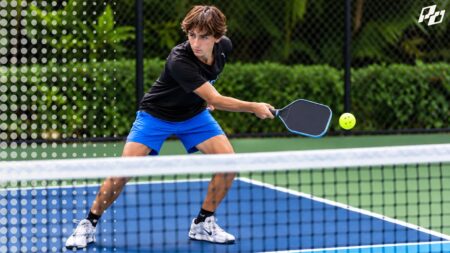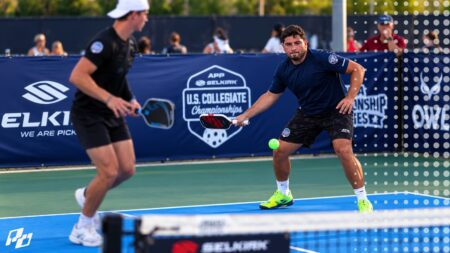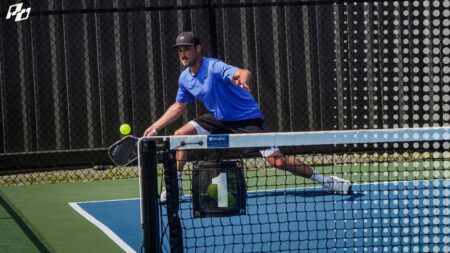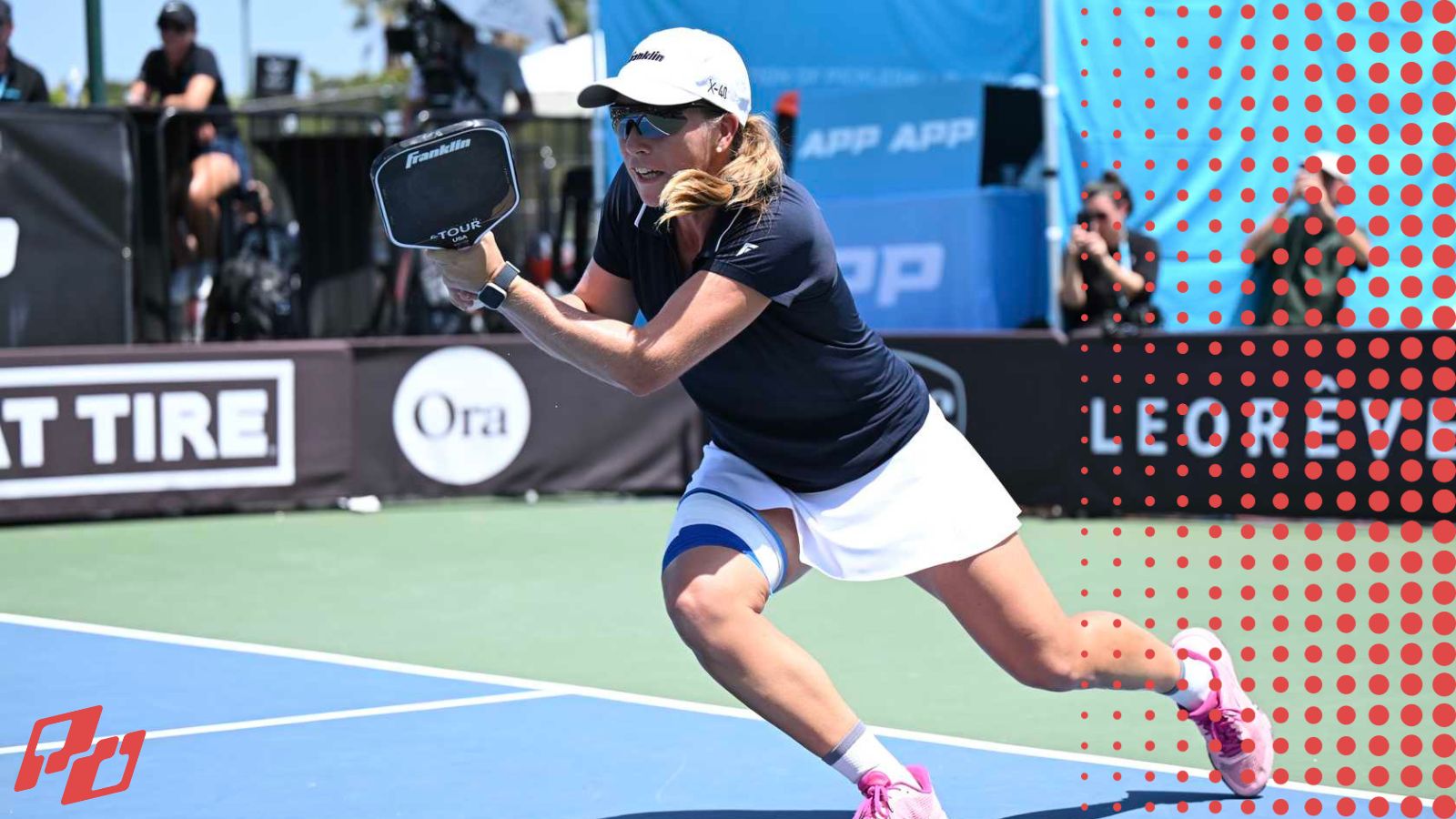
We’ve talked a lot lately about the evolution of the modern backhand — from dinks to flicks to full-on drives.
But there’s a quiet debate heating up among intermediate players right now:
If the two-handed backhand is more stable, and the one-hander gives you more reach and spin — which one actually wins in today’s faster, spinnier game?
It’s not a simple “one is better” answer.
It’s about what you trade for control, timing, and flexibility.
Let’s break it down.
The Real Question Isn’t Spin — It’s Stability
In tennis, the one-handed backhand wins the spin battle. The longer lever and open shoulder allow more racket-head speed and shape.
But pickleball isn’t tennis — and that changes everything.
With a paddle instead of strings, spin is generated differently. You don’t need a long, looping swing — you need friction, face angle, and brush timing.
So yes, a one-hander can technically create more topspin, but not by a margin that wins rallies.
The real difference comes from how well you can control that spin under pressure.
That’s where the two-hander shines — it stabilizes the paddle face through contact, giving you consistency when the ball jumps, skips, or comes fast at your body.
Call it the trade-off between freedom and friction.
Why the Two-Hander Dominates Modern Play
Watch James Ignatowich, Hayden Patriquin, or Jorja Johnson — they’re not using two hands because it looks cool.
They’re using it because the modern backhand has become a defensive weapon.
Here’s why:
- The off-hand controls rotation, keeping the paddle face square under pressure.
- It absorbs pace without fluttering.
- It generates “controlled spin” — not heavy topspin, but forward dip that clears the net and stays down.
- It’s more compact and balanced — no big takeback, no lost time.
And most importantly? It gives you confidence in fast exchanges and high backhands — two of the most common weak spots for one-handers.
At 4.0+ speed, that stability buys you milliseconds — and in pickleball, that’s everything.
When the One-Hander Still Wins
Don’t count it out yet.
A clean one-handed backhand still rules in a few key areas — especially if you know how to use it intentionally.
1. Reach and Recovery
When you’re stretched wide or off-balance, two hands just won’t get there. The one-hander gives you range and flexibility.
2. Roll and Shape
If you’re shaping topspin dinks or brushing crosscourt flicks, the one-hander gives you smoother feel and more natural wrist mobility.
3. Disguise
That short, flicky one-hander can hide drives, rolls, and drops behind the same setup — something that’s harder with two hands locked in.
4. Emergency Defense
When the ball’s outside your body line, you simply don’t have time to plant and use both arms. That’s where the one-hander is your bailout shot.
The Hybrid Era: How Pros Blend Both
Here’s where the game is heading — and where you can take your own backhand next.
Most modern players are hybrid hitters. They use two hands for stability on drives, counters, and speed-ups — but switch to one for reach, resets, or shaping dinks.
It’s not “pick one.” It’s “know when.”
Example:
- Two hands when you’re set at the kitchen and the ball’s above the net.
- One hand when you’re on the run or flicking a low ball crosscourt.
- Two hands for countering pace.
- One hand for touch and spin.
That’s the real evolution of the intermediate game — versatility.
How to Train Both Styles
Drill 1: Dual-Hit Wall Drill
Alternate 5 one-handed and 5 two-handed backhands off a wall. Focus on how your paddle face reacts — stable vs free.
Drill 2: Split Decision Dink
Crosscourt dinks alternating one-hand (for reach) and two-hand (for lift). You’ll learn instinctively when each fits the rally.
Drill 3: High-Low Drive Series
Have a partner feed alternating shoulder-height and knee-height balls. Use two hands on the high, one hand on the low.
Common Mistakes
❌ Forcing a two-hander on every shot
→ You’ll jam yourself and lose reach.
❌ Using wrist flick only on one-handers
→ You’ll pop the ball up; engage the shoulder and torso.
❌ Forgetting footwork
→ The best backhands come from legs and timing — not arms.
❌ Not resetting paddle position after swing
→ Whether one or two-handed, always recover paddle to neutral (chest height, forward).
The Real Skill: Transitioning Instinctively
The key to advancing past 3.5 isn’t picking the “right” backhand. It’s learning to switch between them without thinking.
Your goal isn’t to become a two-handed player or a one-handed specialist — it’s to make both feel automatic.
You want to know:
- When to free the off-hand for reach.
- When to anchor it for power.
- When to blend the two for spin and stability.
That’s the new mark of an advanced player — fluid adaptability at the kitchen.
It’s Not About Choosing Sides
The next time someone tells you the two-handed backhand is the future — or that “real players” use one — smile, and step on court anyway.
Because the best players aren’t defined by how many hands they use. They’re defined by how many options they have.
Learn both. Blend both.
And the next time you see a fastball screaming at your left shoulder, you won’t panic — you’ll just choose the right tool and send it back harder.