
It happens more often than most recreational players admit.
You arrive at the courts late.
The courts are full.
Your friends are already halfway through a game and someone waves you in.
“Jump in next.”
No dinks.
No drives.
No shoulder swings.
No rhythm.
Just straight into competitive play. And within the first rally, everything feels off. Most players immediately think something is wrong with their game. In reality, what you’re feeling is completely normal.
You simply started cold.
And experienced players know the first few minutes without a warm-up require a different strategy, not just better mechanics.
Why Pickleball Feels So Strange Without a Warm-Up
There’s a reason nearly every sport—from tennis to basketball to sprinting—builds warm-ups into competition. Warm-ups gradually increase:
- muscle temperature
- joint mobility
- nerve activation
- reaction speed
Sports physiology research consistently shows that even a small increase in muscle temperature improves neuromuscular efficiency and reaction time. Pickleball might look casual, but physiologically it’s a sport built on:
- fast reactions
- rapid directional changes
- precise paddle control
Without a warm-up, several things happen:
Your brain processes visual information slightly slower.
Your muscles fire a fraction of a second later.
Your grip pressure often becomes tighter than normal.
Those tiny delays are exactly why players miss easy drops or mistime volleys in their first rallies. Professional players experience this too.
The difference is they recognize what’s happening and adjust how they play early points.
The Biggest Mistake Players Make When Starting Cold
When recreational players feel out of rhythm, their instinct is usually to compensate with aggression.
- They swing harder.
- They drive more balls.
- They try to speed the game up.
This is exactly backwards. When the body isn’t warm yet, precision is lower. Bigger swings amplify mistakes rather than fixing them.
Most experienced coaches recommend the opposite approach: slow the rally down until timing returns.
That doesn’t mean playing passive pickleball. It means temporarily prioritizing margin and rhythm over speed and winners.
Think of the first three minutes as a moving warm-up rather than full competition.
How Experienced Players Quietly Warm Up During the First Game
Players who have competed for years often follow a subtle pattern when starting cold. They simplify their shot selection early.
Serves are smooth and controlled rather than loaded with spin. Returns aim deep toward the middle instead of sharp sidelines. Third-shot drops are given a little extra arc.
That extra margin buys time. And time is exactly what your nervous system needs to calibrate.
Ben Johns has talked in interviews about the importance of establishing rhythm early in matches before expanding shot selection. Many experienced players follow the same principle even in recreational play.
The goal isn’t brilliance in the first rally. The goal is finding your timing safely. Once touch returns, the rest of your game tends to follow quickly.
What the Body Actually Needs in the First Few Minutes
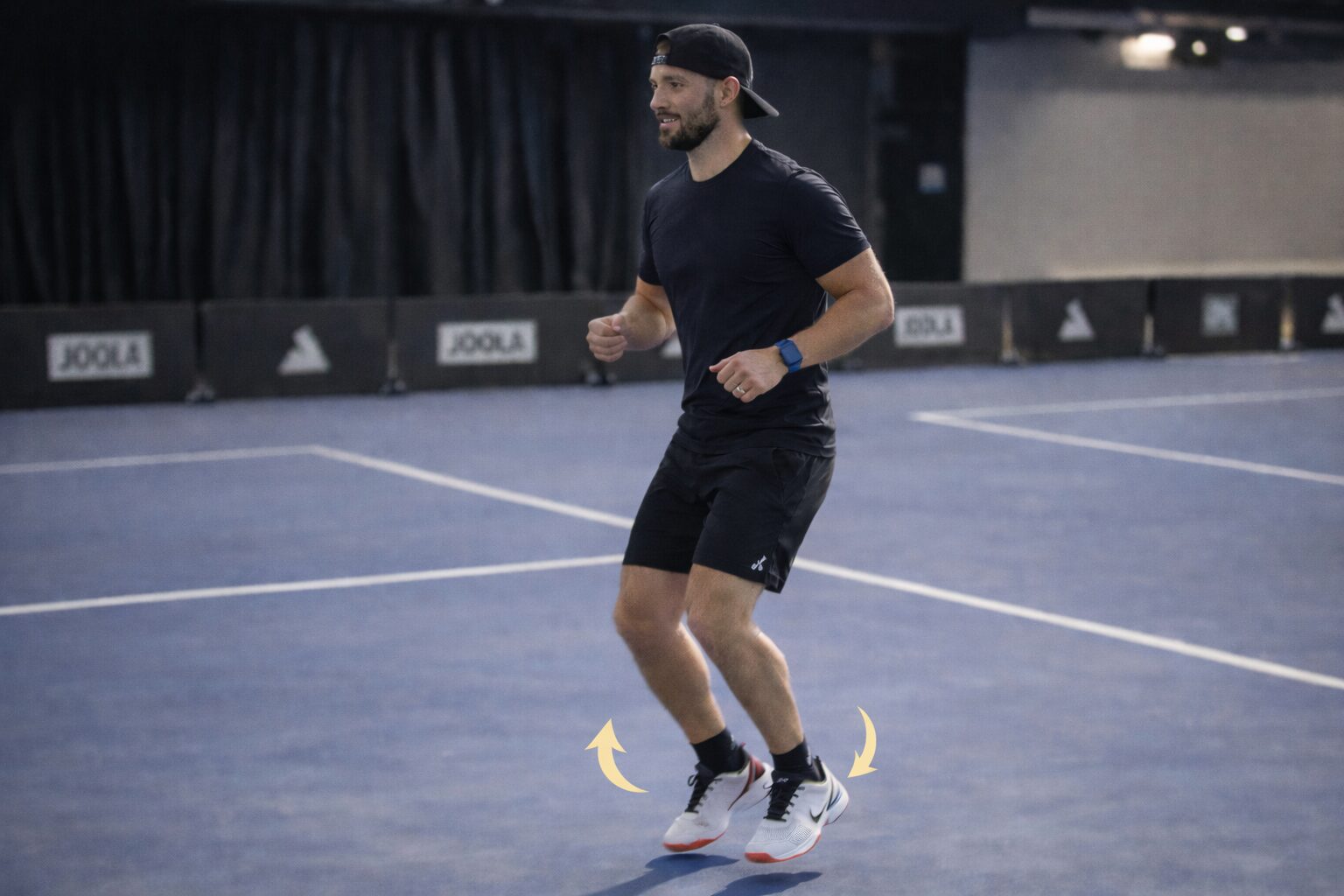
Even if you start playing immediately, your body begins warming itself through movement. Within a few minutes:
- Circulation increases.
- Muscles become more elastic.
- Coordination improves.
That’s why the first five minutes of a match often feel dramatically different from the first rally. You can speed this process up slightly by staying active between points:
→ light bouncing on your toes
→ small paddle swings
→ quick shoulder rolls
These micro-movements help activate stabilizing muscles in your shoulders and forearms. It’s not a full warm-up—but it helps your body wake up faster.
The Injury Risk Most Players Ignore
There’s another reason to respect those early rallies when starting cold. Injury risk is higher when muscles are tight.
Cold muscles are less elastic and absorb force less effectively. That increases strain on tendons and connective tissue.
In pickleball, the most vulnerable areas during cold starts are:
- calves and Achilles during quick sprints
- shoulders during overhead swings
- elbows during aggressive drives
Playing the first few points with controlled swings instead of explosive movement gives your body time to adapt.
The Real Advantage of Players Who Handle This Well
Some players look comfortable even when they jump straight into games. It’s not because they’re magically ready. It’s because they understand the situation and adapt.
They slow the pace slightly.
They prioritize high-percentage patterns.
They let their timing build gradually.
Within five minutes, they’re fully in rhythm.
Meanwhile, players who try to force the game immediately often struggle much longer.