
An overuse injury in pickleball usually builds gradually, not from one obvious moment. Warning signs include pain that keeps coming back in the same spot, starts earlier in sessions, gets worse with specific shots, or begins changing how you move or swing.
Most rec pickleball players do not wake up one morning with a dramatic injury story. It is usually sneakier than that.
Your elbow starts feeling a little cranky after games. Your shoulder takes longer to loosen up. Your wrist does not love mishits anymore. Your knee gets grumpy going down stairs the day after open play. You tell yourself it is probably nothing, keep playing, and then one day the thing that was “just tight” has become the reason you are avoiding backhands, overheads, or long sessions.
That is the world of overuse injuries.
And if you are a rec player, this matters a lot more than most people realize.
The sports-medicine world keeps describing pickleball as a sport with a very real overuse profile, especially for shoulders, elbows, wrists, and other areas that take repeated stress. HSS says the “overwhelming number” of pickleball problems they see fall into the category of overuse injuries, especially sore shoulders and elbows from being worked too long.
Mayo Clinic and Houston Methodist both specifically call out elbow tendon problems as common in pickleball, especially in adults who ramp up play without enough preparation, recovery, or technique support.
So let’s talk about what an overuse injury actually is, how to tell if you are dealing with one, who gets them most often, and what rec players should do before a small irritation turns into a real problem.
What is an overuse injury in pickleball?
An overuse injury is exactly what it sounds like: a body part getting stressed a little too much, a little too often, without enough recovery.
It is not usually one bad moment. It is repeated stress piling up faster than your body can adapt to it.
That is why overuse injuries often feel confusing at first. There is no obvious “I hurt it on that point” memory. Instead, the pain builds gradually. Cleveland Clinic describes tendinitis and repetitive strain injuries this way too: repeated motion irritates tissues over time, and they can take longer to heal than people expect.
In pickleball, that repeated load often comes from:
- gripping the paddle over and over
- quick volleys and counters
- repeated overheads
- hard forehand drives
- lots of backhand blocks or flicks
- sudden increases in playing frequency
- and playing through fatigue because, well, pickleball is fun and “just one more game” is how half the sport gets injured.
Why pickleball creates so many overuse problems
Because it looks easier than it is. That is one of the great traps of pickleball.
People see a smaller court, underhand serve, and social atmosphere, and they assume the physical demand must be low. But the actual movement and repetition profile is sneaky:
- quick starts and stops
- repeated bending and lunging
- lots of paddle contacts
- frequent play sessions
- and often not much recovery because rec players tend to stack games back-to-back
HSS makes this exact point in a different way: many players come to pickleball after years of relative inactivity, and many have not played racket sports before, so their tissues are suddenly being asked to handle a lot of repetitive load.
Houston Methodist says much the same thing about tennis elbow in pickleball — the sport is accessible enough that people jump in fast, but the arm still needs proper preparation and technique to tolerate the repeated stress.
So overuse injuries are not a sign that you are fragile.
Usually, they are a sign that your load, recovery, mechanics, or preparation got out of balance.
What overuse injuries are most common in pickleball?
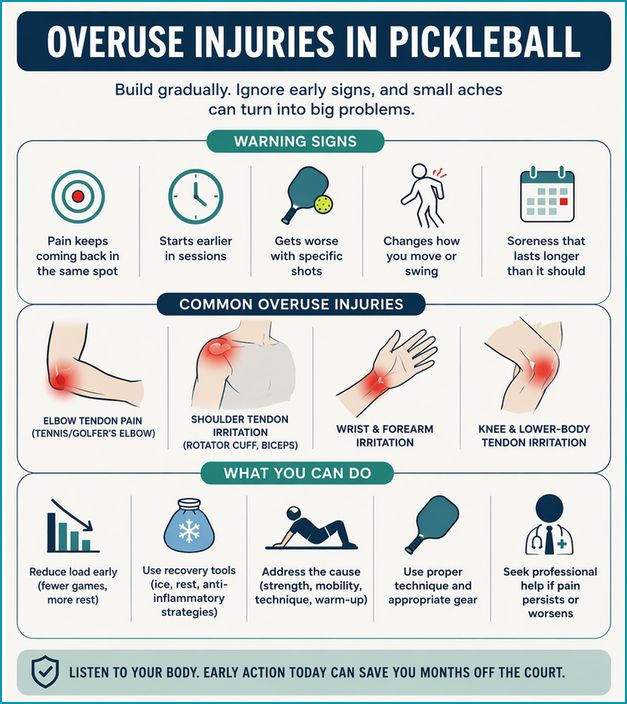
For rec players, the usual suspects are pretty predictable:
1. Elbow tendon pain
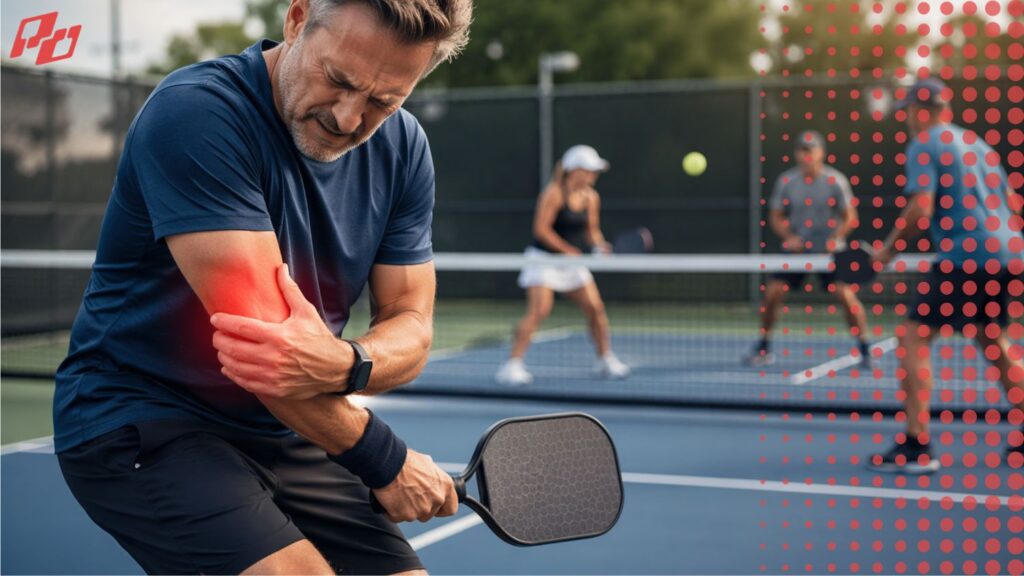
This is the classic one. “Pickleball elbow” is basically the pickleball version of tennis elbow or golfer’s elbow, depending on where the pain is.
Mayo Clinic and Houston Methodist both point to elbow tendon irritation as one of the most common overuse issues in the sport.
2. Shoulder tendon irritation
HSS says they see a lot of biceps and rotator cuff tendonitis, especially in players who have not been very active or who have not played racket sports for years.
Shoulder pain often shows up with overheads, serving, or reaching wide. Johns Hopkins says rotator cuff tendinitis can cause shoulder pain, weakness, swelling, and limited motion after repeated stress.
3. Wrist and forearm irritation
Mayo Clinic’s hand-and-wrist specialists have specifically discussed how pickleball can lead to hand and wrist issues, especially because of repetitive paddle use and impact.
4. Knee and lower-body tendon irritation
While pickleball’s headline injuries often focus on falls and acute ankle sprains, repetitive lunging, decelerating, and stop-start play can also aggravate knees and lower-body tissues over time. General overuse guidance applies here just as much, even when the injury is not as flashy as an ankle roll.
The point is not that pickleball is uniquely dangerous. It is that repeated stress plus enthusiasm is a very powerful combo.
How do you know if it is an overuse injury and not just normal soreness?
This is the part rec players really need.
Because not every ache means injury.
But not every ache is harmless either.
A practical difference is this:
Normal post-play soreness usually:
- feels more general than pinpoint
- shows up after an unusually hard session or long day
- improves within a day or two
- does not keep getting worse every time you play
- and does not clearly change how you swing or move
An overuse injury is more likely when:
- the pain is becoming more predictable
- it keeps showing up in the same spot
- it starts earlier in the session than it used to
- it gets worse with specific pickleball motions
- you start modifying your mechanics to avoid it
- or it lingers beyond a normal recovery window
That pattern matters.
If your elbow hurts every time you speed up a backhand volley, that is different from “my arm feels tired after four games.”
If your shoulder aches specifically on overheads or serving, that is different from “I feel worked.”
If your wrist stings on mishits and then nags for two days, that is not the same thing as ordinary fatigue.
What symptoms should rec players watch for?
Here are the symptoms that should make you think, “Okay, this may be more than normal soreness”:
- pain in the same spot during or after play
- tenderness around a tendon or joint
- stiffness that keeps returning
- pain with gripping, lifting, or twisting
- pain with overheads or hard swings
- weakness or loss of control
- reduced range of motion
- pain that starts mild and keeps creeping forward in the session
- or pain that is now changing how you hit the ball
For elbow overuse specifically, look for pain on the outside or inside of the elbow, especially with gripping or wrist motion. For shoulder overuse, symptoms often include pain with overhead activity, limited motion, and sometimes night pain.
Johns Hopkins says rotator cuff tendinitis can cause pain, swelling, weakness, and limited movement, while Overlake and Franciscan both describe shoulder pain from repeated overhead pickleball motions in similar ways.
A simple rec-player rule: If the same motion keeps bringing the same pain back, pay attention.
Who is more likely to get an overuse injury?
Not just “older people.” That is too simple.
The players most likely to run into overuse problems are usually the ones who combine repetition, imperfect preparation, and enthusiasm.
That often includes:
- newer players who ramp up too fast
- people returning to sport after years off
- players over 50
- players who suddenly start playing many days per week
- people with poor recovery habits
- players with inefficient technique
- and players who keep playing through early warning signs
HSS points out that many of the people showing up with these issues have either been inactive for a while or do not have racket-sport backgrounds.
Houston Methodist says pickleball elbow is especially common in adults who jump in without enough prep and proper mechanics.
And a recent upper-extremity injury study in recreational pickleball players found that 41% reported at least one upper-extremity injury, with 37.5% chronic injuries reported in that sample.
That does not mean you are doomed if you are older or new.
It means you should respect the workload more than your excitement tells you to.
What should you do when you think you have an overuse injury?
Here is where rec players often mess it up: they do either nothing or everything.
They either ignore it for three weeks or panic, stop all movement, and convince themselves their pickleball life is over.
Usually, the smart move is somewhere in the middle.
Step 1: Stop feeding it the exact same stress
That does not always mean full shutdown.
It often means modifying the things that clearly provoke it.
If overheads kill your shoulder, stop hammering overheads for a bit.
If your elbow lights up on hard drives and hand battles, back off the exact motions that are poking the bear.
Step 2: Reduce load before you lose months
This is the biggest practical tip in the whole article.
A lot of rec players wait until the pain is bad enough to force rest. That is backwards. The better move is to cut back early:
- fewer games
- shorter sessions
- more days off
- less back-to-back play
- less high-intensity hitting
Step 3: Use basic recovery tools
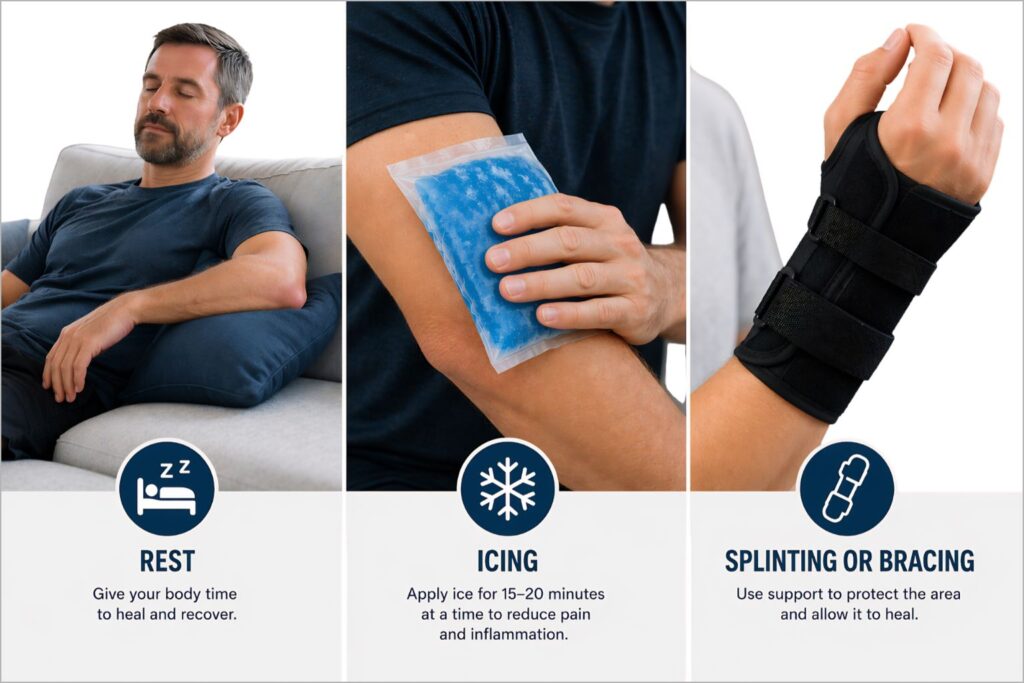
For many overuse problems, conservative treatment starts with activity modification, ice, and anti-inflammatory measures when appropriate.
Cleveland Clinic and Johns Hopkins both describe non-surgical first steps like rest, icing, splinting or bracing in some cases, and anti-inflammatory medication guidance when appropriate from a clinician.
Step 4: Work on the cause, not just the pain
This is huge.
If the problem came from poor mechanics, bad paddle fit, no warm-up, or a giant spike in playing load, you cannot just ice your way out forever.
That is why so many sports-medicine groups emphasize lessons, conditioning, and gradual progression. AAOS literally includes “take lessons” in its injury-prevention advice because bad technique increases injury risk.
When should you actually see a doctor or physical therapist?
Sooner than rec players usually do. You should not wait forever just because the injury was not dramatic.
A good rule is to get evaluated if:
- pain is not improving
- you have weakness
- range of motion is limited
- you have swelling that persists
- the pain is affecting daily life, not just pickleball
- or you are changing your mechanics to avoid it
And there are stronger red flags where you should stop trying to self-manage it:
- numbness or tingling
- severe weakness
- night pain that keeps worsening
- visible swelling or deformity
- inability to grip, lift, or raise the arm normally
- or pain after a pop or sudden sharp event
Those patterns can point to something more serious than routine overuse, including tears, nerve issues, or other problems that deserve proper evaluation.
What are the biggest mistakes rec players make?
This list is painfully consistent.
1. Playing through the warning phase
A lot of players tell themselves, “It only hurts after I play.”
That is often the early phase of an overuse injury. That is when you still have the most power to calm it down.
2. Jumping from “twice a week” to “every day”
The body does not always object immediately. Sometimes it cashes the bill two weeks later.
3. Treating gear as the only solution
Yes, paddle choice can matter.
No, a softer paddle does not automatically fix bad mechanics, too much play, poor recovery, or weak supporting muscles.
4. Skipping warm-up and strength work
AAOS, Mayo, and HSS all lean hard into preparation. Warm up, build strength, and do not ask cold tissues to perform hot actions.
5. Waiting too long to get help
Mild overuse injuries are usually easier to calm down than stubborn ones.
That is not revolutionary. It is just true.
How can rec players lower their risk?
Not with one magic trick. But there are a few moves that matter a lot:
- Warm up before you play, not after game two when your body finally wakes up.
- Build some basic strength in your shoulders, forearms, legs, and core so pickleball is not the only “training” your body gets.
- Do not ramp up too fast. Going from a couple games a week to playing every day is how a lot of overuse problems start.
- Pay attention to technique. Better mechanics usually mean less unnecessary stress on your joints and tendons.
- Use gear that feels manageable, especially if your arm already gets irritated.
- Take recovery days, even when the group chat is making it very hard to be responsible.
The boring truth is this: the body likes gradual progress more than weekend heroics.
So what is the real takeaway for rec players?
An overuse injury usually does not arrive like a plot twist. It arrives like a pattern.
⮕ It is the ache that keeps returning.
⮕ The stiffness that shows up faster.
⮕ The shot you start avoiding.
⮕ The soreness that lasts longer than it should.
⮕ The “I’ll just play through it” phase that quietly turns into a bigger problem.
That is why the smart move is not paranoia. It is awareness.