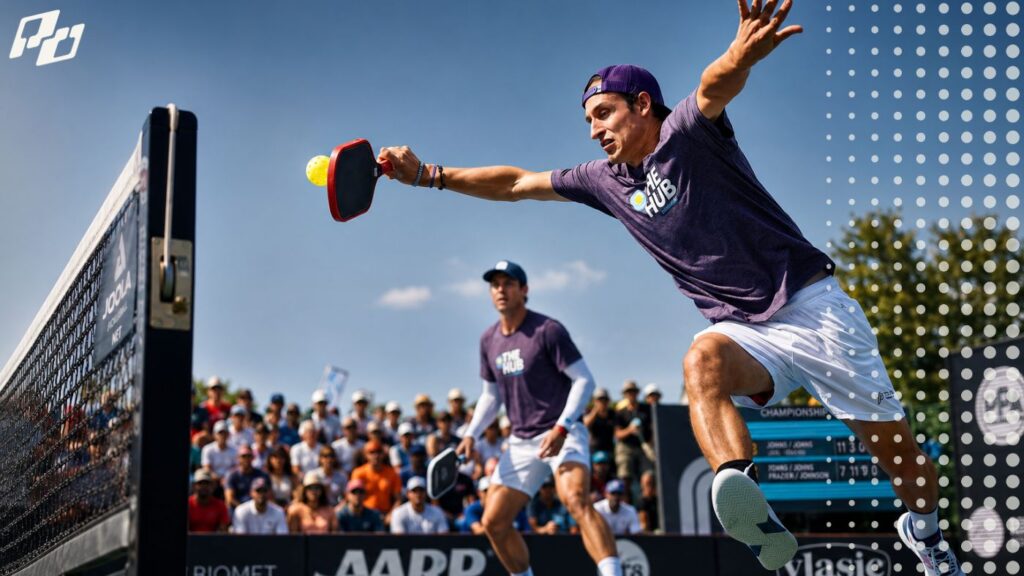
There is a tiny paddle-position detail that separates a lot of advanced kitchen-line attackers from rec players.
It is not more power.
It is not faster hands.
It is not some wild wrist trick.
It is the paddle tip.
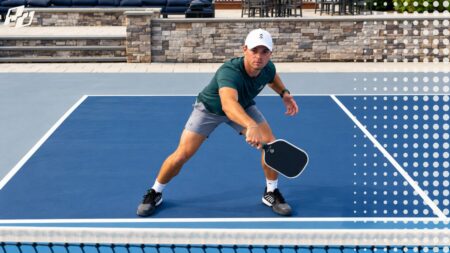
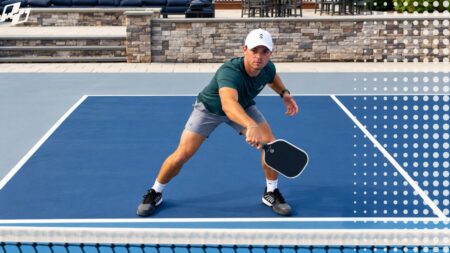
More specifically: advanced players often let the paddle tip drop down before they attack certain balls out of the air.
That small change matters because it gives the paddle a better path to work with. Instead of pushing flat through the ball from the side, the paddle can travel slightly up and through the ball. That creates lift, spin, and a cleaner attack window — especially when the ball is not sitting perfectly high.
And that is the key.
Why Paddle Tip Matters More Than Rec Players Think
At the kitchen line, your paddle angle decides what options you actually have.
When the paddle tip stays too sideways, your swing path tends to become flatter. That can work on higher balls, because the ball is already above the net and you can send it forward.
But on a slightly lower ball — around net height or a little below — a flat sideways paddle often causes problems.
- You either drive the ball into the net.
- Or you open the face too much and float it.
- Or you mistime the contact and spray it wide.
That is why the paddle-tip-down position is so useful. It gives you a more natural low-to-high path without needing a big backswing.
Instead of trying to slap the ball forward, you can brush it upward and forward. That gives you a safer attacking shape.
The Real Benefit: A Bigger Attack Window
The biggest advantage of dropping the paddle tip is simple: it lets you attack more ball heights.
With the paddle tip sideways, your attack window is narrower. You usually need the ball to sit comfortably above net height.
With the paddle tip down, you can handle a slightly lower contact point because the paddle has room to travel up through the ball.
That does not mean every low dink becomes attackable. It means the gray-zone ball becomes more useful.
That is the ball that makes rec players hesitate:
Not a true popup.
Not a clear dink.
Not low enough to leave alone.
Not high enough to smash.
That is where the paddle-tip-down attack helps. It gives you a better way to create shape without taking a giant swing.
Think “Path,” Not Just Wrist
A lot of rec players hear this idea and immediately think, “So I should use more wrist?”
Not exactly. The wrist is involved, but the real idea is paddle path.
The paddle tip drops so the paddle can move from low to high through contact. The wrist and forearm help create that quick upward acceleration, but the shot should not feel like a loose, random wrist snap. It should feel compact and controlled.
A better way to think about it: Tip down. Brush up. Recover fast:
That keeps the idea simple.
You are not trying to muscle the ball. You are creating a better path for the paddle.
The Contact Should Feel Small
The paddle-tip-down attack should not look dramatic. That is part of why it works.
Your opponent should not see a huge backswing or obvious windup. The paddle drops, accelerates, and returns to ready position quickly. Think of it like a short burst, not a full swing.
The shot should feel like:
- quiet paddle
- tip drops
- quick brush
- finish in front
- ready again
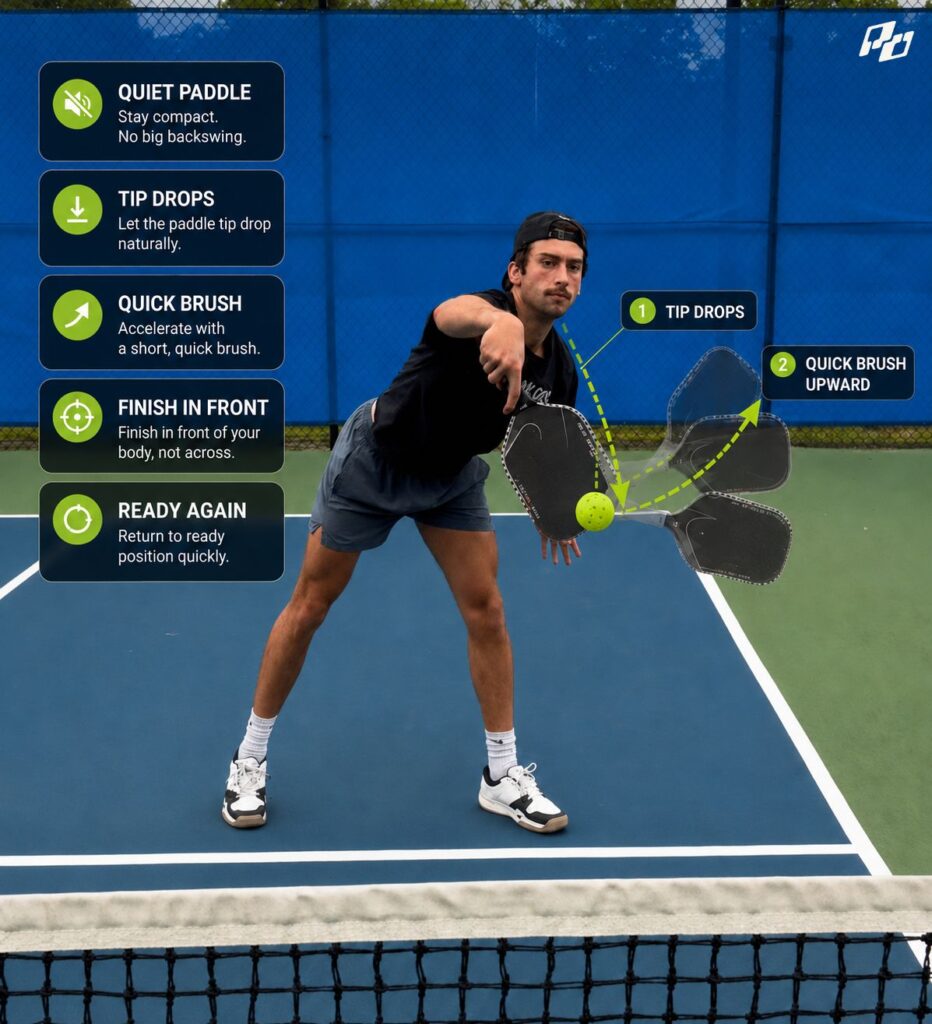
If your paddle finishes way across your body or your shoulder rotates like a full forehand, you probably made the swing too big.
At the kitchen, big swings create big counters.
When Paddle Tip Down Makes Sense
This works best when the ball is:
✓ Around net height
✓ Slightly above net height
✓ Slightly below net height but still in front of you
✓ Floating softly enough for you to control
✓ Close enough that you do not need to reach
The most important phrase there is in front of you.
If the ball is beside your hip, behind your body, or too far outside your frame, dropping the paddle tip will not magically fix the shot.
⮕ You are probably late.
And the smarter play is usually to dink, reset, or block.
Paddle tip down is not a rescue move.
It is an attack shape for a ball you are already positioned to handle.
When It Does Not Make Sense
Do not use this idea as permission to attack bad balls. Skip the paddle-tip-down attack when:
✕ You are reaching
✕ Your feet are moving through contact
✕ The ball is clearly below net height
✕ Your opponent is loaded and waiting
✕ You are off balance
✕ Your partner is not ready for the counter
This is where many rec players get into trouble. They learn a new attacking detail and start using it on everything.
That is not the goal.
The goal is to make the right attack safer and cleaner — not to turn every kitchen ball into a speedup.
Best Targets for This Attack
Do not aim for tiny sidelines when learning this. Start with targets that reward compact pressure:
- the paddle-side hip
- the inside shoulder
- the middle seam
- the opponent’s dominant-side pocket
- or the space between paddle and body
These are better than trying to paint a sideline because the paddle-tip-down attack is usually meant to jam or rush the opponent, not hit a clean winner.
The target cue: Attack the body window, not the sideline.
That keeps the shot higher percentage.
The Little Detail I’d Test Before I Trusted It
Here’s how I’d think about this shot: don’t make it your new favorite attack right away. Make it your new experiment.
The first few times you use the paddle-tip-down shape, pay attention to your miss.
- If the ball keeps going into the net, you probably dropped the tip but never brushed up through contact.
- If it floats high, your paddle face is too open.
- If it flies long, you may be accelerating forward more than upward.
- If it gets countered hard, you probably used it when the opponent was already set.
That feedback matters more than whether the shot worked once.
For rec players, the real win is not learning a flashy new attack. It is learning a cleaner attack shape you can actually trust under pressure.
So start small.
Use it on one ball type: a soft ball around net height, in front of your body, when your feet are still. Aim middle or hip, not sideline. Then watch what happens.
When it starts feeling boringly reliable, then you can make it nastier.
That is usually how the best kitchen attacks are built — not by swinging bigger, but by making a tiny paddle detail repeatable enough that it stops feeling like a trick.