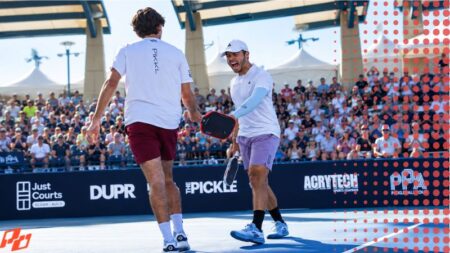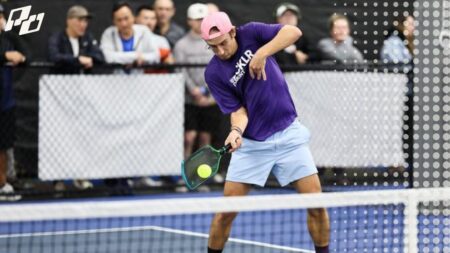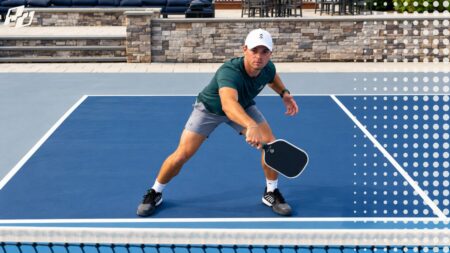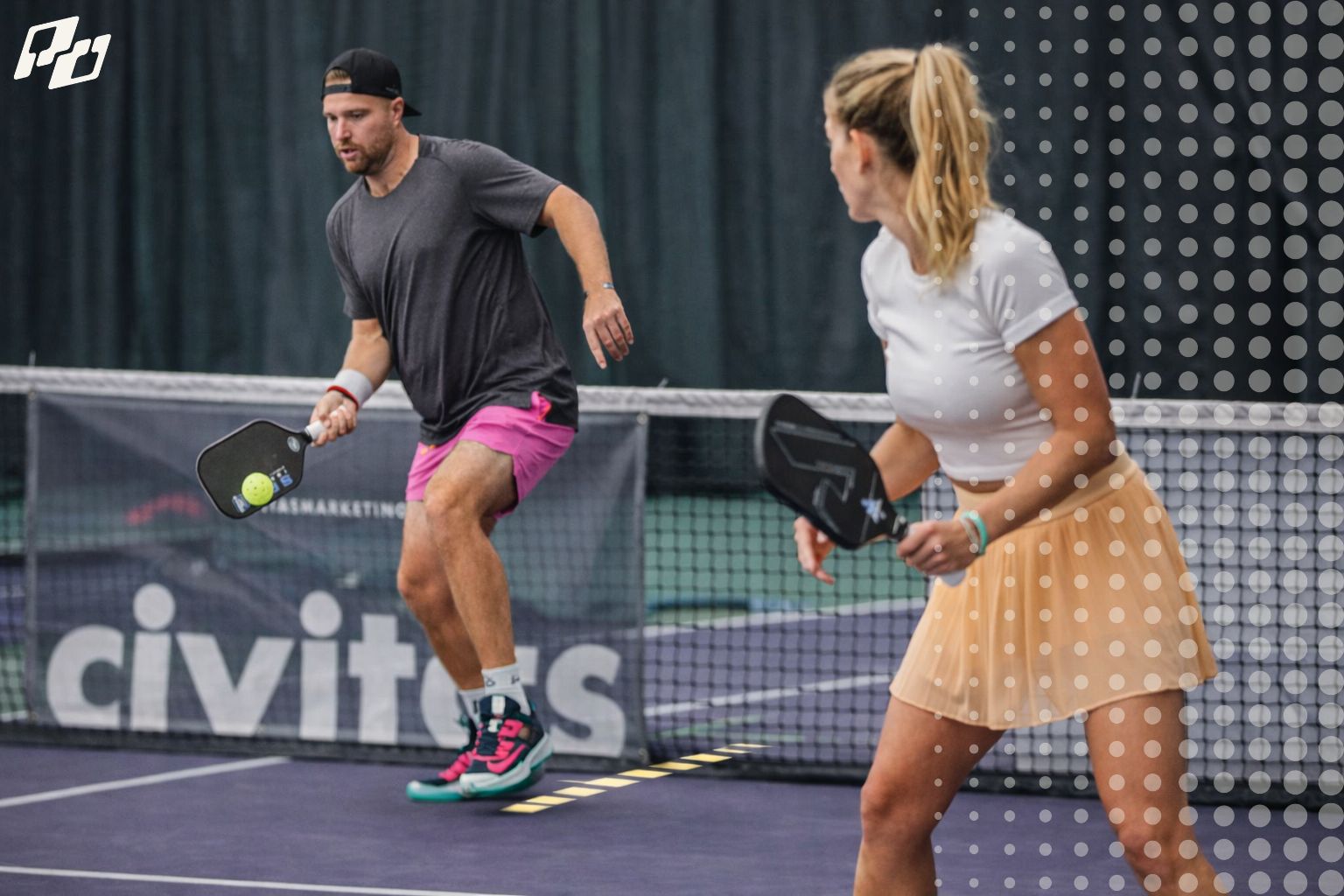
One of the biggest early-intermediate doubles mistakes in pickleball has nothing to do with stroke mechanics.
It is positioning.
Specifically: what you do when your partner is hitting the third-shot drop.
A lot of players in the 2.5 to early 3.0 range know, in theory, that the serving team wants to drop and move in. But when the return goes to their partner, they freeze. Or they do one of two things:
- They stay all the way back, perfectly parallel with their partner.
- Or they panic and sprint straight to the kitchen line no matter what kind of drop is coming.
Both create problems.
And that is exactly why pickleball coach Tanner Tomassi recently addressed this issue and shared such useful advice. His point is simple, but strategically important: when your partner is hitting the third-shot drop, you should usually move two steps in ahead of them, then read the quality of the drop before deciding whether to keep moving forward or prepare for defense.
That gives you options.
➡️ It gives you a head start if the drop is good.
➡️ And it gives you enough balance and time to defend if the drop floats too high.
That in-between position is where a lot of smart doubles pickleball starts.
Why this matters so much
In doubles, the serving team starts at a disadvantage.
The returning team is usually already at or near the kitchen line, while you and your partner are back near the baseline. That means the third shot is not just another shot. It is the shot that is supposed to help your team neutralize the point and start taking the court back.
But here is what a lot of early-intermediate players miss: the third-shot drop is not just your partner’s responsibility. Your positioning as the non-hitting partner affects:
- whether your team can move in together
- whether you can pressure a weak fourth shot
- whether you can cover counters
- and whether your opponents feel comfortable or uncomfortable
So even when you are not hitting the drop, you are still heavily involved in what happens next.
The two common mistakes
Let’s start with the two bad habits Tanner points out.
Mistake 1: staying parallel with your partner
This is the passive version.
The return goes to your partner, they are back at the baseline, and you just stay right beside them. You watch them hit the drop, but you do not gain any court position.
Why this is a problem:
✖️ If the drop is good, you are too far back to apply pressure.
✖️ If the fourth shot pops up, you are not close enough to attack it.
✖️ If your partner hits a quality drop, your team still feels passive because both players are still deep.
In other words, you waste a good third shot.
Mistake 2: sprinting straight to the kitchen
This is the overeager version.
Some players hear “drop and move in,” so they take that to mean “run to the kitchen immediately no matter what.” That sounds aggressive, but it often turns into a disaster.
Why?
Because if the drop floats high, you are now stranded too far forward while the other team is about to hit down at your feet. That is one of the hardest positions in pickleball.
✖️ You have no time.
✖️ Your weight is moving forward.
✖️ Your paddle is often not set.
✖️ And your opponents are about to punish the ball.
So the problem is not wanting to move in. The problem is moving in before you know whether the drop earned it.
The better answer: two steps in and read the ball
This is the heart of Tanner’s advice, and it is excellent. When the return goes to your partner, you do not stay all the way back and you do not sprint all the way in.
Instead, you move two steps in ahead of your partner and watch the drop:
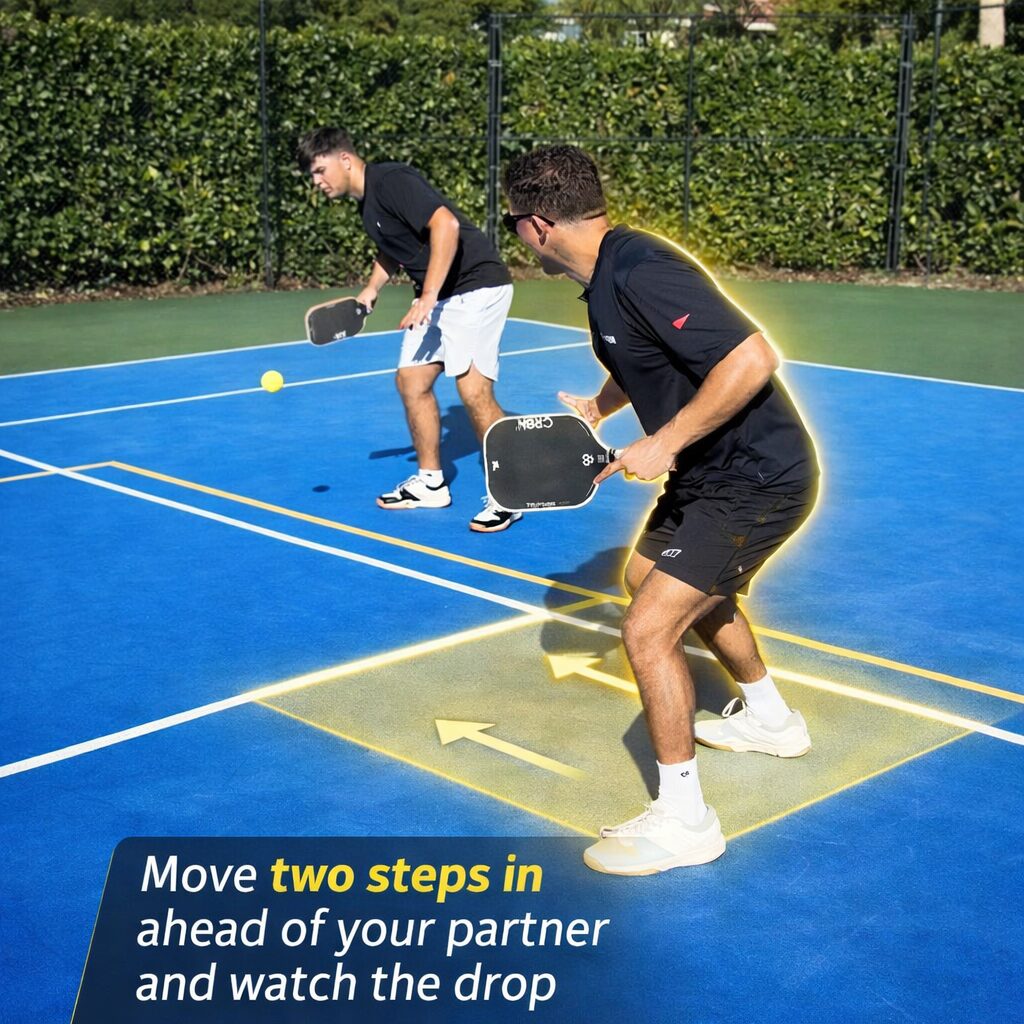
✓ That position gives you a much better decision window.
✓ You are not committed too early.
✓ But you are also not stuck too far back.
You are active, balanced, and ready to react based on what your partner actually hit.
That is the key: your movement should be tied to the quality of the drop, not to a fixed script.
Why the “two steps in” position works
This in-between spot solves a lot of doubles problems at once.
First, it gives you a head start. If your partner hits a good aggressive drop, you can move in quickly and put pressure on the fourth shot.
Second, it keeps you from getting stranded. If the drop is too high, you still have enough space and balance to retreat, defend, or brace for a hard reply.
Third, it makes your team feel more connected. Instead of one player being back and one player being wildly forward, you are staggered in a smart way that lets you adjust together.
Fourth, it creates visual pressure. Even if you are not fully at the kitchen yet, your presence a little farther up the court can make opponents feel like they have less time and less space.
That last point matters more than people think. In doubles, your positioning influences your opponents’ decisions. If they see one partner already creeping in, they often feel rushed into hitting a more difficult fourth shot.
What you should be looking for
The “two steps in” idea is only useful if you know what you are reading. As your partner hits the third-shot drop, you should be assessing three main things:
- How high is the ball traveling?
- How deep is it landing?
- How much pressure will it put on the opponents?
A good drop usually:
- clears the net with margin
- lands in the kitchen or very close to it
- and forces the opponent to hit up rather than down
A bad drop usually:
- floats too high
- lands too deep
- or sits up enough that the opponent can attack
Your job is to read which one you got.
If the drop is good, move in and apply pressure
This is when the two-step head start really pays off.
If your partner hits a quality drop — especially one that lands low and forces an upward contact — you should continue moving in and start applying pressure.
That does not always mean charging wildly to the kitchen line. It means moving forward with purpose, paddle up, balanced, ready for:
- a pop-up
- a soft reset
- a weak roll
- or a ball you can volley from mid-transition
This is where a lot of free points come from at the early 3.0 level. Why?
Because many opponents do not handle good drops very well. They may pop the fourth shot up, hit it into the net, or give you a ball you can block or counter from a forward position.
But you only get to capitalize on that if you did not stay too far back.
If the drop is high, do not keep drifting forward
This is just as important. If your partner’s drop floats or sits up too much, do not continue walking into trouble.
This is where discipline matters.
A lot of players see themselves already moving in and think, “Well, I guess I have to keep going now.”
No. You do not.
If the drop is high, you need to shift into defense. That may mean:
- stopping your forward movement
- taking a small step back
- widening your base
- setting your paddle
- and preparing for a harder fourth shot
This is where Tanner’s advice is especially smart. Because you only moved two steps in, you still have room to react. You are not fully exposed.
That is a huge difference.
A good visual for early 3.0 players
Think of it like this:
When your partner is hitting the third-shot drop, your first move is not to the kitchen line. Your first move is to a decision zone.
That decision zone is slightly ahead of your partner, where you can:
- see the drop
- judge the quality
- and then decide whether to continue forward or hold/retreat
That is a much better mental model than: “drop equals run.”
Because in real doubles pickleball, the right movement depends on the shot quality.
Practical scenarios
Let’s make this more real.
Scenario 1: your partner hits a strong third-shot drop cross-court
The return goes deep to your partner’s backhand side. You move two steps in and watch. Your partner hits a soft, low drop that lands nicely in the kitchen.
This is your green light. Now you keep moving in with your paddle up. Be ready for the opponent to:
- pop it up
- roll it softly
- or dink it back
Because you already had a head start, you are in a much better position to pressure that fourth shot.
Scenario 2: your partner’s drop floats too high
The return comes deep, your partner tries to drop it, but the ball sits up above net height. This is not the time to keep charging.
Now you stop, get balanced, and prepare for a hard fourth shot. Maybe you take a step back. Maybe you widen your base. Maybe you shade toward the most likely attack lane.
The key is that you do not donate an easy point by drifting forward into a ball the opponent is about to hammer.
Scenario 3: your partner hits a decent but not great drop
This is a very common one in rec play. The ball is not terrible, but it is not amazing either. It lands a little high, but still forces some movement.
This is where the two-step concept really shines, because now you can stay slightly forward, paddle up, but not overcommit. You can continue advancing carefully if the opponent’s contact is weak, or hold your ground if they look ready to attack.
That middle read is exactly what better doubles players do.
What your body should look like in that position
This part matters. When you move those two steps in, do not just stroll forward casually. You should be:
- on the balls of your feet
- slightly bent at the knees
- paddle up in front
- chest facing the play
- and weight balanced enough to move either forward or backward.
That last point is huge. If your weight is already falling forward, you are much more vulnerable if the drop is attacked.
So this is not just about where you stand. It is also about how ready you are to change direction.
The communication piece
You do not need complicated signals. Even simple phrases help:
- “Good” if the drop is solid and you can move
- “Back” or “up” if it floated
- “Mine” if you are taking the next ball
- “Stay” if your partner is drifting too far
At early 3.0, basic communication can clean up a surprising number of transition mistakes.
A simple cue that works
If you want one simple line to remember, use this: two steps in, then decide.
That is it.
✖️ Not: run in no matter what.
✖️ Not: stand beside your partner and hope.
Two steps in, then decide.
That one cue is practical, easy to remember, and much closer to how smart doubles actually works.