
Pickleball burnout is common when you play too often, chase ratings, repeat the same games, or turn the sport into pressure instead of fun. To recover, take a short break, reduce volume, change groups, drill instead of playing, add recovery days, and return with a lighter, more intentional schedule.
At first, pickleball feels almost impossible not to play.
You find a group. You start improving. You buy a better paddle. You learn the third shot drop. You start checking DUPR. You play one extra game, then one extra day, then suddenly your “fun hobby” is basically on your weekly calendar like a part-time job. And for a while, that feels great.
Then one day, something weird happens.
You do not feel like playing.
Not because you hate pickleball. Not because you are injured. Not because you stopped caring.
You just feel… done.
The courts are still there. The group chat is still buzzing. The games are still available. But the spark feels flat. You may even feel guilty about it, especially if you have been improving or playing almost every day.
Here is the good news: that feeling is more common than most players admit. In rec-player conversations, burnout often shows up after long stretches of intense play, tournament prep, rating pressure, repetitive groups, social friction, or the feeling that pickleball has quietly turned from “fun” into “obligation.”
And here is the more important point: Burnout does not always mean you need to quit pickleball.
But it does mean you need to change your relationship with it.
First, What Does Pickleball Burnout Actually Feel Like?
Pickleball burnout is not just being tired after a long session. That is normal fatigue.
Burnout is different. It feels more like emotional and mental resistance to something you normally enjoy.
You may notice:
- you stop looking forward to games
- you feel annoyed by the same group dynamics
- you dread tournaments you already signed up for
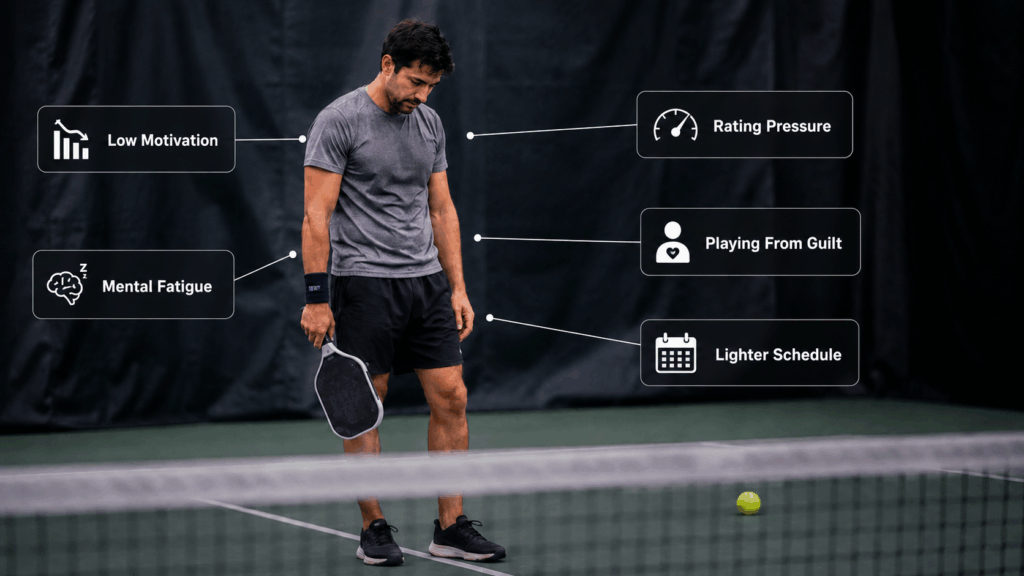
- your body feels fine but your motivation is gone
- you are playing out of habit instead of desire
- you feel pressure to maintain your rating
- you are irritated by mistakes faster than usual
- you avoid the group chat
- you keep saying “I should play” instead of “I want to play.”
That last one is a big clue.
“I want to play” is motivation.
“I should play” is pressure.
When pickleball moves from want to should, burnout can creep in.
Sports psychology research often describes athlete burnout as a combination of emotional and physical exhaustion, reduced sense of accomplishment, and sport devaluation — basically, the sport starts taking more than it gives. Burnout is also linked with motivation, sleep, stress, well-being, and the way an athlete’s environment supports or drains them.
For rec players, that matters because you may not think of yourself as an “athlete,” but your body and brain do not care what label you use.
If you play nearly every day, chase improvement, compete, manage partners, track ratings, and put pressure on yourself, you are training like an athlete in many ways.
So you can burn out like one, too.
The Sneaky Problem: Pickleball Rewards Obsession Early
Part of the reason pickleball burnout surprises people is that the early stage is so addictive. You improve fast.
In the first few months, almost everything works. That early improvement loop is powerful.
You play more, you get better.
You get better, you want to play more.
You play more, you meet more people.
You meet more people, you get invited to more games.
Now pickleball becomes part of your identity.
That is fun — until it becomes heavy.
At some point, the improvement curve slows. The easy gains disappear. You are no longer just learning the rules and getting comfortable. Now you are fighting for smaller upgrades: cleaner resets, better shot selection, fewer pop-ups, stronger counters, smarter partner movement.
Progress becomes less obvious. And when progress slows but pressure stays high, pickleball can start to feel like work.
That is when a lot of serious rec players get confused.
They think: “Why am I not excited anymore? I still love the game.”
You may still love it. You may just be overloaded by the way you are playing it.
Burnout Reason #1: You Turned a Hobby Into a Job
This is probably the biggest one.
If you play every day, track every result, drill every weakness, chase every rating point, and feel guilty when you miss a session, you have not just created a hobby.
You have created a job with no paycheck. And unlike a job, nobody is forcing you to show up. That makes the guilt weird.
You might feel like:
- “If I take a break, I’ll lose progress.”
- “If I skip games, I’ll fall behind.”
- “If I don’t play tournaments, I’m wasting my level.”
- “If I’m not improving, what’s the point?”
- “If I play less, people will pass me.”
That mindset can keep you grinding even after the fun is gone.
But long-term improvement does not come from endless exposure. It comes from the right balance of stress, recovery, skill work, and motivation.
Even in broader training culture, rest is not a weakness. Recovery is where adaptation happens. Research and coaching around athlete burnout consistently point to the importance of recovery, motivation quality, sleep, stress management, and avoiding relentless pressure as part of sustainable performance.
For pickleball, the practical translation is simple: Playing more is not always the same as getting better.
Sometimes playing less — but with more purpose — makes you better and happier.
Burnout Reason #2: Your Games Got Too Repetitive
Pickleball is social, but it can also become oddly repetitive.
Same group.
Same courts.
Same style.
Same arguments.
Same partner frustrations.
Same guy speeding up everything.
Same player avoiding strong competition.
Same line-call drama.
Same “advanced court” politics.
At first, familiarity feels comfortable. Later, it can feel stale.
This is especially common when players improve into the 3.5–4.5 range. The game becomes more serious, but not always more enjoyable. People start caring about ratings, partner selection, court hierarchy, paddle legality, tournament results, and who “belongs” where.
The social environment can become more tiring than the sport itself. That is important because burnout is not always caused by the physical act of playing.
Sometimes you are not tired of pickleball. You are tired of the version of pickleball you are currently surrounded by.
The fix
Change one variable before you assume you are done with the sport.
Try:
✓ a different open play group
✓ a different facility
✓ a private foursome
✓ skinny singles
✓ a ball machine session
✓ drilling instead of games
✓ mixed-level social games
✓ a ladder with clearer structure
✓ playing outdoors if you always play indoors
✓ or playing with friends who care less about the result
A fresh environment can bring back the feeling you thought was gone.
Burnout Reason #3: You Are Overplaying and Under-Recovering
Pickleball can trick you because it does not always feel like a “real workout” until your body starts complaining.
But if you play hard, pickleball includes:
- repeated split steps
- fast lateral shuffles
- lunges
- sudden stops
- trunk rotation
- shoulder load
- calf and Achilles stress
- reaction demands
- and long periods of low-level mental focus
Now do that five, six, or seven days a week. At some point, your system may stop feeling fresh.
Physical fatigue and mental fatigue feed each other. If your legs feel heavy, your shot selection gets worse. If your timing is off, you get frustrated. If you get frustrated, you grip tighter. If you grip tighter, you miss more soft shots. Then the game feels less fun.
That is not a character flaw. That is load management.
Signs you may be physically overcooked
✓ slower first step
✓ more pop-ups
✓ more missed returns
✓ achy knees, calves, hips, or shoulder
✓ poor sleep after night play
✓ irritability during games
✓ needing longer to warm up
✓ losing focus late in sessions
✓ no desire to play the next day
If your body is quietly asking for a break and you keep answering with “one more game,” burnout can become the messenger.
Burnout Reason #4: DUPR and Ratings Changed the Emotional Math
Ratings can be useful. They help organize games, tournaments, ladders, and competitive levels.
But ratings can also steal joy if they become the main reason you play. Once a number starts feeling like your identity, every match gets emotionally heavier.
A bad game is no longer just a bad game. It becomes:
“Am I getting worse?”
“Will people stop inviting me?”
“Did I just drop below that player?”
“Was I overrated?”
“What does this say about me?”
That is exhausting.
The irony is that rating pressure often makes players worse at the exact things that help ratings long term: smart shot selection, patience, emotional control, partner trust, and learning from losses.
If you are burned out, ask yourself honestly: Do I miss playing pickleball, or do I miss feeling like I was improving?
Those are different. If the rating chase is the main fuel, you may need a different fuel source.
Burnout Reason #5: You Hit a Skill Plateau
Skill plateaus are sneaky because they feel like emotional burnout, but they often start as technical frustration.
You keep playing, but the same problems stay. At first, playing more helped. Now playing more just exposes the same weaknesses.
That creates a frustrating loop:
You play.
The same weakness shows up.
You get annoyed.
You play more to fix it.
The weakness shows up again.
Now pickleball feels less fun.
This is where a lot of players confuse “I’m burned out” with “I’m tired of repeating the same errors.”
The solution may not be a full break. It may be a better training structure.
The fix
Stop using random games as your only improvement plan. Pick one issue and build a small block around it:
✓ 15 minutes of transition resets before games
✓ one session of crosscourt dinks and counters
✓ a week where you track only return depth
✓ a ball machine session for balls at your feet
✓ one lesson focused only on third-shot decision-making
✓ one game where you attack only balls above net height
When improvement becomes specific again, motivation often returns.
The Big Question: Should You Take a Break or Push Through?
This is where players need to be careful.
Sometimes you need discipline.
Sometimes you need rest.
The trick is knowing which one.
Push through gently if:
✅ you still enjoy the game once you start
✅ you are just in a short slump
✅ your body feels okay
✅ the issue is one technical frustration
✅ you feel better after a lighter session
✅ or you are avoiding pickleball because of one uncomfortable group dynamic
In that case, do not quit. Adjust.
Play shorter. Drill more. Change groups. Reduce pressure.
Take a real break if:
❌ you dread playing
❌ you feel emotionally flat on court
❌ your body is constantly sore
❌ you are irritable every session
❌ you have lost interest in other things too
❌ you are playing only from guilt
❌ or pickleball is making your life feel smaller instead of fuller.
A break is not failure. A break is maintenance.
Some players come back after a week. Some need a month. Some need a season of playing less. That does not mean the game is gone. It means your relationship with the game is changing.
The “Active Break” Option
A lot of rec players hate the phrase “take a break” because they think it means doing nothing.
It does not have to.
You can take a break from your current pickleball routine without becoming inactive. An active break might mean:
- no competitive games for two weeks
- only drilling
- only social play
- only ball machine work
- two days per week instead of six
- no DUPR events for a month
- no group chat pressure
- replacing one session with strength training
- trying tennis, disc golf, swimming, hiking, cycling, or gym work
This works because you are not abandoning movement. You are changing the stimulus.
For many players, another activity restores the part of the brain that pickleball has been draining.
Then when you come back, the court feels like a treat again.
The Three Types of Pickleball Burnout
Not all burnout is the same. This matters because the fix depends on the type.
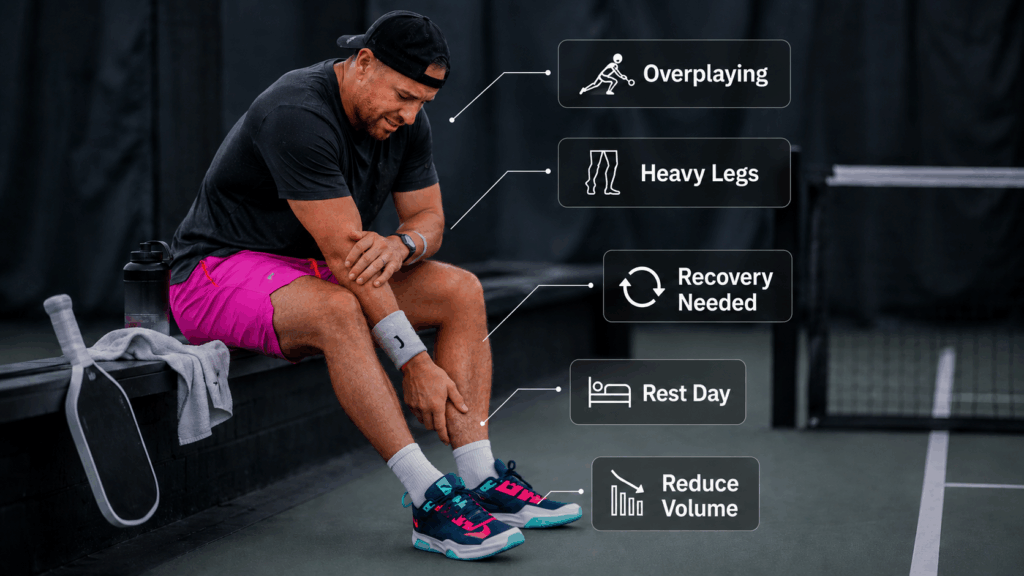
1. Physical burnout
Your body is tired.
You need recovery, sleep, mobility, strength work, and fewer hard sessions.
Signs:
- soreness
- heavy legs
- slower reactions
- nagging aches
- low energy
- poor warmup response
Fix: Reduce volume. Add rest days. Strength train. Shorten sessions. Stop playing through fatigue.
2. Mental burnout
Your brain is tired. You need less pressure, fewer ratings-based games, clearer goals, and more variety.
Signs:
- dread
- boredom
- irritability
- no excitement
- overthinking
- frustration with small mistakes
Fix: Change the format. Play for one focus. Take a short break. Stop tracking every result.
3. Social burnout
Your community is tiring you out. You may still love the sport but dislike the drama, cliques, pressure, or repetitive group dynamics.
Signs:
- avoiding certain players
- dreading open play
- feeling judged
- frustration with partner selection
- annoyance with court politics
Fix: Find new games. Build a trusted foursome. Drill privately. Try a new venue. Play with people who match your energy.
Most players have a mix of all three. So do not just ask, “Am I burned out?”
Ask: What part of pickleball is burning me out?
That question gives you a plan.
How to Play Less Without Getting Worse
This is the fear that keeps many players trapped.
They think: “If I play less, I’ll lose everything.”
Not true.
You may lose a little timing at first. Your hands may feel less sharp for a few sessions. Your touch may need a warmup. But real skills do not disappear overnight.
What usually happens is this:
- sharpness drops first
- fitness can dip if you do nothing else
- decision-making stays if you keep watching and thinking
- technique stays if it is well-learned
- motivation often improves with rest
You can maintain a strong rec game on less volume if the sessions are better structured.
A sustainable schedule for serious rec players
Instead of six random play sessions, try:
Day 1: Skill session
Drops, resets, counters, dinks, serves, returns.
Day 2: Competitive play
Best games you can find, with one tactical focus.
Day 3: Hybrid session
Drill 20–30 minutes, then play games where that skill must show up.
Two off-court days
Strength, mobility, walking, cycling, yoga, or recovery.
This can be more productive than playing exhausted every day.
The “Fun Audit”: Why Are You Playing?
If burnout is creeping in, do a quick audit. Write down your top three reasons for playing pickleball right now.
Possible answers:
- fun
- friends
- fitness
- competition
- improvement
- identity
- stress relief
- tournaments
- ratings
- routine
- community
Now ask:
Which of these is still working?
Which one is causing pressure?
Which one do I need more of?
Which one do I need less of?
If you started for fun and fitness but now only play for rating and status, of course it feels different.
Your original reason got buried.
The fix may be to reconnect with why you started — or to choose a new reason that fits your current life better.
How to Know If a Break Is Working
A good break should make you feel lighter, not anxious. During a break, watch for:
✓ better sleep
✓ less irritability
✓ more interest in other activities
✓ fewer aches
✓ curiosity returning
✓ wanting to watch or think about pickleball again
✓ feeling excited by a specific game invitation
Do not force the comeback too early.
If you take three days off but spend the whole time refreshing the group chat and feeling guilty, that is not a break.
That is still pickleball running in the background. A real break gives your mind permission to not optimize for a while.
The Comeback Plan After Burnout
When you feel ready, do not return with the same schedule that burned you out. That is like recovering from a sunburn and going straight back into the desert with no sunscreen.
Come back gradually.
Week 1: Just enjoy it
Play once or twice. No tracking. No big expectations. No tournament prep.
Week 2: Add one focus
Pick one skill or tactical theme. Keep it simple.
Week 3: Rebuild structure
If you want to train again, add one drill session and one competitive session.
Week 4: Decide what schedule actually feels sustainable
Maybe it is two days per week.
Maybe three.
Maybe four during tournament prep.
Maybe everyday play is no longer your sweet spot.
That is not a step backward.
That is maturity.
When Burnout Might Be More Than Pickleball
This is important.
If you only feel burned out from pickleball, that is one thing.
But if you are losing interest in everything — not just pickleball — or you feel persistently flat, hopeless, irritable, isolated, or exhausted, consider talking to a medical or mental health professional.
That does not mean something is “wrong” with you. It means you are taking your overall health seriously.
Sometimes pickleball is the first place we notice a bigger life-stress issue because it used to be the thing that made us feel better.