

Let the ball go out in pickleball when it is shoulder-high or rising, hit from below net height, struck with a big backswing, or coming from an off-balance opponent. Also watch court position, spin, angle, and wind. The goal is to stop saving your opponent’s bad attacks.
One of the easiest ways to win more points in pickleball is also one of the hardest skills to trust: letting the ball go.
Every rec player knows the feeling. A ball comes flying at your chest, shoulder, or face, and your hand reacts before your brain finishes the sentence.
You hit it.
Then you turn around and watch it land two feet past the baseline.
Free point gone.
And the worst part? You probably knew it was going out. You just could not stop yourself.
That is why learning to let out balls go is not just a rules thing. It is a discipline skill, a vision skill, and a pattern-recognition skill. For 3.0–4.0 rec players, it can be worth several points per game because many opponents speed up balls that were never going to land in. Coaching discussions often frame this as a probability skill rather than an absolute rule: the goal is not to eliminate every mistake, but to reduce the number of out balls you accidentally save.
And that is the right mindset.
You are not trying to become perfect.
You are trying to stop rescuing your opponent’s bad attacks.
First: “Shoulder High, Let It Fly” Is Helpful — But Not Enough
You have probably heard the old saying: Shoulder high, let it fly.
It is a good starting point. If a hard-hit ball reaches you at shoulder height or above, especially near the kitchen or midcourt, there is a strong chance it is going long.
But pickleball has changed.
Paddles create more spin. More players can roll balls with topspin. Some hard balls that look high may still dip. Some players hit with enough shape to bring the ball down late.
That means “shoulder high, let it fly” is useful, but it is not foolproof. Multiple coaches now teach players to look beyond height and read backswing, contact point, court position, momentum, spin, angle, and weather conditions before deciding whether to play or dodge the ball.
A better rule is: Shoulder high is a warning sign, not a final answer.
The final answer comes from stacking clues. So let’s build the stack.
1. Read Where the Opponent Hits From
The same ball hit from the baseline and the kitchen line are not the same ball. This is one of the biggest things rec players miss.
If your opponent is back near the baseline, they have more court to work with. They can swing harder, hit higher over the net, and still have enough distance for the ball to drop in.
But if they are close to the kitchen and attack hard from a low or medium contact point, the court behind you gets very short very fast.
That is why a speedup from the kitchen line is much more likely to sail long than a drive from the baseline.
The practical read
If the opponent is:
⮕ At the baseline:
Be more willing to play the ball. They have room for the shot to drop.
⮕ In transition:
Start reading carefully. Low attacks from midcourt often float long, especially if the player is moving forward.
⮕ At the kitchen:
Be much more suspicious of hard balls at your chest, shoulder, or above. They have less runway.
This is the first filter.
Do not ask only, “How high is the ball when it gets to me?”
Ask: Where did it come from?
A shoulder-high ball from the baseline may land. A shoulder-high ball ripped from the kitchen often will not.
2. Read Their Contact Point: Low Contact Usually Means Trouble for Them
Contact point may be the best clue of all.
If your opponent attacks a ball from below net height, they usually have to hit up. And if they hit up with pace, the ball needs a lot of spin to come back down.
Some players can do that. Most rec players cannot do it consistently. That is why low-contact speedups are often out balls in disguise.
The practical read
If they contact the ball:
⮕ Above net height:
They can hit down or forward. Be ready to play.
⮕ Around net height:
This is a judgment ball. Read spin, speed, and balance.
⮕ Below net height:
Be ready to let it go, especially if they swing hard.
The closer they are to the net, the more this matters. A low ball attacked from the kitchen is a very different risk than a low ball driven from deep in the court.
This is why the best out-ball readers often know before the ball reaches them.
They see the opponent hit from low and think: That ball has to climb. If it keeps climbing at me, I’m out of the way.
A good mental cue: Low contact plus big speed equals let-it-go alert.
Not automatic. Alert.
3. Read the Backswing: Big Swing, Short Court, Bad Math
A big backswing is not always bad.
From the baseline, a player may need a bigger swing to drive the ball deep.
But at the kitchen? A big backswing is a huge warning sign.
When a player is close to the net and takes a long, dramatic swing, they have very little time and space to control the ball. Unless they create excellent topspin, that ball often keeps flying.
This is especially true at the rec level.
A lot of players speed up because they are excited, not because the ball is actually attackable.
You see:
- paddle goes way back
- shoulders open early
- arm gets long
- body lunges forward
- ball comes fast and high
That is a gift if you let it go.
The practical read
Use this simple equation:
⮕ Big backswing + close to kitchen + hard contact = likely out
If the player is deep in the court, the big swing is less predictive.
If the player is at the kitchen and winds up like they are hitting a tennis forehand, get ready to dodge.
A short, compact speedup is often more dangerous because the player is controlling the paddle face. A huge swing usually means they are hoping power solves the point.
Let them prove it.
4. Read Their Balance and Momentum
This is where out-ball reading becomes more advanced.
A balanced player can control pace, spin, and direction. An off-balance player is borrowing control from luck.
When your opponent is leaning, falling forward, reaching wide, backing up, or running through the ball, their body momentum adds energy to the shot. That extra energy often pushes the ball long or wide.
This is especially common in rec play because players attack while moving instead of stopping, setting, and striking cleanly.
The practical read
Be suspicious when your opponent is:
- running through the shot
- falling forward
- reaching outside their body
- leaning backward
- stretched wide
- late to contact
- or hitting while their feet are still moving
A player who is moving forward and attacks hard may unintentionally add too much pace. A player reaching wide may lose paddle-face control. A player falling backward may float the ball.
This does not mean every off-balance shot goes out. But it changes the probability. And that is the point.
Better players are not thinking: “Will this definitely go out?”
They are thinking: “This player is off balance, low, close to the net, and swinging big. I like my odds if I let this go.”
That is how you earn free points.
5. Read Spin: Topspin Dips, Slice and Flat Balls Carry
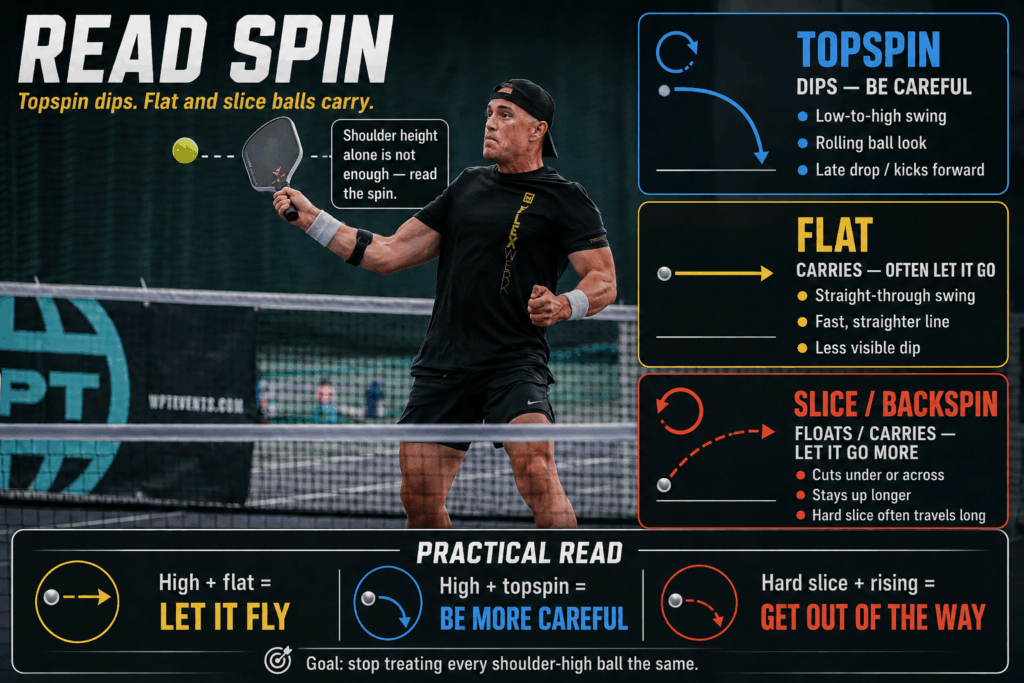
This is why shoulder height alone is not enough anymore.
A hard ball with topspin can look like it is going long and then dip late.
A flat ball tends to carry.
A slice or backspin speedup can also float and travel farther, especially if hit hard.
So if you want to let more out balls go without getting burned, you need to start reading spin.
You do not need pro-level vision. You just need a few simple clues.
Topspin clues
The opponent’s paddle travels low to high.
The ball has a rolling shape.
The ball starts higher but curves down.
The bounce may kick forward.
Topspin is the ball most likely to surprise you by landing in.
Flat ball clues
The paddle travels more straight through the ball.
The ball comes fast on a straighter line.
There is less visible dip.
If it is high at your body, it may sail.
Flat speedups from low contact are often good balls to leave.
Slice/backspin clues
The paddle cuts under or across the ball.
The ball floats or carries.
The ball may stay up longer.
Hard slice attacks often travel long.
Coaches commonly teach that topspin helps the ball dip, while flatter or sliced hard balls are more likely to carry long.
The practical read
⮕ If it is high and flat, let it fly.
⮕ If it is high but clearly rolling with topspin, be more careful.
⮕ If it is sliced hard and rising, get out of the way.
The goal is not to identify spin perfectly every time. The goal is to stop treating every shoulder-high ball the same.
6. Read the Angle: Sharp Crosscourt Attacks Have Less Court
Direction matters.
A ball hit straight down the line has more usable depth than many players realize. A ball hit deep crosscourt has the longest diagonal path. But a sharp angle speedup across the court can run out of space quickly.
This is why some balls that look dangerous are actually bad attacks.
If your opponent is trying to hit a sharp angle with pace, especially from close to the kitchen or from a low contact point, the court may not be long enough.
The practical read
Be more willing to play:
- down-the-line drives
- deep crosscourt drives
- balls hit through the middle
- topspin balls with shape
Be more willing to let go:
- sharp speedups from the sideline
- wide attacks that are still rising
- low crosscourt flicks with too much pace
- balls hit hard from close range toward your outside shoulder
A simple cue: The sharper the angle, the shorter the court.
If the ball is going hard and wide, ask whether it actually has enough room to land.
Many times, it does not.
7. Use the “Prove It” Rule Early in the Game
This is one of my favorite rec-player strategies.
Early in a game, make opponents prove they can keep aggressive shots in. If someone loves to speed up from below net height, do not automatically save those balls. Let one or two go. See what happens.
If someone drives every third shot with a huge backswing, let the high ones fly.
If someone attacks while falling forward, make them prove they can control that momentum.
If there is a tailwind behind them, make them prove they can keep hard balls in.
This is not passive. It is scouting.
The practical read
In the first few rallies, gather information:
- Do they hit with topspin or mostly flat?
- Do their speedups dip or sail?
- Do they miss long when rushed?
- Do they attack low balls?
- Do they overhit when moving forward?
- Do they adjust after missing?
⮕ If they prove they can keep those balls in, respect it.
⮕ If they keep missing long, stop saving them.
This is how you turn observation into free points.
And it also changes your opponent’s behavior. If they realize you are not touching their out balls, they often slow down, aim safer, or stop attacking as freely.
That gives you control without hitting a shot.
The Out-Ball Cue Stack
Here is the easiest way to remember it. Do not rely on one clue. Stack them.
| Cue | More Likely Out | More Likely In |
|---|---|---|
| Court position | Opponent near kitchen or midcourt | Opponent near baseline |
| Contact point | Below net height | Above net height |
| Backswing | Big swing close to net | Compact swing |
| Balance | Falling, reaching, running through | Set and balanced |
| Spin | Flat or slice with pace | Topspin with clear dip |
| Angle | Sharp and wide | Deep line or deep crosscourt |
| Weather/ball | Tailwind, cold/hard ball | Headwind, softer ball |
When you see three or four “likely out” clues together, your confidence should go way up.
Example:
Opponent is at the kitchen.
Ball is below net height.
They take a big backswing.
They are leaning forward.
The ball comes chest-high and rising.
That is not a ball you need to heroically block. That is probably your point if you move.
What Your Paddle Position Has to Do With Letting Balls Go
This sounds weird, but your paddle position can make you hit more out balls.
If your paddle is always held too high near your chest or face, your body is primed to react to high balls. You are basically inviting yourself to swat balls that were going long.
A better ready position changes depending on where you are.
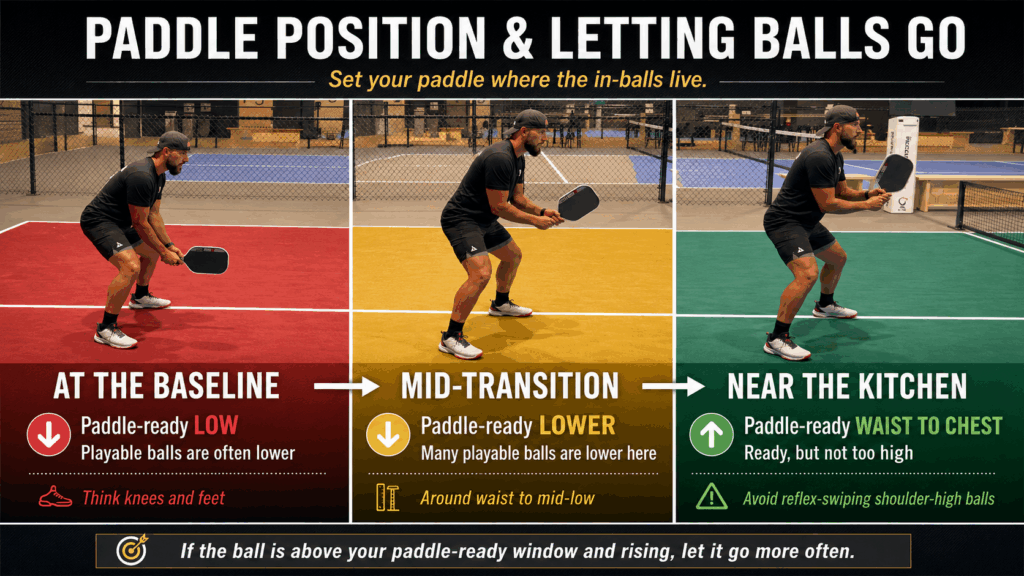
At the kitchen, your paddle should be ready, but not so high that every shoulder-high ball triggers a reflex.
In midcourt, your paddle can be lower because balls that are high at you from there are often going out.
Near the baseline, you should be thinking more about balls near your knees and feet, not balls up around your shoulders.
Some coaching explains this by saying your paddle-ready position should adjust lower as you move back because the “in” ball window changes based on your court position.
The practical cue
Set your paddle where the in-balls live.
At the kitchen, many playable balls are around waist to chest height.
In transition, many playable balls are lower.
At the baseline, playable drives are often lower still.
If the ball is above your paddle-ready window and rising, let it go more often.
Why You Keep Hitting Out Balls Anyway
Knowing the cue is one thing. Actually letting the ball go is another. Most rec players hit out balls for three reasons.
1. Panic
The ball comes fast, and the hand reacts.
Fix: decide earlier. Read the opponent before contact, not only the ball after contact.
2. Pride
You want to show you can handle pace.
Fix: remember that dodging an out ball is not weakness. It is winning without risk.
3. Fear of being wrong
You are afraid the ball might land in.
Fix: accept that you will be wrong sometimes. The goal is to be net positive.
That last point matters.
If you let four questionable balls go and three land out, you won three free points and lost one. That is still a great trade.
Some instruction calls this “net positive” thinking: you do not need to be perfect at letting balls go; you need to win more points from it than you lose.
That mindset is huge. You will misjudge some balls. Everyone does.
But if you never let anything go, you guarantee your opponent’s mistakes stay alive.
Partner Communication: Say It Early and Clearly
In doubles, your partner often has the better view.
The player facing the ball feels the speed. The partner sees the side angle and trajectory. That is why communication matters.
Use simple calls:
“No!”
“Let it!”
“Bounce!”
“Watch!”
But say it early.
A late “no” after your partner has already swung is not helpful. The earlier you recognize the trajectory, the more useful your call becomes.
Best partner rule
If your partner says “no,” trust them unless you clearly see the ball dropping in. This takes practice. But once partners trust each other’s out-ball calls, you save a lot of points.
You can also agree before games: “Call me off high balls if you see them sailing.”
That one sentence can prevent a lot of accidental saves.
How to Practice Letting Balls Go
This skill must be trained.
You cannot just tell yourself, “Next time I’ll let it go.”
Your body needs reps where the correct action is not swinging.
Drill 1: Targeted Speedup Read
Start at the kitchen with a partner.
You dink back and forth. Your partner is allowed to speed up at one known target, like your left hip or right shoulder.
Your job is not to guess direction. You already know the target.
Your job is only to decide: Counter, block, or let it go.
This isolates the out-ball decision.
Drill 2: Contact Point Drill
Have your partner feed attacks from different contact points:
- below net
- net height
- above net
You say “in” or “out” before the ball lands. At first, do not even hit. Just read.
This trains your eyes.
Drill 3: Full-Court Drive Read
Have your partner drive balls from the baseline, transition zone, and kitchen area.
You let some go and play some. After each ball, say why:
“Low contact, big swing.”
“Topspin, dipping.”
“Kitchen, shoulder high.”
“Baseline, plenty of room.”
This makes the skill conscious before it becomes automatic.
Drill 4: Partner Call Drill
Play skinny doubles or half-court rallies.
Only the non-hitting partner makes the “no” call.
This trains communication and trust.
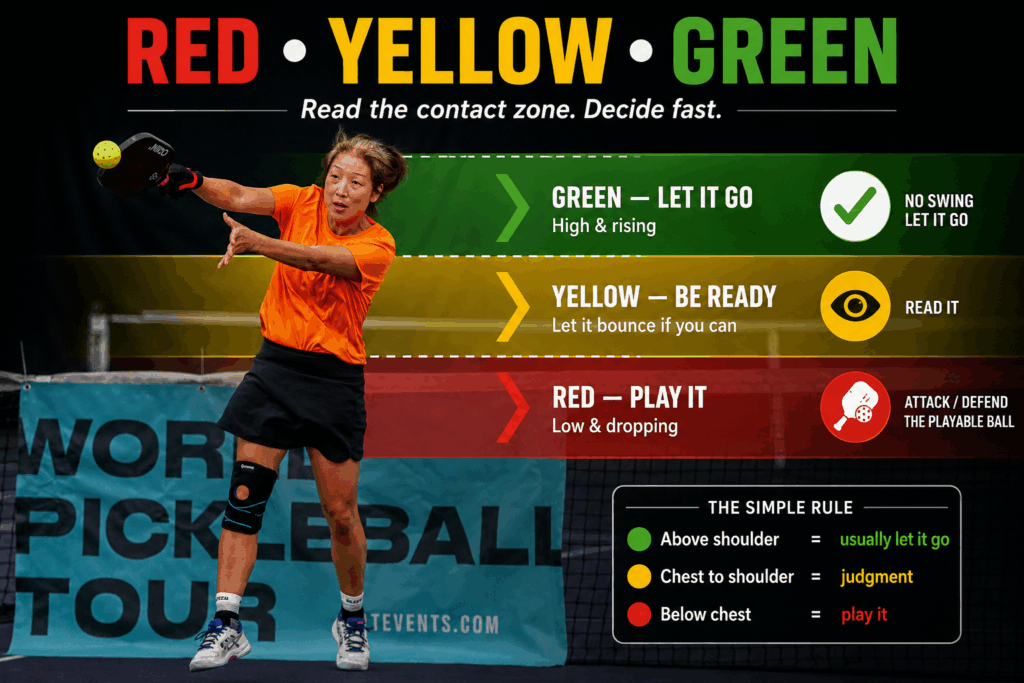
The Simple In-Game System: Red, Yellow, Green
Use this during rec games.
Green: Let it go
Let it go when:
- it is shoulder-high or above and rising
- opponent attacked from below net height
- big backswing near the kitchen
- opponent is falling or running through contact
- ball is flat or sliced hard
- sharp angle is carrying wide
- or your partner calls “no.”
Yellow: Be ready, but do not panic
These are judgment balls:
- chest-to-shoulder height
- topspin with possible dip
- medium-speed ball from transition
- opponent is balanced but contact is low
- wind may affect the ball
On yellow balls, stay ready. Let it bounce if you can. Do not swing just because you are nervous.
Red: Play it
Play it when:
- it is below chest height and dipping
- opponent is balanced and hitting with topspin
- ball is coming from deep in the court
- trajectory is clearly dropping
- or it is aimed at your feet
This system helps because it gives your brain a category before your hand panics.