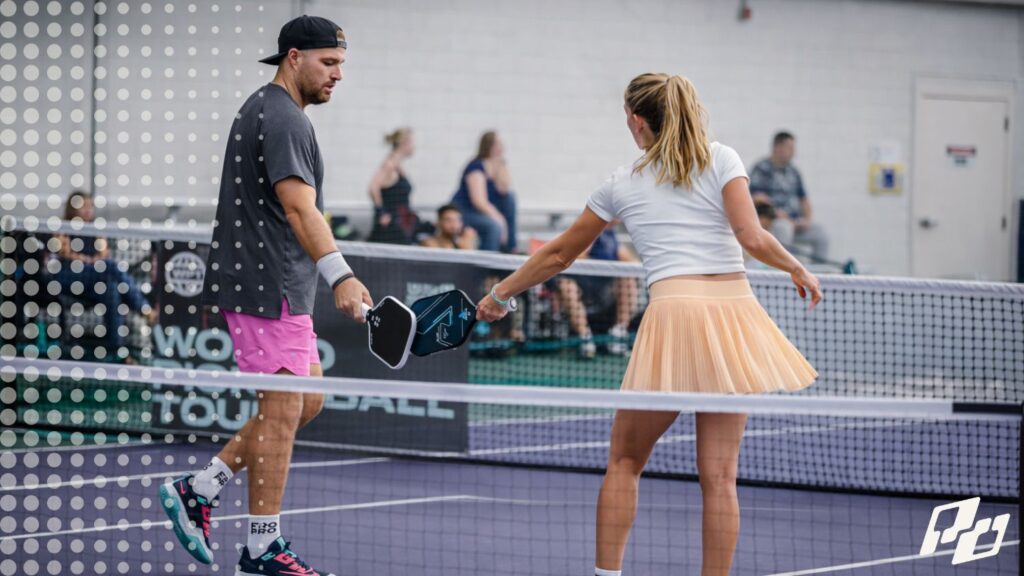
When a pickleball doubles match starts slipping, the best first move is usually a short, calm conversation with your partner — not a brand-new tactic. Ask what they are seeing, agree on one simple adjustment, and use one shared cue to get back in sync quickly.
When a doubles match starts slipping, the first fix usually is not a brilliant new tactic. It is better communication.
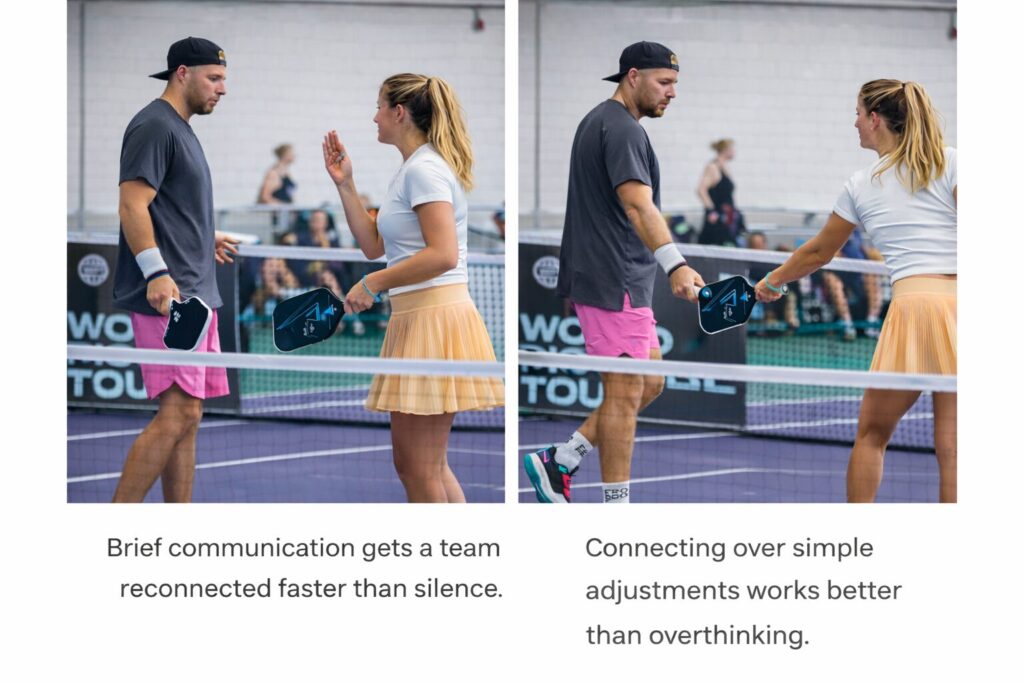
Under pressure, the most helpful conversations are usually the simplest ones: What are you seeing? Do we want to change anything? Should we target a different spot? That kind of quick check-in helps both players get back on the same page faster than a long mid-match strategy talk.
That is the real angle for rec players too:
⮕ When you are down, your first job is not to get more creative. It is to get more connected.
A lot of rec teams do the opposite. One partner starts forcing. The other goes quiet. Both players begin making separate decisions inside the same rally. At that point, you do not just have an execution problem. You have a coordination problem.
So if your game is slipping, the first emergency repair is often not technical. It is getting back in sync with your partner before the match gets away from both of you.
Why silence hurts doubles faster than bad mechanics
In singles, you can go quiet and try to solve the puzzle internally.
In doubles, silence is expensive.
If you and your partner stop talking when things go bad, a few problems usually show up at once: your shot choices stop matching, your targets become inconsistent, your positioning gets disconnected, and frustration starts filling the space where communication should be.
That is why this idea matters so much. You do not need a whiteboard or a five-minute strategy session. You just need to stop the drift before both players start solving the match in different ways.
That is especially important for rec players because a lot of people think communication is just etiquette — calling balls, saying the score, maybe tossing out a “nice shot.”
That is only the surface. In competitive doubles, communication is also a form of performance control.
It helps you reset emotionally, simplify decisions, agree on one adjustment, and stop playing two different matches on the same court.
The real problem when you are down 6–0
When a team loses one game, then falls behind badly in the next, the issue is often not “we need ten new ideas.” It is usually one of these:
- one partner is frustrated and mentally shrinking
- both players are overthinking
- one player is trying to fix everything alone
- or the team has stopped making coordinated choice.
That is why the wrong mid-match response is usually to lecture, over-strategize, dump five adjustments on your partner, or pretend nothing is wrong.
The better response is closer to:
- ask what they are seeing
- ask whether they want to change one thing
- suggest a simple pattern
- and get both players moving in the same direction again
That kind of brief, focused communication matches broader team-performance research too. Meta-analytic work on team-building in sport shows that interventions improving team cohesion and role clarity can positively affect team functioning. And research on teamwork execution and team resilience shows that teams cope better under pressure when their coordination and communication processes hold up.
In rec pickleball terms, that means this:
⮕ A calm 15-second conversation can be more valuable than a great forehand.
What to say when things are going badly
This is where a lot of players freeze. They know they should say something, but they do not want to make it worse.
So they either stay silent or say something useless like:
- “Come on.”
- “We’ve got this.”
- “Just stop missing.”
None of that helps.
The best communication under pressure is short, specific, non-accusatory, and focused on the next adjustment.
Better questions to use
Try lines like:
- What are you seeing right now?
- Do you want to change one thing?
- Should we go more to one player’s backhand?
- Do you want me to poach more or stay home?
- Should we slow this down and make more balls?
- Do you want more middle, more body, or more corner?
Notice the pattern: these are not emotional complaints. They are decision prompts.
They do two things at once:
- they help your partner re-engage,
- and they reduce the number of choices both of you are trying to hold in your head.
So when your partner is spiraling, your job is not to impress them with tactical genius. It is to reduce chaos.
Why “one adjustment” beats “ten adjustments”
This is the most practical lesson in the whole topic. Rec players often think better communication means more communication.
Not exactly.
What helps most is usually better quality communication, not more volume. In a slipping match, the sweet spot is usually:
- one observation
- one adjustment
- one shared cue
For example:
Observation: They are speeding up everything crosscourt.
Adjustment: Let’s keep more balls middle and make them hit through us.
Shared cue: Middle first.
Or:
Observation: We are getting beat because we are rushing.
Adjustment: Let’s stop forcing and make them hit one more ball.
Shared cue: Useful, not perfect.
Or:
Observation: They are camping on your backhand dink.
Adjustment: Let’s play more into their inside hip and take a few more middle balls.
Shared cue: Body and middle.
That is enough.
A lot of teams lose because they keep trying to solve the whole match at once. But performance under pressure usually gets better when attention narrows to a relevant, manageable target.
Research on pressure and performance keeps pointing to the same idea: athletes perform better when they can regulate attention and avoid cognitive overload.
That is why one clear adjustment often works better than a tactical buffet.
The hidden value of communication: it changes emotional momentum
This part matters a lot, especially in rec doubles. A match can turn long before the score turns.
You can often feel when a team has mentally separated:
- one partner stops making eye contact
- one gets quiet
- the other starts pressing
- and the scoreboard begins moving faster against them
Good communication interrupts that slide. Even before it solves the tactical issue, it sends a message:
⮕ We are still operating as a team.
That matters because emotional states spread in teams. For rec players, that means a short conversation can do three jobs:
- calm the more frustrated player
- give the quieter player a role
- and re-create a sense of joint control
That is huge. Because when players feel out of control, they usually start taking worse risks.
What not to do when your partner is in a weird headspace
Sometimes your partner does not look like they want to talk. That is real. And it means your communication has to be especially careful.
Do not do these:
- criticize their misses
- tell them everything they are doing wrong
- ask five questions in a row
- or turn the timeout between rallies into a coaching seminar
That usually feels like pressure, not help. Instead, try this order:
1. Start with emotional temperature
You good? What are you seeing?
Not: Why do you keep doing that?
2. Offer one simple adjustment
Let’s go more middle.
or
Let’s just make balls for two rallies.
3. Give them agency
Want me to do anything different?
That last part matters a lot. It turns the conversation back into a partnership.
The smartest kinds of mid-match adjustments
Rec players often ask: okay, but what should we actually change? Here are the best categories of adjustment because they are simple and high value:
⮕ Target adjustment
Change where you are hitting.
- more middle
- more body
- more backhand corner
- more inside foot
⮕ Tempo adjustment
Change how fast you are playing.
- fewer rushed speed-ups
- more neutral balls
- one extra dink before attacking
- block instead of countering everything
⮕ Shape adjustment
Change the kind of ball you are sending.
- lower trajectory
- more margin over the net
- deeper returns
- safer thirds
⮕ Role adjustment
Change who is doing what.
- poach a little more
- stay home more
- let the left side take more middle
- have the right side protect line more clearly
These are useful because they are easy to communicate and easy to test quickly.
And that is what a good in-match adjustment should be: simple enough to use immediately.
A practical emergency script for rec doubles
If you are down badly and need something usable right now, use this:
Step 1: Ask
“What are you seeing right now?”
Step 2: Suggest
“Let’s change one thing.”
Step 3: Choose one adjustment
Examples:
- More middle
- More body
- Make them hit one more ball
- Fewer speed-ups
- I’ll poach more
- Let’s get to the kitchen and stop forcing
Step 4: Reinforce after the next point
“Yep, keep that.”
or
“Okay, not that. Let’s try this instead.”
That is enough to stop the emotional freefall and create structure.
Why this tip matters so much for rec players
At the pro level, both players already understand patterns, tendencies, and counters at a high level.
At the rec level, communication often matters even more because teams are more likely to:
- get emotionally disorganized
- misread each other’s intentions
- and keep repeating a losing pattern without naming it
So while the advice sounds simple, it is actually high-level in the best way.
It teaches rec players that when things go sideways, the answer is often not: hit harder, try more, panic faster.
It is: talk sooner, simplify faster, and get aligned again.
That is one of the biggest differences between teams that stay stuck and teams that recover.