
Pickleball endurance is less about long-distance running and more about recovering between short bursts while keeping your legs, footwork, and decision-making sharp. A smart plan combines brisk walking intervals, lower-body strength, and short court-movement drills so your third game still looks like your first.
You probably don’t need to become a runner. You need to stop becoming a different pickleball player after Game 3. That is the endurance problem recreational players actually notice.
Early in the session:
✔ Bend your knees
✔ Move around the ball
✔ Recover after a wide dink
✔ Split-step on time
✔ Attack selectively
Ninety minutes later?
✖ Stand taller
✖ Reach farther
✖ Recover slower
✖ Speed up balls because you don’t feel like playing another six-shot dink exchange
Then you blame your technique. But sometimes your technique didn’t disappear. Your legs stopped supporting it.
Pickleball endurance isn’t really “run for a long time”
The physical demands of doubles pickleball are surprisingly stop-and-start.
A 2025 analysis of professional men’s doubles found that 67.4% of points lasted only 3–9 seconds, while most recovery periods lasted 9–15 seconds. Effective play accounted for about 39% of match time, with a work-to-rest ratio around 1:1.6.
Obviously, your Tuesday-night 3.75 game is not professional men’s doubles.
But the pattern matters: move → stop → recover → move again.
That is very different from jogging continuously for 45 minutes.
It helps explain why Connor Derrickson—the strength and conditioning coach who has worked with pros including Catherine Parenteau, Anna Bright, Federico Staksrud and Hayden Patriquin—takes a somewhat contrarian position.
He says many doubles players who fade late are not gasping for air. Their legs feel heavy. His prescription emphasizes lower-body strength, strength endurance, and short hard efforts with substantial recovery rather than simply adding long slow runs.
That doesn’t mean aerobic conditioning is useless. It means you need two engines.
Engine 1: Can you recover between efforts?
This is your aerobic base.
It is what helps your breathing and heart rate settle after the ugly point where you chased a lob, sprinted back in, defended two overheads, and somehow won.
Better aerobic fitness means you can recover more effectively before the next demanding effort.
And pickleball itself can provide a meaningful cardiovascular stimulus.
In one study of players 65 and older, participants averaged more than 68 minutes of moderate-to-vigorous physical activity per pickleball session.
But recreational doubles is inconsistent conditioning.
One day you play four competitive games almost continuously.
Next week you spend half the session waiting behind six paddles.
That is why relying entirely on pickleball to build pickleball endurance can be unreliable.
Engine 2: Can your legs keep repeating your stance?
This is the one players underestimate. Think about what your lower body actually does during two hours of doubles.
You rarely perform a heroic 50-yard sprint. Instead, you perform hundreds of small contractions:
- sit into ready position
- shuffle
- push laterally
- decelerate
- lunge
- recover
- hold a semi-squat at the kitchen
- explode forward
- then do it again
A friend of mine and experienced pickleball player described his fatigue almost perfectly: after about an hour his legs felt “dead,” he stopped bending his knees for low balls, and started standing upright at the kitchen.
That is not merely fitness trivia. Once your stance rises, your pickleball changes.
Low balls become harder.
Wide dinks create reaching.
Your first step gets later.
Resets become arm-dominant.
You start contacting drives from worse spacing.
So here’s a better definition:
Pickleball endurance is your ability to preserve your movement quality as fatigue accumulates.
Now we can actually train it.
The plan: 3 types of work, no distance running required
You do not need five new workouts. You need three small ingredients.
1. The boring base: walking intervals
Two days per week.
About 25–35 minutes.
Start with five easy minutes.
Then alternate:
3 minutes brisk
2 minutes easy
Repeat five times.
Finish easy.
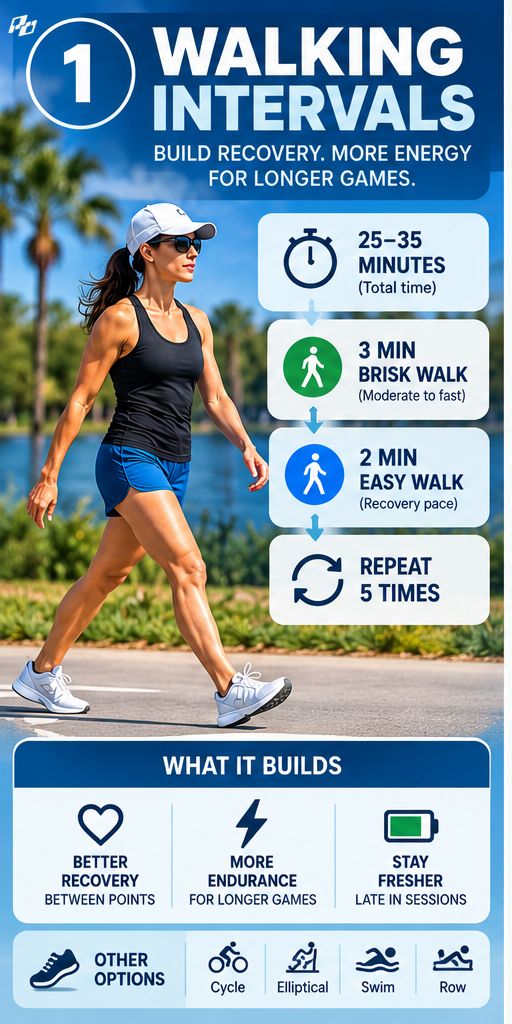
The brisk sections should make you breathe noticeably harder while still allowing short sentences.
If running bothers your joints—or you simply hate it—walking uphill, cycling, elliptical work, swimming, or rowing can perform the same basic job.
For older players especially, this is a useful compromise: current cardiovascular guidance emphasizes moderate aerobic work for older adults, with exercise tailored to health and function rather than forcing everyone into high-intensity training.
What this is building: recovery between points, games, and harder training bouts.
Not speed.
Recovery.
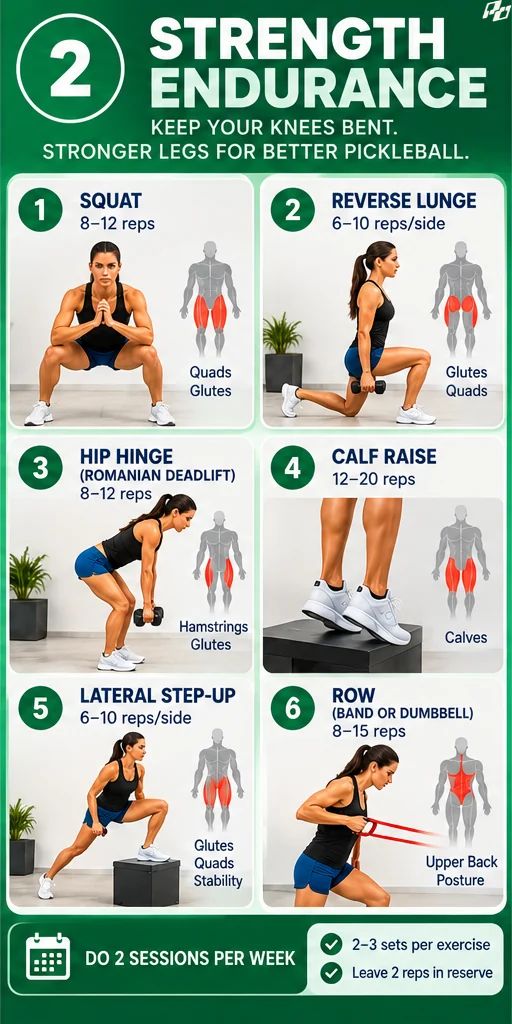
2. The part that keeps your knees bent: strength endurance
Twice per week, about 20–30 minutes.
You do not need bodybuilding workouts. Use movements that make the positions you repeatedly use in pickleball cheaper:
| Exercise | Starting Dose | Why It Transfers |
|---|---|---|
| Squat or sit-to-stand | 2 × 8–12 | Repeated low ready position |
| Reverse lunge or split squat | 2 × 6–10/side | Wide dink recovery and deceleration |
| Hip hinge or Romanian deadlift | 2 × 8–12 | Posterior-chain support and braking |
| Calf raise | 2 × 12–20 | Repeated push-offs and court movement |
| Lateral step-up or side lunge | 2 × 6–10/side | Side-to-side kitchen movement |
| Row or band row | 2 × 8–15 | Postural endurance and trunk control |
Leave a couple of good repetitions in reserve. You are trying to become more durable, not destroy yourself Tuesday so you cannot play Wednesday.
ACSM’s 2026 resistance-training guidance emphasizes that consistency matters more than elaborate programming and recommends working the major muscle groups at least twice weekly.
This part becomes increasingly important with age because maintaining strength, balance, and physical function matters alongside aerobic fitness—not underneath it.
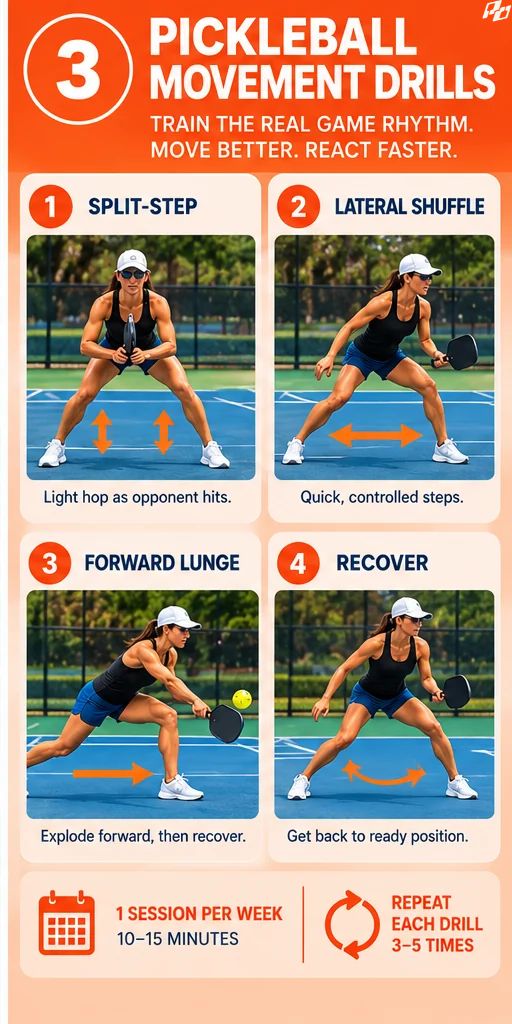
3. Train the actual rhythm of pickleball
This is the part most “cardio plans” miss. Once per week, do 10–15 minutes of repeated court movement.
Not shuttle sprints until you collapse.
Quality movement.
Try this:
Start in your kitchen-line ready position.
For 8 seconds:
- shuffle two steps right
- recover
- two steps left
- recover
- step back toward transition
- come forward
- split-step
Then rest 24 seconds.
Repeat six times.
Rest two minutes.
Do another set.
That’s it.
Why such generous recovery? Because you are initially training repeatable quality, not practicing exhausted movement.
This also loosely reflects pickleball’s short-burst structure rather than turning the workout into continuous running. Research on professional doubles shows most rallies are brief and separated by recovery periods, while Derrickson similarly recommends short bursts followed by substantial rest.
After two or three weeks, progress one variable:
8 seconds work / 20 seconds recovery.
Or 10 seconds work / 25 seconds recovery.
Or seven repetitions instead of six.
Do not change all three.
The goal isn’t to become tired
A conditioning workout is not successful because you finish lying on the floor. For pickleball, I would judge it by this question: did Rep 12 still look like Rep 1?
Could you still:
Stay low.
Stop under control.
Push cleanly.
Recover your feet.
And split-step instead of stumbling into position?
Once your mechanics collapse, you’re no longer practicing the movement you want late in a match.
You’re practicing your tired version.
Use the “third-game test”
This is how I’d measure improvement without VO₂ testing or a smartwatch. Once every two weeks, notice four things in your third competitive game:
1. Ready-position height
Are you still bending or standing nearly upright?
2. Wide-ball recovery
After a wide dink, do you recover—or stay stuck there?
3. Between-point breathing
Does one normal pause settle you, or are you still breathing hard when the serve begins?
4. Lazy reaches
How often do you reach for balls you would have moved to in Game 1?
Those tell you more about useful pickleball endurance than how far you can jog.
Players who fade after several games describe late footwork, mistimed shots, heavy legs, and mental sloppiness—not merely being unable to breathe.
What should improve—and when?
Do not expect magic in seven days. But you also do not need six months before anything changes.
Exercise research shows cardiorespiratory improvement can occur with interval programs within four weeks, although larger changes tend to appear with longer programs.
For middle-aged and older adults specifically, interval training has been shown to improve VO₂max, and one study of sedentary seniors using 19 interval-cycling sessions over 9.5 weeks reported a 14.1% increase in VO₂peak and an 11.6% improvement in six-minute walking distance versus deterioration in controls.
Pickleball-specific evidence is encouraging too.
In a 2026 randomized trial, 72 pre-frail older adults completed an eight-week supervised pickleball intervention. Compared with controls, the pickleball group improved functional fitness, including a roughly 31-meter improvement in six-minute walk distance, while also improving chair-stand performance and quality-of-life measures.
That does not prove this exact plan produces those exact results. But it gives us a sensible timeline.
✅ Weeks 1–2
The biggest change may simply be awareness.
You notice when your legs—not your lungs—are causing your technique to degrade.
✅ Weeks 3–4
You may begin recovering more comfortably between repeated efforts, especially if you were previously doing almost no conditioning.
✅ Weeks 5–8
This is a more realistic window to look for meaningful changes in work capacity: less late-session leg heaviness, better recovery, and less deterioration in movement quality.
Individual response varies enormously with starting fitness, age, sleep, health, playing volume, and training consistency.
Older players should make one adjustment
Do less hard conditioning and more useful conditioning.
If you are 55, 65, or 75, the objective is not proving that you can survive a brutal HIIT workout. It is increasing the amount of high-quality pickleball your body tolerates.
For many active older players, one harder interval session per week is plenty initially. The American Council on Exercise similarly recommends that older adults begin with low interval volume, generous recovery, and usually only one HIIT session per week before considering two. Walking incline rather than increasing running speed can also reduce impact.
And strength should not be optional.
A separate 2026 study comparing pickleball players over 55 with nonplayers found the pickleball group had significantly better balance and leg strength, although the study was small and observational.
Another eight-week randomized trial in women aged 60–75 found improvements in balance, stride length, walking velocity, and cadence after supervised pickleball training three times per week.
The pattern is pretty clear: for aging pickleball players, endurance, strength, balance, and movement capacity belong in the same conversation.
Don’t accidentally train yourself out of pickleball
Here is the final mistake.
You play Monday.
Strength train hard Tuesday.
Do court intervals Wednesday.
Play three hours Thursday.
Your legs feel awful Friday.
So you conclude conditioning doesn’t work.
That is not conditioning.
That is scheduling.
Your off-court work exists to make your pickleball better. If it regularly makes your pickleball worse, reduce the dose.
A simple week could look like:
Monday: Pickleball
Tuesday: 30-minute walking intervals + short strength session
Wednesday: Pickleball
Thursday: Rest or easy walk
Friday: Strength + 10-minute court intervals
Saturday: Pickleball
Sunday: Easy movement or rest
Move the days around however you like. The principle matters more than the calendar: base + legs + repeated effort + recovery.