Pressure in pickleball is sneaky.
It does not always show up as panic. Sometimes it looks like rushing your serve. Sometimes it is a dink you normally make that suddenly floats. Sometimes it is your third shot drop landing halfway up the net. Sometimes it is your partner saying, “Just get it in,” and somehow making you feel less confident.
And every rec player knows the classic late-game spiral:
You were playing fine at 3-3.
You were loose at 5-5.
You were attacking smart at 7-7.
Then suddenly it is 9-9, and your brain starts commentating like a nervous sports announcer.
Don’t miss this return.
Don’t pop this up.
Don’t lose this game.
Don’t be the reason your partner gets annoyed.
That is pressure.
And here is the good news: pressure does not mean you are weak. It means the moment matters to you. The problem is not having nerves. The problem is letting those nerves take over your attention, your body, and your decision-making.
Sports psychology has a pretty clear explanation for why this happens. Under pressure, athletes can become distracted by worries about the outcome, or they can start over-monitoring skills that normally run automatically. Both patterns can disrupt performance — especially on shots you have hit thousands of times.
In pickleball terms, that means your normal dink turns into a careful dink. Your normal serve turns into a guided serve. Your normal reset turns into a “please don’t mess this up” reset.
And that is usually when the ball goes exactly where you were afraid it would go.
The First Rule: Stop Trying to “Not Be Nervous”
This is where a lot of players get stuck. They think the goal is to make nerves disappear.
It is not.
You may feel nervous before a tournament match. You may feel tight at 10-10. You may feel your heart rate jump when serving for the game. That is normal. Pressure often creates physical and mental changes: muscle tightness, anxiety, self-doubt, cautious strategy, and reduced confidence.
The goal is not to become emotionless.
The goal is to play well while feeling something.
That is a much more realistic target.
A better mindset is: “I don’t need to feel calm. I need to act clear.”
That one distinction can save you. Because if you wait until you feel perfectly relaxed, you may never play the point. But if you have a clear routine, a clear target, and a clear cue, you can still perform even when your stomach is doing cartwheels.
Why Pressure Feels Worse in Pickleball
Pickleball has a unique pressure structure.
In tennis, you get multiple serves. In pickleball, one missed serve is just gone. In doubles, your partner is standing right there. In rec play, everyone is close enough to hear your frustration. At the kitchen, the court is small, reactions are quick, and one pop-up can end the rally immediately.
That makes the game feel socially and tactically intense.
Pressure often spikes in these moments:
- serving at 9-9 or 10-10
- returning after your partner just said, “Please get this in”
- protecting a lead
- playing against a stronger team
- playing with a partner you want to impress
- being targeted repeatedly
- getting stuck in a long dink rally
- trying not to miss an “easy” ball
- playing a tournament after mostly doing open play
The shot may be the same. But the meaning changes.
A dink at 2-2 feels like a dink. A dink at 10-10 feels like a referendum on your entire pickleball identity.
That is the trap.
Pressure Is Mostly Attention
A lot of players think pressure is about confidence. Partly, yes. But in the moment, pressure is really about attention.
Where is your mind?
On the ball?
On your target?
On your footwork?
On your partner’s mood?
On the score?
On what happens if you lose?
On how embarrassed you will feel if you miss?
When pressure gets bad, attention usually goes to the wrong place.
Sport psychology often divides self-talk into two useful types: instructional cues that direct attention toward execution, and motivational cues that help confidence or effort.
For pickleball, this matters because vague self-talk usually does not help much.
- “Don’t miss” gives your brain nothing useful to do.
- “Deep middle return” does.
- “Don’t pop it up” is fear.
- “Low over the net” is a task.
- “Please don’t lose” is outcome.
- “Soft hands, big target” is process.
Pressure management starts when you give your attention a job.
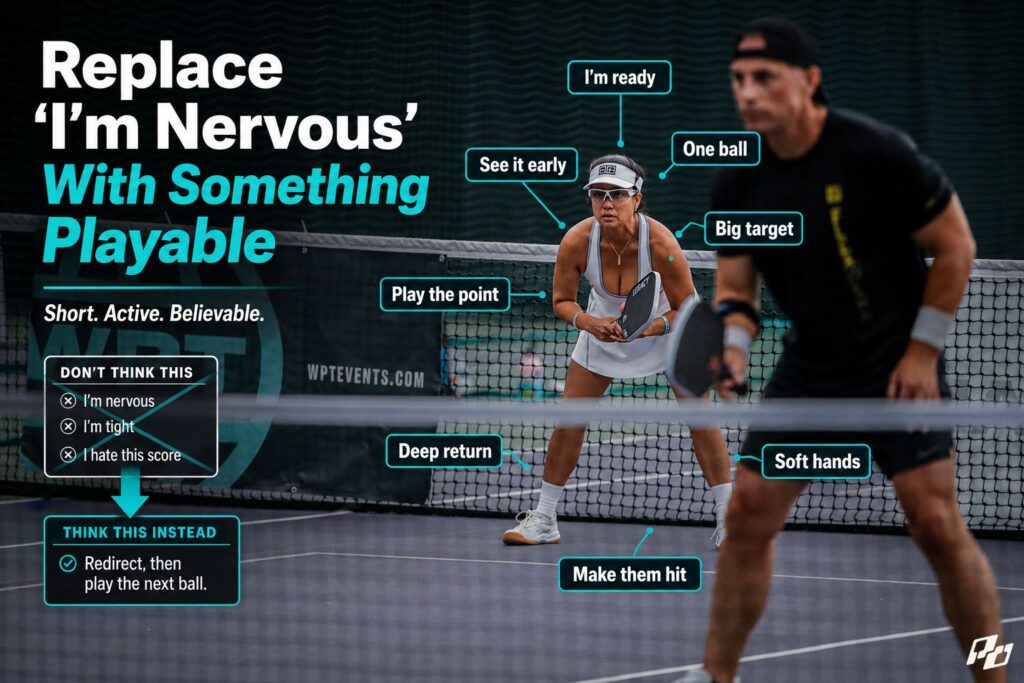
Replace “I’m Nervous” With Something Playable
One of the simplest shifts is changing the phrase you use when you feel pressure. Most players walk back to serve or return and think:
“I’m nervous.”
“I’m tight.”
“I hate this score.”
“I always mess this up.”
“I can’t miss.”
That may be honest, but it is not useful. A better phrase is short, active, and believable.
Try:
“I’m ready.”
“One ball.”
“Big target.”
“Play the point.”
“See it early.”
“Deep return.”
“Soft hands.”
“Make them hit.”
The key is not pretending you are fearless. The key is redirecting.
“I’m ready” works because it is not a technical essay. It is a reset button. It tells your nervous system: we are not debating the score right now. We are playing the next ball.
And honestly, for rec players, that is often enough.
Your Routine Is the Anchor
When the match gets chaotic, you need something that stays the same. That is what a routine does.
Pre-performance routines are widely used in sport because they create consistency, predictability, and a familiar mental sequence before execution. They can help the athlete return attention to something known instead of spiraling into worry.
In pickleball, your routine does not need to be dramatic.
It can be:
- walk behind the baseline
- look at your target
- take one breath
- bounce the ball once
- say your cue
- serve
Or:
- turn away from the net
- touch your paddle strings/face
- exhale
- look at the return target
- say “deep middle”
- play
The routine matters because pressure makes players rush. A routine gives you a speed limit.
Build a Serve Routine That Actually Works
The serve is one of the easiest places to feel pressure because everyone is waiting for you. Here is a simple serve routine for rec players:
- Step behind the baseline and pause.
Do not serve while still emotionally reacting to the last rally. - Pick a big target.
Deep middle or deep backhand is better than “somewhere in.” - Take one slow exhale.
Not a giant meditation ceremony. Just enough to slow your rush. - Say one cue.
Examples: “smooth,” “deep,” “through,” “ready.” - Serve at 80–85%.
Under pressure, max effort often creates max chaos.
The cue I like most for nervous servers: “Deep and smooth.”
That tells you what kind of serve you want. Not perfect. Not huge. Just deep enough and smooth enough to start the rally.
Build a Return Routine Too
Returns may be even more important than serves in rec pickleball.
A missed serve hurts. A missed return hurts worse psychologically because you had a chance to neutralize the point and get to the kitchen.
Under pressure, many players either guide the return softly into the net or swing too big and miss long.
Your return routine should be even simpler: Split early. See the ball. Return deep. Get in.
That is it.
Do not think about winning the point. Do not think about your partner. Do not think about how good the server is.
Just return deep and move.
A good pressure cue: “Deep first.”
That cue protects you from trying to be too cute. Under pressure, cute returns are dangerous. Deep returns are useful.
Why “Flow State” Is Not Something You Can Force
Players love talking about being “in the zone.” It is real, but you cannot order it like a sandwich.
Flow is generally described as a state of intense focus, full involvement, reduced self-consciousness, and a sense of control or absorption in the activity. It tends to happen when the challenge level and skill level are well matched, with clear goals and immediate feedback.
That matters because rec players often misunderstand flow.
They think:
“I need to feel amazing.”
“I need to stop thinking.”
“I need to play perfectly.”
“I need to get into the zone right now.”
That is too much pressure on top of pressure. Instead, create the conditions that make flow more likely:
✅ clear target
✅ simple cue
✅ steady routine
✅ one point at a time
✅ appropriate challenge
✅ less self-judgment
✅ more attention on the ball and pattern
You do not force flow.
You remove the junk that blocks it.
The “One Point Container”
This is one of the best mental tools for pickleball. Treat every rally as a container.
When the point begins, your job is to play that point. When it ends, the container closes. You are allowed to learn one thing, then you move on.
This matters because rec players drag old points into new points. Pressure grows when points start sticking to each other.
The reset phrase: “New ball.”
Simple. Almost annoyingly simple. But powerful. You cannot replay the last rally. You can only play the next ball.
The Late-Game Problem: Why 9-9 Feels Different
Technically, the court does not change at 9-9. But your mind changes.
At 3-3, you are playing. At 9-9, you may start protecting. That is where the “don’t lose” mindset creeps in.
And “don’t lose” pickleball is usually worse pickleball. The better late-game mindset: “Same shot, clearer target.”
Not riskier. Not safer. Clearer.
Late in games, your goal is not to become a different player. It is to execute your highest-percentage patterns with more commitment.
The Pressure Shot Menu
When pressure hits, you need a simple menu — not 15 options.
⮕ Serve
Default to deep middle or deep backhand.
Cue: Deep and smooth.
⮕ Return
Default to deep middle, then get to the kitchen.
Cue: Deep first.
⮕ Third shot
Balanced? Drop or drive based on the ball. Stretched? Choose margin.
Cue: Shape, don’t save.
⮕ Transition ball
Reset if off balance. Counter only if stable.
Cue: Reset from trouble.
⮕ Dink rally
Big target, low ball. Don’t attack from panic.
Cue: Low and boring.
⮕ Speedup
Attack only when the ball is high enough and your body is balanced.
Cue: Attack from strength.
That’s how you reduce pressure: decide your defaults before the chaos begins.
Why “Just Relax” Is Bad Advice
“Relax” is not useless, but it is incomplete. If a player could relax on command, they already would.
A better approach is to give the body something specific to do:
- exhale longer
- loosen grip pressure
- lower shoulders
- soften knees
- look at target
- say cue
- start feet moving
The body often calms down after the behavior changes. Not before.
A useful physical cue: “Loose grip, active feet.”
This works because pressure often creates the opposite: tight grip, frozen feet. And in pickleball, frozen feet turn normal shots into emergencies.
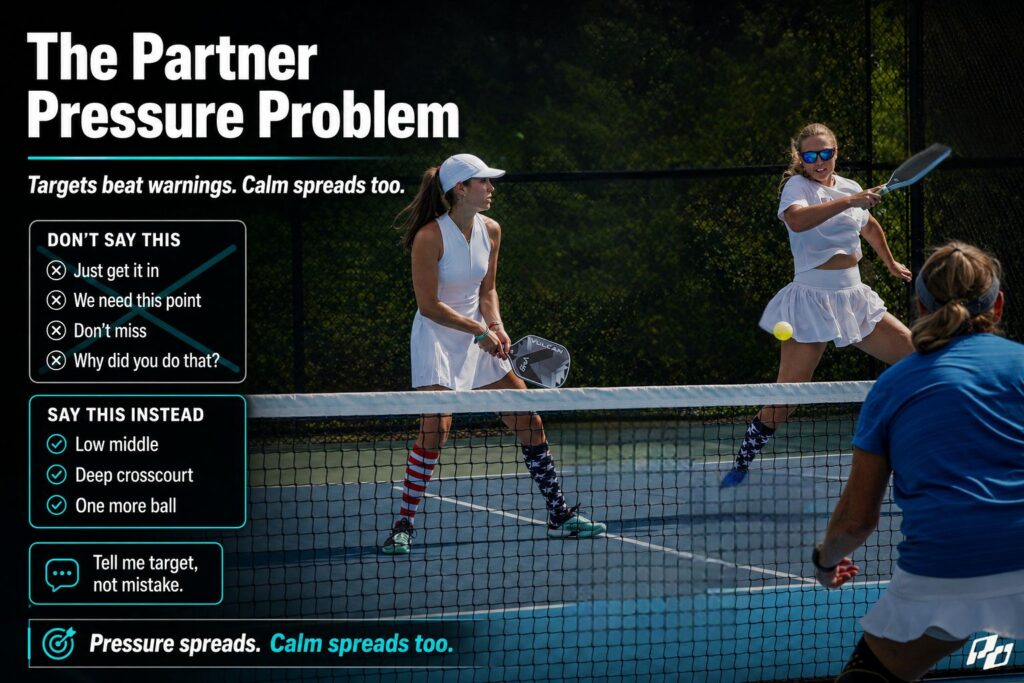
The Partner Pressure Problem
Pickleball pressure is not only internal. Sometimes it comes from your partner. You need a plan for that too.
If your partner is adding pressure, use short, calm language:
“Let’s keep it simple.”
“Deep returns and reset.”
“One point.”
“I’m good — just positive cues.”
“Tell me target, not mistake.”
That last one is excellent.
Instead of “Don’t pop it up,” ask for “Low middle.”
Instead of “Stop missing returns,” ask for “Deep crosscourt.”
The brain plays better with targets than warnings.
How to Help a Nervous Partner
This is just as important. If your partner is nervous, do not dump more pressure on them.
Bad partner phrases:
❌ “Just get it in.”
❌ “We need this point.”
❌ “Don’t miss.”
❌ “You keep rushing.”
❌ “Why did you do that?”
Better phrases:
“You’re good.”
“Big target.”
“Deep middle.”
“One more ball.”
“Let’s reset and work in.”
“Good choice — keep going.”
Pressure spreads. Calm spreads too. Be the partner who makes the court feel smaller, not heavier.
The “Task, Not Outcome” Rule
Under pressure, outcome thoughts are poison if they show up too early. Outcome thoughts sound like:
We have to win this.
I can’t lose to them.
This point decides everything.
Everyone is watching.
My DUPR is going to drop.
My partner is going to blame me.
Task thoughts sound like:
Deep return.
Move feet.
Low dink.
Split step.
Soft hands.
Attack the hip.
Reset middle.
Task thoughts are playable. Outcome thoughts are not.
The rule: Before the point, choose a task. After the point, accept the outcome.
That is how you stay functional.
How to Practice Pressure Without Waiting for a Tournament
A lot of players only practice mental toughness when they are already under pressure. That is too late. You need to create small pressure in practice.
Try these:
1. Start games at 8-8
Every point matters immediately. This trains late-game decisions.
2. One-serve challenge
You get only one serve. If you miss, you lose two points. This teaches routine and commitment.
3. Return streak
You must make 10 deep returns in a row. If you miss, restart.
4. Reset tax
Every transition pop-up costs two points.
5. Partner silence game
No coaching, no frustration comments, only positive or tactical cues.
6. Target commitment game
Before every serve or return, call your target quietly and commit to it.
Pressure becomes less scary when you have rehearsed it.
The 10-Second Reset Between Points
Here is a simple reset you can use immediately.
1. Turn away
Break eye contact with the net and scoreboard.
2. Exhale
Make the exhale longer than the inhale. Let your shoulders drop.
3. Name the next task
Deep return. Low dink. Reset middle. Smooth serve.
4. Say your cue
Ready. One ball. Commit. Smooth.
5. Start your feet
Pressure loves stillness. Get your feet alive.
This takes less than 10 seconds and gives your brain a job.
The Difference Between Pressure and Panic
Pressure is awareness.
Panic is reaction.
Pressure says: “This point matters.”
Panic says: “Do something now.”
The best players do not avoid pressure. They prevent pressure from becoming panic. They do that with routines, target discipline, and emotional resets.
In rec pickleball, panic usually shows up as:
- speeding up too early
- driving from bad balance
- rushing the serve
- trying a hero ATP
- attacking below net height
- poaching wildly
- over-lobbing
- guiding the ball instead of swinging
When you notice panic, simplify.
The cue: “Bigger target, smaller swing.”
That one line fixes a lot of late-game mistakes.
What to Do When You Blow a Lead
Blown leads are brutal.
You were up 8-3. Now it is 8-8. Everyone feels it. The other team is loud. Your partner is quiet. You can feel the game slipping.
This is where players usually make two mistakes:
⮕ They play too safe.
⮕ Or they try to win the whole lead back in one rally.
Neither works. Instead, shrink the game.
Do not think, “We were up 8-3.”
Think, “Next return deep.”
Do not think, “We cannot blow this.”
Think, “Make them hit one more.”
Do not think, “We need a winner.”
Think, “Earn the attack.”
Momentum changes when you stop feeding it panic.
A good phrase: “Win the next normal point.”
Not spectacular. Normal.
The Pressure Cue Cheat Sheet
Use one cue per category. Do not use all of them at once.
| Situation | Cue |
|---|---|
| Nervous before serve | Deep and smooth |
| Nervous before return | Deep first |
| Chaotic rally | Low and boring |
| Transition trouble | Reset from trouble |
| Tempted to attack | Attack from strength |
| After bad point | New ball |
| Protecting a lead | Win the next normal point |
| Partner tension | Big target |
| Frozen feet | Loose grip, active feet |
| Overthinking | One ball |
The Ball Doesn’t Know the Score
Pressure is not the enemy. Pressure is just the moment asking whether you have a plan.
Most rec players do not fall apart because they are mentally weak. They fall apart because they have no reset routine, no default targets, no partner language, and no way to bring their attention back when the score gets loud.
So build that.
- Change “I’m nervous” to “I’m ready.”
- Use a routine before serves and returns.
- Give yourself one clear task.
- Stop dragging the last point into the next one.
- Train pressure on purpose.
And when the match gets tight, remember: the ball does not know the score.