Pickleball can support fitness, mental well-being, social connection, and healthy aging, especially for adults over 50. Research links regular play with more moderate-to-vigorous activity, lower loneliness, greater happiness, and better quality of life. The biggest benefits come from playing consistently, staying socially engaged, continuing to learn, and recovering well enough to keep playing.
Maybe the best thing pickleball does for you isn’t your third-shot drop. Or your DUPR. Or even the calories you burn.
It may be the fact that Tuesday morning suddenly matters.
You have somewhere to go. Three people are expecting you. Someone will ask how your weekend went.
You’ll chase a few balls you probably shouldn’t chase, solve a dozen little tactical problems, laugh at an accidental winner, and leave physically tired but mentally switched on.
Researchers are beginning to study that combination—and pickleball is producing some surprisingly interesting results.
A 2025 systematic review found pickleball participation was associated with greater happiness, life satisfaction, social integration and lower depression, particularly in older players. But the researchers were careful: most of the evidence was observational, so we cannot say pickleball itself caused all those improvements.
Then newer studies strengthened the picture.
In 2025, a national survey of 1,667 U.S. pickleball players found greater playing frequency and longer sessions were associated with higher mental well-being.
And in 2026, a randomized controlled trial took things a step further.
Seventy-two pre-frail older adults were assigned either to an eight-week supervised pickleball program or to continue their normal lifestyle. After eight weeks, 42% of the pickleball group moved from pre-frail to non-frail status, compared with 8% of the control group. The pickleball group also improved functional fitness, walking performance, sedentary time and both physical and mental quality-of-life scores.
So pickleball may be doing something valuable. But here’s the more useful question: How do you play in a way that gets more of those benefits?
Think of it as building a pickleball well-being stack.
Not more games at any cost. A better combination of movement, connection, challenge and recovery.
Layer 1: Play Often Enough That the Court Becomes Part of Your Week
One of the most interesting findings comes from that 2025 study of 1,667 players.
Players who reported playing three or more times per week had higher WHO-5 mental well-being scores than those playing twice per week or less. Players whose sessions lasted more than two hours also reported higher scores.
Don’t turn that into: “Science says I need three two-hour sessions.”
It doesn’t.
This was an observational survey. Happier, healthier or more socially connected people may simply play more pickleball.
But it does suggest that regularity matters. And that makes sense. A game once every three weeks is recreation. A recurring Monday-Wednesday-Friday group can become part of the architecture of your life.
You know when you’re playing.
You know who might be there.
You have something to anticipate.
For a 50+ player especially, that recurring structure may be more valuable than occasionally cramming five hours into a Saturday.
A better target:
Build a schedule you can repeat without needing to recover from it for three days. Consistency beats the occasional pickleball marathon.
Layer 2: Don’t Waste the Social Part
This may be where pickleball separates itself from a treadmill.
A 2025 national study surveyed 825 Americans over age 50. Current pickleball players had lower odds of reporting loneliness than people who had never played or had stopped playing. People who had played pickleball were also more likely to report making social connections through physical activity.
Earlier research points in the same direction.
A study of 208 pickleball players aged 50–83 found participation was positively associated with happiness and several measures of social capital, including feelings of trust, safety and neighborhood connection.
That suggests something more specific than: “Being around people is healthy.”
The repeated contact may matter. You see the same people again and again. That’s exactly what players describe themselves.

In community discussions, players frequently talk about arriving at open play knowing nobody, becoming a regular, then gradually ending up with a real social circle. Others describe court friendships turning into coffee, dinners, birthdays and support away from pickleball.
That’s anecdotal evidence—not clinical research—but it closely matches what the social-integration studies are measuring.
So use the court differently.
- Don’t leave immediately after game four every time.
- Learn names.
- Play occasionally outside your regular foursome.
- Return to the same open play consistently.
- Invite someone evenly matched to drill next week.
That sounds trivial. It isn’t. Familiar strangers are how communities start.
Layer 3: Keep Something in Your Game That You’re Trying to Learn
Fitness and socialization were the two strongest overall motivations in a study of 690 active pickleball players aged 55+.
But something changed among the players who became more deeply involved in pickleball: competition and skill mastery became more important.
That’s worth paying attention to.
One reason pickleball can remain compelling long after the novelty wears off is that the game keeps giving you solvable problems.
- Can I stop popping up my resets?
- Can I recognize the attackable dink sooner?
- Can I get my return deeper?
- Can I stop rushing through transition?
That creates a completely different experience from exercise done purely to “get my cardio.”
There is feedback.
There is curiosity.
There is progress.
There is frustration, too—but productive frustration can be part of what keeps an activity engaging. So give yourself one project at a time.
Not:
“I need to become a 4.0.”
Try:
“For the next three weeks, I’m going to see how many transition balls I can reset instead of counterattacking.”
That turns ordinary rec games into a learning environment without making every point feel like an exam.
Layer 4: Let Pickleball Be Exercise—But Don’t Pretend It’s the Same Workout for Everyone
Pickleball can generate meaningful cardiovascular work.
In one study of players 65+, participants accumulated an average of more than 68 minutes of moderate-to-vigorous physical activity per pickleball session.
Another study of recreational older players found average heart rates around 70% of predicted maximum in both singles and doubles. More than 70% of playing time fell into moderate-to-vigorous heart-rate zones, although accelerometer measurements suggested singles involved more movement than doubles.
So yes—pickleball can absolutely count as meaningful activity. But two people can stand on adjacent courts for 90 minutes and get completely different workouts.
One is moving efficiently, chasing balls and playing long rallies.
The other is waiting 15 minutes between games and barely taking three steps during a point.
If fitness is part of your reason for playing, judge the actual session, not just the time between arrival and departure.
Layer 5: The Benefit Disappears Fast If Your Body Can’t Keep Playing
Here is the finding I would put in bold for every enthusiastic 50+ player.
In the 1,667-player well-being study, players reporting an injury within the previous year had lower mental well-being scores than those without an injury history.
That doesn’t prove injury caused poorer well-being. But it should challenge the idea that: more pickleball = more benefit.
Players themselves describe the same tradeoff. In one recent community discussion about health improvements, players reported better cardiovascular fitness and social connection—but also more aches, sore feet and accumulated wear from playing frequently.
The goal should therefore be: Play enough to benefit. Recover enough to come back.
For a lot of rec players, the smartest improvement to their pickleball schedule isn’t another open-play session. It’s adding:
- basic lower-body strength
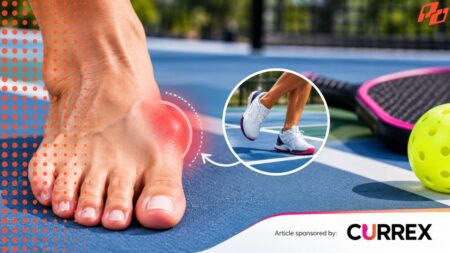
- calf and foot strength
- balance work
- hip strength
- and an actual recovery day
Especially if you’re playing three, four or five times per week. That isn’t time away from pickleball. It’s what protects your ability to keep playing it.
The Sweet Spot Isn’t Maximum Pickleball

Don’t chase a magic number of hours. A better week gives you four things:
Movement — you actually worked.
Connection — you played with people you enjoy.
Mastery — something still challenged you.
Recovery — you finish wanting to play again.
Lose one, and the experience changes.
Too much competition can feel stressful.
Too little movement may not deliver much fitness.
Too much volume eventually catches up.
And playing the same way forever gets stale.
The sweet spot may not be more pickleball. It may be the right mix of movement, people, progress, and recovery.
There’s One More Reason Pickleball Seems to Stick
A six-week intervention with previously inactive middle-aged and older adults found improvements in several physical and cognitive measures. But one of the most revealing findings wasn’t a test score.
Participants showed strong adherence, reported high satisfaction, and many said afterward that they wanted to continue playing pickleball.
That matters. The theoretically perfect exercise program is not particularly useful if you hate doing it.
Pickleball has an unusual advantage:
You can show up for the game and accidentally exercise.
You can show up for exercise and accidentally make friends.
You can show up to see friends and accidentally become obsessed with learning a third-shot drop.
Those motivations feed each other. And that may be one of pickleball’s biggest strengths as we age.
A Better Way to Measure a Good Pickleball Week
Don’t only ask: How many games did I win?
At the end of the week, try four different questions:
✔ Did I move enough to feel physically challenged?
✔ Did I spend time with people I genuinely like?
✔ Did I get better at something?
✔ Does my body still feel capable of playing next week?
Four yeses? That’s probably a pretty good pickleball week.
Because the best return on pickleball may not be another tenth of a rating point. It may be having a sport that keeps you moving, learning, connected and eager to come back for years.