A study making the rounds deserves a closer look than the headline gives it – both because the finding is genuinely encouraging, and because the details matter if you’re going to take it seriously.
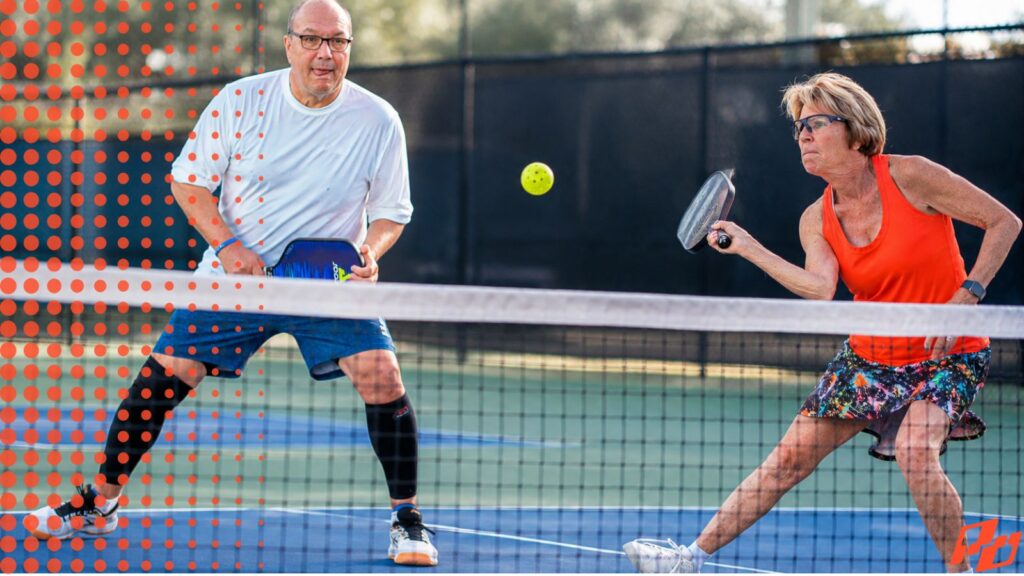
Researchers at the Chinese University of Hong Kong ran a randomized controlled trial to answer a specific question: could eight weeks of pickleball reverse pre-frailty in older adults? Published in the International Journal of Nursing Studies, the trial found that it could – and the effect was substantial.
But the full paper tells a richer, more useful story than “pickleball reverses frailty,” and that’s the version worth having.
If you’d rather hear me break down the study, its biggest findings and the important details behind the headline, watch my video below.
First: what is pre-frailty?
Frailty is a recognized geriatric condition marked by reduced strength, energy and resilience, making older adults more vulnerable to falls, illness and loss of independence. Pre-frailty is the stage just before it, and it’s extremely common: researchers estimate it affects nearly half of older adults worldwide.
The critical thing about pre-frailty is that it’s dynamic and often reversible. It’s a yellow light, not a diagnosis, the window in which the right intervention can still turn things around. That’s precisely why the researchers targeted it.
What the study actually did
This was a randomized controlled trial, widely considered the gold standard for testing cause and effect.
Researchers enrolled 72 adults aged 65 and older who lived independently and had been classified as pre-frail using the Fried Frailty Phenotype. The participants had a median age of 67, and about 58% were women.
They were randomly assigned to one of two groups: a pickleball group or a control group.
The people who measured the results did not know which group each participant was in. Researchers also included everyone who originally enrolled in the final analysis, even if they did not complete every session. This intention-to-treat approach helps reduce bias and makes the findings harder to overstate.
Here’s the part worth writing down, because it shows exactly what the pickleball program involved:
THE DOSE
- 8 weeks, with two 60-minute sessions per week—16 sessions total.
- Each session included:
- 10 minutes of warm-up
- 45 minutes of pickleball instruction and play
- 5 minutes of cool-down
The sessions were led by a certified pickleball instructor with experience working with older adults, with no more than eight players per instructor.
The program progressed gradually:
Weeks 1–2: basic skills and fundamentals
Weeks 3–6: dinks, volleys and doubles strategy
Weeks 7–8: real match play
The researchers also modified the rules for safety, including mandatory underhand serves and strict enforcement of the kitchen line.
In practical terms, the intervention was about two hours of supervised, social and progressively structured pickleball each week. The control group continued with their normal daily routines.
What they found
The headline result was encouraging: after eight weeks, 42% of participants in the pickleball group were no longer classified as pre-frail, compared with just 8% of the control group.
That works out to an absolute recovery increase of about 33 percentage points. Put simply, for every 100 similar participants, roughly 33 more people recovered from pre-frailty in the pickleball group than in the control group.
But there is an important detail behind that headline.
When researchers examined the five individual components of frailty, most of the improvement came from one area: physical activity. Participants who had been too sedentary at the beginning of the study became active enough that they no longer met that frailty criterion.
The other components, including measures of muscle weakness, did not improve significantly.
That gives us a more accurate picture of why pickleball helped. It did not reverse pre-frailty by producing dramatic gains in raw strength. It helped by getting sedentary older adults to move consistently in a way they enjoyed and were willing to continue.
For many older adults, that is the hardest part—and one of pickleball’s biggest strengths.
The pickleball group also made measurable gains beyond frailty status:
- LOWER-BODY STRENGTH: About five additional chair stands in 30 seconds, an important measure linked to mobility, fall risk and independence.
- UPPER-BODY STRENGTH: Roughly four additional arm curls.
- FLEXIBILITY: A meaningful improvement in shoulder reach.
- ENDURANCE: About 31 additional meters during a six-minute walk.
- MENTAL HEALTH: A significant improvement in mental well-being, one of the strongest effects observed in the study. Physical quality-of-life scores improved as well.
The researchers also used accelerometers worn throughout the day to track activity outside the pickleball sessions.
The pickleball group reduced daily sedentary time by about 37 minutes and added roughly 17 minutes of light physical activity. In other words, the program did not just get participants moving for two scheduled sessions each week. It helped them become more active throughout the rest of the day.
Sleep did not change significantly.
The part most articles won’t tell you
Good health reporting means being honest about a study’s limitations. Here are the most important ones, several of which the researchers acknowledged themselves.
THE STUDY LASTED ONLY EIGHT WEEKS.
There was no long-term follow-up, so we do not know whether the improvements lasted for six months, a year or longer.
IT WAS ONE SMALL STUDY.
The trial included 72 relatively healthy, community-dwelling older adults in Hong Kong who were mobile enough to participate in a group sport. The findings may not apply to people who are frailer, less mobile or from very different populations.
PICKLEBALL IS NOT A REPLACEMENT FOR STRENGTH TRAINING.
Grip strength did not improve significantly, and the researchers noted that people with genuine muscle weakness would still need targeted resistance training. Pickleball provides broad, functional exercise, but it does not replace lifting.
PRE-FRAILTY CAN CHANGE NATURALLY.
Some participants in the control group improved without playing pickleball because pre-frailty can shift over time. Even so, the difference between the two groups was large enough to suggest that the pickleball program had a meaningful effect.
None of these limitations erase the result. A well-designed randomized trial showing a 42% recovery rate in the pickleball group compared with 8% in the control group, along with measurable fitness and mental-health gains, is a strong and encouraging signal.
It just is not proof that pickleball is a miracle cure, and presenting it that way would overstate what the study actually found.
Why it worked—and why that’s the encouraging part
The researchers’ explanation may be the most useful takeaway from the entire study.
Pickleball appeared to succeed where many exercise programs for older adults struggle, and the reason was not simply the movement involved. It was adherence: people kept showing up.
Participants attended an average of 81% of the sessions. There were no serious injuries, and every participant said they wanted to continue playing after the study ended.
That matters because even the best exercise program only works when people stick with it. Pickleball is social, enjoyable and mentally engaging, which makes it easier for participants to return week after week.
The community aspect may be more than a pleasant bonus. For this group, it may have been a major part of what made the program effective—the difference between thinking, “I should exercise,” and looking forward to the next session.
The bottom line
For an older adult in the pre-frail stage, this study offers a meaningful reason to consider pickleball.
One trial cannot prove that pickleball will produce the same results for everyone. But the potential benefits are encouraging: greater physical activity, improved strength and endurance, better mental well-being and a higher chance of remaining independent.
The commitment was also relatively manageable—about two supervised, social hours of pickleball each week.
Anyone who is older or managing a health condition should speak with a doctor before beginning a new activity. Still, this study adds meaningful evidence to the case for pickleball as a tool for healthier aging.
The sport you never age out of may also help you stay active, connected and independent for longer.