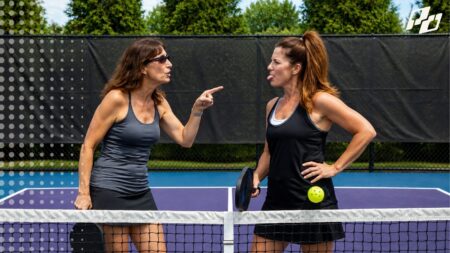
“It Was Out!” (…Was It?)
We’ve all been there.
It’s game point in a close rec match. The rally’s fast, your adrenaline’s up, and then — your opponent’s drive rockets toward the baseline. It’s close — maybe on the line, maybe not. You squint, your gut says “out,” but your inner voice whispers, Don’t be that person…
So, you shrug and say, “Good shot.”
Your friends smile. They call you “so nice.” But walking off the court, you’re thinking:
“I think that ball was out. Why did I give it to them?”
Welcome to pickleball’s quiet identity crisis — the battle between being nice and being honest.
Why This Hits So Deep for Rec Players
Pickleball isn’t tennis. It’s social, neighborly, built on high-fives and post-match laughs.
At rec level, friendliness is part of the culture.
But that same kindness can blur lines (pun intended). When every opponent is also a buddy, calling a close ball out can feel like breaking some unspoken rule of decency.
Here’s the truth though:
Being nice keeps the peace short-term.
Being honest builds trust long-term.
And in a sport where we often self-officiate, trust is everything.
The Problem With Being “Too Nice”
We all know the “Nice Caller.” They never call anything out — ever.
Their motto: When in doubt, give it to them.
It sounds noble… until it isn’t.
Because being “too nice” can actually hurt everyone’s game:
- You train your brain to doubt your instincts.
- You reward sloppy shots. Players start aiming recklessly.
- You build resentment. (“They’d never give me that one!”)
- You break rhythm. Every rally ends in awkward silence or fake cheer.
Soon, what started as courtesy turns into quiet frustration.
The Flip Side: The Over-Enforcer
Then there’s the other end of the spectrum — the player who calls everything out with military precision.
They might be right most of the time… but they forget one thing:
Pickleball is still supposed to be fun.
If you’re policing lines like it’s a pro final, you’ll quickly find yourself with a lot of open court time — because nobody wants to play with the “Referee of Doom.”
So how do you find the balance between pushover and line judge?
The Honest Player’s Middle Ground
Here’s the golden zone — the sweet spot where you can compete hard and stay likable.
1. Call only what you clearly see.
If you didn’t see space between the ball and the line, it’s in. This one principle solves 80% of arguments.
2. Call fast — not after you win the rally.
Delayed calls feel shady, even if they’re right. Make your decision instantly, before emotion kicks in.
3. Loop in your partner.
If they had the better view, defer. Nothing says “team trust” like checking in.
4. Use the “benefit of the doubt” rule intentionally.
Not as guilt management — as a fairness standard. If it’s genuinely too close, replay or concede.
5. Announce your uncertainty.
“I didn’t see it clearly, your point.” That sentence earns you more respect than ten “nice calls” ever will.
The Science Behind Misjudged Calls
Here’s a humbling fact: even pros miss close calls. Our eyes and brain just aren’t built for that speed.
When a ball hits near the line, our vision momentarily blurs from motion and compression. What we think we saw is often what we expected to see.
That’s why your brain sometimes swears the ball was out — when it actually kissed chalk.
Knowing this doesn’t make you less confident — it makes you humble. You’ll call tighter when you’re sure, and fairer when you’re not.
Pro Tip: Adopt the “Respectful Replay Rule”
If a ball’s genuinely too close to call, say this:
“That was too close to tell — let’s replay it.”
No ego, no tension. Just good pickleball.
This move resets the point and keeps the friendship intact. It also sends a subtle signal:
“I care about fairness more than the score.”
And that’s exactly the kind of player people want to play with.
Handling Awkward Moments Gracefully
Let’s be real — sometimes it does get awkward. You call a ball out, your opponent disagrees, and now the air feels heavy.
Here’s how to defuse it like a pro:
- Stay calm. You’re not defending your PhD — it’s a pickleball call.
- Smile and use soft tone: “I saw it out, but happy to replay if you’d prefer.”
- Avoid sarcasm: (“Guess I need new glasses.”) That kills the vibe instantly.
- Move on quickly. Don’t dwell or “prove” your correctness — it ruins rhythm.
Good etiquette isn’t about being perfect. It’s about being gracious under pressure.
Real-Life Story: The Point That Changed My Mind
Last summer, during a rec doubles match, I called a sideline ball out — barely.
My opponent looked at me and said, “You sure?”
I hesitated, replayed it in my mind, and realized I wasn’t 100% certain.
I took a breath and said, “Actually, I’m not. Let’s replay it.”
We did. I lost the point. But afterward, he said,
“That’s the most fair call I’ve ever seen.”
Now, whenever I’m tempted to “guess out,” I think of that rally. Because what you earn by being honest lasts longer than what you lose by being wrong.
The Takeaway: Choose Respect Over Reactions
At the end of the day, pickleball isn’t about perfection — it’s about connection.
You can be both kind and honest. The two aren’t opposites; they’re teammates.
Nice keeps it friendly. Honest keeps it real.
So next time that yellow blur skims the line and everyone looks at you —
take a breath, trust your eyes, and call it the way you truly saw it.
Because the best players aren’t just known for great shots…
They’re remembered for great integrity.