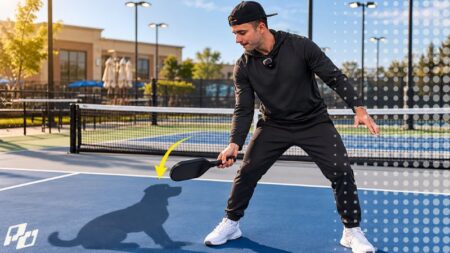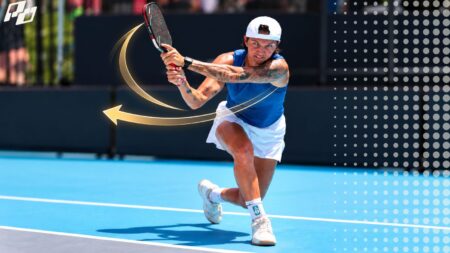
Have you ever watched a player hit a serve that doesn’t seem to bounce — it just skids low and rushes at the returner like it’s angry?
Meanwhile, your serves seem to pop up just enough to make returns easy.
That low-bouncing serve looks like magic, but it’s not. It’s physics — and you can absolutely learn how to create it.
Let’s break down why certain serves stay low, what’s really happening with spin and trajectory, and how you can start serving like the players whose balls never seem to sit up.
The Misunderstanding: “Topspin Makes It Jump”
One of the biggest sources of confusion in pickleball (and tennis, honestly) is topspin.
You’ve probably heard two contradictory things:
- “Topspin makes the ball kick up.”
- “Topspin makes the ball stay low.”
Here’s the truth: both are right — depending on how you hit the ball.
Topspin does two things at once:
- Before the bounce, it makes the ball drop faster because of the Magnus effect (the air pressure difference that curves the ball downward).
- At the bounce, it makes the ball “grip” the court and kick forward — not necessarily up.
That means a low, fast topspin serve will skip forward and stay low, while a high, loopy topspin serve will bounce up because it hits the court at a steeper angle.
The spin type isn’t the issue — it’s the trajectory and impact angle.
What’s Actually Happening at the Bounce
Imagine the serve like a car tire hitting the road. If the ball is spinning forward (topspin), it “grabs” the surface on contact and pushes forward. The energy that might have gone up gets redirected out.
That’s why when a serve comes in fast and deep, it feels like it “skids.” The ball hasn’t lost enough speed to bounce high, and its forward spin carries it through the bounce.
But if your serve arcs high and drops steeply, the ball’s momentum is more vertical. That means more upward rebound — more “pop.”
So when you see a serve that stays low, you’re not seeing a secret grip or illegal spin. You’re seeing smart control of angle and spin ratio.
The Variables That Control Your Bounce
There are four main ingredients that determine whether your serve “skids” or “sits up”:
1. Trajectory
- A serve hit low over the net lands flatter and drives forward after bouncing.
- A higher-arching serve lands at a steep angle and rebounds upward.
Think of it like skipping a stone — the flatter it lands, the smoother it glides.
2. Spin Direction
- Forward topspin gives you that forward “kick.”
- Backspin (slice) can stay low too, but only if hit hard and flat — lofty slices actually bounce higher.
3. Ball Speed and Depth
- The deeper the serve, the less time your opponent has to react — and the lower the ball is still traveling when it reaches them.
- A deep topspin serve that lands just inside the baseline is the hardest ball to attack.
4. Ball and Conditions
- Softer balls (like the Franklin X-40) bounce lower by design.
- Hot, humid air keeps the ball heavy and low.
- Cool or dry conditions (especially at altitude) make it “floaty” and higher-bouncing.
How to Hit a Serve That Skids Low
You don’t need to change your motion — just your focus.
Here’s how to create that low, forward-moving bounce:
Step 1: Hit Through, Not Up
Instead of brushing up on the ball like you’re trying to lift it, brush through the ball toward your target.
You still want spin, but you want forward rotation — not vertical.
Think of your paddle path as level and driving through the ball, not looping under it.
@enhancepickleball Explanation ⬇️ @kenadihance If you want to score on high-level players, you need to learn how to serve with heavy topspin. The problem? Most amateurs don’t have the right technique to generate enough RPMs. We can’t break it all down here, but we just dropped a full video on YouTube showing exactly how to do it. #pickleball ♬ original sound – Enhance Pickleball
Step 2: Aim Lower Over the Net
Your serve should clear the net by no more than a couple of paddle widths. The flatter flight path helps the ball hit with forward momentum instead of downward.
Step 3: Add Depth, Not Height
Aim deep — just inside the baseline. The extra travel distance keeps the ball’s forward energy alive, so it reaches your opponent before it has a chance to bounce up.
Step 4: Practice the “Skip Test”
On your next drill session, try this:
- Hit 10 serves that land deep with a low net clearance.
- Watch how far the ball travels after the bounce.
If it shoots forward more than it rises, you’re getting it right.
What You Should Take Away
Intermediate players often chase “spin serves” because they look flashy. But the pros who make balls stay low aren’t spinning harder — they’re spinning smarter.
You don’t need chainsaw spin or gimmicks. You need:
- A flatter trajectory
- Forward brushing motion
- Deep, consistent placement
The result? A serve that feels like it skips through your opponent’s strike zone instead of sitting up and waiting to be attacked.
Bonus Tip: Know When to Use It
Not every serve needs to skid low.
Use your “skid serve” when:
- You’re serving to a player with slower reactions or a low ready position.
- You’re playing in warm, humid conditions (ball already travels lower).
- You want to push your opponent back to open up your third-shot drop.
Mix it with higher, spinnier serves to disrupt rhythm — that’s where the real power lies.