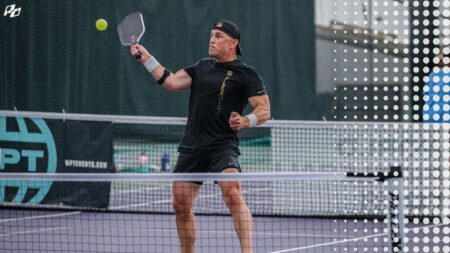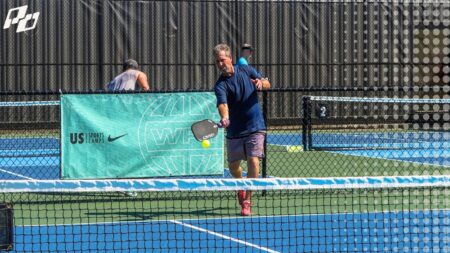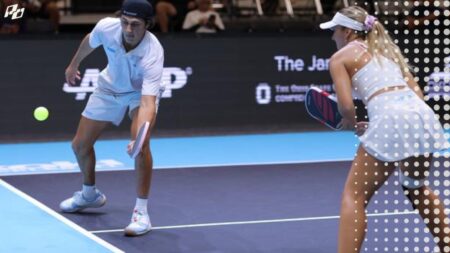

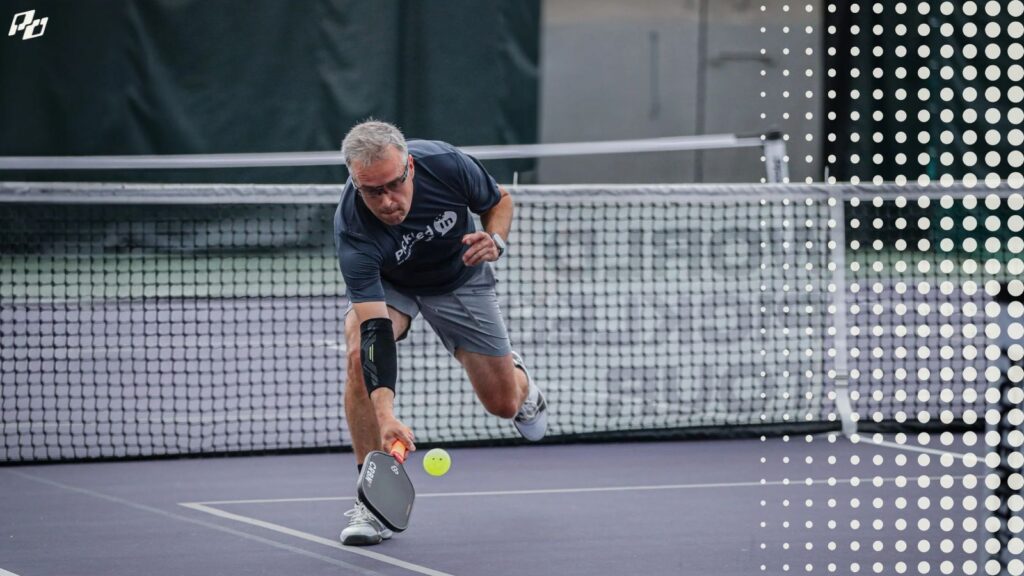
The best third-shot drive targets in doubles are the middle seam and the outer thirds. Aim middle to reduce angles, or attack a moving player or weaker side outside. The goal is a weaker fourth ball that gives you an easier fifth shot or putaway.
Mari Humberg, a professional pickleball player and coach who competes on the PPA Tour, recently shared a simple third-shot drive idea: stop trying to blast winners and start giving your drive a target.
Her court is divided into three lanes: left, middle, right.
At first, that sounds almost too basic to be useful. But there’s a much better way to understand it. Those aren’t really three places to hit.
They’re three different ways to influence the fourth shot coming back at you.
That distinction matters because most good third-shot drives aren’t winners. Their real value is making the opponent’s volley more predictable, weaker, or easier to handle with your fifth shot.
A third-shot drive is often a transition shot that creates a more manageable fifth-shot drop rather than ending the point immediately.
So when you drive, don’t just hit at the open court. Pick the lane that gives you the easiest fourth ball back.
That’s the real job of the drive.
The Middle Lane: Your Control Target
For most players, this should be the default. A drive through the center seam does two useful things.
First, it takes away some of the defender’s best angles. A player volleying from near the middle has less court available for a sharp crosscourt redirect than someone contacting the ball out near a sideline.
Second, you introduce a decision. Whose ball is it?
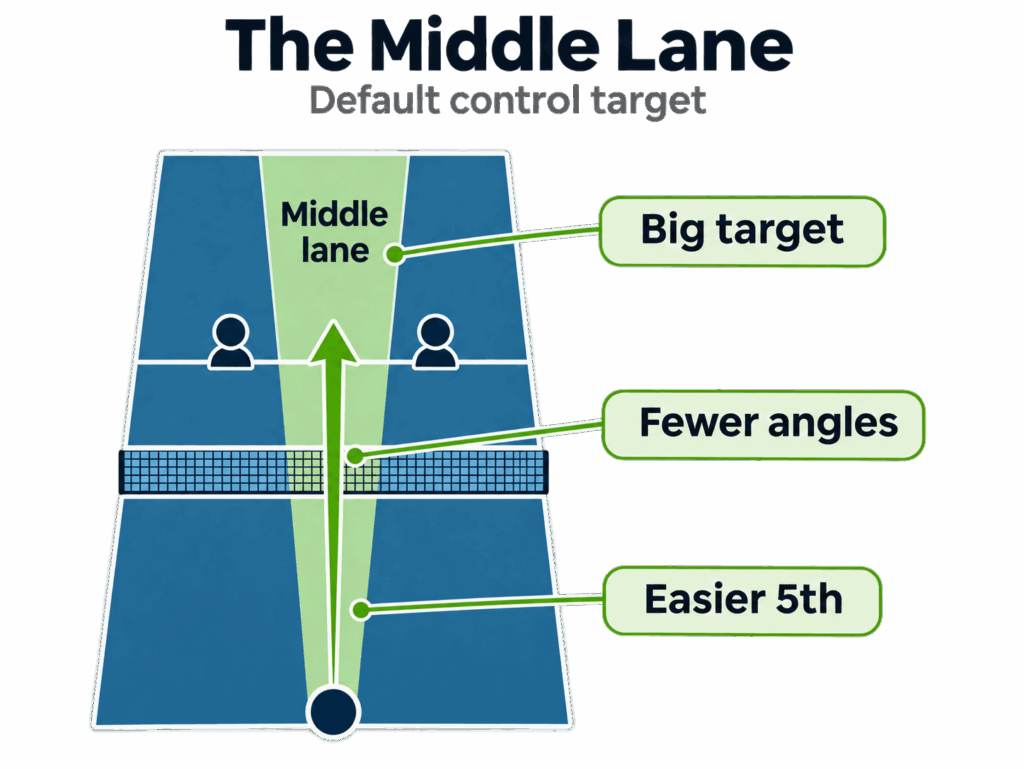
Against experienced partners that hesitation may be tiny, but even a half-beat can turn an aggressive volley into a simple block.
This is why I’d use middle when:
✔ both opponents are established at the kitchen;
✔ you don’t see an obvious weakness;
✔ you’re planning to drive the third and drop the fifth;
✔ or you’re under enough pressure that you want a large, forgiving target.
What should you expect back?
Usually something relatively central. That is exactly what you want.
A central block means you and your partner aren’t being pulled immediately toward a sideline, and your fifth shot becomes easier to organize.
Think of the middle lane as the drive that simplifies the rally.
The Left and Right Lanes: Don’t Aim for the Line
This is where Mari’s idea becomes more interesting. “Left” and “right” shouldn’t mean painting the sideline.
For beginner to intermediate players, the useful target is usually the outer third of the court, aimed through a specific opponent.
That could mean their backhand hip.
Their inside foot.
The side they’re moving toward.
Or simply the player who hasn’t finished coming forward after the return.
USA Pickleball lists the returner as a smart third-shot target because that player is often still moving when the third ball arrives. It also recommends targeting an opponent’s weaker side.
That gives the outer lanes a very different purpose from the middle. You’re not reducing options. You’re trying to make one defender uncomfortable.
Use the outside lane when the returner is still moving
Imagine the returner hits deep and immediately starts toward the kitchen.
Their partner is already planted at the line. That moving returner is often the better target. Drive into the lane they’re occupying before they become fully established.
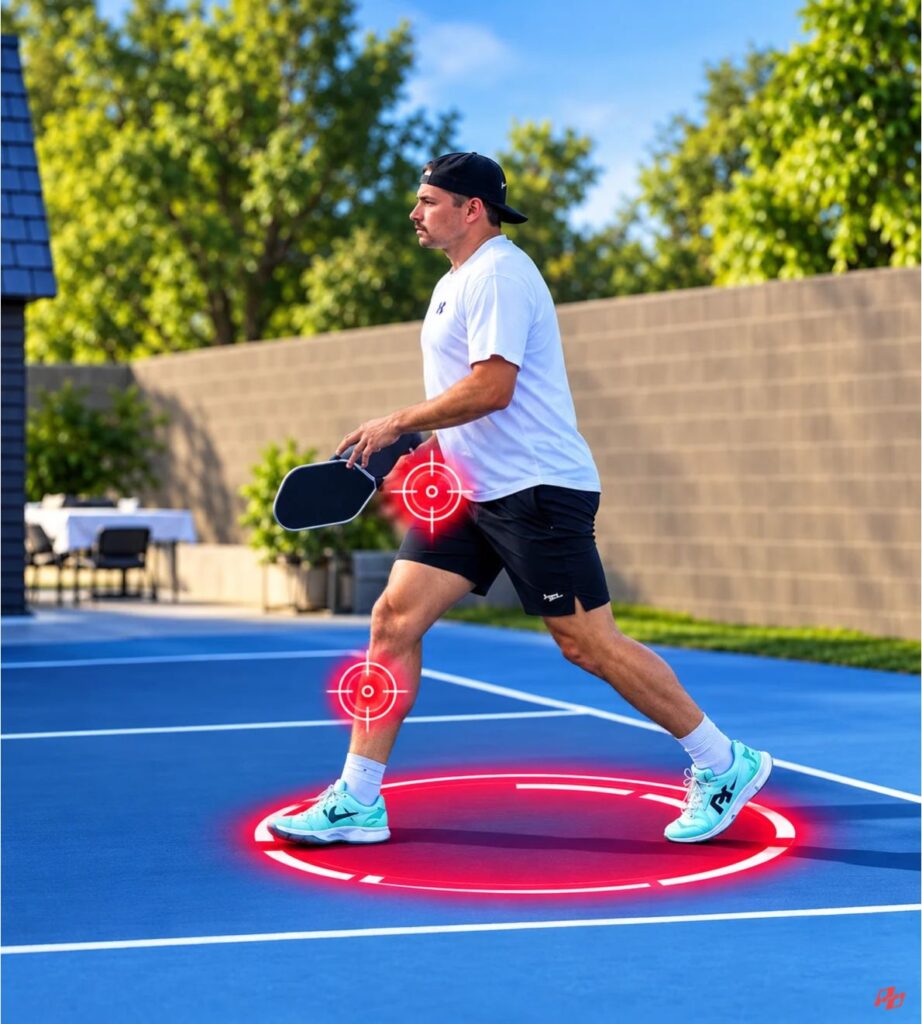
Now they’re trying to do several things at once:
- move forward
- split
- prepare the paddle
- and absorb your pace
That is a perfect setup for the fifth.
The mistake is trying to pass them down the sideline. You don’t need to.
A drive into the hip or inside-foot area gives you much more margin while creating the same uncomfortable contact. Coaches frequently recommend the hip or jam zone for exactly this reason: it removes extension and makes a clean punch volley harder.
Use the Outside Lane to Attack a Real Weakness
The other reason to choose left or right is when you’ve identified something specific.
Maybe the right-side player clearly struggles with backhand volleys.
Maybe someone is leaning toward the middle.
Maybe a team is stacking and one player is still unwinding into position.
Maybe you’ve already driven middle several times and they’re beginning to squeeze the center.
Now the outer lane makes sense.
But notice the sequence: You found the weakness first. Then you chose the lane.
Don’t decide, “I’m going down the line,” simply because you see six feet of open court. That is how a high-percentage drive becomes a low-percentage passing shot.
The better target is usually a broad corridor through the player—not the final six inches of court.
What Each Lane Is Really Trying to Produce
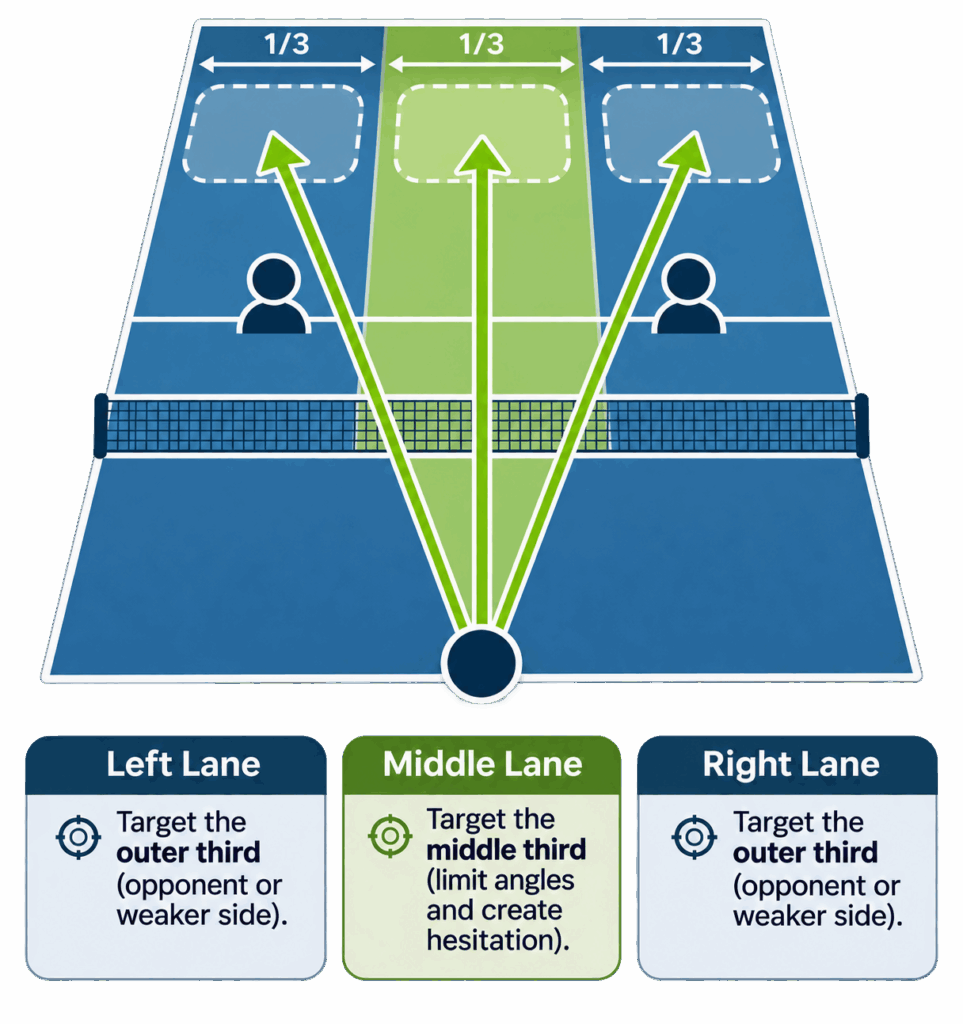
Here’s how I think about the three choices.
Middle:
I want a predictable block and fewer angles.
Left:
I want to pressure the player or contact point on that side.
Right:
Same idea on the opposite side.
The left and right targets therefore change from point to point.
⮕ If the returning player is on your left, left may be the best lane.
⮕ If the weaker backhand is on your right, right may be better.
⮕ If neither defender presents a clear problem, middle wins.
That’s much more useful than memorizing “forehand goes here, backhand goes there.”
Don’t Choose the Lane Until You’ve Read the Return
The third-shot decision comes first. Not every return should be driven.
A drive makes the most sense when the bounce gets above roughly knee height and you can step into contact with balance and forward momentum. A shorter return that gives you comfortable contact is especially attractive.
So my sequence would be:
First: Is this actually a driveable ball?
Second: Where are the two defenders?
Third: Which lane creates the fourth ball I want?
If the return stays low, pushes you backward, or makes you reach, don’t force the three-lane concept onto a bad drive. Drop it.
The targets only matter after you’ve earned the right to drive.
How Hard Should You Hit It?
Hard enough that the opponent can’t comfortably attack. Not so hard that you lose the lane. This is where many intermediate players ruin the whole idea.
They can hit left, middle, and right at 65% pace. Then they swing at 95% and suddenly they have one target: somewhere over the net.
Placement is part of the pressure.
A controlled topspin drive that dips toward the hip or feet can be more troublesome than a flat ball hit several miles per hour faster.
Use the same preparation for all three lanes. Turn early, get behind the ball, contact in front, and let the swing direction and paddle face make the small directional change.
Don’t dramatically reposition yourself to announce where you’re going.
The Drill I’d Use: Three Lanes, Then One More Ball
Put two markers deep in the opponent’s court so you can see three broad corridors: LEFT | MIDDLE | RIGHT
Don’t make tiny targets.
You aren’t trying to hit a dinner plate.
You’re trying to own a lane.
Start with ten balls to each lane at about 70% pace.
Your first benchmark: 7 out of 10 into the correct lane without sacrificing a normal drive shape.
If you can’t do that, don’t add speed. Once you can, stop practicing in a fixed order.
Have your feeder call:
“left,”
“middle,”
or “right”
after the feed is already on its way.
Now you have to prepare normally and change direction without changing your entire swing. Then add the part most players never practice.
- Put a defender at the kitchen.
- Drive your chosen lane.
- They block it.
- Then you must play the fifth.
This is where the drill becomes real.
⮕ If their block sits up, attack.
⮕ If it lands short and neutral, drop.
⮕ If they block it aggressively at your feet, reset.
Now you’re no longer practicing a drive. You’re practicing the drive-plus-one pattern that actually happens in doubles.
A Simple Match Rule
For a few games, give yourself this decision tree:
✔ No clear target? Drive middle.
✔ Returner still moving? Drive their lane.
✔ Backhand or positioning weakness? Use the outside lane that reaches it.
✔ Poor contact for you? Don’t drive at all.
Then pay attention to what comes back. That’s the real feedback.
If your middle drive repeatedly produces manageable central blocks, keep it.
If the wide drive repeatedly gives an opponent a sharp angle, stop calling it a good shot just because it looked aggressive.
And if one outside lane keeps producing weak volleys from the same player, you’ve found something worth revisiting.
Mari’s three lanes aren’t really about precision for precision’s sake. They’re a way of giving the third-shot drive a purpose.
Middle to simplify.
Outside to pressure a specific player.
Then read the fourth ball and play the fifth.
Once you start thinking that way, a good drive stops being the one that looks fastest. It’s the one that leaves you knowing what to do next.