
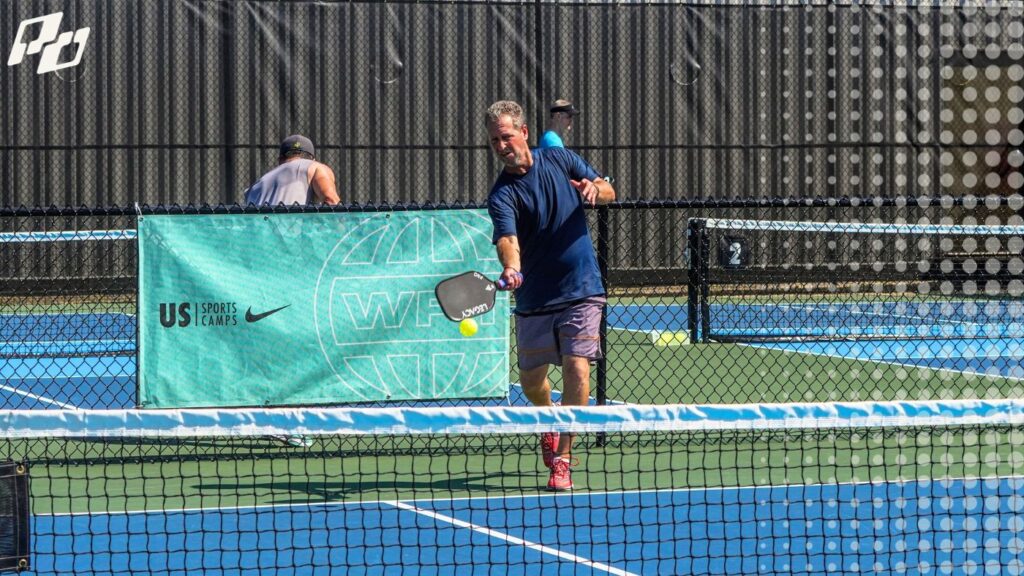
To aim your pickleball serve more accurately, set your feet and shoulders toward the target before you swing. Keep the ball release and swing path repeatable, then let the paddle face make only small adjustments. The less you steer with your hand, the more consistent your serve direction becomes.
If your pickleball serve keeps missing left and right, there is a good chance you are trying to aim too late.
A lot of players decide where they want the ball to go, begin the swing, then make a tiny last-second adjustment with the wrist or paddle face.
That feels like aiming.
It usually creates spray.
A much cleaner way to control direction is to make more of the decision before the swing starts.
Set your body toward the target.
Then let the swing stay simple.
That is why the common coaching tip—point your front foot toward the target—can work surprisingly well.
But the foot itself is not magic. It is organizing everything above it.
Why changing your stance changes the serve
When your front foot and shoulder line turn toward a wide target, your body naturally gives the paddle a clearer path in that direction.
Turn more toward the T and the swing lane changes with it.
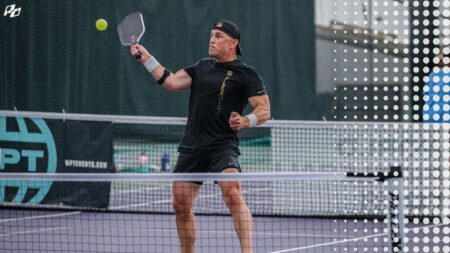
Ava Ignatowich, a PPA Tour professional, teaches a similar idea with the shoulders: players using a more closed stance can point the front shoulder more toward the intended target and let the swing travel naturally through that line.
That is the real value of the foot-angle tip.
Your foot is acting like a rail setter. Once the rail is pointed correctly, you can make essentially the same swing.
Why this works especially well for players who spray the serve
Suppose you want to serve wide. Without changing your setup, you may unconsciously:
- open the paddle face
- pull the arm sideways
- reach farther around the ball
- or flick the wrist
Now four variables changed at once.
If instead you rotate your setup slightly toward the wide target, the arm can make a more familiar motion.
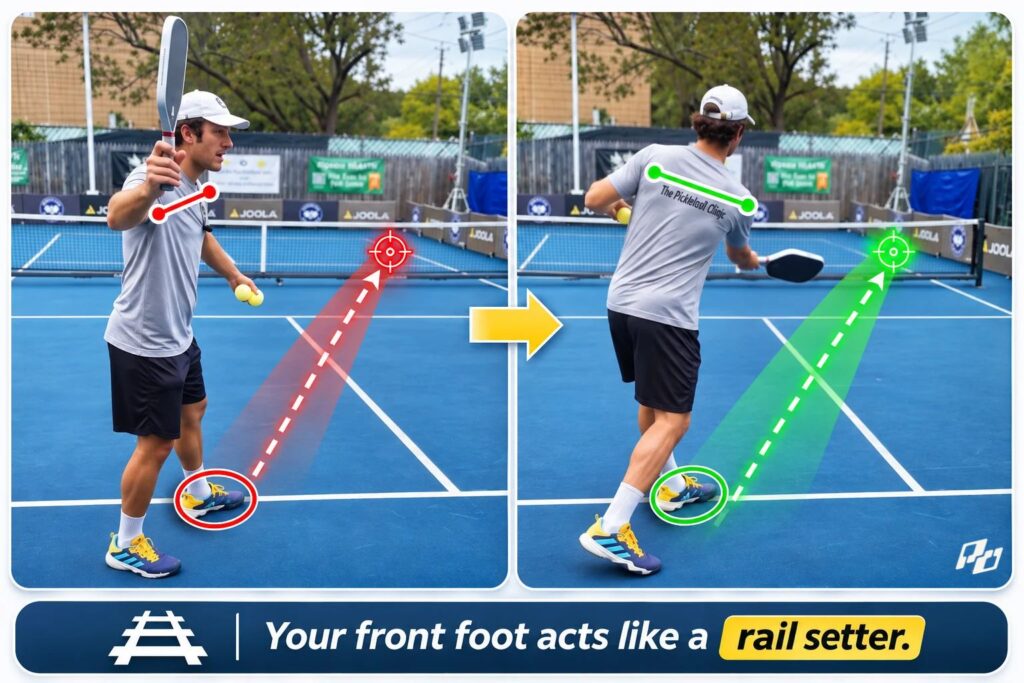
That is what improves repeatability.
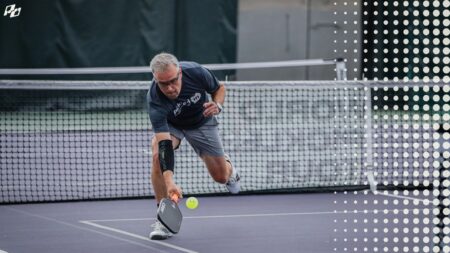
Michael Loyd, a PPA Tour singles player, makes the same broader point when teaching the serve: keep the motion simple and repeatable before chasing extra pace. He also notes that paddle-face direction still matters—if the face is pointed incorrectly at contact, the ball will follow it.
So body alignment does not replace paddle control. It makes paddle control easier.
There are really three aiming layers
Think of serve direction as coming from three things working together:
- Body line sets the general lane.
- Swing path sends the paddle through that lane.
- Paddle face at contact makes the final correction.
If your body is aiming wide but the paddle face suddenly opens toward the middle, the ball does not care where your foot was pointing.
The ball only experiences the paddle at contact.
That is why good serve mechanics emphasize both a stable swing path and a controlled paddle face.
For most intermediate players, though, the body line should do most of the heavy lifting. The hand should not be making emergency steering corrections.
Watch David Dutrieuille, professional pickleball coach and consultant, break down the three things you need to aim your serve better and hit your target more consistently:
Try three lanes instead of “aiming”
This makes practice much easier. Stand behind the baseline and imagine three serving lanes:
Wide.
Body.
T.
Before every serve, choose one.
Then adjust your stance slightly so the front foot and shoulder line support that lane. Do not change anything else.
- Same ball release.
- Same rhythm.
- Same swing speed.
- Same contact point.
Hit five serves to each lane.
The goal is not perfect accuracy. Watch the pattern.
If all five wide serves still drift toward the middle, your stance probably is not actually changing as much as you think—or your paddle face is overriding the setup.
That is much easier to diagnose than randomly “trying harder to aim.”
Depth still comes before precision
There is one danger with directional practice.
Players start painting sidelines and forget that a short serve is often more helpful to the returner than a deep serve that misses the exact corner.
Current coaching guidance still puts depth first because a deep serve keeps the returner farther from the kitchen and makes it harder to step comfortably into the return.
So do not picture a six-inch target. Picture a deep target window.
For example:
- wide and deep
- middle and deep
- T and deep
That keeps the placement useful without turning the serve into target archery.
The wide serve has a hidden cost
Serving wider sounds automatically better because you move the returner. Not always. A wide serve can also create a wider return angle.
If you drag someone far outside the court and they handle the serve comfortably, they may send the return sharply crosscourt and pull you or your partner into an awkward third shot.
So placement should have a purpose.
- Wide works well when you want to test lateral movement.
- T can reduce the return angle and crowd the player’s spacing.
- Body can jam a player who struggles to create room.
Experienced rec players describe exactly this approach: they vary location based on where the returner stands and which movement pattern makes them uncomfortable, rather than simply chasing aces.
That is a better goal for most intermediate players: make the return less comfortable.
Not: hit the line.
When the front-foot method becomes too obvious
There is one limitation to this technique. If you dramatically change your stance every time you change direction, a good returner can read you.
Wide stance angle?
They know wide is probably coming.
Square up toward the middle?
They shade toward the T.
That does not mean you should stop using the method. It means there is a progression.
At first, use obvious stance changes to learn directional control. Then gradually make those changes smaller.
Eventually, advanced players can use nearly the same starting position and alter direction with subtler changes in shoulder line, contact point, swing path, and paddle face.
That is why you see pros serving effectively from both open and closed stances. The body mechanics are more developed, and they do not need a dramatic foot-pointing cue to find a target.
For an intermediate player, disguise comes later. First earn control.
Do not chase the pro stance too early
Open-stance serving has become increasingly common, especially among powerful players. It can produce excellent pace because the hips and torso rotate through the ball.
But it gives you fewer obvious directional guides.
A staggered or slightly closed stance can make placement much easier to learn because the front foot and shoulder create a visible line toward the target.
Michael Loyd recommends a staggered closed stance partly because it makes weight transfer and body organization easier to repeat.
Ava Ignatowich teaches both open and closed options, which is the better way to think about it: neither stance is universally correct.
Use the one that lets you repeat the ball you actually want.
A useful diagnostic
If you keep missing in the same direction, do not immediately change the swing.
Check these in order:
1. Body: Where were your feet and shoulders aimed?
2. Release: Did you release the ball from the same spot?
3. Swing path: Did the paddle travel through the target line?
4. Paddle face: What did it do at contact?
That sequence matters because the earlier the error appears, the less useful it is to fix something later in the chain.
A badly aligned setup followed by a wrist correction may occasionally produce a good serve. It will not produce a reliable one.
The intermediate version of this tip
You do not need to point your front foot exactly at every target forever. Use the idea to build three dependable serve lanes.
- Start with a slightly closed stance.
- Choose wide, body, or T.
- Set the foot and shoulder line.
- Keep the release and swing as similar as possible.
- Then hit through the lane rather than steering toward a tiny target.
Once you can find all three locations reliably, begin making the stance differences smaller. That is when placement starts becoming harder for the returner to read.
The biggest improvement is not that you suddenly learn to hit the corners. It is that you stop asking your hand to make the entire directional decision in the final tenth of a second.
By the time the paddle starts moving, most of the aim should already be built into the setup.