
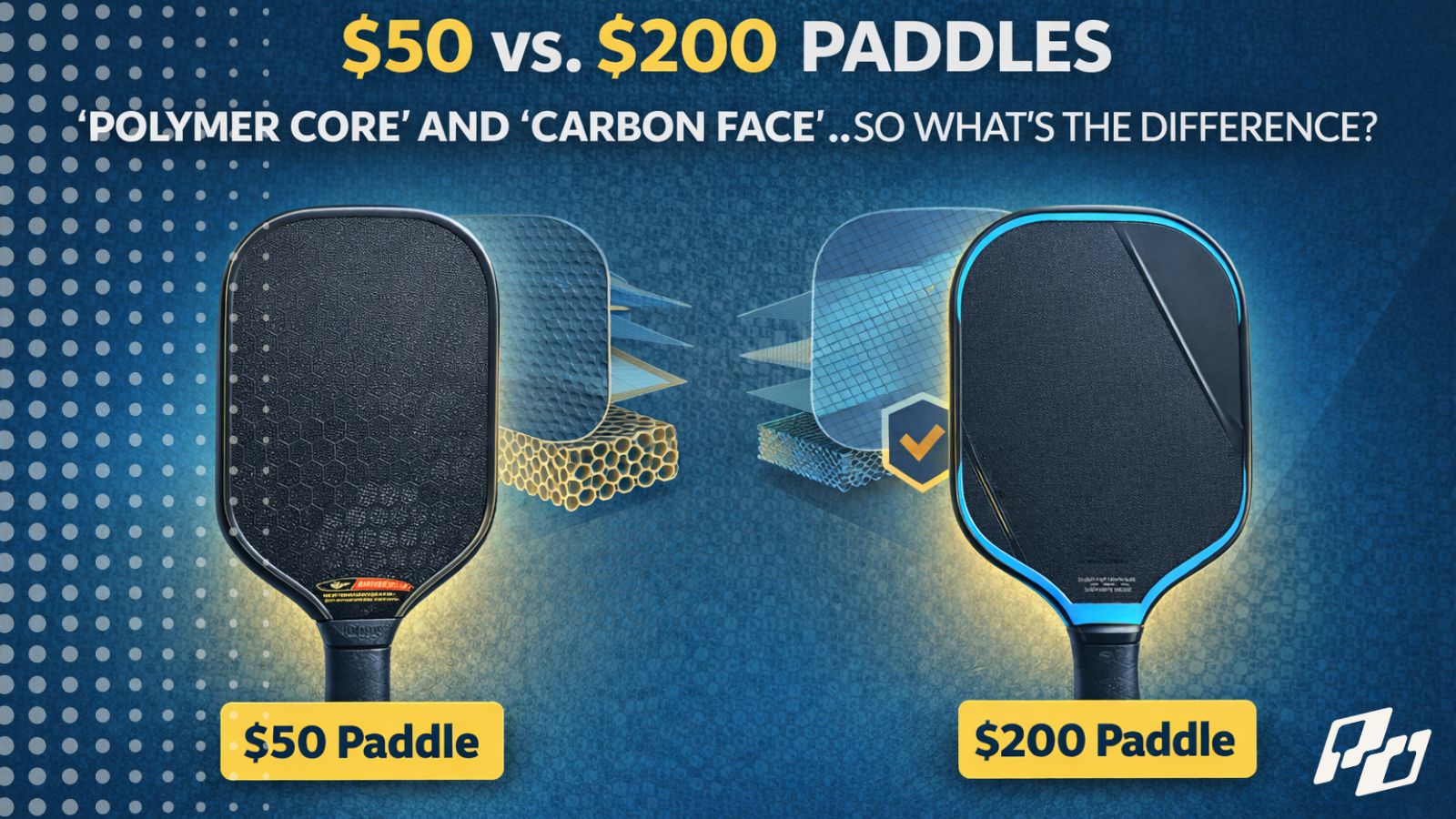
If you’ve ever looked at a $50 paddle and a $200 paddle and thought, “Wait… both say ‘polymer core’ and ‘carbon face’… so what’s the difference?” — you’re asking the right question.
Because in 2026, the headline materials often sound identical, but the grade, layup, bonding, edge structure, and quality control can be very different.
New to pickleball? Start with our best pickleball paddles for beginners, picked with lab data and 3,600 player survey responses.
And that’s the real story: you’re not paying for a magic ingredient. You’re paying for how consistently—and how durably—the paddle is built.
There’s also a new reality shaping modern paddle design. As paddle tech has advanced, it’s been squeezed by stricter testing and clearer limits on spin, surface roughness, and power. Governing bodies increasingly measure surface friction, rebound behavior, and durability—not marketing language.
If you would rather skip the theory, the paddle quiz turns your answers into three lab-scored picks in about 90 seconds.
So let’s do a true three-tier autopsy, layer by layer.
Ten questions, three paddles matched to how you play, scored on lab data.
The Paddle Autopsy, Layer by Layer
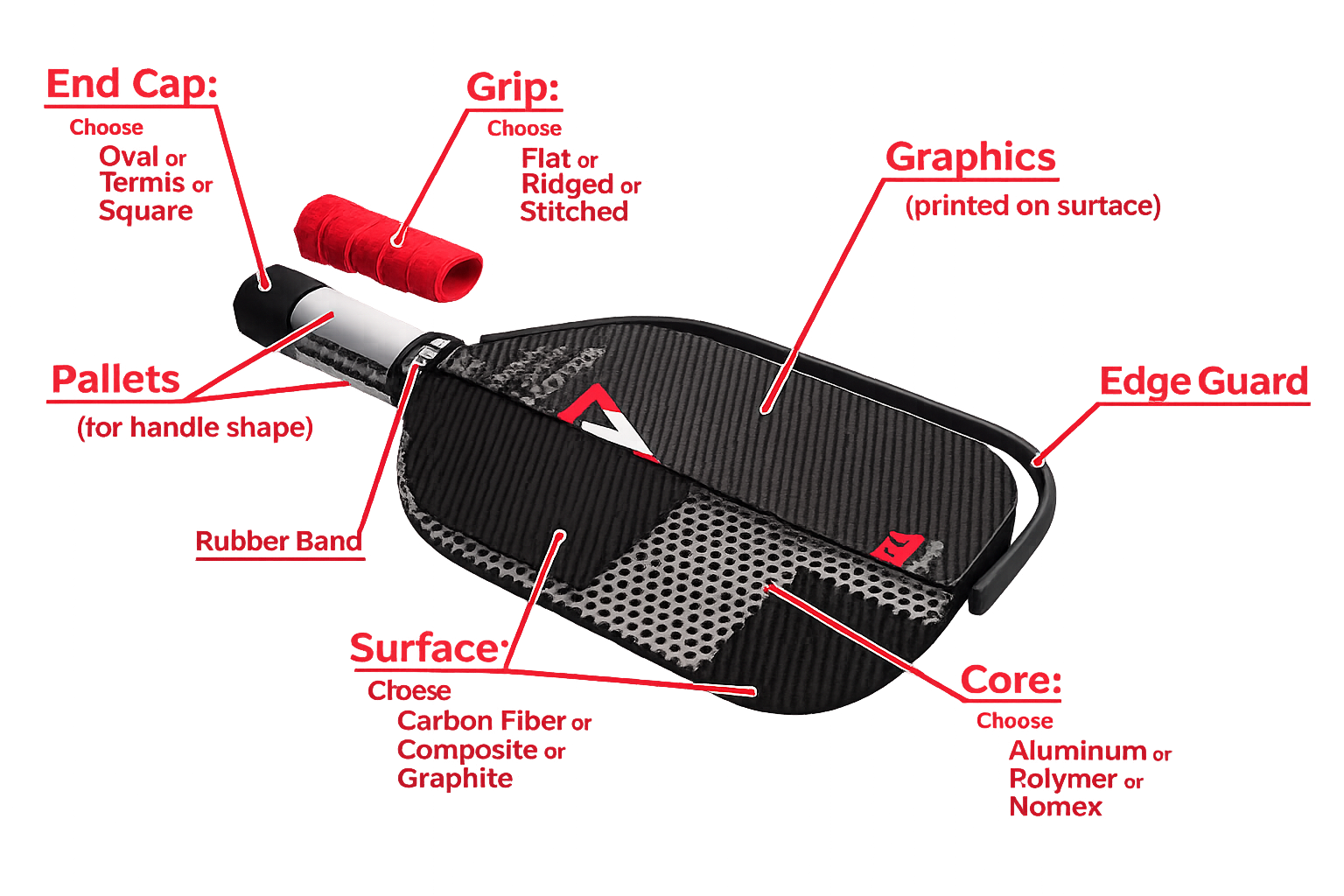
Layer 1: The Face (the part you actually hit with)
$50 tier
At the budget end, “carbon” can mean fiberglass blends, graphite, or entry-level carbon sheets with surface texture that’s often painted or sprayed on. Even when it is carbon, surface consistency and durability tend to vary more across the face and across production runs.
What players usually notice: spin feels fine early, but response becomes unpredictable faster—especially on off-center contact.
$100 tier
This is where more consistent performance faces start to appear, often raw carbon fiber or better-controlled composites. The upgrade isn’t just spin—it’s repeatability. Similar swings begin producing similar outcomes.
$200 tier
Premium paddles justify price through higher-grade carbon fabrics, tighter surface tolerances, and more consistent face processing. This matters because surface behavior is now increasingly measured, not just described.
Top-tier paddles are engineered to sit near allowable limits without drifting over them as the face breaks in.
Layer 2: The Core (where “polymer honeycomb” stops telling the full story)
Yes—most paddles at all price tiers use polypropylene (PP) honeycomb cores. That doesn’t mean they behave the same.
What changes with price includes:
- core density consistency
- cell uniformity
- face-to-core bonding quality
At the $50 tier, bonding and density tend to vary more from paddle to paddle. That’s why two identical budget paddles can feel different. As price increases, bonding becomes more controlled, which stabilizes feel and reduces early breakdown.
This matters because core bonding quality is tied to issues like face deformation and delamination, which have become more closely scrutinized as construction methods evolved.
Layer 3: The Perimeter (why expensive paddles feel “solid”)
This is one of the biggest feel differences recreational players notice immediately.
$50 tier
Traditional edge guards with limited internal reinforcement. Off-center hits twist more. Blocks feel shakier under pace.
$100 tier
Better perimeter stability begins to appear, either through improved edge engineering or partial internal reinforcement.
$200 tier
More premium paddles often use full perimeter reinforcement concepts—commonly foam-supported or unibody designs—that reduce twisting, enlarge the effective sweet spot, and quiet the paddle during fast exchanges.
Layer 4: The Build Process (same materials, very different results)
Most paddles are built using either:
- cold-pressed / laminated construction, or
- thermoformed / unibody construction
Thermoformed designs fuse layers under heat and pressure, creating a more integrated structure. When done well, this improves stability and consistency. When done poorly, it can stress bonding points—one reason durability and compliance testing have become more prominent.
Higher price tiers usually reflect more controlled manufacturing, not just newer buzzwords.
Layer 5: Quality Control and Tolerances (the invisible upgrade)
This is where much of the money actually goes.
Higher-end paddles typically offer:
- tighter weight and balance tolerances
- more consistent face behavior across batches
- more extensive testing and iteration
As certification standards evolve to include measured rebound efficiency, surface behavior, and break-in effects, premium paddles are more likely to be engineered and retested to stay compliant over time—not just on day one.
Spec Sheet Decoder: How to Read Between the Lines
Most spec sheets look impressive—but only a few details actually tell you where a paddle sits in the price-quality spectrum.
What really matters:
- “Polymer core” → normal at all prices; consistency matters more than the label
- Core thickness (13–16mm) → affects feel and stability, not quality by itself
- Raw carbon fiber → ask how consistent and how durable, not just whether it’s used
- Thermoformed / unibody → potential for stability, not automatic superiority
- Weight range vs exact weight → tighter ranges usually signal better QC
- Buzzwords like “maximum spin” → less meaningful than repeatability and predictability
If a spec sheet avoids discussing tolerances, consistency, or durability, that’s usually telling.
Who Should Stop at $100 (And Why That’s Often the Smart Move)
For a large percentage of recreational players, a well-built $100 paddle isn’t a compromise—it’s the optimal tool for where their game actually lives.
You should strongly consider stopping at the $100 tier if your misses are still primarily decision- or positioning-based, not contact-quality based. In other words, if points are lost because of when you swing, where you aim, or how you move—rather than because the paddle twists, vibrates, or behaves unpredictably—premium-level consistency won’t change outcomes yet.
From a technical standpoint, most $100 paddles already deliver stable face response for clean drops and resets, sufficient perimeter support to manage moderate pace, and predictable spin and launch behavior at recreational swing speeds.
There’s also a tolerance factor. $100 paddles often offer slightly more built-in forgiveness, which can help players still refining spacing, timing, and footwork. Ultra-refined paddles reward precision—but they also expose it.
If you’re still improving how you play points rather than how cleanly you strike the ball, a $100 paddle offers the best balance of feedback, forgiveness, and predictability—without paying for performance margin you’re not yet stressing.
Who Actually Benefits From a $200 Paddle (And Who Just Thinks They Do)
A $200 paddle only starts paying off when your game consistently stresses the limits of construction quality, not just performance labels.
You benefit from the premium tier if your errors are contact-quality errors, not decision errors. That means you’re already choosing the right shots, arriving on time, and swinging with intent—but you’re still losing points because the paddle twists on late blocks, vibrates on off-center contact, or behaves differently when pace spikes.
Technically, $200 paddles shine when:
- you’re in frequent, fast hand battles at the kitchen
- reflex blocks and counters happen under time pressure
- off-center contact is unavoidable, not occasional
- you can feel differences in face stability and rebound consistency
This is where tighter tolerances, perimeter reinforcement, and more refined bonding show up as lower launch variation, quieter contact, and more predictable resets.
Who doesn’t benefit yet? Players whose mistakes still come from overhitting, poor spacing, or late decisions. In those cases, premium consistency doesn’t fix the error—it simply exposes it faster.
The honest truth: many players buy $200 paddles hoping for forgiveness. What they actually get is precision—and precision only helps when your game is already asking for it.
If you’re routinely forcing the paddle to handle speed, chaos, and imperfect contact—and noticing when it doesn’t—a $200 paddle earns its keep. If not, it’s an expensive way to learn the same lessons.
The Rec-Player Bottom Line (How to Use This)
If you’re choosing between price tiers, don’t ask “Which paddle is best?”—ask “What problem am I actually trying to solve?”
If you’re coming from a $50 paddle, moving to the $100 tier is the most meaningful upgrade for most rec players. You’re not buying more power or spin—you’re buying predictability. Fewer dead spots. More stable blocks. Shots that behave the same from rally to rally.
Moving from $100 to $200 is a refinement upgrade, not a correction. That jump only helps if your game regularly stresses paddle construction—fast kitchen exchanges, late reflex blocks, or frequent off-center contact under pace.
A simple rule works well in practice:
- If your paddle feels inconsistent, unstable, or unpredictable → upgrade from $50 to $100.
- If your paddle feels consistent but gets overwhelmed by speed → consider $200.
- If your paddle feels fine but points are lost on choices or footwork → upgrade your habits, not your gear.
In 2026, the smartest paddle purchase isn’t the most expensive one—it’s the one that matches the demands you’re actually putting on it.