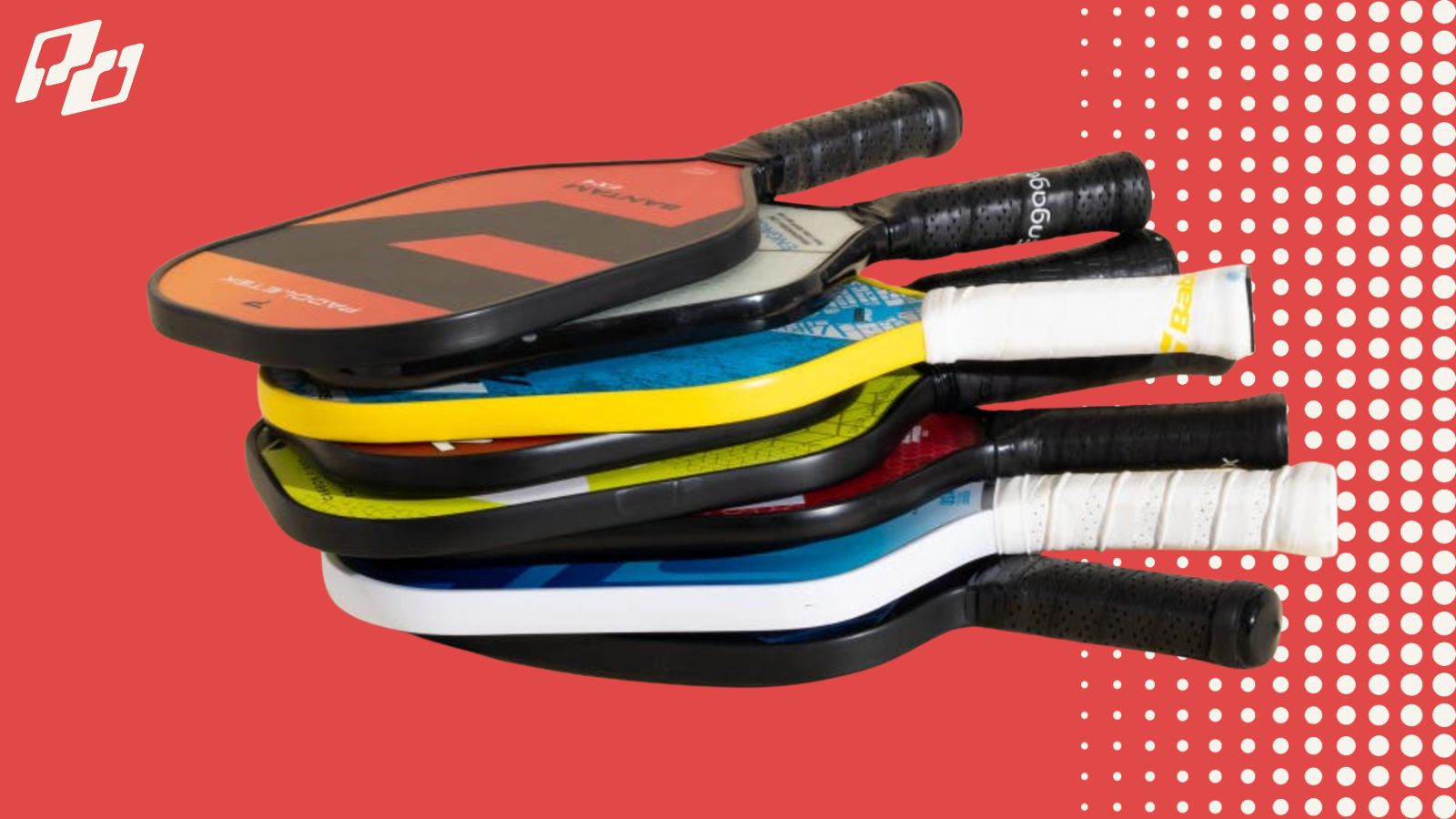
Walk onto any pickleball court and you’ll spot it immediately: the shiny new $333 paddle in one player’s hand, the beat-up $90 stick in another’s, and maybe even a wood paddle hiding in the corner.
So here’s the real question: at what price point does a pickleball paddle actually stop getting better?
New to pickleball? Start with our best pickleball paddles for beginners, picked with lab data and 3,600 player survey responses.
After digging into paddle data, pro opinions, and player feedback, the consensus is clear: somewhere around $150–$200 you hit the “sweet spot.” That’s where paddles deliver pro-level performance without the pro-level price tag.
Past that? You’re mostly paying for brand names, the tiniest performance gains, and features you won’t notice unless you’re already elite.
Ten questions, three paddles matched to how you play, scored on lab data.
Why $150–$200 Hits the Sweet Spot
By the time you hit this range, you’re getting:
- Premium core and face materials (carbon fiber, thermoformed edges, foam injection).
- Solid quality control—fewer duds, fewer dead spots.
- Enough spin, pop, and forgiveness to hold their own against $280+ flagships.
Here’s an example from paddle speed testing:
- $180 Hurache-X Power – 58.3 mph average serve speed
- $280 JOOLA Perseus IV – 59.1 mph
That’s just 0.8 mph faster. Measurable? Yes. Game-changing? Not unless you’re already extracting 100% from your paddle.
Quick Paddle Comparison: $100 vs. $180 vs. $280
| Paddle Tier | Example Price | Core/Face | Durability (avg.) | Serve Speed | On-Court Difference |
|---|---|---|---|---|---|
| Budget | $100 | Basic polymer core, fiberglass face | 3–6 months | ~57 mph | Entry-level build; wears quickly |
| Mid-Range | $180 | Carbon fiber face, thermoformed edges, foam perimeter | 6–12 months | 58.3 mph | Balanced: pro-level feel without elite price |
| Premium | $280 | Advanced carbon + injected foam, flagship QC | 9–12 months (plus warranty perks) | 59.1 mph | ~1–2% faster; noticeable only for elite players |
Mid-range paddles deliver 95% of the performance for ~60% of the price.
The Trade-Off Trap
“Max power” sounds great—until you meet the fine print.
Take the Body Helix F1 TerraCore: a top performer for pop and spin, but with trade-offs:
- Smaller sweet spot – Miss slightly and you lose speed and accuracy.
- Less forgiveness – Mishits drop short or sail long.
- Tougher touch game – Extra pop makes drops harder to control.
For advanced players with fast hands and clean mechanics, it’s a weapon. For most club players, it’s a $190 frustration—more unforced errors, inconsistent resets, and a shaky soft game.
Bottom line: extreme specs demand extreme skill. Unless you’ve mastered control, a balanced paddle will likely win you more points than a pure power monster.
For the average club warrior? That ‘weapon’ can just as easily become a $190 mistake.
The Psychology of Expensive Paddles
Let’s be real—sometimes a $300 paddle does make you play better… but mostly because you think it does.
That’s the placebo effect in action. When you step on court believing you’ve got the “Ferrari of paddles,” you loosen up, trust your shots more, and stop second-guessing yourself.
Sports psychology backs this up: athletes often perform better simply because they believe their gear is superior. It’s the same reason runners swear new shoes make them faster, or golfers insist a new driver fixed their swing.
And yes—it happens in pickleball too. I once saw a 3.5 player rave about how their new $320 paddle “unlocked” their drops. Two weeks later? Same drops, same misses, just with a shinier stick. The honeymoon wore off, but their belief in that first week actually did boost their performance.
Before you spend a dollar on this, take the paddle quiz: ten questions, three paddles matched to how you actually play.
Confidence isn’t sold at $333—it’s free with practice.
Durability Factor
Performance aside, paddles also differ in how long they actually hold up before they start to feel dead.
- Sub-$100 → Usually 3–6 months of solid play before the surface wears smooth or the core softens. Great for beginners, but expect to replace more often.
- $150–$200 → Typically last 6–12 months with regular use. This range is where durability and performance both balance out for most rec players.
- $250+ → Sometimes a touch longer in lifespan, but the real benefit here is usually in the warranty and replacement policy. Top brands often give quicker turnarounds if your paddle cracks, warps, or loses grit.
So how should players factor this in? Think of it like cost-per-month. A $100 paddle that dies in 4 months costs you $25/month. A $180 paddle lasting 10 months? Just $18/month—and it performs better the whole time. That’s why many players see the mid-range as the real sweet spot—for both playability and long-term value.
For many, durability matters more than a barely-noticeable spin boost—especially if you’re playing 4–5 days a week.
The Skill Factor Nobody Talks About
I love gear as much as the next player, but here’s a truth bomb: if you’re not already near the top of your skill bracket, the paddle isn’t holding you back.
A 5.0 player could grab a $10 garage-sale special and still wreck a beginner swinging a $333 Selkirk Labs. Why? Because technique is what squeezes performance out of a paddle.
Think of it like driving: you don’t need a Formula 1 car if you’re still learning how to parallel park.
Pro Player Comparison
It’s tempting to think the latest paddle tech is the “secret sauce” for the pros—but history tells a different story.
- Ben Johns dominated long before thermoformed paddles or foam-injected edges were a thing. His timing, anticipation, and consistency—not the tech—built his resume.
- Anna Leigh Waters did switch to cutting-edge gear, and yes, it matched her aggressive style. But her dominance didn’t magically appear with a new paddle. It just amplified what she already brought to the court: speed, timing, and confidence.
What should you take away? Don’t expect a $300 paddle to unlock skills you don’t already have. If your resets float or your serves miss, no piece of carbon fiber is going to fix that.
But once your mechanics are sharp, the right paddle can highlight your strengths—whether that’s faster hands, sharper spin, or steadier defense.
The best gear won’t turn you into a 5.0—but it can help you squeeze out that extra 2% once your fundamentals are dialed in.
When to Pay More
A $200+ paddle can make sense if:
- You’re a serious tournament player chasing elite specs.
- Your mechanics are rock-solid and you’ll notice a 1–2% gain.
- You care about premium build tweaks and durability.
- You want the best warranty and brand support.
If you check all these boxes—you’ll not only notice the difference, you’ll use it.
The Real Secret to Paddle Value
Forget chasing “the best paddle” and start chasing “the best paddle for you.”
I’ve seen $170 sticks outperform $300 ones in the hands of players they fit perfectly. I’ve also seen expensive paddles collect dust because the owner couldn’t adapt to them.
If a paddle feels natural, matches your style, and makes you confident stepping up to the kitchen… that’s your paddle. Price tag be damned.
Tips for Getting the Most Performance for Your Money
- Demo before you commit: Even 10 minutes on court will tell you more than any spec sheet.
- Match paddle to playstyle: If you block and counter more than you speed up, pick a control paddle with a forgiving sweet spot.
- Don’t sleep on stability: Higher twistweight = less twisting on mishits = lighter grip pressure and longer-lasting hands.
- Hunt the deals: Off-season sales, discontinued models, and even “open box” paddles can drop top gear into your budget range.
Top Places to Demo or Score Deals on Pickleball Paddles
| Store / Program | Details | Why Players Trust It |
|---|---|---|
| Pickleball Central | 30-day “test-drive” return policy; pay return shipping. | A trusted, long-standing retailer with flexible returns—great for real-world testing. |
| JustPaddles | Offers demo and open-box sales. | Highly regarded for honest advice and good deals on well-reviewed paddles. |
| Pickleball Warehouse | Demo up to 3 paddles (fee varies); widely praised for service. | Demo program receives consistent positive feedback from users. |
| Gearbox Sports | “Demo Program” lets you test paddles (usually with modest shipping cost). | Respected brand, players appreciate the opportunity to try premium Gearbox paddles. |
| Pickleball Galaxy | $30 fee for 7-day demo (includes shipping and prepaid return). | Large paddle selection, fast shipping, and discount if you buy within 30 days. |
| Midwest Racquet Sports | Demo up to 3 paddles for $15; get $25 rebate if you buy $149+. | Clear value: low demo fee, beneficial rebate for buyers, respected reviews. |
Final Verdict: Who Should Spend What?
| Player Type | Best Spend | Why |
|---|---|---|
| Beginner (2.5–3.0) | $70–$120 | You’re learning mechanics; save $$ for lessons. |
| Intermediate Rec (3.0–3.5) | $130–$180 | Balanced paddles shine here. |
| Advanced Rec / Local Tourney (3.5–4.0) | $150–$200 | Sweet spot: premium build, fair price. |
| Tournament Regular (4.0+) | $200–$250 | Extra spin/power noticeable—if your mechanics are clean. |
| Pro/Elite (4.5–5.0+) | $250+ | Every % matters at this level. |
Reader Challenge 🎾
Next time you’re on court, swap paddles with a buddy for one game. See if your “budget stick” really holds you back… or if it’s just your footwork.
Bottom Line (From My Paddle Bag to Yours)
After all the testing, chart-staring, and gear talk, here’s the truth: for most of us, the “diminishing returns” zone hits at about $150–$200. Beyond that, yes, the gains are real, but they’re so small you’ll only notice them if you’re already playing at a high level and know exactly how to use them.
If you’re not there yet? Grab the paddle that feels right in your hand, sits in that sweet spot for price, and makes you want to hit “just one more” bucket of balls.
Spend the extra cash on court time, lessons, or tournament entries.Because the paddle helps—but the biggest upgrade is still you.