
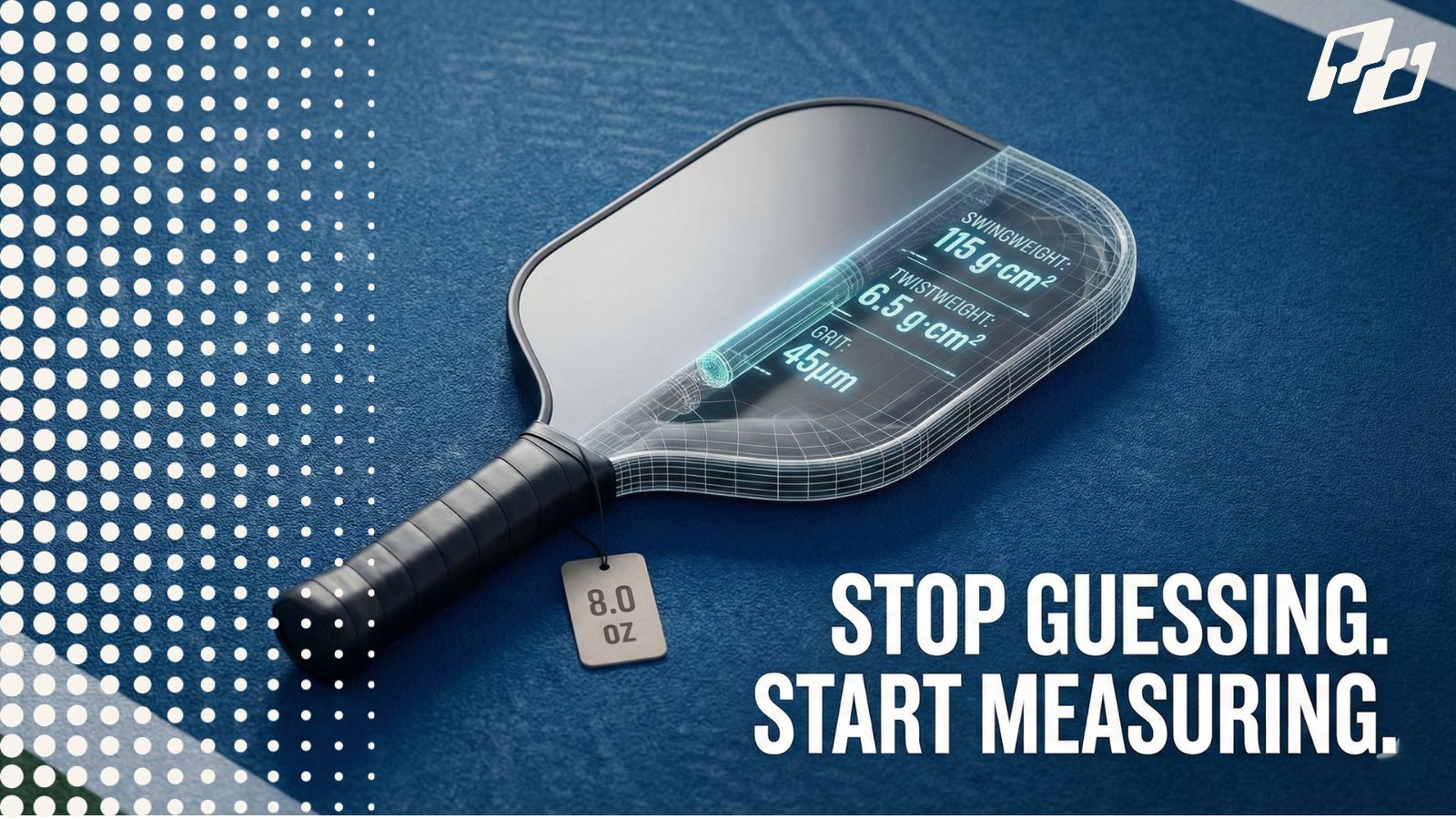
Most rec players compare paddles like this:
“This one weighs 7.8 oz and that one weighs 8.1 oz…”
But two paddles at 8.0 oz can behave completely differently in your hands.
Here are measurable specs you can actually find and use as decision tools when choosing a paddle.
Ten questions, three paddles matched to how you play, scored on lab data.
1) Swingweight (Measured in g·cm² or kg·cm²)
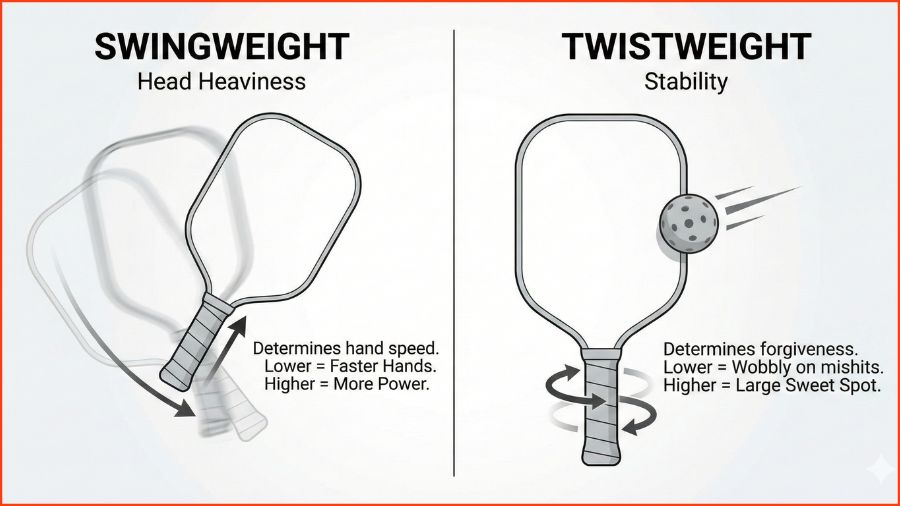
✅ What it is: How the paddle feels when you swing it — not just how heavy it is on a scale.
❓ Why it matters:
Swingweight influences:
- Hand speed at the kitchen
- Feel during fast exchanges
- Stability on drives
Lower swingweight → quicker hands
Higher swingweight → more stability on heavier shots
📍 Where to find it: Most brands don’t list swingweight on their product pages. To find it, check independent review sites or lab-style testers like Pickleball Studio or Paddle Labs, where it’s sometimes labeled as “MOI.” If it’s not published, demo paddles side by side and test fast volleys to compare hand speed.
If you would rather skip the theory, the paddle quiz turns your answers into three lab-scored picks in about 90 seconds.
Example numbers:
- 105–112 kg·cm² → very quick feel
- 113–118 kg·cm² → balanced
- 119–125+ kg·cm² → more stability & plow-through
💡 Rec tip: If you struggle with quick volleys, prefer slightly lower swingweight.
2) Twistweight (Measured in kg·cm² around vertical axis)
✅ What it is: Twistweight is the resistance to twisting when you hit off-center.
❓ Why it matters:
Low twistweight → weird off-center behavior (feeds arm, pops wide).
High twistweight → more forgiving sweet spot.
📍 Where to find it: Just like swingweight, twistweight is usually not listed on brand product pages. Check independent testers like Pickleball Studio and Pickleball Effect, where twistweight is sometimes published alongside swingweight in lab comparison charts.
📊 Example interpretation:
- ~10–12 kg·cm² → lower stability
- ~13–15 kg·cm² → moderate forgiveness
- ~16+ kg·cm² → very stable
💡 Rec tip: If you miss the sweet spot often, a paddle with higher twistweight will feel more consistent.
3) Surface Roughness / Grit Rating (Microns or Grit Score)
✅ What it is: How rough the face is — measured as average height of surface texture (microns) or grit rating.
❓ Why it matters:
More texture → more friction → more spin potential
Less texture → smoother feel, less spin
📊 Example:
- 250–300 grit → moderate spin
- 300–350 grit → high spin
- 350+ grit → very textured (might wear faster)
📍 Where to find it: There’s no official grit scale in pickleball, so terms like “medium grit” or “300 grit” aren’t standardized or directly comparable between brands. That’s why most reviewers look at spin RPM test results instead — they show how the surface actually performs in real play.
💡 Rec tip: If your third-shot spin isn’t getting bite, look for paddles with higher grit numbers.
4) Core Compression / Stiffness (Measured in Shore or Newtons)
✅ What it is: How stiff or soft a paddle core rebounds. This is measured by bounce tests in Newtons or durometer values.
❓ Why it matters:
Stiffer cores → more pop, higher rebound
Softer cores → more touch, more dwell time
📍 Where to find it: Not usually given by brands, but Pickleball Studio, Pickleball Effect and Pickleball Central paddle reviews sometimes provide stiffness tests.
📊 Example readouts:
- Lower force (softer) → softer feel
- Higher force (stiffer) → more pop
💡 Rec tip: If you want easier drops and control, consider paddles that test as softer. If you want easier drives, a harder core helps.
5) Edge Guard vs Edge-Free Designs (Measured in mm thickness/contour)
This isn’t a “numeric performance” value, but it’s measurable:
- Edge guard thickness (mm)
- Edge coverage (percentage around the paddle)
❓ Why it matters:
Edge guard design affects:
• durability
• twistweight
• how close to the edge you can hit without weird response
📍 Where to find it: Specs usually list if there’s an edge guard, polymer wrap, or edge-free design.
💡 Rec tip: Edge-free designs often feel smoother on mishits near the perimeter.
6) Handle Shape & Circumference (Measured in inches)
✅ What it is: How big around the grip is — typically 3.5″–4.5″ range.
❓ Why it matters:
Grip size affects:
- forearm fatigue
- control for spin / wrist moves
- flick shots
📍 Where to find it: Almost every brand spec sheet lists grip circumference.
📊 Rec guidelines:
- ~3.75″–3.9″ → versatile for most players
- <3.75″ → better wrist mobility
- 3.9″ → more stability for drives
💡 Rec tip: If you feel forearm ache during long play, try a slightly larger grip.
7) Recommended Swing Speed Range (RPM / mph)
Some labs measure optimal ball speed ranges for paddle faces.
This is advanced, but:
- Some paddles test better with slower swing speeds
- Others perform best when swing is fast
📍 Where to find it: Detailed lab data from Paddle Lab.
💡 Rec tip: If you’re a developing player with slower to moderate swings, select paddles that test well at lower input speeds — they’ll feel more predictable.
8) PBCoR (Paddle/Ball Coefficient of Restitution)
✅ What it is: A standardized measure of how bouncy a paddle face is.
❓ Why it matters:
Higher PBCoR → more rebound (pop)
Lower PBCoR → calmer, more consistent response
📍 Where to find it: USA Pickleball publishes limits; detailed measurements appear in lab tests.
📊 Practical rule: If two paddles feel equally heavy but one feels “springier,” its PBCoR is likely higher.
💡 Rec tip: Beginners sometimes prefer moderate PBCoR — predictable response over aggressive pop.
How to Use These Specs When Choosing a Paddle
Instead of asking:
“Should I get a thicker paddle?”
Try this:
✔ Check swingweight first — does it match your speed?
✔ Check twistweight — do you mishit often?
✔ Look at surface grit — do you want more spin?
✔ Look at grip circumference — does it fit your hand?
✔ Review core stiffness in tests — touch vs pop preference
✔ See published PBCoR or feel reports — is it predictable?
Quick Cheat Sheet for Rec Players
| Spec | What It Tells You | Best For |
|---|---|---|
| Swingweight | Feel in swing | Fast hands vs power |
| Twistweight | Stability on mishits | Bigger sweet spot |
| Grit rating | Spin potential | Dinks, spin drives |
| Core stiffness | Pop vs touch | Control vs power |
| Grip circumference | Hand fit | Comfort, wrist control |
| PBCoR | Energetic rebound | Predictability vs pop |
Choose With Intention, Not Hype
Here’s what I want you to remember.
Two paddles can weigh 8.0 oz and feel nothing alike. That’s not marketing trickery — it’s physics. Weight and thickness are just surface-level specs. The real differences live in how the paddle is built and how it moves in your hand.
If you start checking things like swingweight, twistweight, spin testing, and core feel, you stop guessing. You stop buying what looks good online. You start choosing what actually supports your hands, your speed, and your style of play.
And here’s my personal advice: Before switching paddles, identify what’s actually frustrating you.
- Losing hand battles?
- Mishitting off-center?
- Overhitting blocks?
- Lacking spin?
Match the spec to the problem. The right paddle won’t magically make you better — but the wrong one can quietly hold you back.
Choose with intention. Your game will feel cleaner almost immediately.