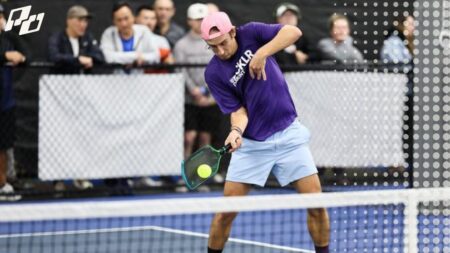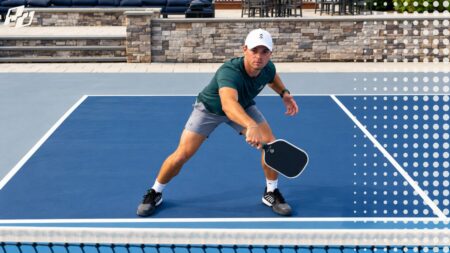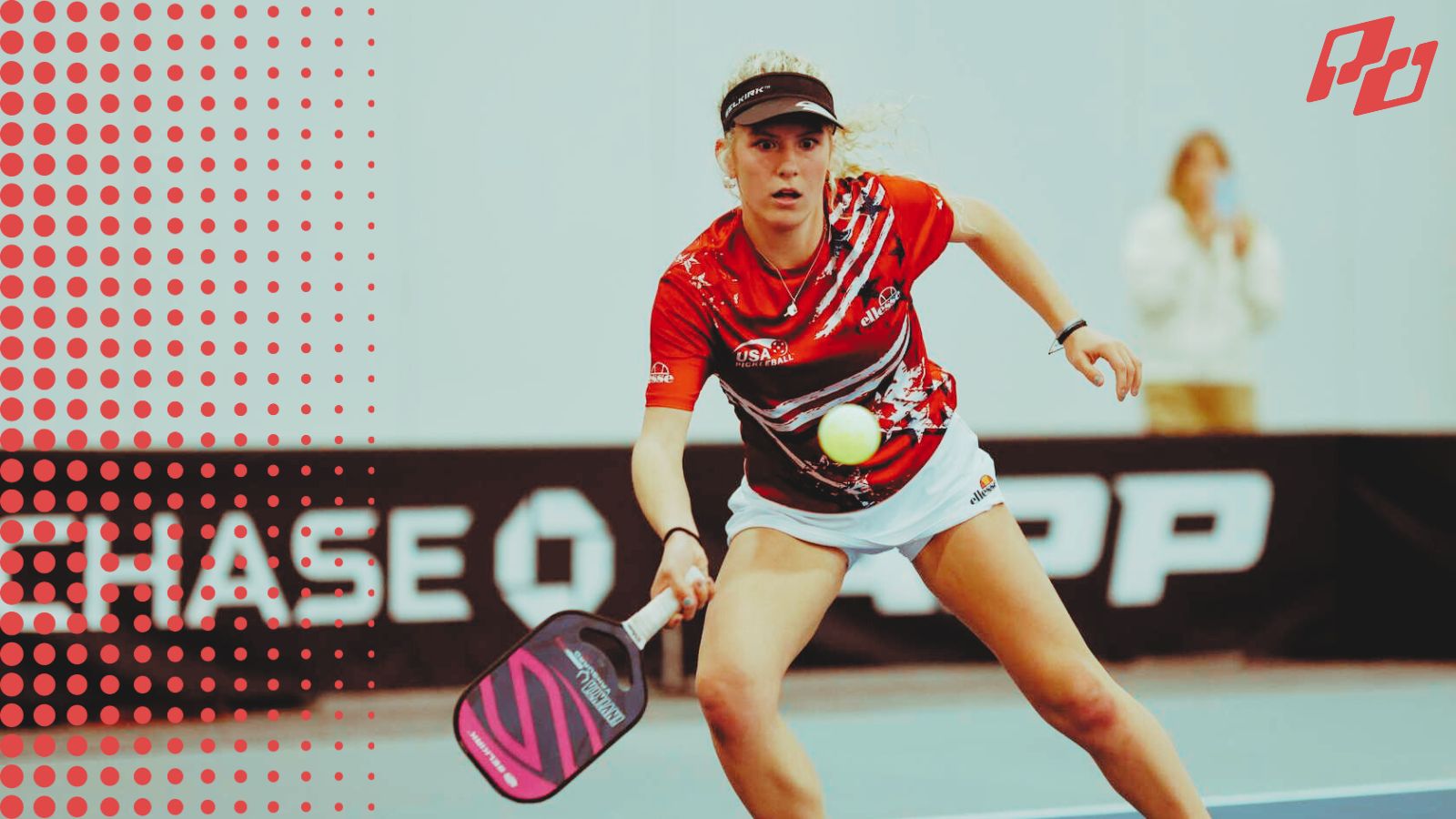
You’ve seen it at the kitchen: a pro holds the paddle with the tip pointed down, then—without warning—rolls a ball that climbs over the net and dives into their opponent’s feet. Or they lull you with a dink, then rip a disguised speed-up before you even blink.
That’s not a quirk—it’s a deliberate setup. The paddle tip-down position changes your available swing paths, contact vectors, and deception options.
Two truths drive this technique:
- You can attack balls below net height when the paddle tip is down.
- You’re more likely to miss long, not wide—a far better miss when you’re at point-blank range.
Let’s break down why this matters, how the pros use it, and how you can build it into your own game.
The Biomechanics: Why Tip-Down Expands Your Hitting Window
When you hold your paddle neutral (flat or sideways), your swing path is flatter. On balls below net height, a flat path tends to send the ball wide or into the tape.
With the tip-down position, your natural swing path changes. The face naturally brushes up and through the ball, helping you lift it cleanly over the net while generating controlled topspin that makes the ball dive down toward your opponent’s feet.
This shape also changes your “miss pattern.” With the paddle tip down, you’re less likely to spray balls wide. Your natural miss tends to be long, which—at close range—is safer and more disruptive than missing sideways. Long misses jam opponents or clip their paddle shoulders, while wide misses hand away points.
And crucially, it gives you a way to attack low balls. That’s something players without this setup simply can’t do.
Deception: One Look, Many Shots
The biggest hidden advantage of keeping the paddle tip down is disguise.
From the same setup, you can dink, roll, speed up, or toss a mini-lob—all without changing your look. That “one picture, many shots” approach forces your opponent to guess, not anticipate.
Every pro does this: they hold a still, tip-down paddle near the kitchen line. Then, at the very last moment, they decide. That could be a soft redink, a sneaky topspin flick, or a perfectly timed hold-and-roll.
If you can keep the paddle steady, with your wrist relaxed and tip down, you create non-telegraphed offense. Your opponent has no visual cue to prepare for speed or spin.
When Tip-Down Shines (and When It Doesn’t)
Best moments to use it:
- Below-net or net-level balls: Use the tip-down angle to brush upward, creating clean lift with topspin.
- At the kitchen line: It’s your best position for deceptive shot variety—dink, roll, or flick.
- In transition: When you’re blocking or half-volleying fast drives, the tip-down face softens the ball and controls pace.
When to back off it:
- Chest-high sitters: These don’t need lift. Switch to a neutral, compact punch volley for direct control and faster recovery.
- Wide reach shots: Prioritize reach and stability over deception. Use a neutral face to maintain solid contact.
Hear Coach John Cincola break down the power and strategy behind keeping your paddle tip down — perfect for dinks, resets, and half volleys.
Targeting and Ball Flight: Make “Miss Long” Work for You
Once you’re comfortable attacking from a tip-down position, start thinking about where those shots land.
- Target the hips or hitting-side shoulder. These zones are hard to clear and often force off-balance blocks.
- Aim for the transition-zone feet. Rolling up at the feet gives you a natural follow-up opportunity.
- Alternate inside- and outside-hip attacks. Inside targets create confusion between partners; outside targets punish overreachers.
When in doubt, attack through the body line—it’s the safest high-percentage offensive target from close range.
The Dink Look That Hides Three Threats
From the same tip-down setup at the kitchen line, you can create three completely different outcomes:
- The redink: A neutralizing, same-side soft ball that keeps you in the rally.
- The top-roll speed-up: A quick wrist-driven flick that surprises your opponent at hip height.
- The micro-lob: A small lift over an opponent leaning too far forward at the line.
All three start with the same visual prep. That’s the art of “hold-and-go” pickleball—keeping your opponent guessing right up to contact.
Check out Coach Marko as he shares 3 super effective tips to disguise your attacks — all while keeping your paddle tip down.
Defensive Utility: The Tip-Down Block
The paddle tip-down position isn’t just for offense—it’s a quiet defensive weapon too.
When you’re under fire, keep the paddle tip slightly down or neutral. Soften your grip to about 3–4 out of 10, hold a steady wrist, and let the ball absorb into the paddle face. A slightly forward (not upward) angle keeps the ball low and drifting softly into the kitchen—without the pop-ups that come from opening the face too far.
You’ll find the ball dies softly over the net instead of ricocheting back. If your opponent’s next ball floats, you’re already in position to roll it back at them.
Paddle Tip Down vs. Sideways vs. Tip Up: Why the Pros Stay Down
If you watch older pickleball footage, you’ll see players holding their paddles sideways or even angled up. That used to work—until the modern game sped up. Today’s pros almost all start tip-down, because it gives them the quickest transitions between blocking, rolling, and disguising attacks.
Still, each paddle angle has its place. Here’s how they compare—and why tip-down has become the gold standard.
| Paddle Angle | When It Works Best | What It Offers | Why It Falls Short |
|---|---|---|---|
| Tip Down | Modern kitchen play, countering, attacking below net height | Compact control, natural topspin lift, disguise, and cleaner blocks | Slightly harder on high, chest-level volleys |
| Sideways (Neutral) | Flat drives or mid-court punch volleys | Stability and straight-line contact for pace | Limits deception and control on low or spin-heavy balls |
| Tip Up (Open Face) | Soft resets or gentle dinks | Adds loft and slows the ball down | Easy to pop up or float short if overused |
The tip-down position is your modern “ready” face—it keeps you dangerous without changing your look. You might briefly shift to neutral for a punch volley, or open slightly up for a soft reset, but those are momentary adjustments.
If your default paddle angle is still sideways or up, you’re one step behind the rhythm of today’s game. The players who win fast-hands battles—and disguise their offense best—all start with the tip pointing down.
Common Errors (and Fast Fixes)
1. Casting from the shoulder: If you swing from your shoulder, your ball will sail. Fix it by leading with the forearm, keeping your shoulder quiet, and contacting out front.
2. Late contact: If you wait too long, you’ll pull the ball wide or dump it. Stay balanced, split-step early, and make contact forward of your body.
3. Over-opening the paddle face: When trying a mini-lob or soft flick, some players open the paddle too much, floating it short. Focus on vertical lift instead of scooping.
4. Telegraphing the attack: If your eyes and shoulders shift toward your target early, you’ll give it away. Keep your posture still, hold your look, and decide late.
Gear Considerations
- Elongated paddles give you more tip speed for brushing roll shots—but require precise timing.
- Gritty surfaces help grip the ball for controlled lift.
- Thicker cores (16mm) provide more stability and better touch for soft hands at the kitchen.
Choose the combination that feels stable, not just powerful—because this technique thrives on precision, not brute force.
Drills to Build It Into Your Game
1. Roll-Read Ladder: Partner feeds low dinks to your backhand side. Keep the paddle tip down, hit three neutral dinks, then roll one to your opponent’s inside hip. Reset.
Focus: Same setup, late decision-making.
2. Block-to-Counter Chain: Start in transition. Block three drives softly into the kitchen (tip-down, soft hands), then roll the fourth into the body line if it floats high.
Focus: Absorb → punish rhythm.
3. Hold-Then-Go Drill: Shadow swing with a one-count hold before deciding between a dink, roll, or mini-lob.
Focus: Maintain the same “picture” through setup to disguise intent.
4. Punch vs. Roll Split: Alternate volleys: chest-high balls = punch (neutral paddle), low balls = roll (tip-down).
Focus: Train shot choice based on ball height, not habit.
Your Kitchen Decision Tree
- Ball below net: Tip-down roll or redink into feet.
- Ball at shoulder height: Neutral punch volley through seams.
- Opponent leaning forward: Disguise and lift a micro-lob.
- You’re under pressure: Tip-down block, float to the middle, reset.
Countering the Counters
When your opponents start catching on:
- If they anticipate your inside-hip roll, delay and go outside-hip instead.
- If they feed ultra-soft dinks to kill your roll, step in and take it early with the same tip-down lift.
- If they lean for your lob, fake open the paddle, then re-dink short to their front foot.
That’s chess, not checkers—and the tip-down setup gives you every piece on the board.
The Bottom Line
The tip-down paddle position isn’t a stylistic choice—it’s a strategic framework.
It reshapes your swing path, stabilizes your contact on low balls, and gives you an attack option from a defensive posture. Most importantly, it keeps your game unpredictable.
If you can hold that steady, tip-down position and make your decisions late, you’ll stop reacting and start dictating.
It’s not about playing fancy. It’s about playing smart, controlled, and unreadable—the hallmarks of every pro-level player who wins points before the opponent even moves.