Most intermediate rec players do not lose attacking points because they are afraid to be aggressive.
They lose them because they attack the wrong ball with the wrong swing.
They try to roll a ball that is already high enough to punish. Or they try to smack a ball that is too low at contact and then wonder why it keeps crashing into the net.
The decision is not just about where the ball is in the rally.
It is about where the ball is at your actual contact point.
That distinction matters.
A ball might bounce high but drop below net height by the time you hit it.
A ball might look low at first but rise into a contact point you can roll.
A ball might be above the net when it crosses, but if you are late and contact it near your knees, it is no longer a “smack” ball.
So the real question is not simply: “Is the ball high?”
The better question is: At the moment I contact it, can I drive forward through it without needing to lift it?
The simple rule: contact point decides the shot
Here is the clean version:
⮕ Below net height at contact: roll it.
⮕ At or above net height at contact: punch or smack it forward.
But we need to be careful with that word “height.”
This is not about the ball’s height when it leaves your opponent’s paddle.
It is not about the ball’s height when it crosses the net.
It is not even only about where the ball bounces.
⮕ It is about the ball’s height when your paddle meets it.
That is why intermediate players get into trouble. They decide too early. They see a ball that looks attackable, load up for a smack, then contact it late below the net and dump it. Or they see a ball that feels uncomfortable, play it softly, and realize afterward it was actually high enough to pressure.
High-level shot selection is not just “be aggressive.”
It is matching the swing to the contact point:
Why below-net contact usually needs a roll
When the ball is below the net at contact, the net is physically in your way. That sounds obvious, but many rec players ignore it.
If you swing forward through a below-net ball with a flat paddle path, the ball has to do one of two things:
It either hits the net, or you instinctively open the paddle face and send it floating. Neither is ideal.
That is why a below-net attack usually needs shape. You need the ball to climb over the net and then dip back down. That means some combination of lift, spin, and controlled speed.
This is where the roll comes in.
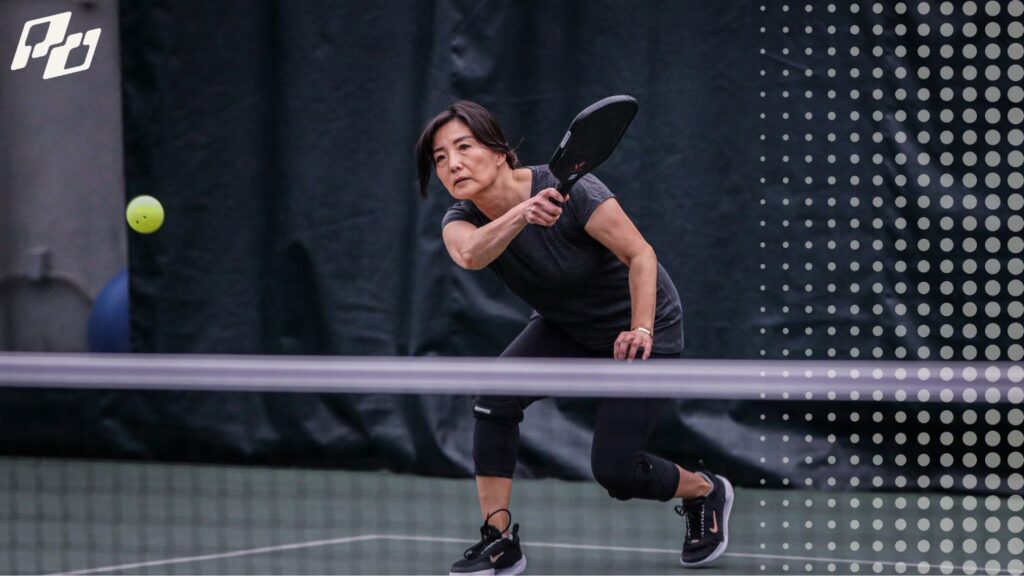
A roll is not a wild topspin rip. It is a controlled upward-brushing shot that helps you clear the net while still keeping the ball from floating too high. Current roll-volley instruction commonly emphasizes brushing up the back of the ball, keeping the motion controlled, and using topspin to add margin and dip.
For rec players, the easiest way to feel it is:
Low contact = get low first. Then brush up and through.
Not just up.
Not just forward.
Up and through.
That is the difference between a useful roll and a panicked scoop.
Here are two key tips to help you hit a cleaner forehand roll:
Also, here’s how to hit a cleaner, more dangerous backhand roll attack:
Why above-net contact usually needs a forward punch
When the ball is at or above net height at contact, you do not need to help it climb. That is your green light to be more direct.
But this is where a different mistake shows up: rec players see a high ball and try to chop down on it.
That often sends the ball into the net.
A good punch or smack is not a giant downward swing. It is a compact forward action through the ball. Punch-volley instruction typically stresses a short motion, stable paddle, controlled pace, and pressure without overswinging.
So the cue is not: “Hit down.”
The cue is: Drive forward through the ball and let the contact height create the downward pressure.
If the ball is above the net, your geometry is already good. You do not need to manufacture a steep downward angle unless the ball is very high and truly put-away height.
For most kitchen attacks, especially at 3.5–4.0, the better goal is a compact forward punch to:
- the opponent’s dominant-side hip
- the paddle-side shoulder
- the middle seam
- or the open space created by their movement
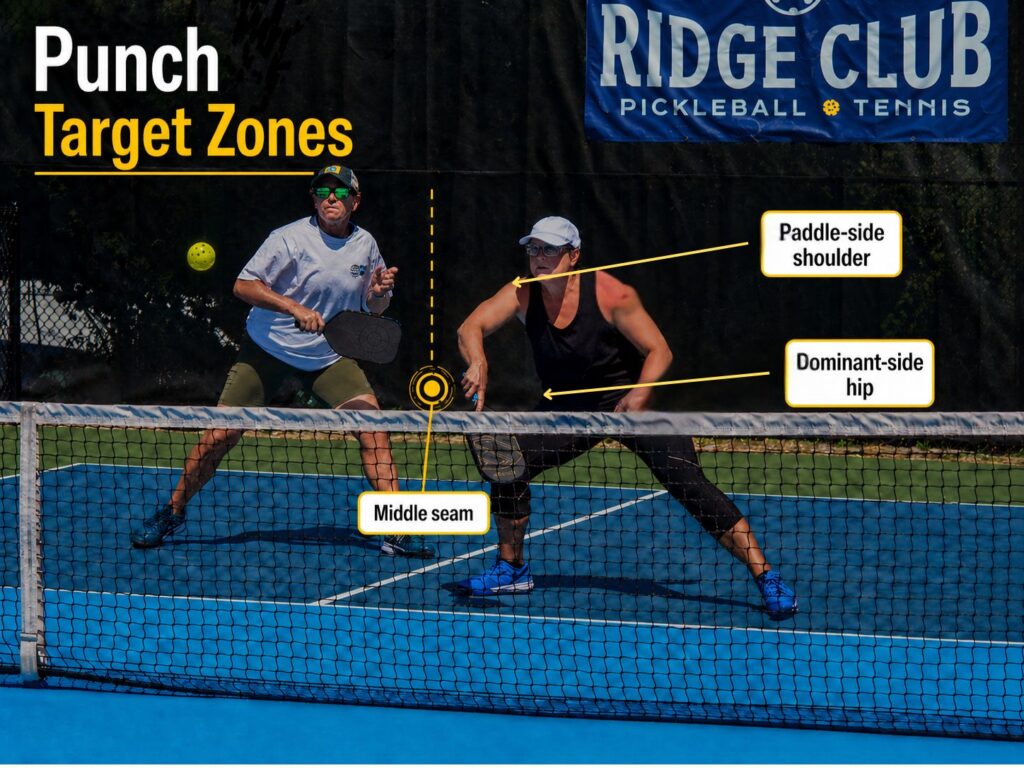
That creates pressure without giving away control.
The biggest mistake: deciding by court position instead of contact point
A lot of intermediate players think:
“I’m at the kitchen, so I should attack.”
“I’m in transition, so I should reset.”
“I’m close to the net, so I should hit down.”
“I’m low, so I can’t be offensive.”
All of those can be wrong.
Court position matters, but it is not the final answer. Contact point is the final filter.
That is the part rec players need to hear clearly: you can be standing at the kitchen and still have a ball below net height that needs a roll or reset.
You can be a step off the kitchen line and still have a ball high enough at contact to punch forward.
You can be in transition and still attack if you are balanced, set, and contacting the ball above the net.
You can be right at the line and still make a terrible decision if the ball has already dropped below your strike zone.
So stop asking only, “Where am I?”
Start asking: where is my contact point?
The contact-point test
Here is a simple in-match test.
Before you attack, ask: can I swing forward without lifting the ball?
⮕ If the answer is yes, punch or smack.
⮕ If the answer is no, roll or reset.
That question works because it forces you to respect the geometry of the shot.
If the ball is above net height at contact, you can usually swing forward and keep the ball low. If the ball is below net height, a purely forward swing does not give the ball enough clearance. You need lift, spin, or a softer reset.
Different shot, same principle.
Low contact limits offense. High contact expands it.
Why “hit downward” causes so many net errors
This is a huge rec-player trap. Players see a ball above the net and think, “Now I can hit down.”
Sometimes, yes. If the ball is truly high, slow, and sitting well above net height, you can angle it down sharply.
But most so-called “high balls” at the kitchen are not overheads. They are only slightly above net height. If you chop down on those, the paddle path becomes too steep and the ball catches the tape.
That is why “forward” is usually a better cue than “down.”
Forward keeps the swing compact.
Forward keeps the ball penetrating.
Forward reduces the net-dump mistake.
Let the ball’s height and your target create the pressure. You do not need to overdo the downward angle.
Why “roll everything” makes you too soft
The opposite mistake is just as common.
Some players learn topspin and start rolling every ball, even the ones they should punish. That makes them look controlled, but it also lets opponents off the hook.
If the ball is at or above net height at contact and your opponent is exposed, a gentle roll may be too polite. You gave them time. You gave them shape. You gave them a ball they can reset.
⮕ At 3.5, that might still win some points.
⮕ At 4.0, better players will neutralize it.
So yes, the roll is valuable. But if you roll attackable balls too softly, you are choosing safety when the rally is asking for pressure.
The better mindset: roll to create clearance when you need it. Punch to create pressure when you have it.
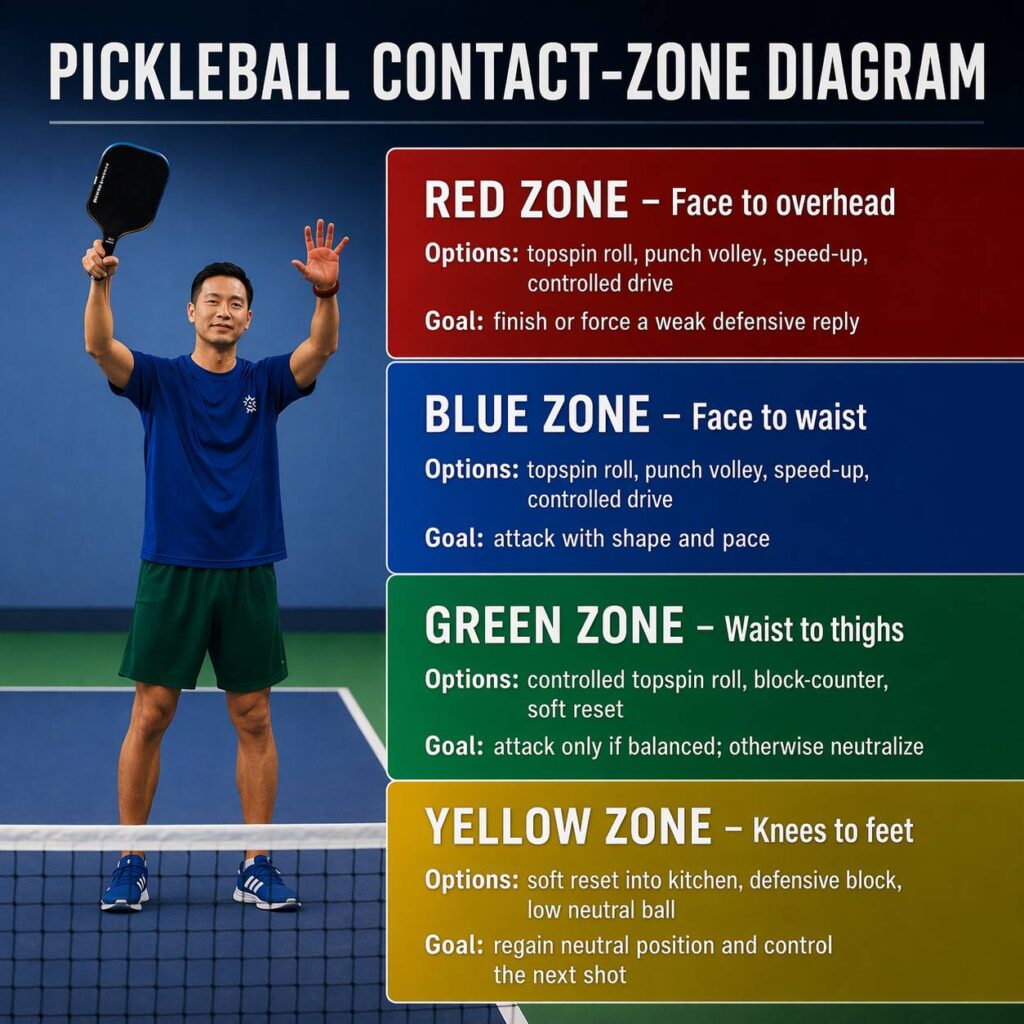
The three contact zones rec players should know
Instead of thinking only “below net” and “above net,” I like giving intermediate players three zones.
Zone 1: Below net height
This is usually a roll, dink, or reset zone.
You can still be offensive, but your offense needs shape. You are not trying to blast through the ball. You are trying to use spin, placement, and margin.
Best choices:
- roll dink
- roll volley
- controlled topspin lift
- reset if off balance
Avoid:
- flat smack
- downward chop
- panic speed-up
Zone 2: Around net height
This is the tricky gray zone.
You may be able to attack, but only if you are balanced and the contact is in front. This is where a compact punch can work, but it needs precision. If you are late or stretched, roll/reset is smarter.
Best choices:
- controlled punch to body
- compact roll through the middle
- soft reset if jammed
Avoid:
- big swing
- trying to hit a winner from a marginal contact point
Zone 3: Clearly above net height
This is pressure territory.
Now you can punch, smack, or drive through the ball. But again, do not overswing. The cleaner you are, the faster the ball will feel to your opponent.
Best choices:
- punch volley
- compact speed-up
- body attack
- angle into open court
Avoid:
- rolling too softly
- chopping down too steeply
- admiring the shot instead of expecting the counter
Balance is the second filter
Contact height is the first decision. Balance is the second.
A ball can be above net height, but if you are falling sideways, reaching behind you, or jammed at the hip, that ball is not as attackable as it looks.
The smarter question is: is my contact point high enough, and am I stable enough to use it?
⮕ If yes, attack.
⮕ If no, choose a roll, reset, or safer placement.
Shot-selection frameworks that use height, balance, opponent position, and risk are useful because they remind players that no single factor solves every ball.
For rec players, though, keep it simple:
High and balanced = pressure.
Low or off-balance = shape or reset.
Where this shows up most in rec games
This roll-vs-punch decision appears constantly. You see it on a loose dink that rises just enough to attack.
If your contact point is above the net, punch forward. If you wait and let it drop, now you may need to roll. That means your indecision changed the shot.
You see it on a fourth shot at the kitchen.
If the third shot is floating and you can contact it high, keep pressure with a punch volley. If the third shot dips below the net before your paddle gets there, roll or reset rather than forcing the smack.
You see it in transition.
A ball around your knees should not be treated like an attack just because you feel impatient. Low contact in transition usually needs shape or a reset. Higher contact with balance can be driven.
You see it in speed-up attempts.
If your speed-up starts from below net height, it better have topspin and a good target. If it is flat from below the net, it is probably going into the net or sitting up.
The best cue for intermediate rec players
Here is the cue I would actually want players using in a match: can I hit forward without lifting?
⮕ If yes, punch.
⮕ If no, roll.
That cue forces the right decision because it includes contact point, net height, and paddle path all at once.
Another useful cue: low contact needs shape. High contact needs pressure.
And one more: do not attack the ball you wish you had. Attack the ball you actually have at contact.
That last one is the most important.