“Pickleball butt” usually refers to deep buttock or hip pain from piriformis irritation, sciatic nerve irritation, high hamstring issues, or hip overload. Rest, modify play, strengthen hips/glutes gradually, and get checked if pain shoots down the leg, causes weakness, limping, or does not improve.
“Pickleball butt” sounds like a joke someone would make after three hours of open play and one too many lunges.
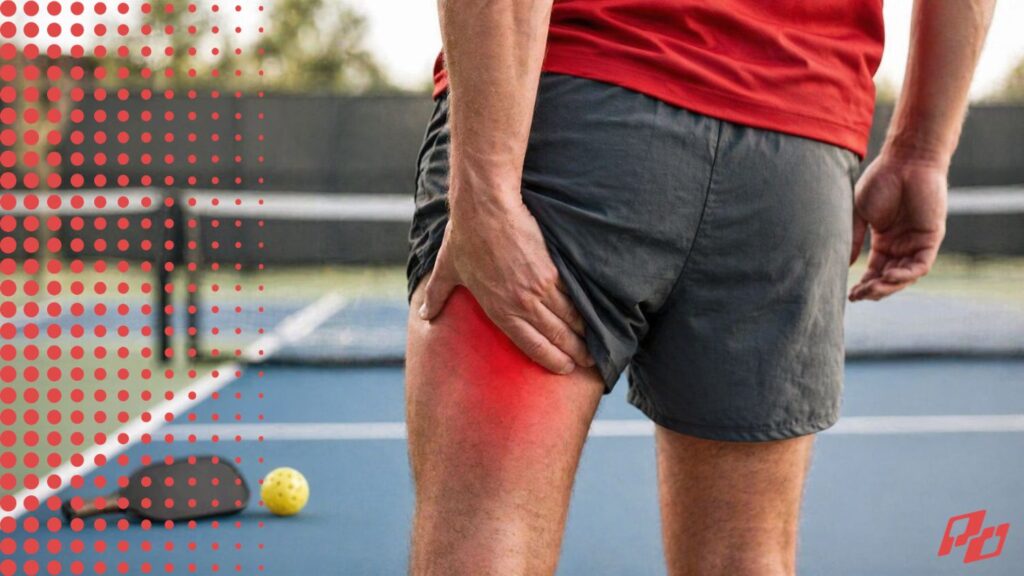
But if you have ever felt that deep, annoying, sometimes sharp pain in one side of your butt after pickleball — especially when sitting, walking uphill, lunging, pushing off, or bending — you know it is not very funny.
For rec players, “pickleball butt” is not really a formal medical diagnosis. It is more of a nickname for a few possible problems around the deep glute, hip, hamstring, low back, and sciatic nerve area.
The most common suspect is often piriformis syndrome, where the piriformis muscle deep in the buttock irritates or compresses the sciatic nerve, causing buttock, hip, or upper-leg pain, numbness, or tingling.
But here is the part I really want rec players to understand: not every pain in the butt is piriformis syndrome.
And that matters, because the right fix depends on what is actually irritated.
Why Pickleball Can Trigger “Butt Pain”
Pickleball looks gentle from a distance. Up close, your hips and glutes know the truth. The sport asks you to do a lot of small, repeated lower-body jobs:
quick lateral shuffles, sudden stops, lunges into the kitchen, split-steps, pivots, low defensive positions, reaching wide for dinks, recovering from lobs, and accelerating from awkward positions.
That can irritate the deep hip rotators, glutes, hamstring tendons, low back, or sciatic nerve — especially if your body is getting more court time than recovery time.
So no, pickleball butt is not “just soreness” every time.
What “Pickleball Butt” Usually Means
Most rec players use the term to describe one of these issues:
1. Piriformis syndrome or deep gluteal irritation
This is the classic version. The piriformis is a small but important muscle deep in the buttock that helps rotate and stabilize the hip. If it gets tight, irritated, or overloaded, it can irritate the sciatic nerve and create pain in the butt, hip, or down the back of the leg.
You might feel:
- deep buttock pain
- pain after sitting
- pain with stairs, hills, lunging, or squatting
- tingling or numbness down the back of the leg
- pain that feels like “sciatica,” even though the source may be outside the spine
2. Proximal hamstring tendinopathy
This is a big one that rec players often miss.
High hamstring tendinopathy causes pain near the “sit bone,” right where the hamstring attaches under the butt. It can feel like deep lower-butt pain and is often aggravated by prolonged sitting, squatting, walking uphill, running, lunging, or bending forward.
That sounds very pickleball-relevant, because lunges and repeated low positions are everywhere in the sport.
3. Sciatica from the low back
Sometimes the pain is not really coming from the piriformis or glute area at all. It may be coming from the spine, such as disc irritation or nerve compression. Mayo Clinic notes that sciatica often responds to self-care, but staying inactive too long can make symptoms worse; cold packs, then heat after a few days, are common self-care measures.
If symptoms travel below the knee, include numbness or tingling, or feel electric/shooting, you should be more cautious.
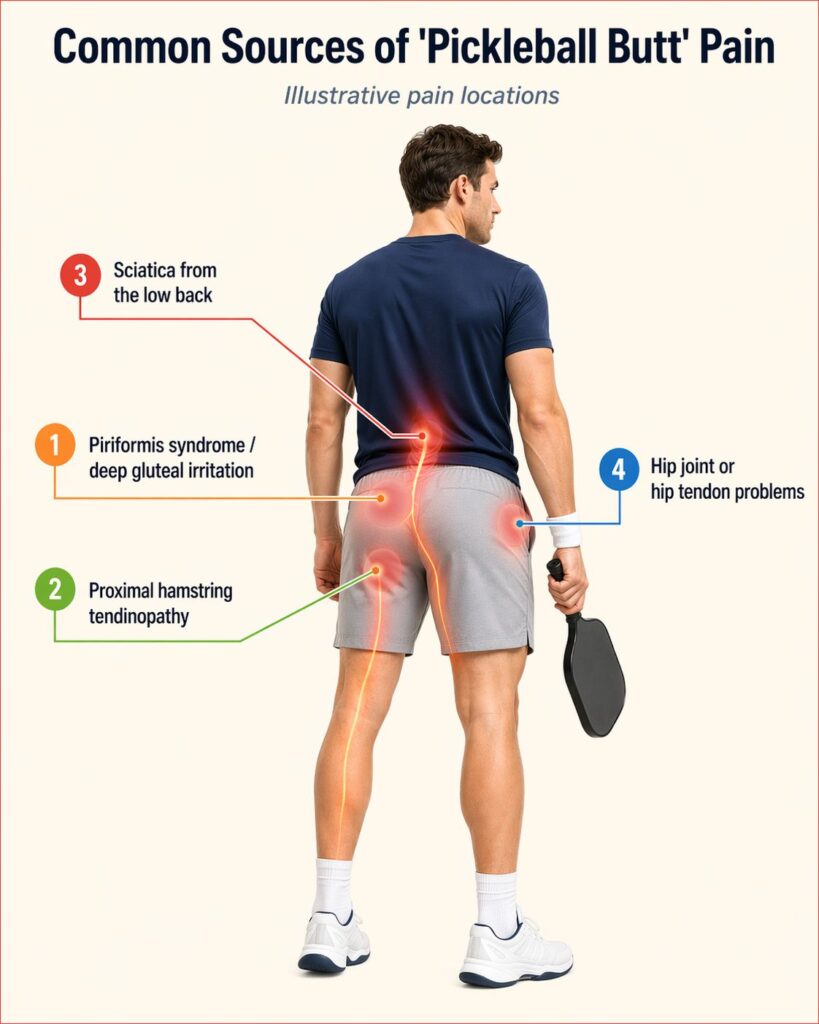
4. Hip joint or hip tendon problems
Hip impingement, labrum irritation, bursitis, gluteal tendinopathy, or even more serious issues can masquerade as butt or outer-hip pain. Ohio State lists hip problems among pickleball injuries, including femoroacetabular impingement with labrum tears.
This is why “I Googled piriformis stretches” is not always enough.
How Serious Is Pickleball Butt?
It depends.
Mild deep-glute tightness after an unusually long session may calm down with smart recovery and load reduction. But pain that is sharp, worsening, traveling down the leg, changing your gait, or keeping you from putting weight on the leg deserves more respect.
Here is my practical rec-player scale:
| Level | Signs | What to Do |
|---|---|---|
| 🟢 Green | Mild tightness, warms up quickly, no limp, no numbness or tingling | Modify and monitor. Play lighter, shorten sessions, and give it more recovery. |
| 🟡 Yellow | Pain keeps coming back, sitting hurts, lunges/stairs trigger it, soreness lasts into the next day | Back off. Reduce or pause play and reassess before it becomes stubborn. |
| 🔴 Red | Severe pain, limping, cannot bear weight, pain shoots down the leg, numbness/weakness, night pain, or pain after a fall | Get checked. See a sports medicine doctor, orthopedist, or qualified PT. |
Why “Just Stretch It” Can Backfire
This is one of the most important parts.
A lot of players feel butt pain and immediately start attacking it with aggressive stretching, lacrosse balls, foam rollers, massage guns, deep tissue work, and every piriformis stretch on YouTube.
Sometimes that helps. Sometimes it makes the whole area angrier.
Why? Because not all butt pain is caused by a muscle that simply needs to be loosened. If the issue is a sensitive tendon, irritated nerve, inflamed tissue, hip joint problem, or low-back nerve referral, smashing the area with a ball or forcing deep stretches can flare it.
With proximal hamstring tendinopathy, for example, pain often worsens with prolonged sitting, squatting, or positions that compress the tendon near the sit bone. If that is your problem, sitting hard on a tennis ball right on the painful tendon may not be the genius move it feels like in the moment.
So here is the better rule: relief work should calm symptoms, not prove how tough you are.
If rolling, stretching, or massage makes pain sharper, more electric, more widespread, or worse the next day, stop doing it and get assessed.
What To Do in the First Few Days
For the first few days, your goal is not to “fix your piriformis forever.” Your goal is to calm the irritated system.
That usually means:
- reduce pickleball volume
- avoid aggressive lunging and deep squats
- avoid long sitting if it flares symptoms
- use short walks if walking feels good
- use ice or heat based on what helps
- avoid painful stretching
- avoid deep pressure directly into sharp nerve-like pain
Mayo Clinic’s general sciatica guidance is useful here: short rest may help, but prolonged inactivity can make symptoms worse; cold packs and heat after a few days may help some people.
The point is not bed rest. The point is relative rest.
Keep moving in ways that do not spike symptoms. Stop feeding the exact motion that keeps making it angry.
Should You See an Orthopedic Doctor, PT, Chiropractor, Massage Therapist, or Acupuncturist?
This is where rec players get overwhelmed because everyone has a different miracle story. Here is how I would think about it.
Start with a proper diagnosis if symptoms are severe, weird, or not improving
If you cannot walk normally, cannot bear weight, have numbness/tingling/weakness, or pain is worsening, I would not start with random treatments. I would get medically evaluated.
A sports medicine physician, orthopedist, or physical therapist can help figure out whether this is piriformis/deep glute, hamstring tendon, back-related sciatica, hip joint, or something else.
PT can be excellent — but the plan has to match the condition
Physical therapy is often recommended for piriformis syndrome once serious conditions are ruled out. Spine-health notes that PT plans typically include exercises, passive techniques, and aids to treat and help prevent recurrence.
But if exercises make you worse, that does not always mean “PT failed.”
It might mean:
- the diagnosis was incomplete
- the exercises were too aggressive
- you kept playing too much while starting rehab
- the wrong tissue was being loaded
- or you need a different therapist who understands racket-sport movement
Massage, dry needling, acupuncture, and chiropractic may help symptoms
Some players get relief from manual therapy, needling, massage, or chiropractic care. That can be useful, especially if pain is driven by muscle guarding or mobility restrictions.
But I would be careful about treating these as the whole solution.
If the underlying issue is poor hip strength, overplaying, weak lateral stability, bad deceleration mechanics, or too much sitting, temporary relief may not hold unless you change the load and rebuild capacity.
Injections can reduce pain, but they are not always the full fix
Some clinicians use injections for persistent cases. Cleveland Clinic lists injections among possible treatments for piriformis syndrome when conservative care is not enough. But even if an injection helps, you still need to address the reason the area got irritated.
Pain relief is great. But pain relief plus better movement is better.
The Rehab Principle Rec Players Need Most
Here is the part I wish more pickleball players understood: you cannot strengthen your way out of an irritated butt while playing the same amount that irritated it.
That is a brutal sentence, but it is true.
If you suddenly add glute bridges, clamshells, squats, bands, and piriformis stretches while still playing four hard open-play sessions a week, your body may not interpret that as rehab.
It may interpret it as more load.
This is especially true if you have not trained your hips consistently in years. Good exercises can still flare symptoms if the dose is too high. So the rehab formula is usually:
- calm it down
- reduce aggravating pickleball load
- rebuild gradually
- return to intensity step by step
- maintain strength so it does not keep coming back
Not glamorous. Very effective.
Exercises That Often Help — Once You Can Tolerate Them
I am going to keep this practical, but with the obvious caveat: if your pain is severe, radiating, worsening, or unclear, get assessed before trying to self-rehab.
For many rec players, prevention and recovery eventually need some combination of:
1. Hip external rotator strength
This helps the deep hip muscles tolerate quick direction changes and stabilize the leg.
Examples:
- banded clamshells
- seated band hip abduction
- side-lying hip external rotation
2. Glute medius and lateral hip strength
This is huge for pickleball because you are constantly moving side to side.
Examples:
- side steps with a mini-band
- monster walks
- single-leg balance reaches
- step-downs
3. Glute max strength
This helps with pushing off, decelerating, and not overloading small deep rotators.
Examples:
- glute bridges
- hip thrusts
- split squats
- sit-to-stands
4. Core and pelvic control
If your pelvis is wobbling every time you lunge, the deep hip muscles may be doing too much emergency work.
Examples:
- dead bugs
- bird dogs
- side planks
- Pallof presses
5. Gradual hamstring loading if the pain is near the sit bone
If the real issue is proximal hamstring tendinopathy, progressive loading is often part of rehab. The 2025 clinical commentary on PHT emphasizes individualized physiotherapy and progressive management rather than one-size-fits-all fixes.
The big cue: exercises should feel like controlled work, not nerve pain or sharp tendon pain.
A little muscle effort is fine.
A flare that ruins the next day is not.
What To Avoid While It Is Flared
When pickleball butt is irritated, the biggest mistake is pretending you can keep your normal game if you just stretch harder afterward. For a while, you may need to avoid or reduce:
- hard singles
- long open-play sessions
- deep lunging for wide dinks
- repeated split-step-to-sprint movements
- aggressive lateral shuffles
- low squatty kitchen battles
- running backward for lobs
- long sitting right after play
- heavy lower-body workouts on top of pickleball
If symptoms travel down the leg like sciatica, be careful with high-impact, twisting, running, jumping, or aggressive bending movements. General sciatica guidance warns that certain strenuous or high-impact exercises can worsen symptoms for some people.
Again, this does not mean never move. It means stop poking the bear.
Can You Keep Playing?
Maybe. But you need rules. Here is a simple return-to-play guide.
| Situation | Signs | What to Do |
|---|---|---|
| ✅ Play lightly | Pain is 0–2/10, no limp, no nerve symptoms, and you are not worse the next day | Keep it short, play easy doubles, and skip singles. |
| ⚠️ Skip play | Pain gets worse during play, changes how you move, or lingers into the next day | Rest, reassess, and avoid the movements that trigger it. |
| 🚩 Get checked | Pain shoots down the leg, you need painkillers to play, or it keeps getting worse | See a sports medicine doctor or qualified PT. |
A better comeback plan
Instead of going from rest straight back to full open play, use stages:
- Walk and do daily activity without symptoms.
- Add gentle mobility and light strength.
- Add controlled court movement without hard play.
- Add short drilling.
- Add easy doubles.
- Add normal doubles.
- Only then add long sessions, tournaments, or singles.
That may feel slow. But it is much faster than turning a two-week irritation into a three-month identity crisis.
How To Prevent Pickleball Butt
Preventing pickleball butt is not about finding one magic stretch. It is about getting your hips ready for the way pickleball actually moves: side to side, low, quick, and often off-balance.
1. Warm up your hips before you play
Do not start cold with low dinks and wide lunges. Give your hips 6–8 minutes to wake up.
Try:
✅ Easy walking or light jogging
✅ Side shuffles
✅ Hip circles
✅ Gentle lunges
✅ Glute bridges
✅ Mini-band side steps
✅ A few controlled split-steps
The goal is simple: tell your hips, “We are about to do pickleball things.”
2. Build side-to-side strength
Pickleball is not just forward and backward. It is mostly lateral movement.
That means walking or biking may help your fitness, but it may not fully prepare your hips for pickleball. Add simple exercises like mini-band walks, single-leg balance, and lateral step-downs.
They are boring. They also work.
3. Do not ramp up too fast
This is where a lot of rec players get into trouble.
Going from 2 days a week to 5, or from one-hour sessions to three-hour open play, can overload your hips fast. Your body can adapt, but it likes gradual increases.
Sudden pickleball enthusiasm is still sudden workload.
4. Avoid long sitting right after play
This sounds small, but it matters. Deep-glute and high-hamstring pain often hate long sitting after activity.
After you play, try walking for 5–10 minutes, standing up often, or avoiding a long car ride right away if sitting triggers symptoms.
5. Clean up your lunge
A lot of hip and butt irritation happens when players reach with the paddle instead of moving their feet.
Think:
✅ Shorter steps
✅ Lower center of gravity
✅ Chest over hips
✅ Knee tracking over toes
✅ Push back with the glute, not the low back
✅ Recover with small steps
Best cue: do not fall into the dink. Step into it.
When It Is Not “Pickleball Butt”
Not every deep butt or hip pain is a simple piriformis issue. Sometimes the pain is coming from the hip, low back, hamstring tendon, or something more serious.
Get checked if you have:
✅ Deep groin or front-of-hip pain
✅ Sharp pain with every step
✅ Trouble bearing weight
✅ Pain shooting below the knee
✅ Numbness, tingling, or weakness
✅ Night pain
✅ Pain after a fall
✅ Symptoms that do not improve after a couple weeks of smart rest and modification
Pickleball injuries are rising, and older players have a higher fracture risk. That does not mean every ache is scary, but severe or stubborn pain deserves respect.
When in doubt, get it checked. That is not dramatic — it is smart.